
Chilat Doina
September 1, 2026
Monday morning in ecommerce has a way of exposing every weak communication habit at once. Ops is asking for a freight update, creative wants final copy approval, the Amazon manager needs buy-in on a promo, and the agency is waiting on a response that should've gone out Friday. Without communication frameworks, each team builds its own version of the truth, and the founder ends up acting as the human router.
That's why good teams don't treat communication as a soft skill. They treat it like a control layer for decisions, handoffs, and escalation paths. In a grown brand, the cost of poor communication isn't awkward meetings, it's missed launches, messy approvals, duplicate work, and slow decisions that show up as lost revenue, strained vendor relationships, and avoidable internal friction.
By Monday at 9:12 a.m., the inbox is already split into four competing realities. The ops lead says inventory is tight, the paid media manager wants budget moved, Amazon is pushing for a clean answer on promo timing, and the designer is waiting to know whether the homepage needs to change before lunch. Everyone is working hard, but nobody is working from the same operating logic.
That's usually the point where the founder becomes the framework. People forward messages upward because there's no agreed path for deciding what matters, who decides, or what happens next. The result is familiar in 7- and 8-figure brands, one team thinks something is urgent because it affects margin, another thinks it's urgent because it affects traffic, and the conversation turns into priority theater.
The problem usually isn't effort. It's that the brand never decided what kind of message belongs in what format, or what level of detail a meeting should produce. A Slack thread gets treated like a decision memo, a meeting gets treated like a brainstorming session, and a vendor email gets treated like a leadership update.
That is where communication frameworks earn their keep. They remove the need to improvise every time an issue crosses a team boundary, which is exactly where ecommerce brands bleed time.
Practical rule: if three people can read the same update and walk away with three different next steps, you don't have a communication problem, you have a framework problem.
The fix is not to write longer updates. It's to make the format do more work before the meeting ever starts. That can be as simple as forcing every recurring discussion, supplier issue, launch risk, or leadership decision into a defined structure so the right people can respond fast and consistently.
A useful test is whether the team can discuss communication in a way that builds actual skill, not just compliance. If you want a practical way to sharpen that muscle, build communication skills exercises can help teams practice clarity, listening, and response discipline without turning every meeting into a lecture.
A communication framework is not a deck, a memo template, or a workshop artifact. It's the operating system behind how information moves, how decisions get made, and how accountability gets assigned. In ecommerce terms, it's closer to your warehouse management logic than your brand guide, because it governs movement, not just style.
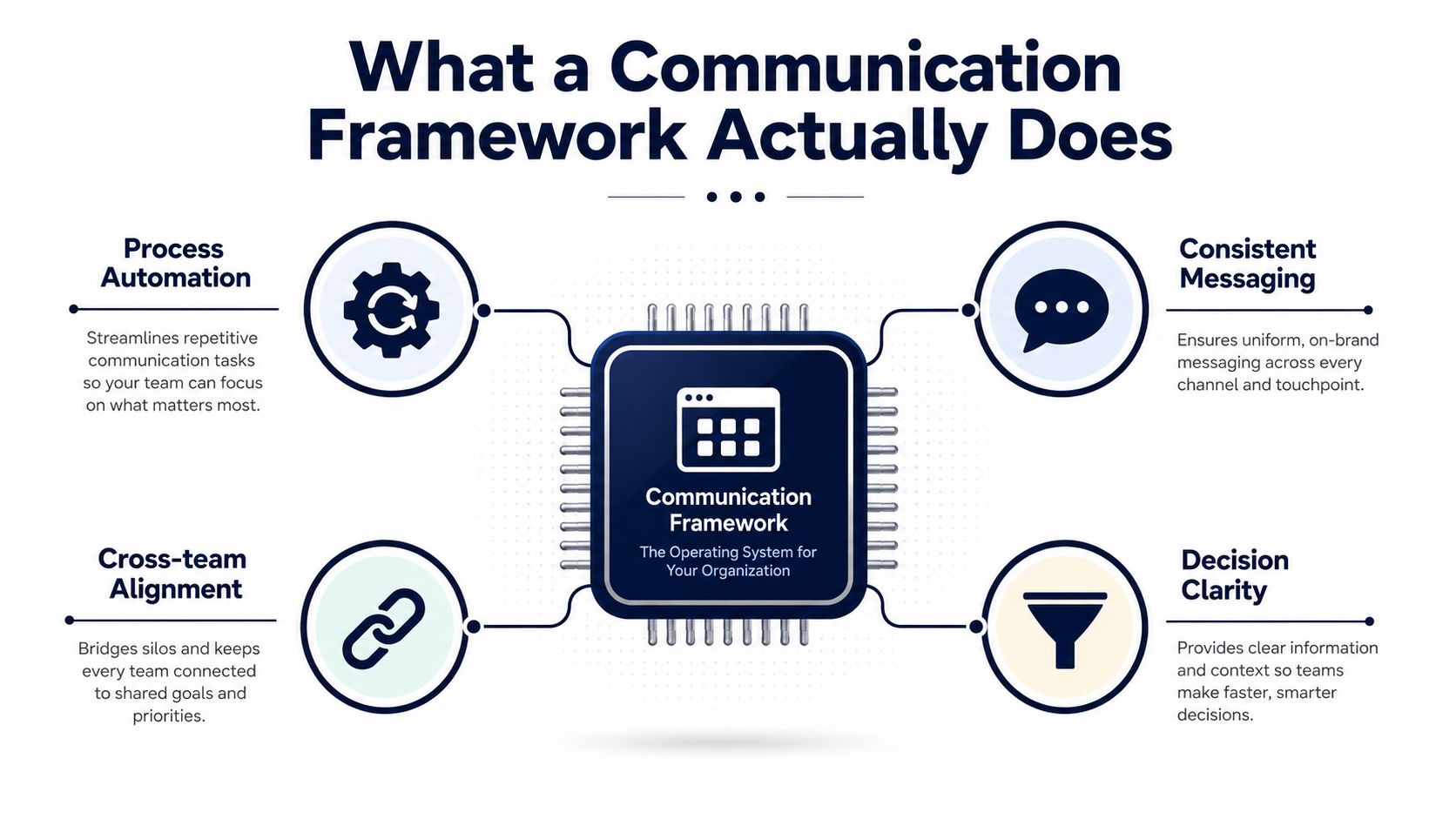
If a warehouse runs on vibes, pallets go missing. If a brand runs on vibes, decisions get duplicated, escalated too late, or approved by the wrong person. A framework says what enters the system, who sees it, what the default response should be, and where exceptions go.
That's also why frameworks matter more as organizations grow. The historical shift in communication models moved from one-way transmission to interactive and strategic systems, with feedback and adaptation built in over time, rather than assuming a message is complete once it's sent as outlined in the development of communication models. In practice, ecommerce brands now operate in an environment where Amazon updates, DTC creative, agency workflows, and internal operations all require that kind of adaptive structure.
The strongest frameworks do four things well. They reduce ambiguity, compress context, make ownership visible, and create a repeatable path from problem to action. That's why structured communication shows up not just in brand work, but in governance, statistics, and technical systems too, where the framework becomes part of the measurement process rather than a decorative layer as seen in official statistics governance and in technical benchmarking environments like ComBench for constrained-network protocol testing.
If your team also needs a practical reference for building the underlying operating discipline, standard operating procedures are the natural companion to communication frameworks. SOPs define the task, frameworks define the conversation around the task.
Communication frameworks work best when they're boring in the right way. They make the next action obvious, which means managers spend less time translating and more time executing.
The old version of communication was linear. One person sent, another received, and the only real question was whether the message arrived intact. That model still exists in practice, but it breaks down fast in ecommerce because a launch, an inventory issue, or a channel conflict rarely ends with a single message.
The shift from linear models to interactive and strategic models matters because it changed the job of communication itself. A framework is no longer just about transmitting information, it's about shaping decisions with feedback, context, and adaptation. That progression is consistent with the communication theory review that traces the field from early transmission models to feedback-aware and digital, multimodal contexts, with Shannon and Weaver's 1949 model as a major milestone in formalizing sender, receiver, noise, and feedback communication model overview.
For ecommerce operators, that evolution mirrors the way brands run. A growth meeting is not a broadcast. It's a negotiation between margin, creative, inventory, customer experience, and channel constraints. If the communication format does not handle all of those inputs cleanly, the meeting becomes theater.
The strongest institutional frameworks now behave like governance tools. The High-Level Group for the Modernisation of Official Statistics built a Strategic Communications Framework project that explicitly tied communication to reputation, external communications, skill sets, maturity modeling, and organizational roadmaps, with Phase I completed in 2018 and endorsed in 2019 official statistics framework project. That's a reminder that mature frameworks do more than tidy up wording, they define how organizations behave.
Ecommerce brands are already in that same shift, even if they don't call it governance. The core question is no longer whether the message sounds clear. It's who owns the decision, what evidence is required, what the exception path is, and how AI-assisted drafting fits into the workflow without creating drift.
A separate evidence review makes the gap obvious. It found only 16 documents with complete evidence-communication frameworks or framework components, which shows how scarce validated end-to-end standards still are evidence communication review. In plain English, most brands are still improvising the system layer.
The brands that win under pressure usually don't communicate more. They communicate with fewer surprises.
These five frameworks are not competitors. They solve different problems, which is why a healthy ecommerce org often uses more than one at the same time. The mistake is trying to make one format do the job of all five.
| Framework | Best Ecommerce Use | Structure | Example Moment | Where It Fails |
|---|---|---|---|---|
| SCQA | Executive briefings, QBRs, quarterly planning | Situation, Complication, Question, Answer | Founder aligning leadership on margin pressure before a promo decision | It becomes too long when a team needs a fast operational call |
| SBAR | Supplier escalations, ops issues, customer service handoffs | Situation, Background, Assessment, Recommendation | Co-manufacturer misses a production slot and the team needs one clear response | It feels stiff if people use it for brainstorming or early ideation |
| AIDA | Landing pages, lifecycle email, product copy | Attention, Interest, Desire, Action | Writing a PDP hero section or abandoned cart message | It breaks when teams expect it to solve ownership or workflow issues |
| RACI | Launch readiness, agency coordination, cross-functional execution | Responsible, Accountable, Consulted, Informed | New SKU launch with marketing, ops, Amazon, and creative in the mix | It can create role sprawl if leadership adds too many cooks |
| PRFAQ | Product rollouts, channel launches, major bets | Press Release, Frequently Asked Questions | DTC site relaunch where the customer outcome needs to be agreed first | It can slow teams down if they try to use it for routine decisions |
SCQA belongs in the room when leadership needs to agree on the problem before debating the solution. SBAR belongs in escalation paths where clarity and speed matter more than persuasion. AIDA is a copy and conversion tool, not a management tool, even though ecommerce teams often misuse it for everything from emails to internal updates.
RACI and PRFAQ do more heavy lifting in cross-functional work. RACI stops launch chaos when too many teams can affect the same outcome, while PRFAQ is useful when the team needs to lock the customer story before the feature list takes over. The important point is to use these as layers, not as a forced either-or choice.
If you're comparing broader operating models and want a useful reference point, top strategic frameworks for 2026 is a practical place to benchmark what leadership teams are reaching for next. For a deeper lens on decision formats specifically, decision-making frameworks help distinguish between communication structure and actual choice architecture.
A Q4 planning meeting usually exposes whether SCQA is doing real work or just looking polished in a doc. The founder starts with the situation, revenue is healthy but margin is getting squeezed by freight and ad costs, then names the complication, which is that the team can't keep pushing discounts without eroding contribution. The question becomes whether the brand should change promo cadence, and the answer is the leadership call on when to protect margin and when to defend share.
That format keeps the discussion from drifting into scattered opinions. It forces the team to agree on the problem first, which matters more than most founders admit.
A supplier escalation needs a different muscle. When a co-manufacturer misses a production slot, an SBAR-style update keeps buying, operations, and customer service working from the same facts. The situation is the missed slot, the background is the order context and downstream risk, the assessment is what the delay means for customer orders, and the recommendation is the action needed from the vendor and the internal team.
The same structure works in a DTC relaunch retro, but PRFAQ pushes harder on customer outcome. The team writes the press release as if the relaunch already succeeded, then fills in the FAQ to test whether design, merchandising, and marketing agree on the value proposition. That is where weak assumptions get exposed fast.
To make this easier to execute, Tooling Studio Kanban integration is useful when you want the framework to live inside the work queue instead of in a separate document. If the decision path is visible in the board, the team is more likely to follow it.
Practical rule: one meeting, one framework, one owner. If you mix formats midstream, the strongest voice usually wins, not the clearest argument.
Start by mapping the recurring decisions your brand makes in a normal week and a normal quarter. Leadership decisions, supplier escalations, launch approvals, agency reviews, and customer messaging each need a different level of structure, so assign a framework to the moment instead of forcing one model everywhere. A simple internal rhythm might look like SCQA for Monday leadership, SBAR for Thursday ops standups, and RACI for Friday launch reviews.
Then pilot one framework with one team for 30 days. Don't roll out five new habits at once, because that usually turns into compliance theater. Use a short retro after each use, and ask three questions, did the format make the decision faster, did it reduce back-and-forth, and did the right owner leave the meeting with a clear next step.
Codify the prompts inside Notion, Slack workflows, or Asana briefs so the framework appears before the meeting starts. That matters because people don't forget to be clear when the prompt is already sitting in the task. They forget when they have to invent the structure on the fly.
Every framework stack needs an owner. In most brands, that's the chief of staff or head of operations, because someone has to keep the formats clean, enforce the cadence, and retire templates that no longer earn their keep. Without that owner, the framework turns into a nice idea that gets reopened every quarter and still doesn't stick.
The reason this works is simple, frameworks need maintenance. They are part discipline, part infrastructure, and the brands that treat them like a shared contract usually move faster with less friction.
Most brands don't drop frameworks because the team is lazy. They drop them because the format becomes heavier than the decision it was supposed to improve. A short SBAR sheet filled out twice is annoying, a 14-page SCQA memo nobody reads is worse, and a RACI matrix with too many names can create more confusion than the launch it was meant to protect.
The scoping review on evidence communication is a useful reminder here. The evidence base is still scarce, which means many teams are building without validated end-to-end standards, and that leaves a lot of room for selective reporting and fuzzy judgment evidence communication review. In ecommerce, that shows up as inconsistent briefs, unclear escalation rules, and frameworks that exist in principle but not in daily use.
The AI layer makes this worse if governance is missing. Teams draft faster, but they often don't know what's allowed, what's restricted, or where AI belongs in the workflow. That's the hidden problem, not the tool itself, because a faster draft with no shared rubric just creates faster inconsistency.
The other failure is leadership drift. If the founder or operator never opens with the format, never measures whether it helps, and never corrects people who skip it, the template becomes optional. Once it's optional, it is already dead.
For teams that want a stronger accountability spine around this, accountability systems are the missing companion piece. A framework without ownership is just documentation.
A framework fails when it's treated like a deliverable. It works when it's treated like a contract for how the team makes decisions.
The fix is not adding more rules. It's making the framework small enough to use, visible enough to remember, and important enough that skipping it has a cost.
The right framework is the one that pays rent this week, not the one that looks smartest in Notion. Early-stage founders usually need AIDA for copy clarity and SBAR for supplier or ops escalations, because those are the moments that shape revenue and prevent avoidable fire drills. Once the team gets bigger and launches start crossing Amazon, DTC, and agency lines, RACI earns its place because ownership gets messy fast.
| Stage | Team Size | Primary Decision | Recommended Frameworks |
|---|---|---|---|
| Early-stage | Under 5 people | Copy clarity, supplier escalation | AIDA, SBAR |
| Growth stage | Around 15 people plus Amazon and an agency | Cross-functional launch coordination | RACI, SBAR |
| Capital-heavy bets | Leadership team with major rollout decisions | Executive alignment and customer story | PRFAQ, SCQA |
SCQA matters when you're pitching investors, aligning senior leadership, or negotiating wholesale partnerships. PRFAQ belongs on bigger bets that need executive air cover before the work gets too far along. The trade-off is overhead, so don't build a museum of frameworks. Pick the two that touch your highest-stakes decisions, define the owner, and review them in 30 days.
If you do one thing this week, schedule a 30-minute slot for a single recurring meeting, assign one framework to it, and make the first draft before the meeting starts. That's how communication becomes an operating advantage instead of another thing your team has to remember.
Million Dollar Sellers is where serious ecommerce operators trade the hard-won playbooks that keep growth organized under pressure. If you're tightening your communication frameworks, Million Dollar Sellers gives you a room full of founders who've already stress-tested what holds up in Amazon, DTC, and omnichannel scale.
Join the Ecom Entrepreneur Community for Vetted 7-9 Figure Ecommerce Founders
Learn MoreYou may also like:
Learn more about our special events!
Check Events