Chilat Doina
December 16, 2025
At its core, the difference between a Direct-to-Consumer (DTC) and a wholesale model is pretty simple. With DTC, you sell your products yourself, directly to the person who will use them. With wholesale, you sell your products in bulk to another company—a retailer—who then sells them to the end customer.
That single choice, however, sends ripples through your entire business. It dictates everything from how you market your product and manage your operations to the kind of relationship you have (or don't have) with your customers.
For any founder, this isn't just a small fork in the road; it's a foundational decision that shapes the very DNA of your company. Each path comes with its own unique set of opportunities and headaches, and you've got to weigh them against your goals, your resources, and the type of product you're selling.
Going the DTC route puts you in complete control. You own the brand story, the customer experience, the pricing, and—most importantly—the customer data. That direct feedback loop is priceless for iterating quickly. But that control isn't free. It demands a serious investment in marketing, customer acquisition, and logistics to build a brand from the ground up.
On the other hand, the wholesale model is your shortcut to scale. By tapping into the established customer bases and distribution networks of retail partners, you get instant market penetration. This path usually means more predictable revenue from large purchase orders and simpler logistics. The trade-off? You give up a chunk of your profit margin and lose control over how your product is priced and presented on the shelf.
This decision tree breaks down the strategic choice: are you chasing control and higher margins with DTC, or are you aiming for rapid scale and broad reach through wholesale?
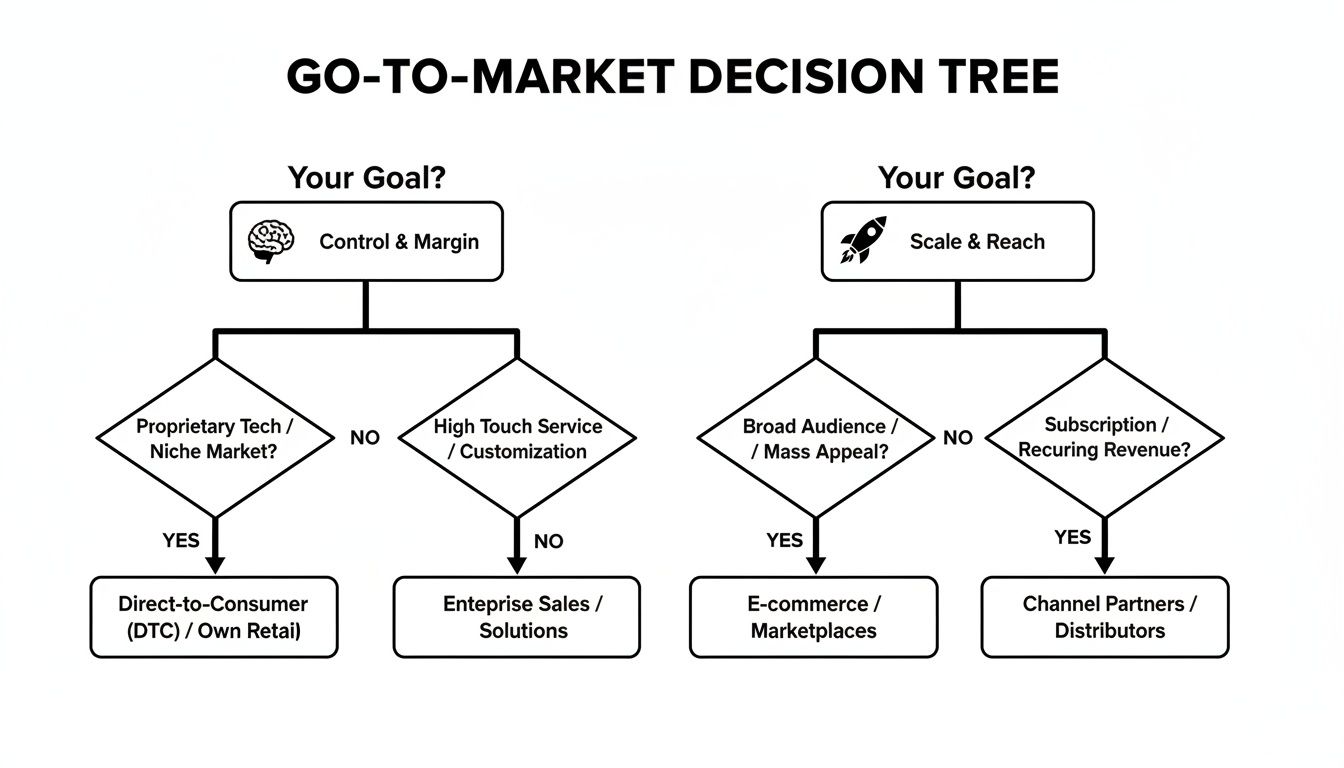
Ultimately, what this shows is that your main business goal—whether it's building a passionate brand community or just getting your product in as many hands as possible—should be the driving force behind your decision.
To really get it, you have to look past the surface-level definitions. A perfect real-world example is how brands operate on Amazon. The choice between Amazon Vendor Central vs Seller Central is a direct reflection of this dilemma, representing the wholesale and direct-selling models, respectively.
To frame the core trade-offs, here’s a quick-glance comparison.
This table breaks down the fundamental differences between the two models to give you a clear, high-level picture of what you're signing up for with each approach.
AttributeDirect-to-Consumer (DTC)WholesaleCustomer RelationshipDirect, personal, and data-richIndirect, managed by the retailerProfit MarginsHigher per-unit gross marginsLower per-unit gross marginsBrand ControlComplete control over messaging and pricingLimited control; shared with retail partnersMarket ReachBuilt from zero; requires heavy marketingInstant access to retailer's customer baseOperational ComplexityHigh (individual order fulfillment, returns)Lower (bulk shipments to fewer locations)Cash FlowDependent on individual sales volumeMore predictable via large purchase orders
As you can see, each model presents a distinct set of operational and financial realities.
The core dilemma in the Direct-to-Consumer vs. Wholesale debate is a classic trade-off between margin and volume. DTC lets you keep the full retail value of every sale, while wholesale sacrifices that margin for the promise of scale and market access.
If you're leaning toward building that direct connection and need a deeper dive into building a robust customer acquisition engine, you can learn more about crafting a powerful https://milliondollarsellers.com/blog/direct-to-consumer-marketing strategy. Each point in this table represents a major strategic pillar we'll explore in more detail.
When you stack up direct-to-consumer against wholesale, the conversation almost always kicks off with profit margins. Sure, DTC brands get to keep the full retail price, which looks fantastic on paper as a higher gross margin per sale. But honestly, that’s just one piece of a much bigger, more complicated financial puzzle. To really get it, you have to dig into the hidden costs and the very different ways cash flows through each model.
The direct-to-consumer route is undeniably appealing, but it carries a heavy financial backpack. Brands are on the hook for every single expense it takes to get a product from a warehouse into a customer's hands. This isn't just about making the thing; it’s about the steep, often volatile costs of marketing, customer service, payment processing fees, and packing up individual orders.
The real beast for any DTC brand is the ever-rising Customer Acquisition Cost (CAC). You’re not just selling; you're building an entire audience from the ground up. That means a serious, non-stop investment in digital ads, content, and keeping a social media presence alive.
All that aggressive marketing spend eats directly into your bottom line. To get a true read on your profitability, you have to look past simple revenue. That’s where you need to get familiar with metrics that factor in all those variable costs. If you're new to this, we’ve got a guide that explains exactly https://milliondollarsellers.com/blog/what-is-contribution-margin and why it's a vital sign for any DTC business.
Beyond that first sale, you need to understand the long game. That's why calculating Customer Lifetime Value (LTV) is so critical. A high LTV can make a high CAC worthwhile, but getting there requires smart retention strategies, which—you guessed it—also cost money.
Despite the costs, the appeal of DTC is massive. It’s why the global market is exploding, with projections showing a leap from $225.5 billion in 2024 to an incredible $880.1 billion by 2034. More brands want to cut out the middleman to own their customer relationships and, of course, their profits.
Switching gears, the wholesale financial model offers a different flavor of stability. Yes, your per-unit margins are much lower—often 40-60% less than what you’d make selling directly—but the entire financial setup is built on predictability and sheer volume.
Wholesale is all about large, consistent purchase orders from your retail partners. This consistency creates a revenue stream you can actually forecast, making things like inventory and production planning much, much simpler. Cash flow is often a lot healthier, too, since big upfront payments from retailers can easily fund your next manufacturing run.
The financial trade-off is clear: Wholesale sacrifices per-unit profitability for operational simplicity and predictable cash flow, while DTC chases high margins at the cost of complex, expensive, and volatile customer acquisition efforts.
This model slashes or even wipes out many of the expenses that bog down DTC brands.
But wholesale isn’t a risk-free paradise. If you become too dependent on a few big retail accounts, you’re in a vulnerable spot. If one of those partners decides to shrink their order or drop your line completely, it can be a massive blow. That revenue concentration is a serious risk you have to manage.
So, which model is financially better? It completely depends on your brand's capital, your tolerance for risk, and what you’re trying to achieve long-term. DTC can offer a sky-high profit ceiling, but it demands a ton of upfront cash and serious marketing chops. Wholesale provides a more stable, lower-risk path to scale, making it a great choice for founders who care more about market penetration and steady cash flow than squeezing every last drop of profit out of each sale.
It's one thing to choose a business model on paper, but it’s another thing entirely to build the operational engine to support it. The day-to-day realities of running a DTC brand versus a wholesale business are worlds apart, demanding completely different infrastructure, skills, and technology.
Picking a model without understanding the operational beast you’ll need to feed is a fast track to frustration and failure.
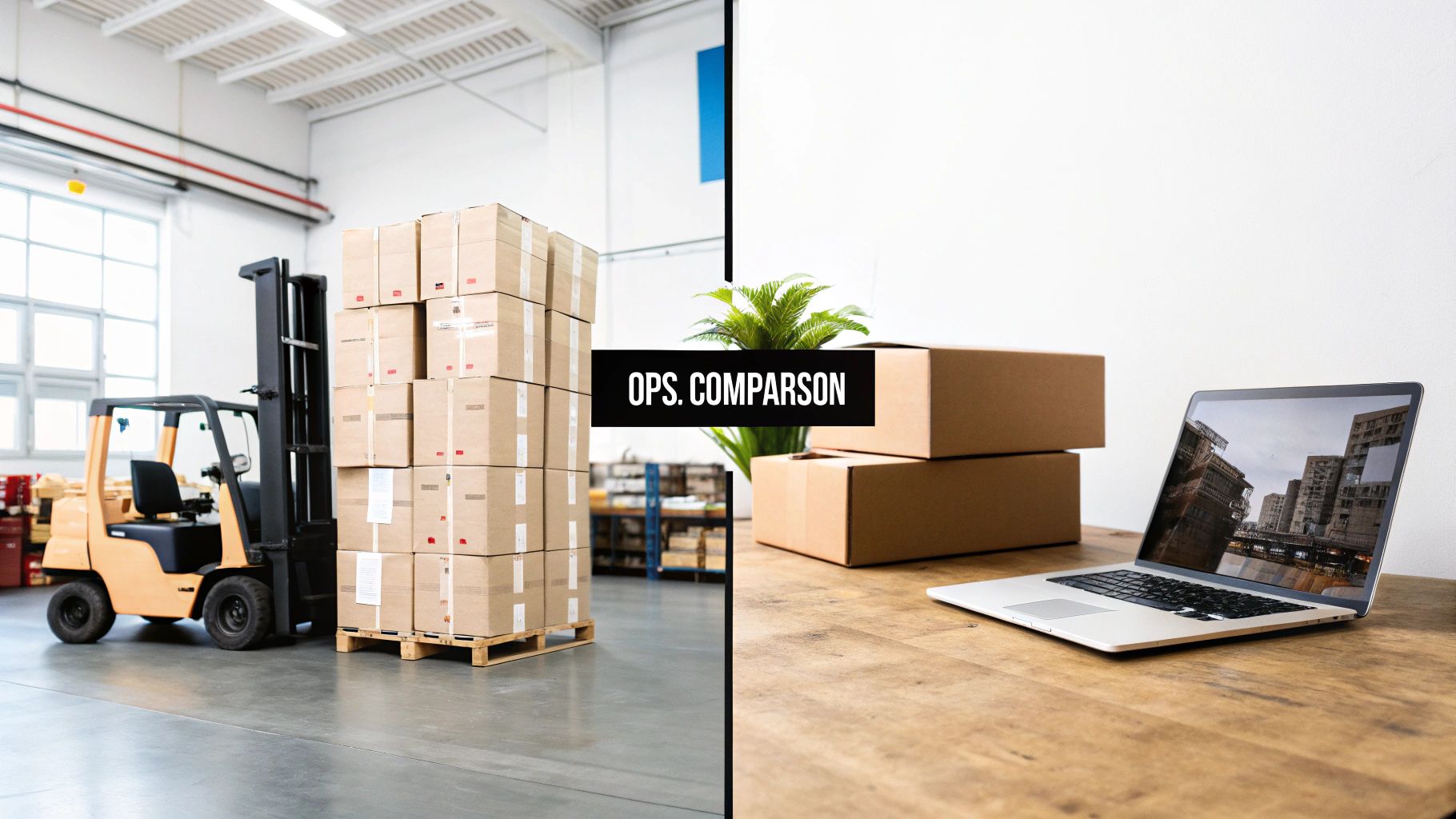
A direct-to-consumer business is a high-touch, data-driven machine. Its heart is a sophisticated e-commerce tech stack that has to juggle everything from website performance and digital marketing to payment processing. Every single order is a mini-project that demands meticulous pick-and-pack fulfillment, individual shipping, and one-on-one customer service.
Wholesale, on the other hand, is all about B2B relationships and bulk logistics. The focus shifts from managing thousands of tiny transactions to processing a smaller number of huge, high-value purchase orders. This requires robust inventory systems that track pallets, not just single units, and the know-how to navigate the complex world of freight shipping and retailer compliance.
Running a DTC brand means you own the entire customer journey, from the first ad they see to the package landing on their doorstep. This requires a unique mix of technical and creative talent that's hard to find.
Your team’s daily grind will be all about granular, customer-focused tasks. We're talking about managing digital ad campaigns, obsessing over website user experience (UX), and providing personal customer support. The logistics are just as detailed, involving individual order fulfillment, processing returns, and keeping a direct line open to thousands of customers.
The real operational challenge for DTC is managing complexity at scale. You are responsible for every single touchpoint, meaning your infrastructure has to support marketing, sales, fulfillment, and service for each individual customer.
The tech investment is no joke. A DTC brand needs far more than a simple storefront; it requires a whole ecosystem of connected tools:
This model is a cash-burner. The rising costs of operating a direct-to-consumer business are a huge concern for many founders. One report noted that as traditional retail channels grew by 22% in 2022, DTC brands faced skyrocketing costs, making the quiet efficiency of wholesale look pretty good. You can get a deeper look at these economic shifts impacting retail models to see what's happening.
Wholesale is less about charming individual customers and more about mastering the supply chain and managing key accounts. Efficiency and reliability at a massive scale are the names of the game. Your infrastructure is built to move pallets, not parcels.
The required skill sets pivot hard from digital marketing to B2B sales and logistics. Your team will be spending their days negotiating contracts with retail buyers, dealing with chargebacks, and making sure your products meet strict retailer packaging and shipping standards. You're not managing social media comments; you're managing freight schedules and EDI (Electronic Data Interchange) compliance.
A solid wholesale operation runs on a totally different tech stack, one centered on:
At the end of the day, the choice between DTC and wholesale is a choice between two completely different operational realities. DTC demands a deep investment in brand building and customer-facing tech. Wholesale demands excellence in B2B sales, supply chain logistics, and large-scale inventory management. Building the right team and infrastructure from day one is everything.
Beyond the spreadsheets and supply chain logistics, your choice between direct-to-consumer and wholesale really gets to the heart of your brand. It's about how you tell your story, who you connect with, and what people actually think of you. Each path offers a completely different playbook for control and connection.
The DTC model hands you the microphone. You're in complete control of the narrative, from the words on your product page to the unboxing experience. This total ownership lets you build a consistent, powerful brand identity that truly clicks with your ideal customer.
In the DTC world, every single click and purchase is a goldmine of first-party data. You see exactly what customers browse, what they ditch in their cart, and what finally convinces them to buy. This direct feedback loop is a massive competitive advantage, allowing you to personalize marketing, tweak products, and pivot your strategy on the fly.
This direct line is also how you build a real community. You’re not just moving units; you're inviting people into your brand's world through email, social media, and loyalty programs. When you own the relationship, you can transform one-time buyers into genuine fans. For a deeper dive, our guide on how to build brand loyalty breaks down exactly how to do it.
Wholesale is a different game entirely. The moment your product lands in a retailer's warehouse, you’re handing over the keys. They decide the shelf placement, the price tag, and how your product is presented. Your carefully crafted brand story can easily get watered down or lost in a sea of other brands.
You lose that direct connection to the end user. That means no first-party data, no immediate feedback, and a much harder path to building a personal relationship. The customer's loyalty is often to the store, not your specific brand.
The core difference here is ownership. DTC brands own their customer relationships and brand narrative. Wholesale brands are essentially renting access to a retailer’s customers and piggybacking on their brand equity.
But don't write off wholesale just yet. Partnering with a respected retailer can be a huge stamp of approval for your brand. Seeing your product on the shelves of a major, trusted store builds consumer confidence much faster than a DTC brand could ever hope to on its own.
This kind of partnership instantly puts your brand in front of a massive, ready-made audience. The sheer reach and exposure from a strategic wholesale deal can be an incredible engine for brand awareness, grabbing customers who would have never found you online. It's a clear trade-off: you sacrifice direct control for broad market validation and a powerful, indirect influence.
The blueprint you draw for scaling your brand looks completely different depending on whether you’re going direct-to-consumer or wholesale. Each path has its own growth engine, and they run on totally different fuel—different tactics, different skills, and different investments. Getting this right, or figuring out how to blend the two, is the key to building something that lasts.
A DTC growth engine is all about digital. You live and die by your performance marketing, influencer partnerships, and the quality of your content. It’s a game of numbers where you’re constantly tracking customer acquisition cost (CAC), conversion rates, and lifetime value (LTV).

On the flip side, wholesale growth is built on handshakes and relationships. Your success hinges on winning over retail buyers, nailing your trade show presentations, and creating sales materials that prove your product will fly off their shelves. It's a B2B sales game, plain and simple.
Scaling a DTC brand means you have to get really good at grabbing and converting attention online. Your growth levers are almost all digital, which means you need a serious—and continuous—marketing budget.
The go-to growth tactics for DTC usually include:
But here’s the catch: the biggest bottleneck is almost always marketing efficiency. As you grow, the cost to get a new customer rarely goes down; it almost always goes up. Leaning too hard on paid ads can get expensive fast, especially when everyone else is bidding for the same eyeballs.
The real challenge in scaling DTC is breaking your addiction to paid ads. Sustainable growth comes from building a brand that people find on their own, turning one-time buyers into loyal fans who spread the word for you.
This is exactly why the DTC e-commerce market—projected to hit $239.75 billion in the US by 2025—is at such an interesting crossroads. Brands are chasing that massive growth, but they’re also getting squeezed by rising acquisition costs. It's a reality that’s pushing many to look back at the stability that wholesale partners can offer. Shopify has some great insights on this shift away from pure-play DTC.
Growing a wholesale business has less to do with clicks and conversions and more to do with landing accounts and shipping big orders. The whole strategy is about expanding your retail footprint, one store at a time.
Wholesale growth is all about:
The main obstacle isn't your ad spend; it's your production capacity and your ability to manage relationships. Landing a huge retail account is a game-changer, but it can also snap your supply chain if you aren't ready to produce and ship massive volumes on a razor-thin schedule.
The sales cycle itself is another major bottleneck. It can take months of meetings, negotiations, and follow-ups to get a "yes" from a new wholesale partner. Your growth is directly tied to your sales team's hustle and your operations team's ability to execute. You're trying to convince a handful of powerful gatekeepers, which is a world away from winning over thousands of individual customers online.
Thinking about Direct-to-Consumer vs. Wholesale often feels like you have to pick a side. But the sharpest brands I see today know that’s a false choice. The real magic happens when you stop seeing them as opposing forces and start blending them into a resilient business model that gets you the best of both.
A hybrid strategy is your best defense against the risks of putting all your eggs in one basket. If you’re a pure-play DTC brand, dipping your toes into wholesale can bring in a steady stream of cash and give you that mainstream stamp of approval. On the flip side, if you're a wholesale veteran, opening a DTC channel is your chance to finally own your brand story and get your hands on that priceless customer data.
This isn't about ditching one for the other. It’s about a smart, phased integration where each channel props the other one up.
For brands born online, moving into wholesale is usually a calculated leap toward bigger scale and brand awareness. The point isn’t just to sell more stuff; it’s to use a retailer's brick-and-mortar presence as a massive, free marketing channel. There’s a certain confidence that comes from seeing a product on a real shelf in a store you trust—something digital ads can’t always replicate.
If you’re a DTC-native brand thinking about this move, don’t just jump in. A phased rollout is key:
A DTC-first brand has to see wholesale as more than just a sales channel. It's a brand-building exercise. The right retail partnership is like a high-visibility billboard that drives new customers back to your website for the full brand experience.
For established brands with deep wholesale roots, launching a DTC site is all about forging direct customer relationships and taking back control. After years of selling through other retailers, these brands often have incredible name recognition but know next to nothing about who their actual customers are.
Making this transition requires a completely different mindset. The goal isn’t to steal sales from your retail partners. It's to build a premium, content-rich hub for your biggest fans.
In the end, a hybrid model turns the "DTC vs. wholesale" debate from an either/or problem into a strategic "both/and" opportunity. By carefully phasing in the model that complements your own, you can build a business that’s more diverse, customer-focused, and built to last.
When you're weighing direct-to-consumer against wholesale, a few key questions always seem to pop up. Let's tackle them head-on with some straight answers to help you map out your strategy.
Not always. It's a classic "margin vs. profit" trap. While you absolutely get a higher gross margin on every single item you sell directly, the net profitability often tells a different story.
Why? Because DTC means you're on the hook for every single dollar of marketing, customer acquisition, individual order fulfillment, and the headache of returns. These costs add up fast. Wholesale, on the other hand, operates on thinner margins but gives you the stability of large, predictable purchase orders. With someone else handling the end-customer marketing and logistics, your operational costs per unit plummet, which can lead to healthier and more consistent net profits.
The real measure of profitability isn't just the sticker price margin. It's what's left after you subtract the steep costs of acquiring and serving each customer—a reality where wholesale often has a distinct advantage.
Yes, and it can be a brilliant move. If you've poured everything into creating a fantastic product but don't have a massive marketing budget or instant brand recognition, starting with wholesale is a powerful strategy. It lets you plug directly into the customer base and distribution muscle of retailers who are already established.
This approach gives you two things you desperately need early on: immediate cash flow and powerful brand validation. You get your product on shelves and in front of customers without having to burn through cash building a DTC engine from the ground up.
Making the jump from pure-play DTC to a hybrid model needs to be a deliberate, phased process—not a free-for-all.
First, you need to be selective. Identify a handful of key retail partners whose brand and target customer are a perfect match for yours. You can't be everywhere at once, so start with the right "everywheres."
Next, you have to nail your channel strategy. Develop a separate inventory and pricing structure for your wholesale partners to avoid a price war with your own website. Finally, make sure your operations are ready for B2B. This means handling things like bulk shipping, palletizing, and invoicing. The smartest way to do it? Launch with just a few select partners, learn the ropes, and then expand your retail footprint.
At Million Dollar Sellers, we know that choosing the right growth strategy is one of the most important decisions a founder can make. Our exclusive community provides the peer insights and proven playbooks from 8- and 9-figure entrepreneurs who have successfully scaled using DTC, wholesale, and hybrid models. Surround yourself with the best to build a more resilient business. Find out more at Million Dollar Sellers.
Join the Ecom Entrepreneur Community for Vetted 7-9 Figure Ecommerce Founders
Learn MoreYou may also like:
Learn more about our special events!
Check Events


