Chilat Doina
March 24, 2026
In e-commerce, not all customers are created equal. While mass marketing casts a wide net, the most successful sellers know that true scale comes from precision. This means moving beyond generic campaigns and understanding exactly who your customers are, what they want, and how they behave. This is the power of customer segmentation. It’s the strategic framework that separates fast-growing brands from stagnant ones, transforming raw customer data into a predictable engine for profit.
For top-tier brand owners, sophisticated segmentation isn't just a marketing tactic; it's a core business discipline for optimizing ad spend, increasing lifetime value (LTV), and building a defensible brand. Treating your customer base as a single, uniform group leaves money on the table and opens the door for competitors to serve specific needs better than you can. The key is to find meaningful patterns within your audience and act on them with purpose.
This guide breaks down 10 powerful customer segmentation examples used by elite e-commerce entrepreneurs, providing the actionable blueprints you need to implement them. We'll move beyond theory and give you the specific definitions, tactics, and strategic insights to turn your customer list into your most valuable asset. Get ready to segment your way to smarter growth.
RFM segmentation stands as a cornerstone among customer segmentation examples for its straightforward yet powerful approach. It's a quantitative method that grades customers based on three specific behavioral data points: how recently they purchased (Recency), how often they buy (Frequency), and how much they spend (Monetary). This model provides a clear, data-backed view of customer value, moving beyond simple transaction counts to identify distinct behavioral groups.
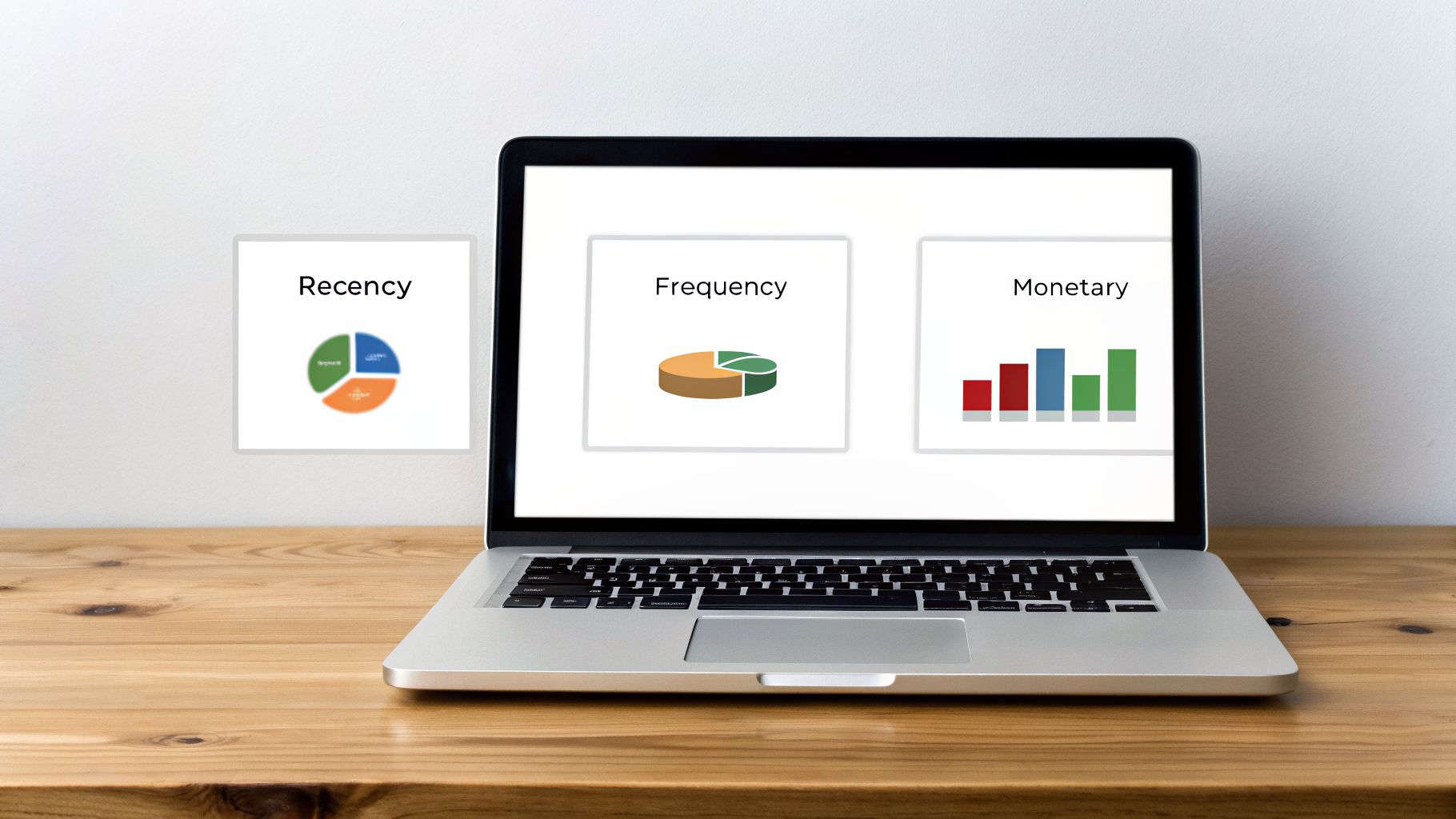
The power of RFM lies in its ability to pinpoint your most valuable customers, often called "Champions" (high R, F, and M scores), who are prime candidates for loyalty programs and early access to new products. Conversely, it flags "At-Risk" customers (low Recency, high Frequency/Monetary) who have stopped buying, signaling an urgent need for re-engagement campaigns.
The process involves scoring each customer on a scale (typically 1-5) for each of the three metrics. Combining these scores creates specific segments. For example, a DTC brand might identify a "Potential Loyalist" segment (high Recency, moderate Frequency) and target them with a subscription offer to increase their purchase cadence.
Strategic Insight: Your best customers aren't just those who spend the most. A customer with a high frequency and recency score, even with a lower monetary value, can be more valuable long-term than a one-time big spender. RFM analysis helps you see this crucial distinction.
Behavioral segmentation is another powerful customer segmentation example that groups customers based on their direct actions and interactions with your brand. This method looks at what customers do, not just who they are. It analyzes browsing patterns, purchase history, feature usage, and overall engagement to create highly relevant segments. For e-commerce brands, this provides a direct window into customer intent and product affinity.

Unlike demographic data, behavioral insights reveal the customer journey in real-time. This allows DTC brands and Amazon sellers to move from broad marketing messages to hyper-personalized experiences. For instance, you can separate one-time buyers from repeat purchasers, or identify users who browse a specific category but never buy, creating distinct opportunities for targeted communication.
Application requires tracking user actions across your website, emails, and apps. By setting up rules based on these actions, you can create dynamic segments. A DTC skincare brand might segment users who have viewed their "anti-aging" product page more than three times in a month but haven't purchased. This segment can then receive a targeted email with customer testimonials and a limited-time offer for that specific product line.
Strategic Insight: Behavioral data is a leading indicator of intent. A customer repeatedly viewing a product page or adding an item to their cart is sending a strong purchase signal. Acting on these signals in near real-time is key to converting interest into revenue and understanding the triggers behind cart abandonment.
Demographic segmentation is one of the most foundational and widely used customer segmentation examples. This method groups customers based on observable, personal attributes like age, gender, income, location, education, and family status. While it's a more traditional approach, it remains vital for understanding the fundamental "who" behind your sales and tailoring product, messaging, and pricing strategies effectively.
Its lasting relevance comes from its simplicity and the direct link between demographics and consumer needs. A DTC beauty brand, for instance, understands that a 25-year-old customer has different skincare concerns and media consumption habits than a 45-year-old. This knowledge, easily gathered through analytics platforms like Google Analytics or via direct surveys, allows for more precise market positioning and media buying.
The process starts with collecting demographic data, often at the point of signup or through customer profile enrichment. Once collected, you can build segments directly within your e-commerce platform or marketing automation tool. For example, a fashion retailer could create a segment for "High-Income Males, Age 30-45, in Urban Areas" to market a new line of premium business-casual wear.
Strategic Insight: Demographic data provides the "why" behind the "what" of behavioral data. Knowing who is performing an action (e.g., abandoning a cart) helps you craft a much more resonant and effective recovery message than simply knowing the action occurred.
Psychographic segmentation groups customers based on their lifestyle, values, attitudes, and personality traits. This qualitative approach moves beyond demographic data (like age or location) to understand the why behind a purchase. For brands selling more than just a product, this method is one of the most powerful customer segmentation examples for creating deep, emotional connections with an audience.
This model helps brands understand the intrinsic motivations driving consumer behavior. It uncovers what customers truly care about, whether it's sustainability, personal achievement, social status, or family well-being. This allows for authentic brand messaging and product positioning that resonates on a much deeper level than a simple feature list.
The process involves gathering qualitative data through surveys, social media listening, and analyzing customer feedback. Brands create detailed customer personas based on shared values and interests. For example, a fitness apparel brand might identify a "Performance Athlete" segment (values: competition, peak performance) and a "Wellness Enthusiast" segment (values: balance, self-care, mindfulness), then tailor marketing content accordingly.
Strategic Insight: Psychographic data reveals the "unseen" motivators. Two customers can have identical demographic profiles but completely different reasons for buying. One might buy an expensive coffee maker for the status and design, while another buys it for the ethical sourcing and sustainable materials.
Geographic segmentation divides an audience based on physical location, such as country, state, city, climate, or even urban versus rural settings. It's a fundamental strategy among customer segmentation examples, particularly for e-commerce brands managing physical inventory and localized marketing. By understanding where customers live, businesses can optimize shipping, tailor product offerings, and create marketing messages that resonate with regional cultures and needs.
The primary benefit of geographic segmentation is operational efficiency and market relevance. For national sellers, it informs inventory distribution to reduce shipping times and costs. For international brands, it's critical for adjusting pricing, language, and marketing campaigns to fit local contexts, avoiding a one-size-fits-all approach that often fails.
This process begins by analyzing sales data to identify clusters of customers in specific regions. E-commerce platforms like Shopify often provide built-in analytics, while Amazon sellers can pull reports from Seller Central to map out sales distribution. This data allows for the creation of segments like "West Coast Urban," "Southern Rural," or "UK-based Buyers."
Strategic Insight: Geographic data is more than just a shipping address. It's a proxy for climate, local events, cultural norms, and purchasing power. A brand selling outdoor gear can use this to promote snow jackets to customers in Colorado and raincoats to those in Seattle, all from the same product line.
Customer Value Segmentation organizes customers based on their predicted future worth to your business, a model that directly impacts long-term profitability and strategic decision-making. This forward-looking approach goes beyond past transactions to identify individuals who will generate the most revenue over their entire relationship with your brand. A fundamental aspect of value-based segmentation involves understanding the customer lifetime value (CLV), a key metric for sustainable growth.

This method is crucial for scaling e-commerce businesses because it helps allocate marketing spend, inventory, and customer service resources more effectively. By focusing on high-CLV segments, brands can improve unit economics and build a more resilient customer base. It answers the question: "Who are my most profitable customers, not just for now, but for the future?"
Application begins with calculating both historical and predictive CLV for each customer. You can then group them into tiers, such as VIP, High, Medium, and Low value. For example, a DTC brand might create a "VIP" segment for the top 5% of its CLV distribution and offer them premium customer service and exclusive access to new products.
Strategic Insight: Your acquisition channels are not created equal. By analyzing the CLV of customers from different channels (e.g., organic search vs. paid social), you can discover which sources bring in the most profitable long-term relationships and adjust your ad spend accordingly.
For a deeper dive into the formulas and methods behind this, you can explore how to calculate customer lifetime value.
Needs-based segmentation is a powerful method that groups customers according to the specific problems they are trying to solve or the outcomes they seek. Unlike demographic or simple behavioral data, this approach gets to the core ‘why’ behind a purchase. For businesses with a varied product catalog, this is one of the most effective customer segmentation examples for ensuring product-to-customer matching and creating messaging that truly connects.
This model, rooted in the "Jobs to be Done" framework, shifts focus from product features to customer goals. A supplement brand, for instance, doesn't just sell powders; it sells improved energy, better sleep, or faster recovery. Recognizing these distinct needs allows for highly specific marketing that speaks directly to a customer's desired end state.
Application begins with customer research-surveys, interviews, and review analysis are essential to uncover the primary drivers behind purchases. Once identified, map your products to these needs. For example, a home storage seller could segment its audience into "Small Apartment Dwellers" needing space-saving solutions and "Large Families" needing organizational systems for clutter.
Strategic Insight: Your customers aren't buying your product; they are "hiring" it to do a job. Understanding that job-whether it's "help me be more productive" or "make my small living space feel bigger"-is the key to unlocking resonant messaging and product development.
Engagement level segmentation moves beyond transactions to categorize customers based on the intensity of their interactions with your brand. It's a behavioral model that tracks activity across multiple touchpoints, from email opens and social media comments to community participation. This approach is a vital part of the customer segmentation examples toolkit because it helps identify who is actively listening, who is drifting away, and who is a true brand advocate.
The strength of this model is its ability to measure brand health and predict future behavior. Highly engaged customers are not only more likely to purchase again but are also your most effective marketers. In contrast, declining engagement is a leading indicator of churn, giving you a chance to intervene before a customer is lost for good.
This method involves tracking and scoring interactions across all channels, such as email click rates, social media engagement, and support ticket frequency. Email marketing platforms like Klaviyo and community tools like Circle make it easy to create segments like "Highly Engaged," "Moderately Engaged," and "Dormant." A DTC brand might define "Highly Engaged" users as those who have opened 5+ emails and clicked on 2+ in the last 30 days.
Strategic Insight: Engagement is a currency. A customer who actively participates in your community and shares your content may provide more long-term value through social proof and word-of-mouth marketing than a silent, high-spending customer.
Channel preference segmentation is a powerful strategy that divides customers based on where they prefer to discover, shop, and communicate with your brand. In an omnichannel world, this means understanding if a customer is an Amazon loyalist, a DTC website regular, a social commerce browser, or someone who interacts across multiple platforms. This method is crucial for optimizing marketing spend and creating a fluid, consistent customer experience that meets people where they are.
The core idea is to recognize that not all channels serve the same purpose for every customer. Some may use TikTok for discovery but prefer the trust and brand experience of your DTC site for the actual purchase. Others might exclusively browse and buy on Amazon. Acknowledging this behavior is key to effective personalization and is a hallmark of strong customer segmentation examples.
Application starts with tracking the customer journey across your sales and marketing touchpoints. By connecting data from sources like your Shopify store, Amazon Seller Central, and social media platforms, you can identify the primary channels for different customer groups. For example, a brand might find that email subscribers are most likely to convert on their DTC site, while Instagram followers convert directly through social shopping features.
Strategic Insight: Your most valuable customers might have a specific, high-value channel combination. For instance, customers who discover your products on YouTube and later purchase on your DTC website might have a significantly higher lifetime value than those who only interact on a single marketplace. Identifying these cross-channel paths unlocks major growth opportunities.
Price sensitivity segmentation is a powerful method for categorizing customers based on how their purchasing behavior is influenced by price. This approach goes beyond simply tracking who buys what, instead revealing who are your deal-seekers, who are willing to pay a premium, and who are largely price-neutral. For any e-commerce business, understanding price elasticity enables dynamic pricing, targeted promotions, and product tier development that maximizes revenue from every customer group.
This model is a critical tool for identifying different value perceptions within your audience. It helps you understand that a "one-price-fits-all" strategy often leaves money on the table. Instead, you can tailor offers and product positioning to match what each segment is willing to pay, protecting your margins while still capturing sales from budget-conscious shoppers.
The process involves analyzing historical purchase data to see which customers primarily buy during sales versus those who purchase new, full-price items. You can also run A/B tests on pricing for specific products or use surveys to gauge willingness to pay. This data helps create segments like "Bargain Hunters" (high sensitivity), "Value Shoppers" (moderate sensitivity), and "Quality/Brand Driven" (low sensitivity).
Strategic Insight: Price-insensitive customers are a goldmine for increasing average order value and lifetime value. Instead of offering them discounts they don't need, focus on creating premium product tiers or exclusive bundles that provide more value at a higher price point. This is key to building a robust pricing psychology strategy.
| Segmentation Type | Implementation Complexity (🔄) | Resource & Speed (⚡) | Expected Outcomes (📊) | Ideal Use Cases (💡) | Key Advantages (⭐) |
|---|---|---|---|---|---|
| RFM Segmentation (Recency, Frequency, Monetary) | Low 🔄 | Low data needs; quick monthly runs ⚡⚡ | Clear tiers of high-value and at-risk customers 📊 | Campaign targeting, retention, inventory prioritization 💡 | Simple, actionable, scalable ⭐ |
| Behavioral Segmentation | High 🔄🔄 | Requires tracking systems and continuous processing; slower to set up ⚡ | Predictive actions, better personalization and recommendation lift 📊 | Personalization engines, cart recovery, lifecycle campaigns 💡 | Highly predictive of future actions; improves ROI ⭐⭐ |
| Demographic Segmentation | Low 🔄 | Easy to collect; fast to use in ad platforms ⚡⚡ | Broad audience targeting and creative optimization 📊 | Media targeting, persona-driven messaging, inventory planning 💡 | Readily available; integrates with ad platforms ⭐ |
| Psychographic Segmentation | High 🔄🔄🔄 | Expensive research, surveys, qualitative analysis; slow ⚡ | Deeper brand affinity and premium positioning gains 📊 | Premium DTC positioning, brand storytelling, niche products 💡 | Drives emotional connection and higher willingness-to-pay ⭐⭐ |
| Geographic Segmentation | Low-Med 🔄🔄 | Uses location data; moderate setup for logistics optimization ⚡⚡ | Region-specific demand insights and cost savings 📊 | FBA/warehouse placement, localized campaigns, pricing by region 💡 | Optimizes fulfillment and localized marketing ⭐ |
| Customer Value Segmentation (CLV-Based) | High 🔄🔄 | Requires margin, CAC and predictive models; moderate speed ⚡ | Profit-focused prioritization and smarter budget allocation 📊 | Resource allocation, VIP programs, retention investment decisions 💡 | Directly tied to profitability and spend efficiency ⭐⭐ |
| Needs-Based Segmentation | High 🔄🔄🔄 | Deep interviews and research; slow to operationalize ⚡ | Strong product-market fit and targeted value propositions 📊 | Product development, messaging for outcome-driven buyers 💡 | Enables precise problem-solution alignment and premium pricing ⭐⭐ |
| Engagement Level Segmentation | Medium 🔄 | Moderate tracking across channels; relatively quick updates ⚡⚡ | Identification of advocates and re‑engagement opportunities 📊 | Email list hygiene, community growth, re‑engagement flows 💡 | Improves retention and referral potential ⭐ |
| Channel Preference Segmentation | Medium-High 🔄🔄 | Requires multi-channel tracking and attribution; moderate speed ⚡ | Optimized channel spend and tailored channel experiences 📊 | Omnichannel strategy, channel-specific creative and loyalty 💡 | Improves ROI by aligning experience to preferred channels ⭐ |
| Price Sensitivity Segmentation | Medium 🔄🔄 | Analytical testing and A/B pricing; continuous monitoring ⚡ | Better pricing strategies and targeted promotions 📊 | Dynamic pricing, tiered offers, discount targeting 💡 | Maximizes revenue through targeted pricing and tiers ⭐ |
Moving from theory to practice is where the real value of customer segmentation is unlocked. We've explored a wide range of powerful customer segmentation examples, from the foundational RFM model to nuanced psychographic and behavioral approaches. The sheer number of options can feel overwhelming, but the key is not to implement everything at once. The goal is to start smart, build momentum, and create a system of continuous improvement.
True mastery comes from iterative action, not from drafting a perfect, all-encompassing plan from the start. The most successful e-commerce brands didn't build their complex segmentation funnels overnight; they did it one test, one campaign, and one insight at a time.
Instead of trying to boil the ocean, select one or two segmentation models that directly address your most pressing business challenges.
Don't let a lack of specialized tools become a barrier. You can begin this process with the resources you already have. Your e-commerce platform's built-in analytics, your email service provider’s tagging system, or even a well-organized spreadsheet can be the launchpad for your first segments.
The objective is to create a self-reinforcing loop that drives growth. This "segmentation flywheel" is a simple yet powerful concept:
As you gain confidence and gather more data, you can layer on more advanced models. You might combine behavioral data with demographic filters or enrich your high-CLV segments with psychographic insights. For a compelling real-world example of segmentation put into action, analyze the success of the Starbucks Rewards Program, which expertly combines behavioral, value-based, and lifecycle data to create personalized experiences that drive loyalty and repeat purchases.
The journey from a one-size-fits-all marketing approach to a deeply personalized one is a marathon, not a sprint. Each of the customer segmentation examples we've discussed is a tool. Your job is to pick the right tool for the job at hand, use it to build something, measure your work, and then pick it up again to build something better. The path to smarter, more profitable e-commerce marketing begins with a single step: choosing your first segment and taking action today.
Ready to surround yourself with top-tier e-commerce operators who are mastering these strategies daily? Join Million Dollar Sellers, an exclusive community for vetted seven-figure Amazon and e-commerce entrepreneurs. Learn directly from peers who have built and scaled their businesses by turning customer segmentation examples into profitable, real-world systems.
Join the Ecom Entrepreneur Community for Vetted 7-9 Figure Ecommerce Founders
Learn MoreYou may also like:
Learn more about our special events!
Check Events