
Chilat Doina
September 3, 2026
You're reconciling contractor invoices after midnight, jumping between Stripe, Slack, Notion, and a spreadsheet that nobody updates. One freelancer is waiting for approval, another has access to customer data after their project ended, and you're not sure whether the person handling paid media is a contractor, a de facto employee, or an undocumented risk.
That's not a hiring problem. It's an operating-system problem. Contractor management should connect role design, classification, onboarding, deliverables, payment timing, access control, and performance data in one workflow. Treating those pieces as separate HR, legal, finance, and procurement tasks is how ecommerce brands lose margin and control without noticing.
The warning sign usually appears in the payments ledger. You started with one “helper freelancer,” then added a designer, a virtual assistant, a media buyer, a sourcing agent, and someone to fix the Shopify theme. Eventually, the brand has a contractor roster spread across payment tools, email threads, direct messages, and personal spreadsheets, with no single owner accountable for the full picture.
That drift is freelancer sprawl. Scope overlaps, rates vary without a clear reason, deliverables get revised repeatedly, and contractors wait for information or approvals before they can work. The business pays for activity, but leadership can't reliably connect that activity to clean output, cash timing, or business risk.
The workforce is often larger than the headline roster suggests. A 2023 NBER working paper found that roughly 1 in 10 workers who initially reported being employees on one or more jobs were independent contractors on at least one job, and that including those workers nearly doubled the estimated contractor share to about 15% of workers in the studied data. Standard main-job survey measures estimated independent contractors at 6.3% to 7.4% of employment over a 22-year period, which shows why a single worker-status field can undercount real contractor activity. Workday's overview of contractor management software provides useful context for why lifecycle controls matter.
Start with a roster audit. Export every recurring payment, search accounts payable for contractor-like vendors, and review active permissions in Shopify, Amazon Seller Central, Meta Ads, Google Ads, Klaviyo, Gorgias, and shared drives. Record the person, role, scope, rate, payment method, contract status, tax form, systems accessed, manager, and next review date.
Then ask four uncomfortable questions:
Operating rule: If you can't explain a contractor's output, owner, access, rate logic, and exit plan from one record, you don't have a managed relationship.
Poor contract management can create measurable commercial loss. A 2026 industry summary reported that only 11% of businesses rated their contract management as very effective, while 40% lacked clear ownership of contract responsibilities. It also cited an average annual revenue loss of 9.2% from poor contract management, and reported that 61% of users engaged with their primary CLM tools daily. Those figures support a practical conclusion: contract records, approvals, renewals, and audit trails belong inside the operating model, not in scattered admin files. This guide to improving gross margins is a useful companion when you're tracing contractor overhead back to contribution margin.
For international hiring, create the same discipline before you expand into new regions. If you're evaluating hiring tech contractors in LATAM, use the process to compare talent access, engagement structure, documentation, and ongoing ownership, not just hourly cost.
Ecommerce teams rarely need a generic “contractor department.” They need specific capabilities with clear ownership. The right engagement depends on how often the work occurs, how closely it touches proprietary data, and whether the person makes daily decisions that affect the P&L.
Use this decision rule: if the role has high customer-data access, a fixed weekly cadence, or meaningful classification risk, default to an employee structure and obtain local legal advice. If the work is bursty, project-based, specialized, and independently delivered, contracting may fit better. Payment through a platform doesn't determine legal status. The relationship's actual facts matter.
Creative and UGC producers usually own concepts, scripts, briefs, edits, and finished assets. Project fees or retainers can work, but every agreement should define revision limits, usage rights, source-file delivery, and approval ownership. Keep the work contracted when demand is campaign-driven and the creator controls execution. Bring the function closer to the core team when creative decisions depend on daily brand, inventory, and merchandising context.
Paid media buyers manage campaign builds, testing plans, budget pacing, reporting, and optimization. A retainer can fit a stable account, while a project engagement suits an audit or rebuild. This role touches daily P&L decisions and sensitive advertising data, so the closer the buyer works to your internal cadence, the more carefully you should assess classification and whether an employee arrangement is safer.
Sourcing and product research agents deliver supplier lists, quotation comparisons, samples, market scans, and quality follow-up. Project or milestone pricing usually aligns better than open-ended hourly work. Keep approval of suppliers, purchase orders, and product claims with an internal owner.
CX and VA operations cover tickets, order exceptions, catalog updates, research, and routine coordination. These roles often run on a fixed schedule and use customer or operational systems. That combination can make employee classification more appropriate than a contractor label, especially when the brand controls the method and daily hours.
Lifecycle and email specialists own flows, campaigns, segmentation, testing, and reporting. A defined build can be contracted, while ongoing optimization may justify a retainer or an internal hire. The contract should specify list access, data handling, approval rights, and ownership of automations.
Fractional developers and growth specialists handle defined sprints, analytics work, conversion improvements, integrations, or technical audits. Project pricing works well when requirements are stable. Keep architecture decisions, credentials, and production approvals under internal control.
| Role | Core Deliverable | Engagement | Rate Band | Default |
|---|---|---|---|---|
| Creative and UGC | Approved concepts and finished assets | Project or retainer | Define by scope and revision limit | Contracted for campaign bursts |
| Paid media | Testing, optimization, and reporting | Retainer or project | Define by account complexity | Review employee fit for daily P&L work |
| Sourcing | Supplier research and quotation package | Project or milestone | Define by sourcing scope | Contracted with internal approval |
| CX and VA | Tickets, updates, and operational tasks | Hourly or recurring engagement | Define by workload and access | Review employee fit for fixed schedules |
| Lifecycle and email | Flows, campaigns, and reporting | Project or retainer | Define by channel scope | Mixed, based on data access and cadence |
| Fractional dev and growth | Technical sprint or growth project | Project or hourly | Define by sprint requirements | Contracted for defined specialist work |
A practical ecommerce team structure should distinguish decision ownership from execution capacity. Contractors can produce excellent work, but the brand should retain authority over customer data, spend approvals, brand standards, vendor selection, and production access.
Portfolio quality is a starting point, not a hiring system. A polished portfolio can hide slow communication, weak judgment, poor revision habits, or an inability to work inside your tools. Write the scorecard before you post the role, so every candidate faces the same standard.
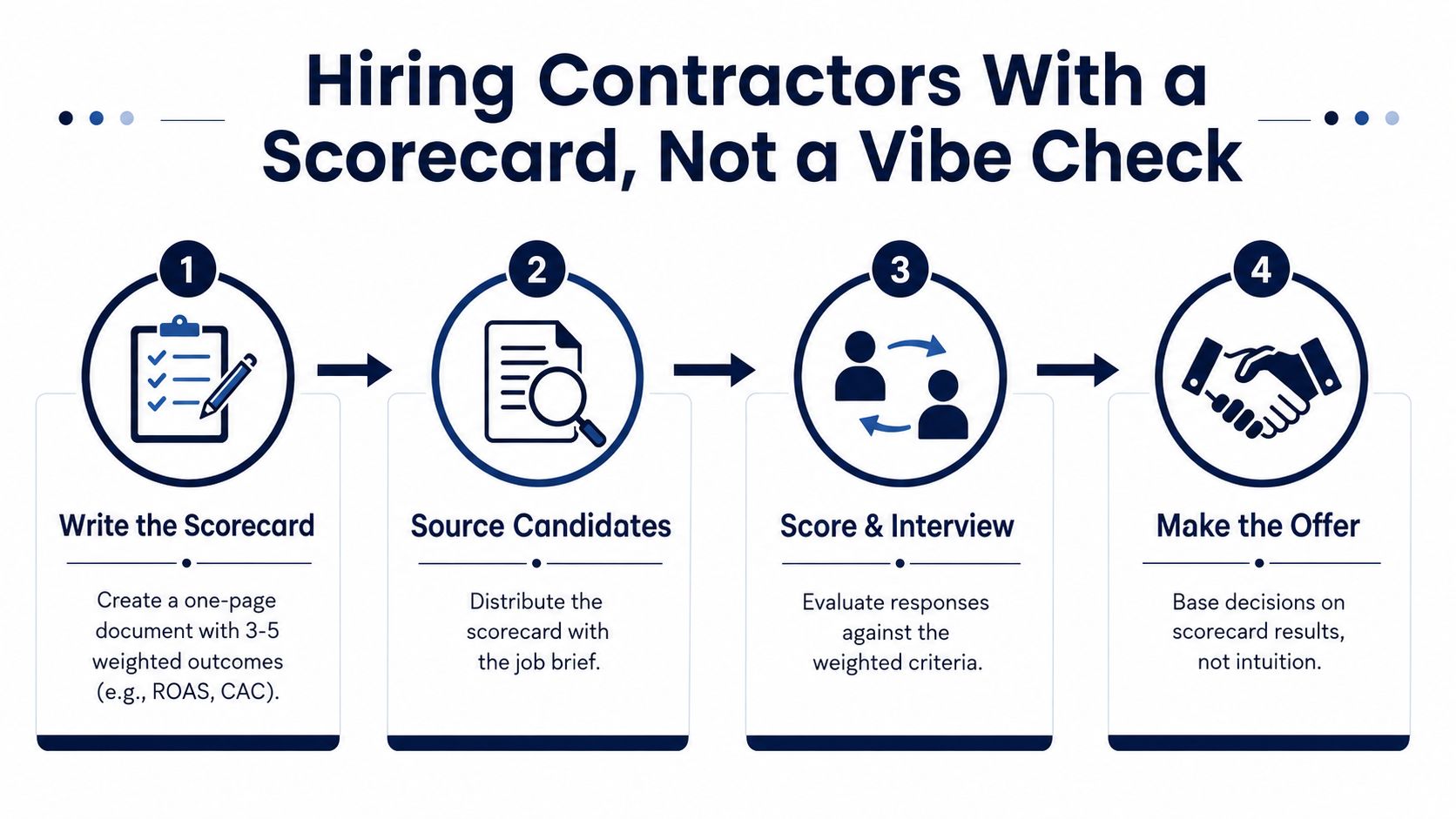
Keep it to three to five weighted outcomes. For a media buyer, the scorecard might include profitable acquisition, testing discipline, creative iteration speed, reporting quality, and response reliability. Don't score personality when you can score evidence.
A usable scorecard has four fields:
Give candidates the scorecard with the brief. Their questions reveal whether they understand the work, and their proposed approach shows how they think before they have access to your systems.
Run a paid test that mirrors a small slice of the role. A media buyer might audit a campaign and produce a testing plan. A UGC creator might turn a product brief into concepts and one draft. A developer might diagnose a controlled issue in a staging environment.
Score the submission against the predefined outcomes. Look for assumptions, clarity, prioritization, and whether the candidate flags missing information. Don't reward a beautiful answer that ignores commercial constraints.
Complete a three-reference check focused on behavior. Ask what the contractor did when a deadline moved, how they handled revisions, whether they raised blockers early, and what kind of direction they needed. A reference who only confirms the portfolio hasn't answered the question you care about.
Set expectations through a 30-60-90 day ramp:
Missed deadlines, unreported scope creep, and refusal to use agreed tracking tools override a strong portfolio. You're not buying talent in the abstract. You're buying dependable output inside a commercial system.
A contractor agreement should make the relationship operationally legible. It must tell the contractor what to deliver, tell finance when to pay, tell the brand who owns the work, and give the company a defensible process for access, review, and exit.
Use a standard package, then have qualified counsel adapt it to the relevant jurisdictions. The core clauses are straightforward:
The US Department of Labor's current guidance emphasizes a fact-specific employment test under the FLSA, so a contract calling someone an independent contractor doesn't resolve the question. Review control, independence, economic dependence, permanence, and the actual working relationship with counsel.
For international engagements, collect the documents relevant to the person and jurisdiction. That may include a W-8BEN where appropriate, business registration details, right-to-work information where relevant, VAT or GST information, and sanctions or privacy checks. The exact requirement depends on the country, person, service, and payment structure.
Independent-contractor measurement also shows why one status field isn't enough. Research found that survey and administrative tax data can be difficult to reconcile, and that probing employment arrangements plus low-hours work is important for identifying contractor activity. Build standardized intake questions and periodically revalidate the relationship instead of treating onboarding as a permanent answer. The AEA conference paper on contractor measurement explains this methodology problem.
| Clause | What It Protects | Red Flag to Watch |
|---|---|---|
| Scope and deliverables | Output, acceptance, and accountability | Vague “support” language |
| IP assignment | Ownership of ads, code, copy, and creative | No pre-existing IP carve-out |
| Payment terms | Cash planning and invoice disputes | Payment due without acceptance rules |
| Termination | Orderly exit and handover | No notice or transition requirement |
| Confidentiality | Customer, supplier, and brand information | Broad access without deletion duties |
| Classification review | Documented engagement intent | Fixed hours and company-controlled methods |
Keep a one-page checklist with the agreement, tax documents, approved systems, manager, renewal date, and offboarding steps. If you need a practical reference for how to write a contractor termination letter, focus on clear dates, final deliverables, access removal, payment treatment, and return or deletion of company information.
Stamp every agreement through one contract lifecycle management system. If you're not ready for dedicated software, a controlled Notion database plus DocuSign can work, provided one owner maintains the record and DMs never become the source of truth.
The cheapest rate isn't the lowest cost. A low hourly quote can become expensive when the contractor needs constant direction, misses deadlines, or creates rework. Choose the rate model based on how clearly you can define output and how much risk you want the contractor to carry.
An hourly arrangement is useful for exploratory work, support that varies, or a defined technical sprint. Put a cap or approval threshold around it. A retainer suits recurring creative production, CX coverage, or lifecycle operations when the brand needs predictable capacity. Project pricing fits packaging, photography, audits, migrations, and other work with a clear beginning and end.
Performance pricing can align incentives, but it creates attribution disputes unless the baseline, channel ownership, exclusions, returns, and payment timing are explicit. Equity-for-fees belongs with senior advisors who accept deferred cash and can tolerate illiquidity. It's a poor substitute for a clear budget.
| Rate Model | Payment Trigger | Risk Bearer | Best-Fit Ecommerce Role |
|---|---|---|---|
| Hourly | Approved time and invoice | Brand bears scope risk | Defined development or research sprint |
| Retainer | Recurring capacity or service period | Shared risk | Creative, CX, or lifecycle support |
| Project | Milestone or accepted deliverable | Contractor bears delivery risk | Packaging, photoshoot, audit, migration |
| Performance or revenue share | Measured attributable result | Contractor bears more performance risk | Affiliate-led acquisition |
| Equity for fees | Vesting or agreed equity event | Contractor defers cash | Senior strategic advisor |
Use payment timing as a cash-control lever. Weekly payments help retain reliable specialists who need fast settlement, while net-15 or net-30 terms preserve working capital when the contractor can absorb the delay. Milestone payments protect both sides when the work has meaningful handoffs.
A simple invoice SOP prevents avoidable friction:
Don't promise a payment cycle your cash position can't support. This cash-flow management guide is useful when you're connecting contractor commitments to inventory purchases, advertising spend, and operating reserves.
The right default is simple: retainers for dependable ongoing capacity, hourly for bounded uncertainty, projects for discrete outputs, performance pricing for measurable acquisition, and equity only when the seniority and risk justify deferred cash.
Contractors don't need more meetings. They need a predictable information loop. A short weekly rhythm catches blockers early, while a monthly review determines whether the engagement still produces enough value to continue.
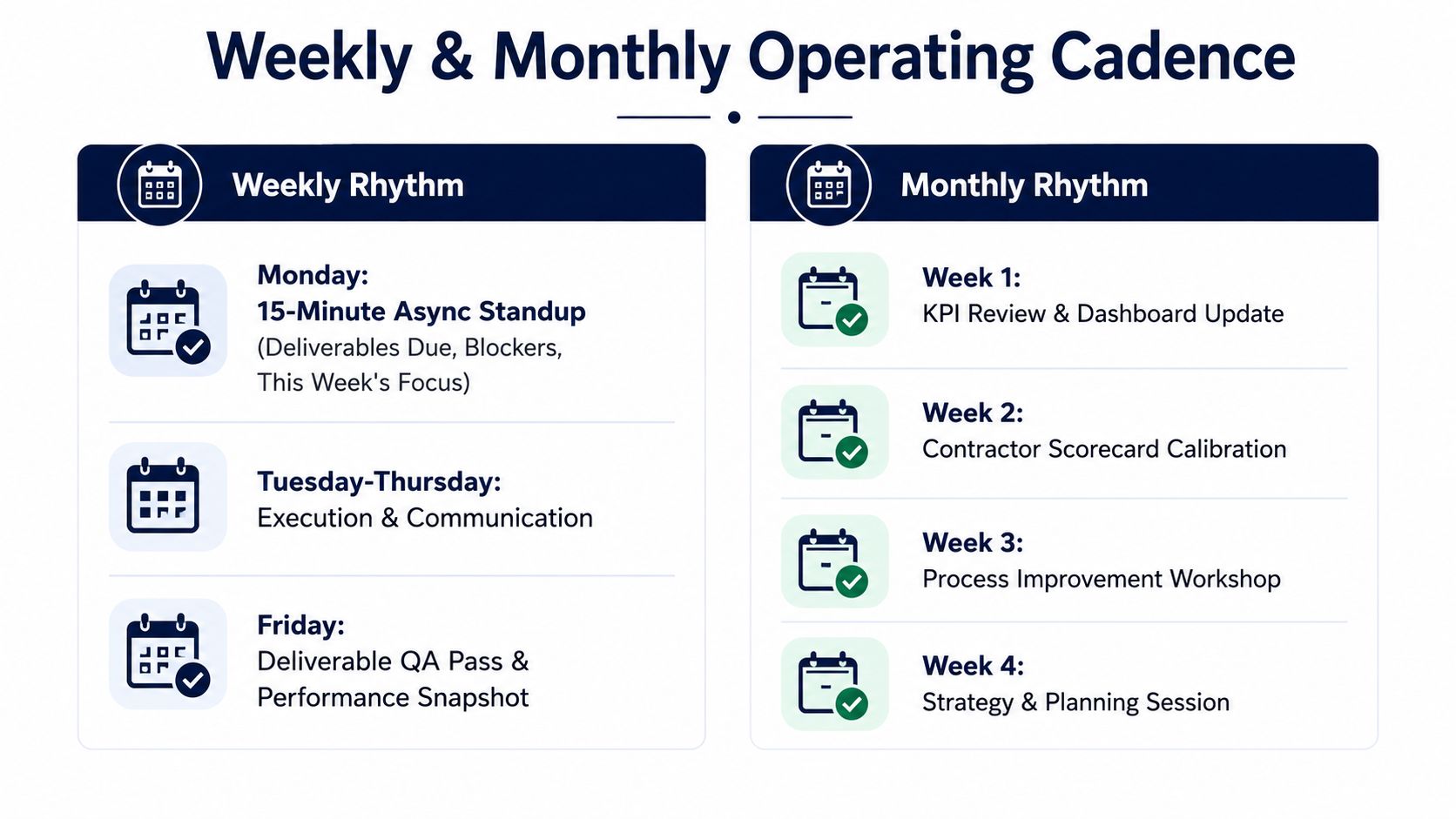
Monday's async standup should answer three questions: what was delivered, what is blocked, and what will be completed this week. Keep it in one channel or project record. The contractor should link the relevant brief, file, campaign, ticket queue, or pull request.
Friday is for deliverable QA. The owner checks work against the scorecard, records revisions, and captures one performance snapshot. Don't wait until renewal time to discover that “almost done” has become the contractor's normal definition of complete.
The monthly review should cover output, timeliness, cost per deliverable, communication quality, and scope fit. Retainers that represent meaningful recurring spend deserve a deeper quarterly business review, including capacity, upcoming launches, risks, and whether the relationship should expand, narrow, or end.
A dashboard can live in Notion, Airtable, or Looker. Keep it boring and centralized:
For media, connect the contractor record to acquisition metrics such as cost per acquired customer. For CX, use response time and customer satisfaction measures. For every role, add internal stakeholder feedback because a contractor can hit deadlines while making the team slower.
Dashboard test: Every tile should trigger a decision. If a metric doesn't change scope, coaching, payment approval, or renewal status, remove it.
Watch for three leading indicators: missed standups for two consecutive weeks, revision creep beyond two rounds, and silence when blockers appear. Those signals mean the engagement needs a reset before the contract date arrives. Re-scope the work, change the owner, or offboard cleanly. Don't keep paying for a relationship that requires the founder to provide invisible project management.
Don't attempt to perfect the system before using it. Install a minimum viable operating layer, then improve it with real contractor data.
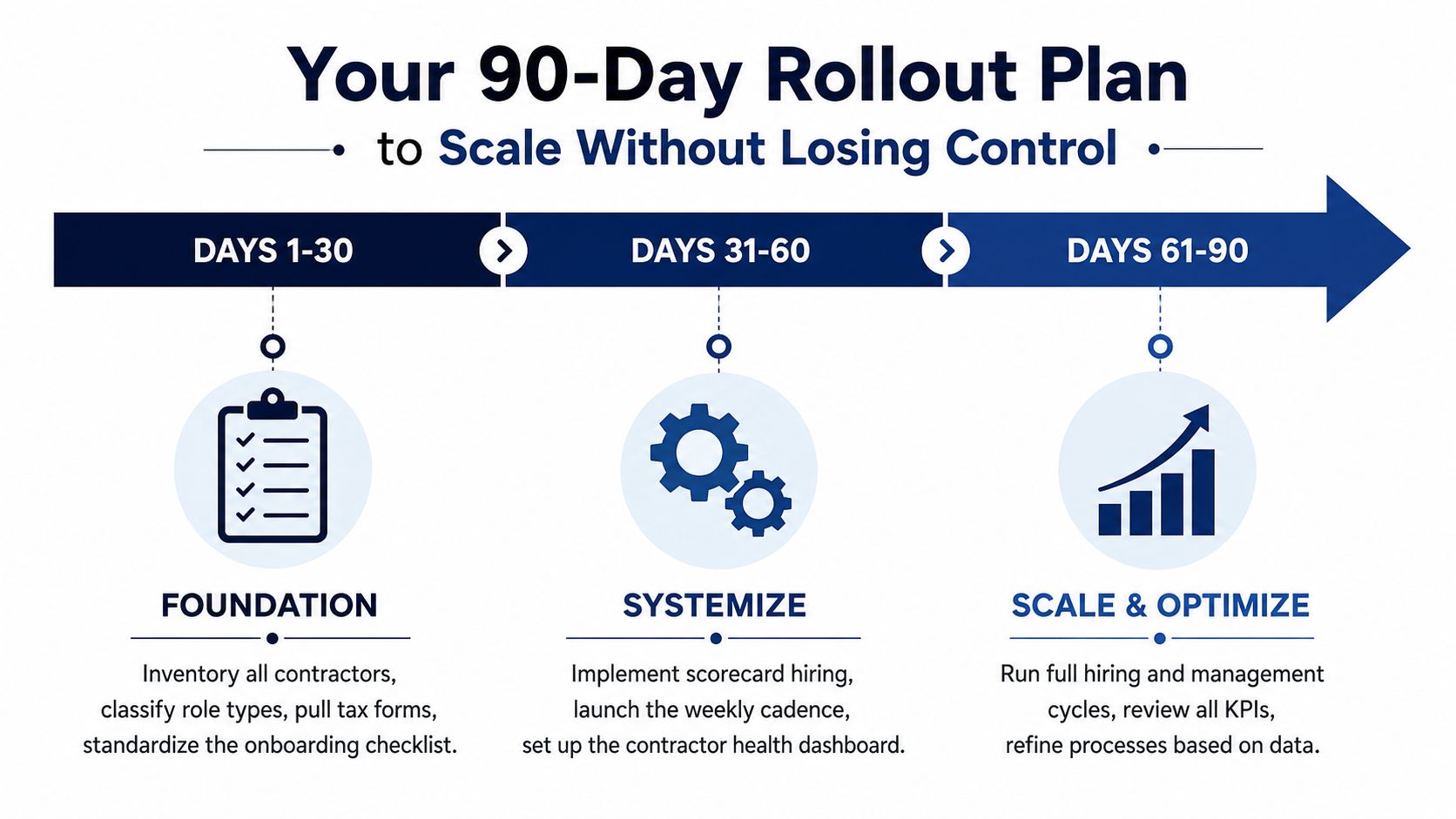
The founder should appoint one operations owner and give Finance a defined approval role. Inventory every contractor, recurring vendor, and active external collaborator. Classify each role by work type, control level, data access, cadence, and likely engagement structure.
Collect tax documents, contracts, invoices, system permissions, and renewal dates. Standardize the master agreement, onboarding checklist, rate card, and roster fields. At day 30, make a go or no-go decision: if you can't identify the owner, scope, payment status, and access level for every active relationship, stop adding contractors until the gaps are fixed.
Ops owns the scorecard template, candidate test, onboarding workflow, and weekly standup. Finance owns invoice requirements, documentation checks, payment scheduling, and committed-spend visibility. The founder should approve exceptions, high-risk access, unusual compensation, and roles that may belong inside the core team.
Move active contractors onto the same operating cadence. Don't force every person into identical tooling, but require the same minimum records: deliverables, owner, status, blockers, acceptance, invoice, and review date.
Deploy the health dashboard and review it weekly. Add quarterly revalidation triggers for classification, access, scope, rate, and business need. By the end of the rollout, every recurring engagement should have a renewal decision supported by evidence rather than familiarity.
Use one north-star operating metric: cost per clean-output hour trending down while cycle time shrinks. “Clean output” means work accepted with minimal rework, clear ownership, and no avoidable waiting. If output gets cheaper only because quality falls, the system is failing.
Common failure signs include a dashboard nobody updates, contracts that don't match actual working practices, invoices approved without deliverable checks, and contractors retaining access after their scope ends. Another warning is founder dependence. If every decision still routes through you, you've documented administration, not built an operating system.
Million Dollar Sellers gives serious ecommerce operators access to a trusted peer network, practical strategy sharing, and vetted recommendations for scaling the people and systems behind a brand. If contractor management is becoming a constraint, visit Million Dollar Sellers to connect with founders who've built operating discipline across Amazon, DTC, and omnichannel businesses.
Join the Ecom Entrepreneur Community for Vetted 7-9 Figure Ecommerce Founders
Learn MoreYou may also like:
Learn more about our special events!
Check Events