
Chilat Doina
October 14, 2025
When we talk about managing cash flow, what we’re really talking about is keeping a close eye on the money moving in and out of your business. It's about more than just balancing the books; it's about proactively forecasting what you'll need down the road, juggling your payables and receivables, and always keeping a healthy cash reserve on hand.
This discipline is what separates the brands that weather market shifts from those that get swept away.
Profitability on paper means absolutely nothing if you can’t pay your suppliers, cover payroll, or jump on a hot marketing opportunity. We’ve all heard the old cliché, "cash is king," but for an e-commerce brand, it's the very oxygen your business breathes.
A company can look incredibly profitable and still fail spectacularly if all its cash is tied up in slow-moving inventory or stuck in accounts receivable. This is exactly why learning to manage cash flow is a non-negotiable survival skill.
At its core, effective management comes down to three things:
Picture this: you have a product that’s flying off the virtual shelves. Your profit and loss statement looks amazing. To keep up with demand, you had to place a massive inventory order, and your supplier wants to be paid in 30 days.
Meanwhile, your payment processor holds onto your sales revenue for 14 days, and a key wholesale client pays on 60-day terms. All of a sudden, you have a huge bill due with no cash on hand to pay it. This scenario, the dreaded "cash flow gap," is exactly how thriving businesses go under.
The journey of cash through an e-commerce operation is constant and complex, with critical touchpoints that can make or break your liquidity.
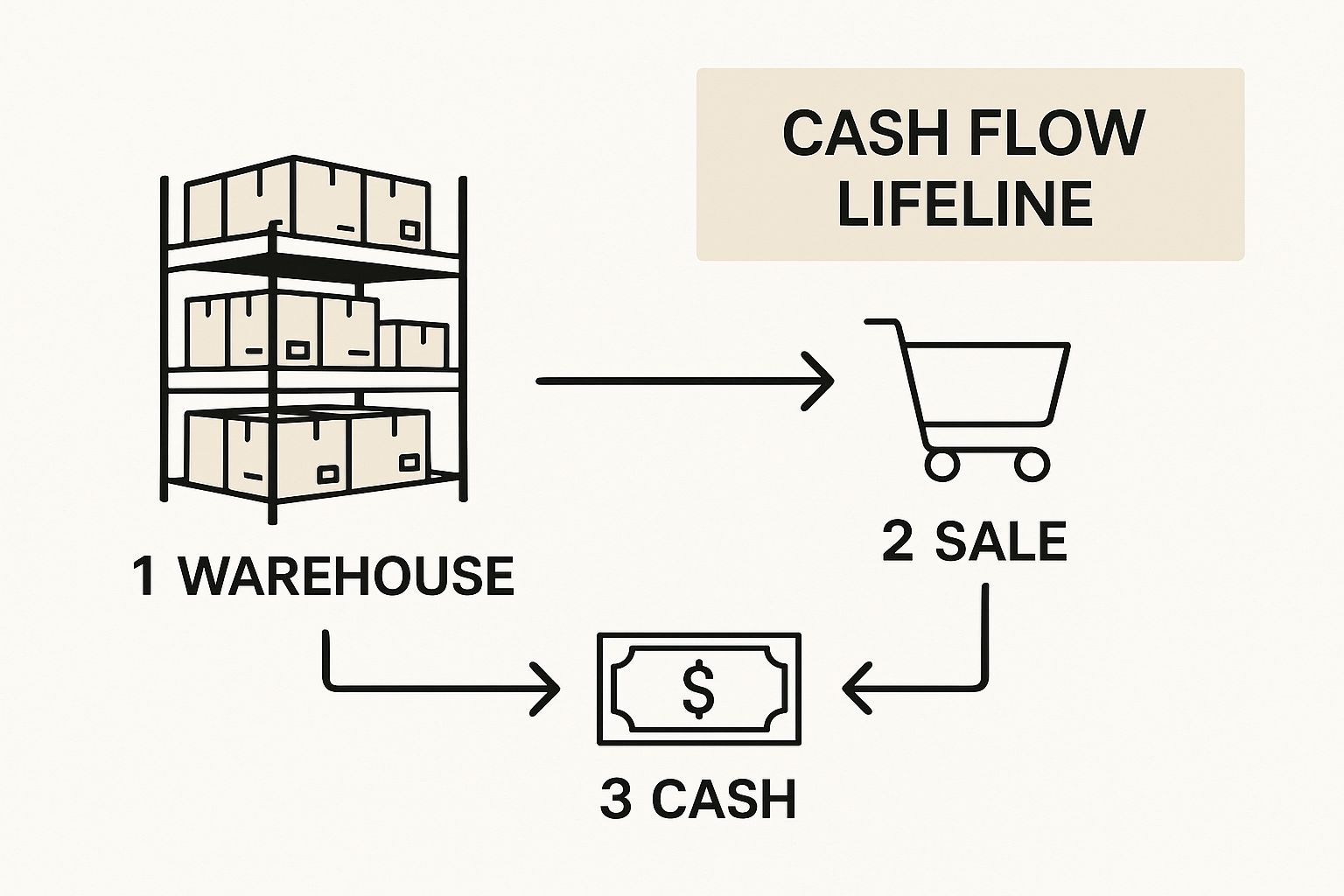
As you can see, your cash is always in motion—from customers to your bank, then out to suppliers, ad platforms, and employees. It’s a true lifeline.
In a volatile market, being proactive is everything. According to PwC's Global CFO Survey, a staggering 57% of CFOs identified cash flow as a top risk to their operations. This is especially true for smaller businesses that often rely on gut feelings instead of solid systems, leaving them wide open when supply chains falter or customers pay late. You can find more financial management insights from InfoPlusVN.
The goal isn’t just to survive month-to-month. It’s to build a resilient business that can confidently seize growth opportunities—like a bulk inventory deal or a timely ad spend increase—without risking financial stability. That’s the true power of mastering cash flow.

Let's be honest: a static spreadsheet with last quarter's numbers isn't a planning tool. It's a history report. To really get a grip on your e-commerce finances, you need something alive—a dynamic, forward-looking cash flow forecast that moves and breathes with your business.
Think of this forecast as your financial GPS. It'll help you spot cash shortages long before they hit, pinpoint smart opportunities for growth, and make confident calls on inventory, ad spend, and hiring. Without it, you're just flying blind.
First things first: you need to map out every dollar coming into your business. For an e-commerce brand, this is way more nuanced than just taking your average daily sales and multiplying by 30. A reliable projection needs a bit more detail.
Ground your sales projections in data, not just wishful thinking. Pull up your sales figures from the past 12-24 months. Look for the rhythms of your business—the seasonal peaks, the lulls, and how past marketing campaigns moved the needle.
When you're forecasting your inflows, really dig into these factors:
Getting your inflow projection right is the bedrock of your entire forecast. A sloppy sales estimate will throw every other number off, so take the time to dial this in. For a deeper dive, check out these different https://milliondollarsellers.com/blog/inventory-forecasting-methods—they can seriously boost your accuracy.
Next up, you have to track every single dollar that will leave your business. I find it really helps to split these outflows into two buckets: variable costs and fixed costs. This simple separation makes understanding your financial structure so much clearer.
Variable Costs are the expenses that move in lockstep with your sales volume. Sell more, and these costs go up.
Fixed Costs, on the other hand, are your steady, predictable bills that don't really change month-to-month, no matter how many units you move.
To build a forecast you can actually rely on, it's critical to know your key operational numbers. Take some time to calculate your break-even point to see exactly how much you need to sell just to cover all your costs. This one number is a game-changer for setting realistic sales targets.
Pro Tip: Don't get caught off guard by those irregular but totally predictable expenses. I'm talking about quarterly tax payments, annual insurance renewals, or that new piece of equipment you know you'll need. Plug them into your forecast so they don't create a surprise cash crunch.
To give you a clearer picture, here’s a simplified look at what a three-month forecast might look like.
CategoryMonth 1 (Projected)Month 2 (Projected)Month 3 (Projected)Cash InflowsSales Revenue$50,000$55,000$60,000Other Income$500$500$500Total Inflows$50,500$55,500$60,500Cash OutflowsVariable CostsCOGS$15,000$16,500$18,000Shipping & Fulfillment$5,000$5,500$6,000Marketing & Ads$7,500$8,000$8,500Fixed CostsSalaries & Wages$10,000$10,000$10,000Software & Subscriptions$1,000$1,000$1,000Rent & Utilities$2,000$2,000$2,000Total Outflows$40,500$43,000$45,500Net Cash Flow$10,000$12,500$15,000Beginning Cash$20,000$30,000$42,500Ending Cash$30,000$42,500$57,500
This table shows how you can map out your expected cash position, helping you plan for both growth and potential shortfalls.
A forecast should never be a "set it and forget it" document. Your business is constantly evolving, and your forecast needs to keep pace. That's why the rolling forecast is one of the most powerful tools in an e-commerce owner's arsenal.
Instead of making one big 12-month forecast at the start of the year, a rolling forecast is a living document. At the end of every month, you do a quick three-step check-in:
This simple monthly rhythm transforms your forecast from a static guess into a dynamic management tool. It forces you to constantly test your assumptions against reality, making your predictions sharper and sharper over time. It's the single best way to build a forecast you can actually bet your business on.
https://www.youtube.com/embed/SXpTQBpYPM0
Trying to manage your e-commerce cash flow with a bunch of disconnected spreadsheets is a fast track to frustration. It's slow, clunky, and honestly, you’re almost guaranteed to miss something critical. In today’s world, the right financial technology isn’t just a nice-to-have; it’s a real strategic advantage.
Good tools take you out of the history books and give you a live pulse on your business's financial health. They finally connect the dots between your sales channels, bank accounts, and ad spend, painting one clear picture of where your money is going and when.
Look, a well-built spreadsheet forecast is a decent starting point. We’ve all been there. But the seven- and eight-figure brands gain their edge by graduating to dedicated software. These tools don't just organize data; they automate the grunt work and deliver insights a spreadsheet could only dream of.
Think about what it takes to update your forecast manually. You’re constantly pulling reports from Shopify, cross-referencing bank statements, and trying to categorize every little expense. It’s not just a time-sink—it’s a recipe for human error.
Modern accounting and cash flow software makes that whole process obsolete.
This kind of automation frees you up to do what you're best at: thinking strategically. You get to spend your time analyzing the numbers instead of just chasing them down. For those of you deep in the Amazon ecosystem, it’s worth exploring the 12 best tools for Amazon FBA sellers to find platforms built specifically for its unique financial quirks.
The next big leap is happening right now with the rise of artificial intelligence (AI) in finance. This isn't just tech-bro buzz; it’s a fundamental shift in how you can predict and prepare for your cash flow needs.
AI-powered tools don’t just show you what happened last month. They build predictive models to forecast what’s likely to happen next. By crunching your historical sales data, customer payment habits, and even seasonality, they can produce cash flow projections with startling accuracy.
This is already making a huge difference for big players. Take Prysmian Group, a global cable manufacturer. They brought in an AI-powered treasury solution to automate their global cash flow forecasting. The result? They slashed manual work by 50% and pocketed $100,000 in annual savings. You can dig deeper into how AI is shaping financial management on NSKTGlobal.com.
An AI-driven tool can flag a potential cash crunch weeks or even months out. That gives you a massive head start to line up financing, push back a big purchase, or run a flash sale to juice your inflows. It’s the ultimate financial early-warning system.
Your perfect toolset really depends on where your business is at. A solopreneur just starting out has totally different needs than an omnichannel brand doing eight figures. Still, a solid foundation usually has a few key pieces.
A Scalable Accounting Platform
This is ground zero for your finances. A solid system like Xero, QuickBooks Online, or NetSuite acts as the single source of truth for all your financial data. It’s where you’ll handle invoicing, pay bills, and run core financial reports.
A Dedicated Cash Flow Forecasting Tool
If your accounting software is the rearview mirror, a forecasting tool is the windshield. Platforms like Float, Dryrun, or Jirav sync with your accounting system to create dynamic, rolling forecasts. They let you model out different "what-if" scenarios so you can make decisions proactively, not reactively.
Specialized E-commerce Integrations
This part is crucial. Make sure your chosen tools plug directly into your sales platforms (Shopify, Amazon, etc.) and payment processors. That seamless connection is what makes real-time data flow possible and finally gets you out of the manual data-entry business for good.
At the end of the day, investing in the right tech pays for itself many times over. The time you save, the errors you avoid, and the strategic clarity you gain are exactly what you need to scale your business with confidence. It's time to stop guessing and start managing your cash with precision.

A solid cash flow forecast is your map, but optimizing your working capital is how you actually drive the car. It's all about freeing up the cash that's already inside your business but is currently stuck in day-to-day operations.
By dialing in on the big three—inventory, accounts receivable, and accounts payable—you can make some seriously impactful changes to your liquidity, often without complex financial gymnastics. These are real-world tactics that put cash back where it belongs: in your bank account.
For any e-commerce brand, inventory is the classic cash trap. Every single unit sitting on a warehouse shelf is capital you can't pump into marketing, new product development, or payroll. The name of the game is holding just enough stock to meet demand without strangling your cash flow.
A great way to tackle this is with a just-in-time (JIT) inventory model, or at least a modified version of it. Instead of placing massive POs months in advance, you order smaller batches more frequently, timing them to land just before you run out.
Yes, this demands a rock-solid relationship with your suppliers and a keen sense of your sales velocity, but it drastically slashes carrying costs and frees up a ton of cash.
You also have to be ruthless with your slow-moving stock.
Letting stale inventory collect dust is like letting a slow leak drain your bank account. Turn it over.
That gap between making a sale and the money actually hitting your account? It's a killer. The shorter you can make that cycle, the healthier your cash position will be. For e-commerce stores, this usually comes down to payment processor settlement times and any wholesale accounts you might have.
One of the oldest tricks in the book is still one of the most effective: offer early payment discounts. A term like "2/10, net 30" gives your wholesale clients a 2% discount if they pay you within 10 days instead of the full 30.
Think about it. That small discount is often a tiny price to pay for getting your money 20 days sooner. You can immediately turn around and reinvest that cash into ads or inventory for your next winning product.
It's a simple calculation. If the cost of the discount is less than the cost of borrowing money or the opportunity cost of not having that cash on hand, it's a strategic win.
On top of that, you have to protect the cash you’ve already earned. Chargebacks can yank revenue right out from under you. It’s critical to implement chargeback protection strategies for e-commerce to prevent your hard-won cash from being clawed back unexpectedly.
While you want to collect cash as fast as humanly possible, you should do the exact opposite with your own bills—without torching your supplier relationships, of course.
Extending your payment terms is a powerful lever for improving your cash flow. If a supplier gives you "net 30" terms, don't pay that invoice the day you receive it. Use their credit as a short-term, interest-free loan and pay closer to the due date. This keeps cash in your bank account longer, giving you more flexibility.
And don't be afraid to negotiate. If you're a good, reliable customer, you have more leverage than you think. Ask for "net 45" or even "net 60" terms. The worst they can say is no, but getting an extra 15-30 days to pay can be a complete game-changer for your working capital cycle.
These three areas aren't just line items on a balance sheet; they are active levers you can pull to directly influence your company's financial health. For a deeper dive, our complete guide to https://milliondollarsellers.com/blog/working-capital-optimization covers more advanced techniques.
Below is a quick-glance table breaking down these tactics.
AreaStrategyImpact on Cash FlowDifficulty to ImplementInventoryJust-In-Time (JIT) OrderingHigh: Frees up significant cash from unsold stock.Medium: Requires reliable suppliers & accurate forecasting.InventoryLiquidate Slow-Moving StockHigh: Converts dead assets back into usable cash quickly.Low: Can be done immediately via sales or bundles.ReceivablesEarly Payment DiscountsMedium: Accelerates cash inflow at the cost of a small margin.Low: Easy to offer on invoices.ReceivablesChargeback ProtectionMedium: Prevents revenue loss and protects existing cash.Low-Medium: Involves setting up tools and processes.PayablesExtend Payment TermsHigh: Lengthens the cash conversion cycle in your favor.Medium: Requires negotiation with suppliers.PayablesPay Invoices Near Due DateMedium: Keeps cash in your account for the maximum time.Low: Simple change in payment process.
Ultimately, taking a proactive stance on managing your working capital is no longer optional. With capital getting tighter, treasury teams are focusing heavily on strategic cash management. In fact, over half of surveyed organizations hedge their financial exposures, with 79% using cash flow hedge accounting. This shows a clear shift toward actively managing working capital as a core financial strategy.
Daily management and solid forecasting are great, but real financial muscle comes from being ready for the curveballs. What happens when your best-selling product gets stuck on a cargo ship for an extra month? Or when your key supplier decides to double their prices overnight?
These aren't just "what-if" scenarios; they're the reality of running an e-commerce business.
That’s where a cash buffer—your emergency fund—stops being a “nice-to-have” and becomes a non-negotiable part of your financial playbook. It’s the safety net that lets you navigate a crisis with a clear head instead of making panicked, sloppy decisions that could sink everything you’ve built. Honestly, without one, a single bad month could easily become your last.
The first question everyone asks is, "So, how much is enough?" While every business is unique, a solid rule of thumb for any e-commerce brand is to have three to six months of essential operating expenses parked in a separate, high-yield savings account.
And I don't mean your total monthly outflow. We're talking about the absolute bare-bones costs needed to keep the lights on if your revenue suddenly flatlined.
To get this number, you’ll need to figure out your essential fixed and variable costs:
The goal here isn’t to thrive during a downturn; it’s just to survive. Calculating this gives you a concrete savings target. For instance, if your essential monthly burn is $20,000, your cash reserve goal would be somewhere between $60,000 and $120,000.
This buffer does more than just pay the bills. It buys you time. Time to pivot your marketing, find a new supplier, or secure a line of credit without being forced into terrible terms out of sheer desperation.
Having the cash is only half the battle. A smart operator also has a plan for how to use it. A contingency plan is your playbook for a crisis, mapping out your responses to your biggest cash flow threats before they even happen.
Start by brainstorming the most likely—and specific—threats to your business. Don't be generic.
Common E-commerce Cash Flow Risks
Once you have your list, create a simple "if-then" response for each scenario.
If This Happens...Then We Will...Our main supplier has a 6-week delay.Immediately contact our vetted backup supplier and place a smaller, bridge order.Shipping container costs double.Temporarily increase product prices by 5% and raise the free shipping threshold to $100 from $50.Our primary ad account is suspended.Immediately reallocate 75% of the ad budget to our secondary channels (TikTok and email marketing).
This exercise forces you to think through solutions when you're calm and rational, not in the middle of a five-alarm fire. It also shines a spotlight on your weak spots. If you don’t have a backup supplier, your plan makes it painfully obvious you need to find one now.
This kind of proactive planning turns potential disasters into manageable problems, which is a core skill in learning how to manage cash flow effectively for the long haul. Building this resilience is what ensures your business is built to last.
Got questions about cash flow? Good. That means you're thinking like a serious e-commerce founder. Let's tackle some of the most common head-scratchers I see from brand owners when they start getting their financial house in order.
Think of this as your quick-hit guide to cut through the confusion so you can get back to building your business with confidence.
This is the big one. Get this wrong, and you're flying blind.
Profit is what's left after you subtract all your business expenses from your revenue. It's a number on your P&L statement, an accounting metric. But here's the catch: you can't take profit to the bank or pay your supplier with it.
Cash flow is the real, actual money moving in and out of your bank account. I’ve seen incredibly profitable brands go under because they ran out of cash. Why? Maybe they had too much money tied up in inventory, or a huge wholesale customer was taking 90 days to pay. You pay your bills with cash, not profit. End of story.
If you’re only checking in quarterly or—even worse—annually, you're asking for trouble. For any e-commerce brand, you need to be looking at your cash flow statement at least weekly. That rhythm is frequent enough to catch a negative trend before it spirals into a five-alarm fire.
Honestly, most of the seven- and eight-figure founders I know give their cash flow dashboard a quick glance every single day. It only takes a couple of minutes, but it gives them a constant, real-time pulse on the financial heartbeat of their business.
In simple terms, working capital is the money you have available to run your day-to-day operations. It's the difference between your current assets (think cash in the bank, inventory you can sell) and your current liabilities (what you owe suppliers, credit card bills, etc.).
When you have positive working capital, you can cover your short-term bills. When it’s negative, you’re in the danger zone—it’s a massive red flag that you might not be able to pay your upcoming invoices. Freeing up and optimizing working capital is a direct path to a healthier cash position.
Absolutely. It's a silent killer for fast-growing e-commerce brands, and it happens all the time.
Here are a few classic scenarios:
This is exactly why running your business off the P&L alone is a rookie mistake. You have to watch your cash.
When you’re in a cash crunch, don't try to boil the ocean. You need quick wins to stop the bleeding and give yourself some breathing room.
Focus on the low-hanging fruit first. Try these three things this week:
At Million Dollar Sellers, we know that mastering your finances is what separates the top 1% of sellers from everyone else. Our exclusive community is where elite e-commerce entrepreneurs share the exact strategies they use to scale their brands profitably and build resilient, cash-flow-positive businesses. If you're ready to learn from the best in the industry, find out if you qualify for MDS.
Join the Ecom Entrepreneur Community for Vetted 7-9 Figure Ecommerce Founders
Learn MoreYou may also like:
Learn more about our special events!
Check Events