
Chilat Doina
October 4, 2026
A generic privacy policy and a cookie banner won't keep an ecommerce brand compliant if the underlying systems continue collecting, sharing, and retaining data in ways the policy never describes. Regulators increasingly assess the operational reality behind the documents, including vendor relationships, opt-out handling, data subject requests, tracking technologies, and security controls.
For ecommerce operators, data privacy compliance is an operating discipline. Amazon, DTC storefronts, advertising platforms, customer service tools, fulfillment partners, and subscription systems all create different data paths. A brand can have carefully written legal language and still fail because nobody knows which app receives customer information, which vendor retains it, or whether an opt-out reaches every downstream system.
The popular advice is simple: publish a privacy policy, install a cookie banner, and move on. That advice fails because a document describes an intention, while compliance depends on what your technology stack does.
A privacy notice might say that a brand shares information with service providers for fulfillment, analytics, advertising, and customer support. That sentence doesn't answer the operational questions an auditor or regulator may ask. Which providers receive the data? What fields do they receive? What is the processing purpose? Does the vendor use the information for its own purposes? Can the brand honor a deletion request across that system? Does an opt-out stop the relevant advertising signal?
The regulatory environment makes this gap harder to manage. In 2025, there was no new broad U.S. federal privacy law, but state amendments continued across Connecticut, Montana, Oregon, Colorado, Kentucky, Texas, Utah, Virginia, and California. California also finalized rules involving automated decision-making, risk assessments, and cybersecurity audits, as described in the 2025 privacy transition analysis from Wolters Kluwer. A single static policy can't keep pace with changes that affect systems, vendors, assessments, and advertising workflows.
A brand's risk changes whenever a marketing manager adds a retargeting pixel, a developer launches a personalization feature, or an operations lead connects a new returns platform. The privacy team may not hear about the change until an audit asks for the record of processing or a customer requests deletion.
That makes privacy a cross-functional workflow:
A useful privacy-by-design reference, especially for teams building AI-enabled or automated workflows, is AgentStack's 2026 privacy guide. The practical value isn't the existence of another policy checklist. It's the reminder to involve privacy review before a feature becomes embedded in production.
Practical rule: If your team can't explain where a customer record goes after checkout, the brand isn't operationally ready, regardless of how polished its privacy notice looks.
The same discipline used for data-driven decision-making applies here. Teams need reliable inputs, clear ownership, documented decisions, and a process for updating the underlying information. Privacy compliance should sit inside launch reviews, vendor onboarding, campaign operations, and incident management, not in a folder that someone opens before an audit.
You can't protect, delete, or explain personal data that nobody has inventoried. The most useful starting point is a living map that follows information from the first advertising interaction through checkout, fulfillment, support, retention, and deletion.
A Shopify or WooCommerce audit should begin with discovery, not assumptions. Export the installed apps, review theme and tag-manager configurations, inspect checkout extensions, and ask engineering for server-side integrations. Then compare that list with finance, customer support, warehouse, subscription, email, fraud, analytics, and advertising tools. The app store list rarely captures every script or data transfer.
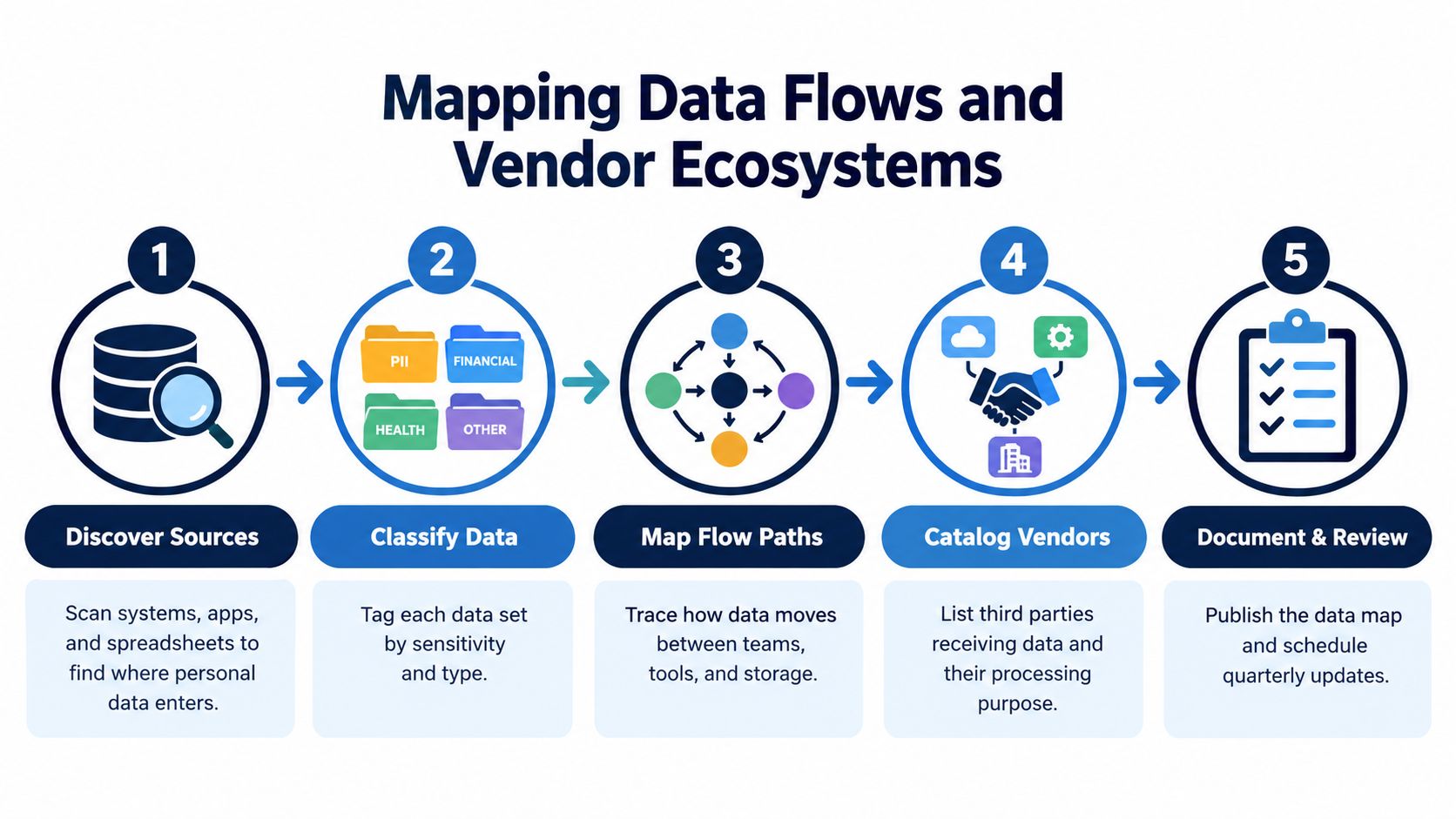
Map the journey in business order. For each stage, record the data collected, the purpose, the system receiving it, the people or vendors with access, the retention expectation, and the action that removes or suppresses it.
The survey evidence points to a serious execution problem. About 50% of U.S. and U.K. organizations said they were very prepared to address privacy laws, while only 34% had conducted data mapping, according to the Legiscope privacy compliance survey summary. A preparedness claim without a current map is usually a confidence problem, not a control.
A CRM isn't one type of data. It can contain contact details, support conversations, purchase history, preferences, authentication information, and internal notes. Classify each category by sensitivity and purpose, then assign an owner who can explain how it is used.
Your inventory should include:
Marketing teams often create the hardest gaps. A new advertising app may send email addresses, purchase events, product views, or customer identifiers to a platform without updating the inventory. A living process requires an intake rule: no new app, pixel, audience, or integration goes live until someone records its fields, purpose, recipient, retention behavior, and opt-out handling.
Vendor management should support that process rather than sit separately from it. A structured vendor management system can connect the vendor record to contracts, processing purposes, risk reviews, renewal dates, and evidence. The tool matters less than the ownership model. Every vendor that receives personal data needs a business owner and a privacy decision that remains current after launch.
Consent management fails when a brand treats it as a banner design problem. A banner can present choices, but it doesn't automatically stop a downstream platform from receiving an event, remove an existing audience, or update an email and SMS preference across every system.
Build consent around the actual processing activity. A visitor's choice for analytics shouldn't determine advertising, personalization, email marketing, or embedded media. The preference center should use clear categories, provide a way to change the decision, and create a record that connects the choice to the relevant channel and processing purpose.
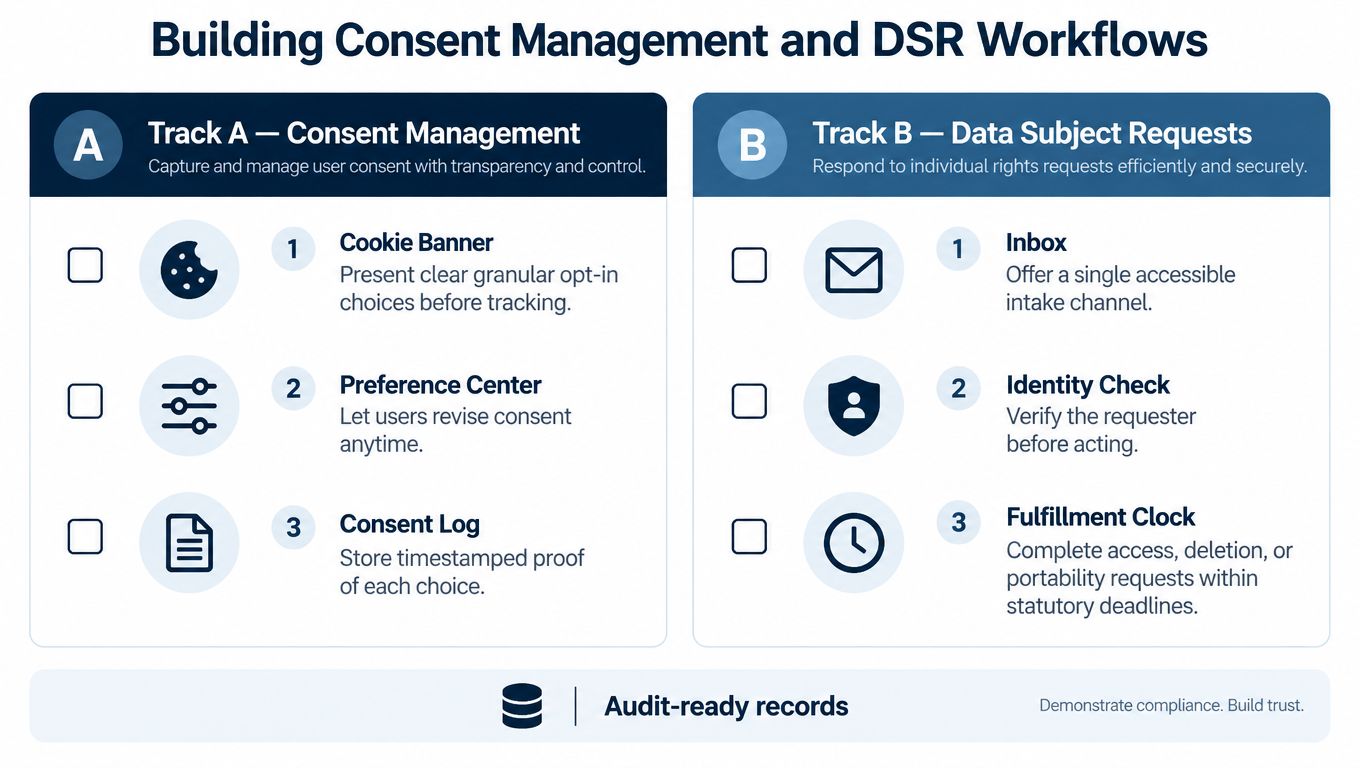
A workable consent architecture has four parts:
Test the system as an operator, not just as a developer. Reject advertising consent, browse products, submit a form, complete a purchase, and inspect the events that reached each platform. Then reverse the choice and verify that future activity changes. Review whether an existing audience is removed or suppressed according to the platform's controls. A visual banner test won't reveal a server-side event that ignores the visitor's preference.
Data subject requests should enter through a defined channel, even when a customer sends the request to support, privacy, or a social account. The first employee who sees the request should know how to route it, preserve the receipt date, and avoid making irreversible changes before identity verification.
A practical workflow looks like this:
Spreadsheets are useful for an early inventory, but they become a weak control when they act as the system of record for active requests. Rows get duplicated, deadlines are missed, attachments spread across inboxes, and nobody can prove whether a vendor completed its task. Automation should create assignments, reminders, system queries, approval gates, and an audit trail. It shouldn't remove human judgment from identity verification or retention exceptions.
A well-designed CRM implementation can make this workflow easier when privacy requirements are included in the data model and integration design. The goal isn't to buy a separate tool for every regulation. It's to make the request path visible, repeatable, and testable from intake through completion.
Your privacy notice and your vendor contracts should describe the same operating reality. If the notice says a provider acts only on the brand's instructions, but the contract permits broader use, the mismatch creates risk. If the contract includes appropriate restrictions but the brand's systems send data for a different purpose, the paperwork doesn't repair the practice.
Start with the data map. For each processing activity, compare the public notice, internal record, vendor agreement, consent language, and actual integration behavior. Look for differences in purpose, data categories, recipients, retention, international access, advertising use, and individual rights support.
Avoid copying a broad template and adding more categories than the business can explain. A stronger notice identifies the specific purposes for collection and distinguishes necessary processing from optional marketing or advertising activity.
Review these areas closely:
The California Privacy Protection Agency's $1.35 million settlement with Tractor Supply involved failures related to privacy notices, service provider agreements, and opt-out mechanisms for sharing and sale of personal information, as summarized in White & Case's U.S. data privacy guide. The lesson for ecommerce teams is practical. A notice, contract, and opt-out control must work together.
A vendor review should answer more than whether a provider has a security page. Check the agreement for documented processing instructions, permitted data categories, purpose restrictions, confidentiality, security obligations, subprocessors, assistance with rights requests, incident notification, deletion or return at termination, audit support, and rules for onward transfers.
Ask the vendor to identify every subprocessor that touches the relevant data. Record the answer in the vendor inventory and create a review trigger for changes. An agency may install a new analytics tool, a fulfillment partner may change its warehouse software, and a support platform may introduce an AI feature. Your contract process needs a way to catch those changes before customer data moves through them.
For teams comparing contract language, it can help to explore privacy terms as a reference point. Don't use another organization's terms as a substitute for legal advice or a vendor-specific review. Use them to identify topics your own agreements need to address, then align the language with your actual data flows.
Privacy and security can't be managed as separate workstreams. A brand can't demonstrate responsible data handling if an unnecessary employee group can access customer records, a vendor retains exports indefinitely, or a breach response team can't identify which systems received the affected fields.

Start with controls that reduce exposure during ordinary operations. Apply role-based access, separate production data from testing environments, protect sensitive records in transit and at rest, review privileged accounts, and remove access when a person changes roles. Centralized governance helps the business answer who approved a data use, who owns the system, and where evidence is stored.
Privacy-enhancing technologies can support specific use cases, such as reducing the information exposed during analytics, audience activation, or collaboration. They aren't a replacement for minimization or access control. If the business doesn't need a field, the safest version is usually not to collect it.
A benchmark study found that 82% of medium and large organizations actively measure privacy programs, and those organizations averaged a 74% privacy performance score. The same study found that privacy audit assessments were the most commonly used of nine measurement methods, according to TrustArc's 2025 global privacy benchmarks report.
For an ecommerce brand, measurement should produce decisions rather than a decorative dashboard. Useful indicators include whether the data map has current owners, whether vendor reviews are complete, whether access recertification occurred, whether consent signals propagate correctly, whether DSRs have documented outcomes, and whether deletion jobs produce evidence.
Audit evidence matters: A control that happened but left no record is difficult to defend. Store the approval, result, exception, owner, and review date where the relevant team can retrieve them.
Run internal assessments on a repeatable cadence and after material changes. Test a new advertising integration, a customer deletion, a compromised support account, and a lost fulfillment export. The assessment should identify the control gap, assign an owner, set a remediation decision, and preserve the evidence.
A practical resource for connecting security controls with privacy and data protection can help teams frame the relationship between technical safeguards and governance. The operating model still needs to reflect the brand's own systems and risk profile.
A breach plan should name the incident lead, privacy decision-maker, security lead, communications owner, outside counsel, platform contacts, and vendor escalation paths. It should explain how the team preserves evidence, contains access, identifies affected systems, determines the data involved, evaluates jurisdictional obligations, and documents each decision.
Don't wait for a breach to discover that Amazon, Shopify, a 3PL, or an email provider has a different escalation process. Keep contact details and contractual notification obligations with the vendor record. Run tabletop exercises around realistic ecommerce scenarios, such as a compromised helpdesk account, an exposed customer export, or a vendor reporting unauthorized access.
A response team should be able to connect the incident to the data map, identify the affected processing purposes, and produce a defensible record of containment and notification decisions. That connection is why continuous mapping, vendor oversight, and security testing belong in one privacy program.
Generic advice breaks down at the channel level because Amazon, a DTC storefront, and a third-party logistics provider don't expose or control customer information in the same way. The right checklist starts with the platform's architecture and the brand's permitted business purpose, then applies the relevant legal and contractual requirements.
Amazon sellers should treat marketplace customer information as platform-controlled data, not as a convenient source for building an independent marketing database. Review what information the seller account, reports, messaging tools, and approved integrations expose. Limit access to employees who need it, document the permitted purpose, and keep marketplace data separate from DTC customer profiles unless the collection and use are independently authorized.
Check the following:
A DTC brand controls more of its storefront, which creates more responsibility. Audit browser pixels, server-side APIs, checkout scripts, consent mode signals, customer accounts, subscriptions, loyalty features, and post-purchase tools. A consent choice should affect both browser and server-side collection where the business relies on both.
Also review hidden data paths. Product recommendations may receive browsing history, subscription systems may store billing and delivery details, and customer support tools may contain free-text information that marketing teams later export. Assign a purpose and retention rule to each path. If a vendor cannot explain how it honors opt-outs or deletion requests, treat that as a remediation item rather than accepting a checkbox in the procurement form.
A 3PL may handle names, addresses, phone numbers, order details, returns, and delivery exceptions. The brand should know which warehouse systems and carriers receive those fields, which employees can view them, and what happens to data after an order or return closes.
Document the 3PL's retention and deletion process, access controls, incident escalation route, subprocessors, and restrictions on using customer data for its own purposes. Confirm that the contract supports rights requests and breach investigations. Warehouse security matters, but so does the digital export created when an operations employee downloads a shipping report.
| Ecommerce Channel | Primary Privacy Focus | Common Compliance Pitfall |
|---|---|---|
| Amazon | Marketplace data boundaries, access permissions, approved communications, and controlled exports | Treating marketplace customer information as an unrestricted DTC acquisition list |
| DTC storefront | Consent signals, pixels, server-side events, subscriptions, and integrated customer systems | Updating the banner while an advertising or analytics integration continues sending events |
| Third-party logistics | Address security, retention, subprocessors, access controls, and incident escalation | Signing a generic service agreement without documenting deletion, use restrictions, or vendor assistance |
The financial stakes are material. The GDPR permits fines for serious violations up to the greater of €20 million or 4% of a company's global annual revenue, and European regulators had issued more than 2,800 fines totaling over €7.1 billion by early 2026, according to the GDPR enforcement figures tracked by CMS. Those figures don't mean every ecommerce mistake produces a penalty, but they do show why channel-specific controls matter.
The practical sequence is clear: map each channel, restrict collection to a defined purpose, make consent and opt-outs travel with the data, contractually control vendors, test DSR fulfillment, and preserve evidence. A static policy can support that work, but it can't perform it.
Million Dollar Sellers offers ecommerce founders an invite-only peer community, strategy sharing, mastermind discussions, private forums, and vetted service recommendations. Visit Million Dollar Sellers to connect with operators who can exchange practical lessons on scaling Amazon, DTC, and omnichannel businesses while building stronger operating controls.
Join the Ecom Entrepreneur Community for Vetted 7-9 Figure Ecommerce Founders
Learn MoreYou may also like:
Learn more about our special events!
Check Events