Chilat Doina
August 29, 2026
At 2 AM, an ecommerce founder is reconciling a 3PL invoice against a packaging supplier's delivery schedule while a critical component vendor in Shenzhen has stopped replying. The information exists somewhere, but it's spread across spreadsheets, inboxes, ERP notes, shared drives, and messages sent by people who are already asleep.
That operating model can survive an early-stage brand. It becomes expensive once supplier relationships multiply across Amazon, DTC, contract manufacturing, freight, packaging, warehousing, and marketplace services. The problem isn't that teams have too many vendors. It's that nobody has a reliable system for deciding who can be onboarded, what each supplier has agreed to deliver, when documents expire, and how performance affects future spend.
Vendor management systems promise to solve that problem. The platforms centralize supplier data, automate approvals, track obligations, and create an auditable record of decisions. But software alone won't fix fragmented operations. The strongest ecommerce implementations pair the right controls with a realistic view of integration work, internal ownership, and total cost of ownership.
The late-night reconciliation usually starts with a small discrepancy. A 3PL invoice includes accessorial charges that nobody expected. The packaging vendor delivered cartons later than planned, but the delay wasn't connected to the purchase order. A manufacturer's revised component price appeared in an email and never reached the cost model. Each issue looks manageable on its own. Together, they create margin leakage and force the founder or head of operations to become the company's human database.
As brands scale, supplier operations become harder to reconstruct. A buyer may know which factory produces a specific SKU, finance may hold the latest payment terms, and the warehouse team may know that the supplier regularly misses labeling requirements. None of that knowledge helps much when it remains trapped in separate conversations.
Fragmented vendor administration creates several recurring problems:
A useful supplier vetting checklist helps teams evaluate vendors before they enter the network. A vendor management system takes the next step by governing what happens after selection.
The category has moved well beyond a contact directory. One industry estimate values the vendor management systems market at US$11.2 billion in 2026 and projects US$27.9 billion by 2034, while another estimates US$11.51 billion in 2026 and US$23.16 billion by 2033. Those forecasts differ, but both point to sustained investment in centralized supplier lifecycle management, as reported by Coherent Market Insights.
Operator's rule: If a supplier decision still depends on remembering which spreadsheet is current, the business has outgrown its process.
Modern VMS platforms fit ecommerce better when they connect supplier governance to actual operating events. A missed 3PL SLA should affect a performance record. A packaging change should trigger a specification review. A supplier termination should initiate access removal, data return, and open-order reconciliation. That is the structural upgrade, replacing tribal knowledge with governed workflows.
A useful VMS follows the supplier lifecycle rather than presenting a pile of disconnected features. The practical test is simple: can the platform move a supplier from discovery to approval, active performance management, and eventual offboarding without forcing the team back into email?
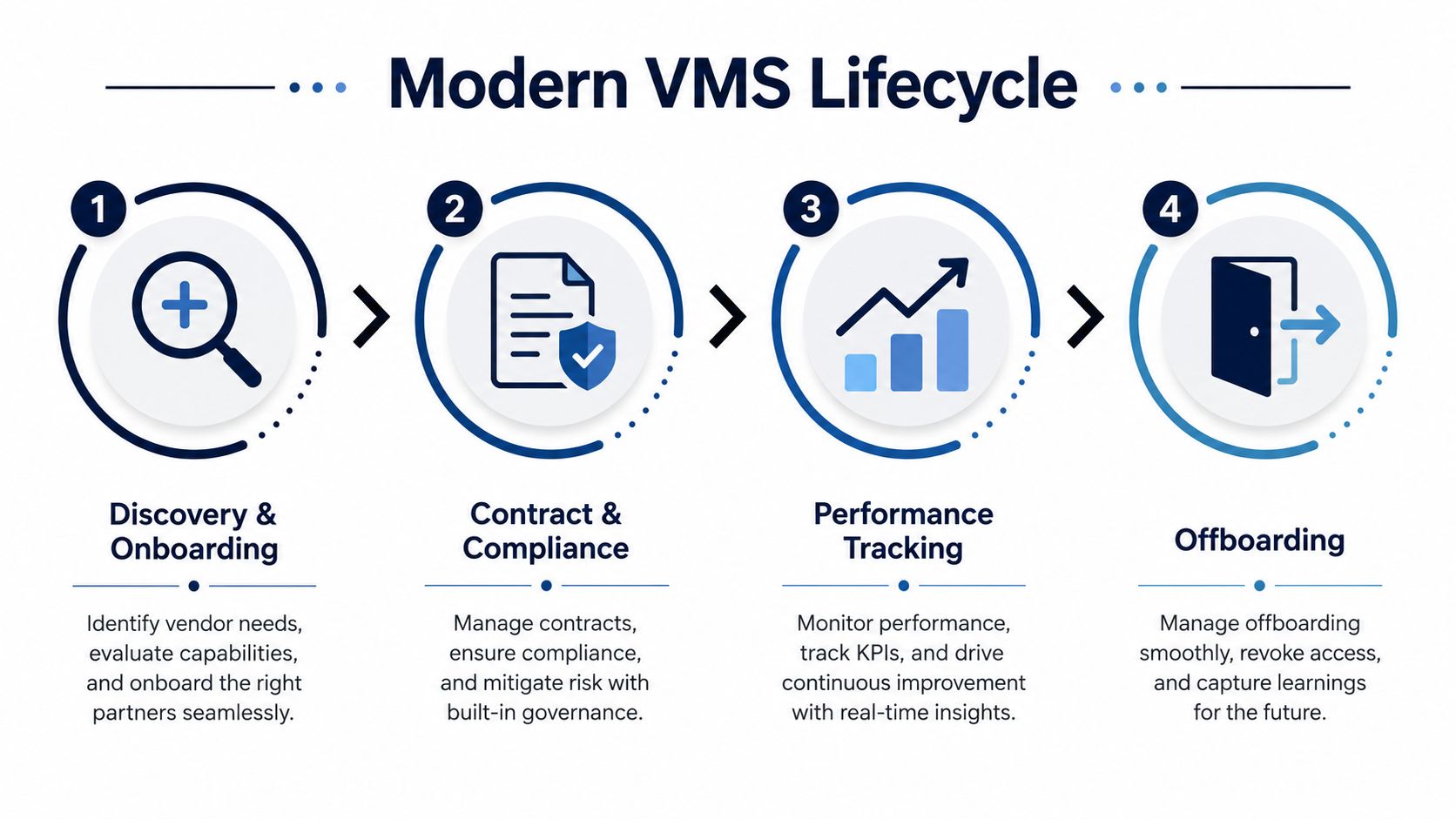
Start with a controlled intake form. The supplier should provide legal information, payment details, ownership contacts, insurance certificates, tax documentation, quality credentials, and relevant operating capabilities through a portal. Finance can review payment data while operations evaluates capacity and quality. The system should record who approved each step and prevent activation until required checks are complete.
That matters for ecommerce because supplier types vary widely. A packaging converter may need material specifications and testing documents. A 3PL may need service-level commitments, warehouse locations, insurance, and escalation contacts. An overseas manufacturer may require additional scrutiny around quality, intellectual property, data access, and single-source exposure.
Store the signed agreement, amendments, rate cards, service levels, product specifications, and quality agreements in one controlled record. Version control matters because the latest carton dimensions, labeling requirements, or approved unit cost must be obvious to the people placing orders.
Renewal alerts should align with commercial calendars. A contract renewal that arrives just before a peak buying period deserves earlier review than one tied to a non-critical service. For security-sensitive suppliers, ENISA's supply-chain cybersecurity guidance references ISO/IEC 27002:2022 supplier relationship controls and describes lifecycle stages covering planning, selection, agreement, management, and termination.
Scorecards should connect supplier performance to the work the brand cares about. For a 3PL, that may include order accuracy, dispatch timing, inventory adjustments, and response quality. For packaging, it may include defect rates, delivery reliability, and adherence to approved specifications.
Use supplier stratification rather than applying the same process to everyone. NIGP's supplier relationship management best practice emphasizes strategic supplier identification, clear expectations, internal roles, management involvement, and continuous performance management.
A strategic manufacturer might receive quarterly business reviews and formal remediation plans. A transactional office-supply vendor may only need basic approval and renewal tracking.
Offboarding is where many lightweight tools fail. The workflow should confirm outstanding orders, invoices, inventory, documents, system access, data return, and replacement coverage. For a technology or logistics partner, termination should connect to identity and access revocation. For a manufacturer, it may also require disposition of molds, tooling, confidential specifications, or remaining components.
A database stores information. A genuine VMS enforces the sequence of decisions so the team doesn't have to remember every control manually.
Start with the operating systems your team already depends on and the cost of keeping data synchronized between them. A feature checklist matters only after the platform can support the way your brand buys, stores, moves, and pays for products.
For an ecommerce brand, the VMS should fit the existing stack, including an ERP such as NetSuite, accounting software such as QuickBooks, an inventory platform, a 3PL dashboard, Shopify, and marketplace seller tools. A platform with every workflow feature can still become expensive if each critical connection requires custom development. A simpler system with reliable integrations may deliver better operating economics.
Use this matrix to compare ownership, implementation effort, and scaling risk.
| Criteria | Enterprise Procurement Suites | Mid-Market VMS Platforms | Ecommerce-Native Tools |
|---|---|---|---|
| Integration depth | Broad ecosystem and mature APIs, but configuration can require specialist help | Often practical for ERP, accounting, and approval workflows, with variation by provider | Usually strong in ecommerce workflows, but may have narrower enterprise connectivity |
| Implementation effort | Can be extensive because of governance, permissions, and process complexity | More focused and adaptable for lean operations | Often faster when the brand's use cases match the product's assumptions |
| Administration | Requires deliberate ownership and ongoing configuration | Typically manageable by operations or procurement leads | Usually familiar to ecommerce teams, but may need additional governance as the network grows |
| Pricing exposure | Can include implementation, modules, users, suppliers, and integration costs | Often easier to model, but contract details still matter | May be attractive initially, with potential limits around advanced controls |
| Best fit | Large, complex organizations with formal procurement programs | Mid-market brands seeking structured workflows without a large procurement department | Brands prioritizing speed, ecommerce context, and lighter administration |
First, what must connect on day one? Separate required integrations from desirable ones. Supplier approvals should reach finance, while fulfillment and quality data should feed vendor reviews. If those handoffs remain manual, the team will keep a parallel spreadsheet and reconcile conflicting records.
Second, who owns the data after launch? Identify the person responsible for adding suppliers, updating contacts, changing approval rules, reviewing exceptions, and resolving failed integrations. A platform that needs developer intervention for routine administration is not lightweight, regardless of how simple its interface appears.
Third, how does growth affect pricing? Compare per-user, per-vendor, transaction, module, and integration charges. A per-user model may suit a small team, while a per-vendor model can become expensive as the supplier network expands. Industry reporting found that more than 60% of MSPs surveyed spent US$200,000 to US$500,000 annually on integrations, while over half reported dissatisfaction connected to complexity, maintenance, and developer shortages, according to BBC Magazine's coverage of VMS integration costs.
Fourth, what does the fallback process look like? Integrations fail. Before signing, require clear answers about error handling, data reconciliation, support ownership, audit history, and export rights. Confirm who handles a failed inventory sync when a purchase order, warehouse receipt, or supplier invoice is already in motion.
A practical framework for choosing suppliers helps separate selection criteria from convenient feature requests. Review business automation principles as well, particularly the distinction between automating a stable process and automating confusion.
Cloud deployment can reduce upfront infrastructure requirements, but it does not remove integration work, data cleanup, permissions design, or internal ownership. One market analysis projects cloud deployment growth at a 12.9% CAGR through 2030. Treat AI recommendations as optional until supplier records are accurate, approvals are reliable, contracts are searchable, and performance data is usable. At the 7- and 8-figure level, those foundations usually matter more than another dashboard or predictive feature.
Implementation fails when the team treats the VMS as a software installation instead of a redesign of supplier operations. A phased rollout protects daily execution while exposing data and integration problems early.
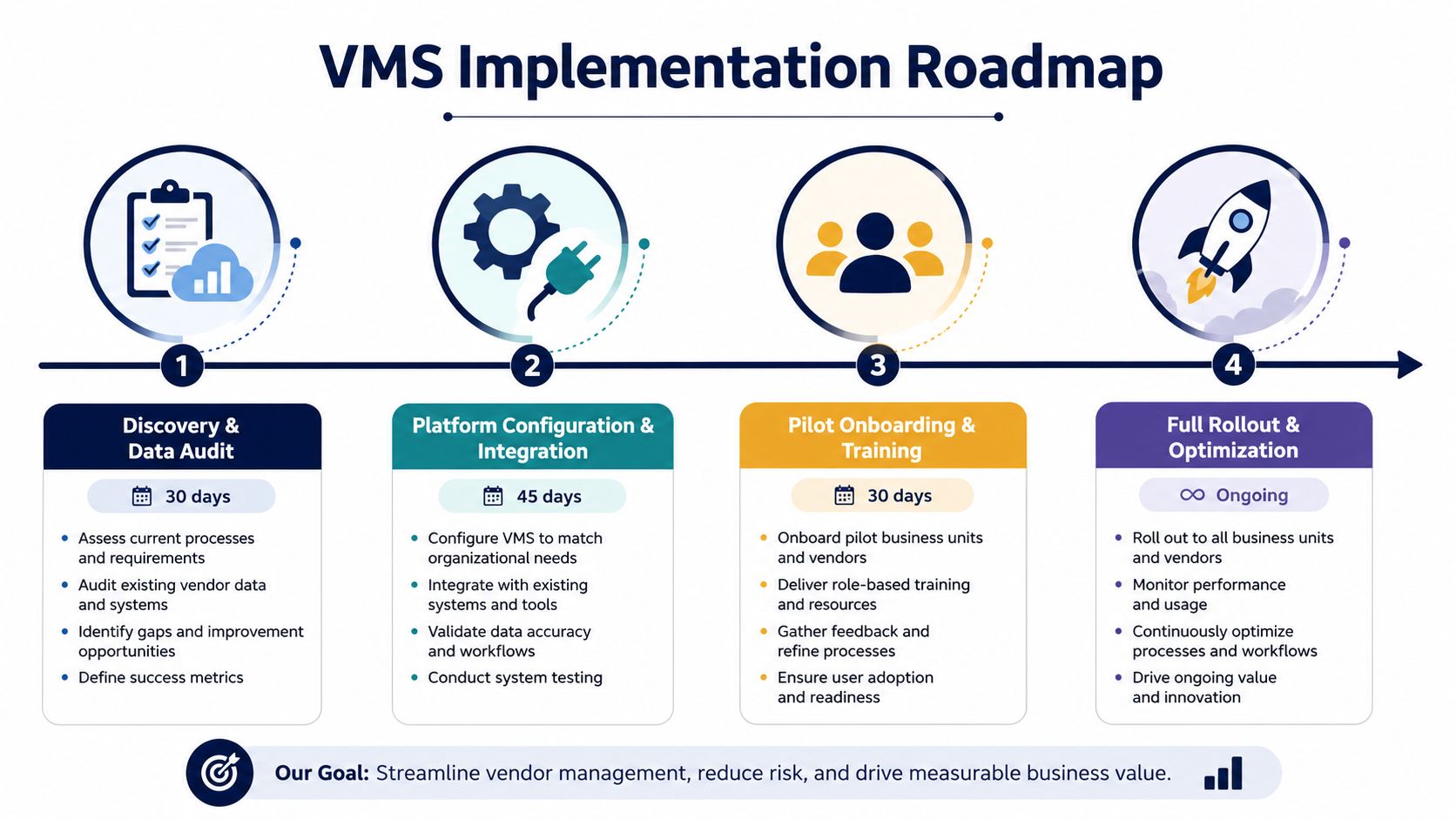
Use the first 30 days to establish the starting point. Consolidate supplier names, legal entities, payment records, contracts, contacts, categories, locations, and current status. Remove duplicates and identify vendors that exist in the ERP but not in the operations team's files.
Map the workflows, not the intended ones. Document how a new packaging vendor gets approved, how a 3PL dispute reaches finance, how a quality issue becomes a supplier escalation, and where people use personal spreadsheets to fill process gaps.
Decision gate: Don't configure the platform until the team agrees on the authoritative supplier record and the minimum data required for activation.
The next sprint should connect the VMS to the systems that control money and movement. Prioritize the ERP, inventory platform, accounting system, and relevant 3PL data. API limitations and old data formats often surface here, especially when supplier names, item codes, and purchase-order references don't match across systems.
Keep the first integration narrow. A clean supplier master and approval status are more valuable than an ambitious data exchange that nobody can reconcile.
Run a controlled pilot with suppliers representing different operating realities, such as a 3PL, packaging partner, overseas manufacturer, and lower-risk service provider. Train procurement, finance, warehouse, and buying teams using real scenarios rather than generic product tours.
Run the VMS alongside the legacy process during the pilot. That parallel period reveals missing fields, confusing approval steps, and supplier resistance before the system becomes the official record.
Move to broader onboarding only after the pilot meets agreed process requirements. Publish ownership rules, escalation paths, and reporting expectations. The principles in how to automate business processes apply here: automate repeatable work, assign exception owners, and review the process after real users test it.
Avoid full automation before the basic workflow is stable. A fast, automated version of a broken approval chain creates errors at greater speed.
More controls don't automatically create safer supplier operations. A brand that requires every low-risk vendor to complete the same extensive audit can slow the business without improving its exposure to meaningful risk.
The better approach is risk-tiered governance. NIGP's supplier relationship guidance supports stratification by supplier importance and the application of different management practices. For ecommerce, the useful inputs are revenue exposure, supply criticality, substitution difficulty, data access, regulatory sensitivity, and the consequences of failure.
A single-source manufacturer for a best-selling product belongs in the highest tier. That supplier may need documented contingency planning, deeper quality review, formal performance meetings, and escalation rules. A local stationery provider shouldn't receive the same burden.
A practical structure might look like this:
The workflow should also distinguish between a material change and routine activity. A change in ownership, bank details, manufacturing location, data access, insurance status, or product specification deserves an alert. A routine contact update shouldn't stop a purchase order.
Mid-market brands rarely have a large compliance department. If every exception requires legal review, the VMS becomes a queue instead of an operating system. Assign decision rights in advance. Finance can own payment and tax checks, operations can own delivery and capacity, quality can own specifications, and leadership can handle strategic escalations.
PwC's global compliance survey reported that 61% of respondents were already using automation or a third-party risk management solution to assess third-party risk, according to the coverage referenced by Gartner's third-party risk management technology review. The practical lesson isn't to automate everything. It's to automate evidence collection, reminders, scoring, and routing while keeping judgment with the person accountable for the relationship.
A fast approval is valuable only when the business knows what risk it accepted.
A VMS earns its place when it improves commercial outcomes, not when it produces attractive dashboards. Track the connection between supplier behavior and gross margin, inventory availability, working capital, and customer experience.
Start with a baseline before implementation. Pull recent delivery records, defect and return information, purchasing cycle times, expedited freight, invoice discrepancies, and manual labor associated with supplier administration. Without a baseline, the team can report activity but can't prove improvement.
| KPI | Target Benchmark | Business Impact |
|---|---|---|
| On-time delivery rate | Set a baseline by supplier and lane, then improve against the agreed SLA | Protects availability and reduces emergency replenishment |
| Defect and return rate | Establish a product- and supplier-specific baseline | Connects quality failures to refunds, rework, and customer dissatisfaction |
| Procurement cycle time | Measure request, approval, onboarding, and purchase-order stages separately | Shows whether workflow automation removes administrative delay |
| Invoice discrepancy rate | Compare billed charges with approved terms and receipts | Identifies accessorial leakage and reconciliation effort |
| Supplier concentration | Track exposure by SKU, category, and critical service | Highlights dependency and supports backup sourcing decisions |
| Contract compliance | Monitor purchases against approved rates, terms, and specifications | Protects negotiated value and reduces unauthorized changes |
For broader supply-chain measurement ideas, Logivo's KPI guide provides a useful reference point. Adapt its principles to the decisions your team makes.
Calculate VMS ROI with the costs the operation already feels:
ROI = (annual avoided cost and protected margin minus annual VMS cost) ÷ annual VMS cost
Include reduced manual procurement effort, fewer expedited shipments caused by preventable stockouts, lower quality-related returns, recovered invoice discrepancies, and savings from consolidated negotiations. Subtract subscription fees, implementation, integration maintenance, internal administration, and training.
Don't invent a target benchmark before the data exists. A credible scorecard shows the current baseline, the agreed service level, the owner, the reporting cadence, and the action triggered by failure. That turns performance management into an operating rhythm rather than a monthly report nobody opens.
A brand is ready for vendor management software when supplier complexity is creating decisions the current process can't reliably support. The test isn't whether the team has a certain number of vendors. It's whether people can answer basic questions quickly: which agreement is current, who approved the supplier, what happens when performance falls, and what exposure exists if a critical partner fails?
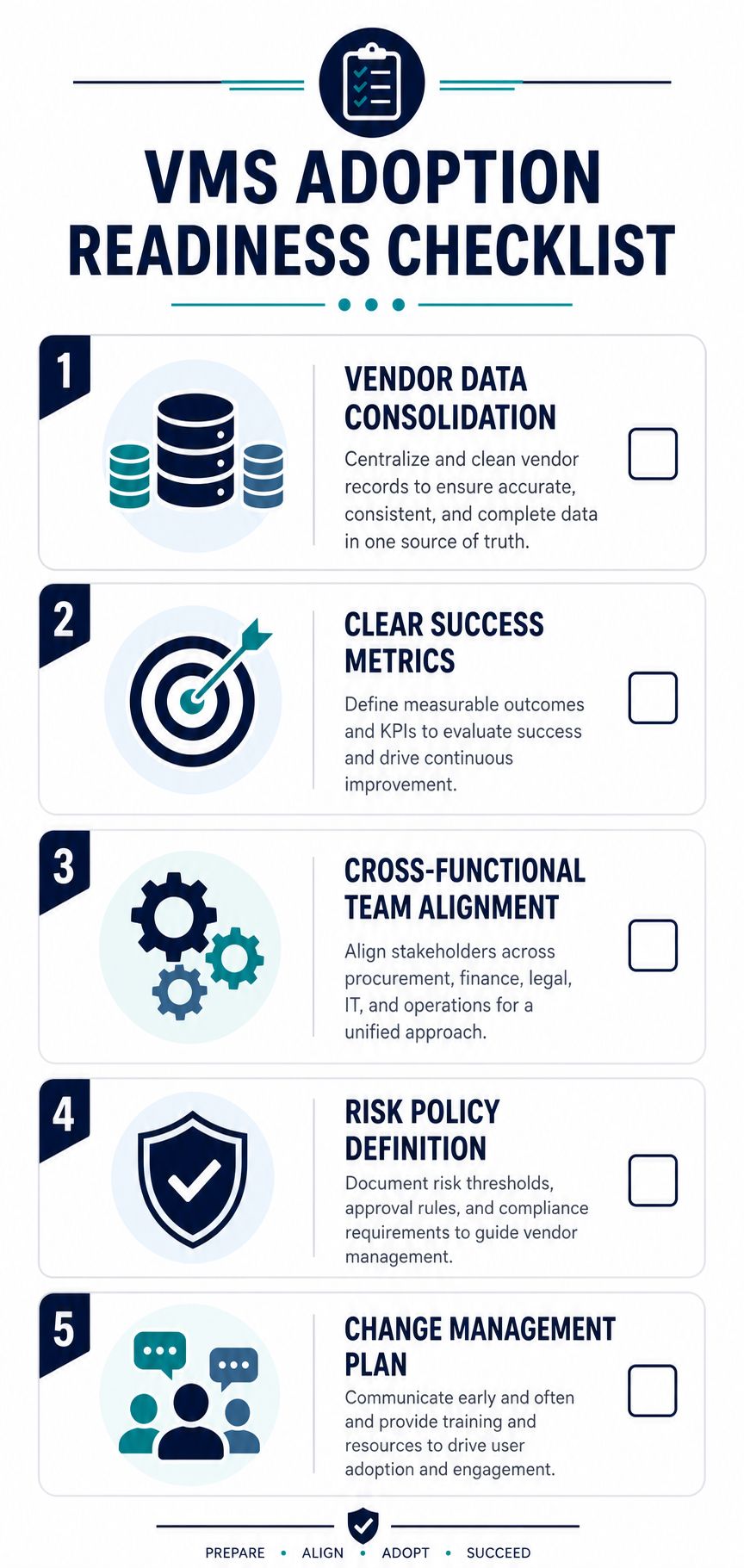
Use five gates before selecting a platform.
Create one list of active, inactive, duplicate, strategic, and pending suppliers. Match legal entities across the ERP, accounting system, purchase records, contracts, and warehouse files. Flag missing owners and expired documentation.
Choose the baseline KPIs before the demo becomes a buying exercise. Include delivery performance, defects, cycle time, invoice discrepancies, and critical supplier exposure. Decide who owns each metric and what action follows a miss.
Finance, procurement, warehouse, buying, quality, and leadership must agree on the workflow. If the warehouse team can't use the process during a receiving problem, the design is incomplete. If finance doesn't trust the supplier record, people will keep separate files.
Map the systems that must connect first. Usually, that means the ERP, accounting platform, inventory records, and 3PL data. Document the source of truth for supplier status, purchase orders, invoices, delivery events, and performance results.
Choose a manageable group of suppliers that exposes different workflows. Include a critical manufacturer, a logistics partner, a packaging vendor, and a lower-risk supplier. Use the pilot to test onboarding, approvals, document updates, scorecards, exceptions, and offboarding.
Industry adoption is already broad. One summary reports that more than 76% of enterprises have implemented digital supplier management strategies, about 69% of procurement departments use automated vendor performance monitoring, and roughly 63% prioritize centralized vendor databases, according to Global Growth Insights' vendor management software market summary. The implication for mid-market ecommerce teams is practical: delaying the decision doesn't preserve simplicity. It preserves fragmented records, manual exceptions, and missed opportunities.
Audit your current vendor workflow this week, identify the three bottlenecks costing the most time or margin, and schedule platform demos within the next 30 days. Compare each option on integration ownership, data quality, risk tiering, and total cost of ownership, not just the feature list.
Million Dollar Sellers gives serious ecommerce operators access to a trusted peer network, practical strategy sharing, and hard-won insight from founders scaling Amazon, DTC, and omnichannel brands. Visit Million Dollar Sellers to connect with operators who understand the supplier, integration, and execution challenges behind high-growth ecommerce.
Join the Ecom Entrepreneur Community for Vetted 7-9 Figure Ecommerce Founders
Learn MoreYou may also like:
Learn more about our special events!
Check Events