Chilat Doina
August 19, 2026
You've reached the point where every important decision feels expensive. A pricing change affects conversion and contribution margin. A purchase-order mistake ties up cash. A new advertising channel creates reporting noise before it creates demand. Your team can bring you data, agencies can offer recommendations, and AI can produce options, but none of those sources necessarily knows what it feels like to make the same decision at a similar scale.
That's where an ecommerce mastermind group can earn its place. The value isn't another library of tactics. It's access to experienced operators who can challenge assumptions, share relevant benchmarks, and hold you accountable when the correct move is uncomfortable. The catch is that a mastermind isn't automatically useful at every stage. The right question is whether your current decisions justify the cost, time, and confidentiality required.
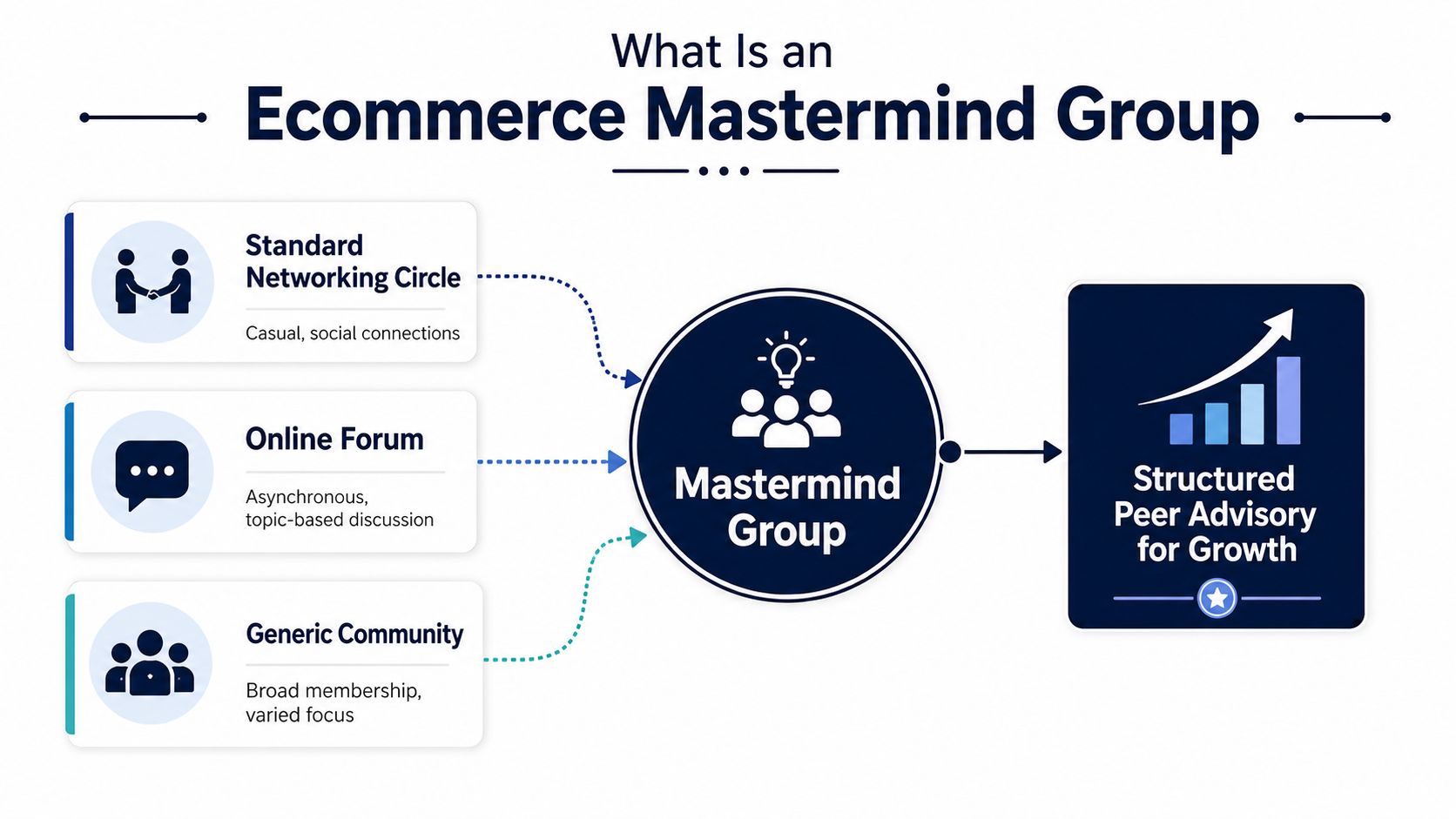
An ecommerce mastermind group is a private, structured peer network for business owners who meet regularly to solve operating and growth problems together. Members typically share more than polished wins. They bring real constraints, including channel performance, margin pressure, inventory exposure, hiring decisions, and failed experiments, then ask peers to pressure-test the next move.
That structure separates a mastermind from casual networking. In a networking circle, the objective is usually relationship-building. An online forum supports asynchronous, topic-based discussion. A broad community may include useful people, but members often operate at very different levels and have little reason to disclose sensitive information.
A credible group normally has four operating features:
The cohort also matters. A seller doing early product validation may need tactical guidance on listings, customer research, or fulfilment. An established brand may need a confidential review of channel concentration, working capital, or an executive hire. The closer the members are in operating complexity, the more specific their feedback can become.
Practical rule: If members only exchange links, motivational posts, and surface-level wins, you're in a community. If they dissect decisions and revisit commitments, you're in a mastermind.
The model works because it turns isolated experience into a repeatable decision process. You present the problem, peers ask questions that expose missing assumptions, the group compares relevant experiences, and you leave with a defined action. That's more demanding than networking, but it's also why the format can help when a founder's main bottleneck is judgment rather than information.
The strongest evidence for mastermind participation comes from structured peer networks, especially among founders who have already moved beyond generic business advice. Million Dollar Sellers was founded in 2016 and includes 700+ vetted founders generating $14B+ in combined annual revenue, with a $6.5M median member TTM revenue and 5+ years of average tenure. These figures appear in MDS's community benchmark, describing a network concentrated among established ecommerce operators.
According to the same 2025 benchmark report, the community is active every day and has grown about 3× faster than the market for four straight years. That figure does not prove membership caused each founder's growth. It does indicate sustained demand for curated peer input, particularly when a company is large enough for decisions about inventory, channel risk, hiring, or capital allocation to carry meaningful downside.
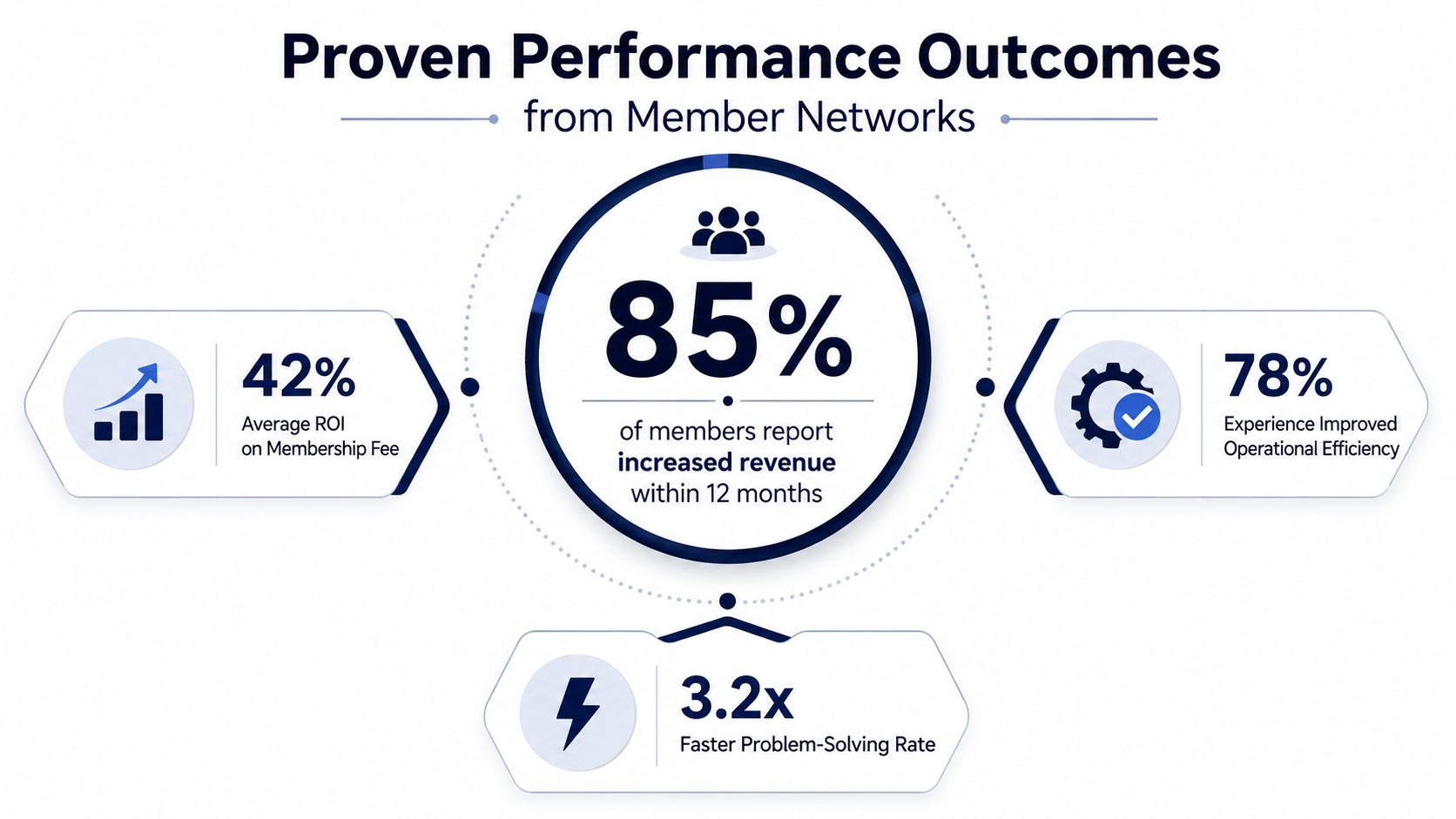
A longitudinal study summarized by Esteemed's analysis of CEO peer groups reported that member companies grew annual revenue by 4.6% in 2020, while comparable non-members declined by 4.7%. The finding supports a practical interpretation: facilitated peer review can help owners correct course during uncertainty, when an isolated decision may affect the entire company.
Research covering 61 peer coaching groups across 24 settings found that benefits developed through repeated critical incidents, shared reflection, and pattern recognition, rather than generic networking alone, as summarized in the Academy of Management conference research. For an ecommerce operator, that may mean identifying a recurring margin problem across several brands, comparing supply-chain responses that have already been tested, or rejecting an advertising change that improves dashboard results while weakening contribution profit.
A mastermind earns its cost when the decision is expensive, ambiguous, and difficult to evaluate from inside one company. Routine research, administrative work, and straightforward execution usually belong with internal staff, specialist advisers, or a virtual assistant. The group is better suited to decisions where judgment matters more than information.
That distinction matters at different revenue stages. An early seller may get sufficient value from targeted operators, software support, or an experienced consultant. A larger brand facing channel concentration, working-capital pressure, or an executive hire may need confidential peers who understand those trade-offs firsthand. A mastermind can improve judgment, but it cannot repair weak fundamentals or replace capable operators.
Ecommerce didn't invent the mastermind model. Long before marketplace sellers and direct-to-consumer brands became major operating categories, executives used confidential peer groups to compare decisions, discuss leadership problems, and maintain accountability.
The historical progression is visible in major executive networks. YPO was founded in 1950 and now spans 142 countries with tens of thousands of members. Vistage was founded in 1957 and is cited as a long-tenured peer advisory model with 45,000+ members. Entrepreneur-focused EO was founded in 1987 and now serves entrepreneurs across 60+ countries with about 18,000 members, according to Practical Ecommerce's discussion of the industry's history and trends.
These organizations established the core operating logic that ecommerce groups later adapted:
Ecommerce founders face general leadership problems, but they also operate inside unusually fast feedback loops. Marketplace policies, paid acquisition costs, inventory timing, conversion rates, fulfilment constraints, and customer expectations can change the economics of a decision quickly. A peer who understands those mechanics can ask better questions than a general business contact.
The specialization also improves language. “Our growth is slowing” is a broad leadership concern. “Our blended acquisition cost is rising while repeat purchase is flat and stock cover is tightening” gives a peer group something concrete to examine.
That evolution doesn't make older executive networks irrelevant. It shows why specialized rooms emerged. Ecommerce masterminds borrow the established architecture of executive peer advisory and apply it to founders managing marketplaces, DTC storefronts, and omnichannel operations.
The model has also moved from local relationships to global operator networks. A founder may now find peers with experience in the same product category, channel mix, and business complexity without relying only on geography. That access is useful, but only if the group protects relevance and doesn't confuse a large membership base with a well-matched advisory cohort.
Three formats dominate the market, and each solves a different problem. Choosing among them starts with an honest assessment of whether you need peer judgment, facilitation, education, or all three.
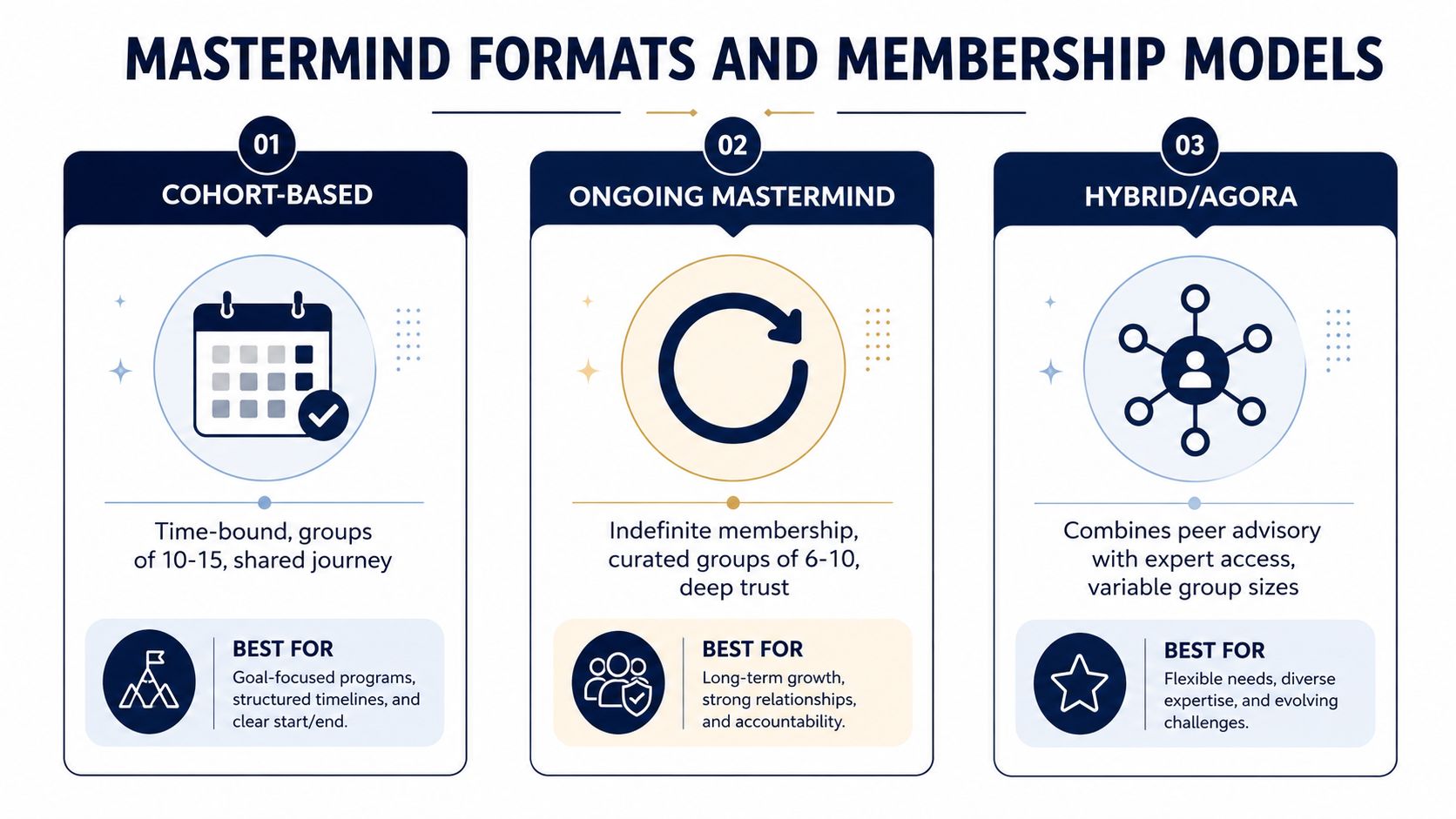
| Format | How it works | Best fit |
|---|---|---|
| Peer-only group | Members lead the discussion and exchange experience without a standing professional coach. | Operators who can frame problems clearly and contribute useful experience in return. |
| Coached mastermind | A facilitator sets the agenda, manages turn-taking, challenges assumptions, and tracks commitments. | Founders who need structure, accountability, or help turning discussion into action. |
| Hybrid model | Peer advisory sits alongside workshops, coaching, expert sessions, and a resource library. | Members who want confidential peer input plus access to targeted education. |
Peer-only groups can produce direct, unfiltered conversations. They may also drift if members avoid difficult questions or let attendance become inconsistent. This format works best when the participants already have strong operating discipline.
A coached group costs more in time or money, but facilitation can prevent the loudest participant from dominating the meeting. The facilitator should guide the group without turning every session into a lecture. If the coach gives generic answers instead of drawing out member experience, you may be paying for coaching when what you wanted was peer comparison.
Hybrid groups offer breadth, but breadth can dilute focus. A resource library doesn't matter if you need a decision on a supplier, pricing architecture, or a senior hire this week. Before joining, ask how much access is live, how much is recorded, and which benefits depend on your own participation.
The membership experience also resembles broader membership products, where access, content, and interaction are packaged together. This guide to membership sites can help clarify the difference between an ongoing member environment and a course-based purchase.
The right format is the one that matches your bottleneck, not the one with the longest list of benefits.
A serious ecommerce mastermind group should make it difficult for the wrong member to enter. That doesn't mean every credible group needs the same revenue threshold. It means the organization should be able to explain whom it serves, why members are comparable, and how it protects the quality of discussion.
Start with the application process. A meaningful application may ask about business model, channels, operating stage, and the problems you want to solve. Referral-based entry can also work, but a referral alone shouldn't replace clear standards.
Public pricing varies widely. Independent roundups place many mastermind offers around $300 to $3,000 per month, while elite rooms can reach $7,500+ per year or far higher, as discussed in ecommerce mentorship and coaching pricing coverage. Price alone doesn't establish quality. Member relevance, meeting cadence, confidentiality, and facilitation matter more than a premium label.
Calculate the fee against a decision you're likely to make, not an abstract promise of growth. If the group helps prevent a costly inventory commitment, improve pricing discipline, or shorten a stalled hiring decision, the value may be substantial. If you're joining because you feel lonely as a founder but can't commit to preparation and follow-through, the membership may become an expensive social outlet.
For additional context on how an established ecommerce peer network describes the model, review MDS's business mastermind guide. Treat any organization's own description as a starting point, then verify it through member conversations and a clear explanation of operating rules.
A mastermind produces growth through better decisions and faster execution, not through inspiration. The operating loop is simple, but the quality of each stage determines whether the group becomes useful.
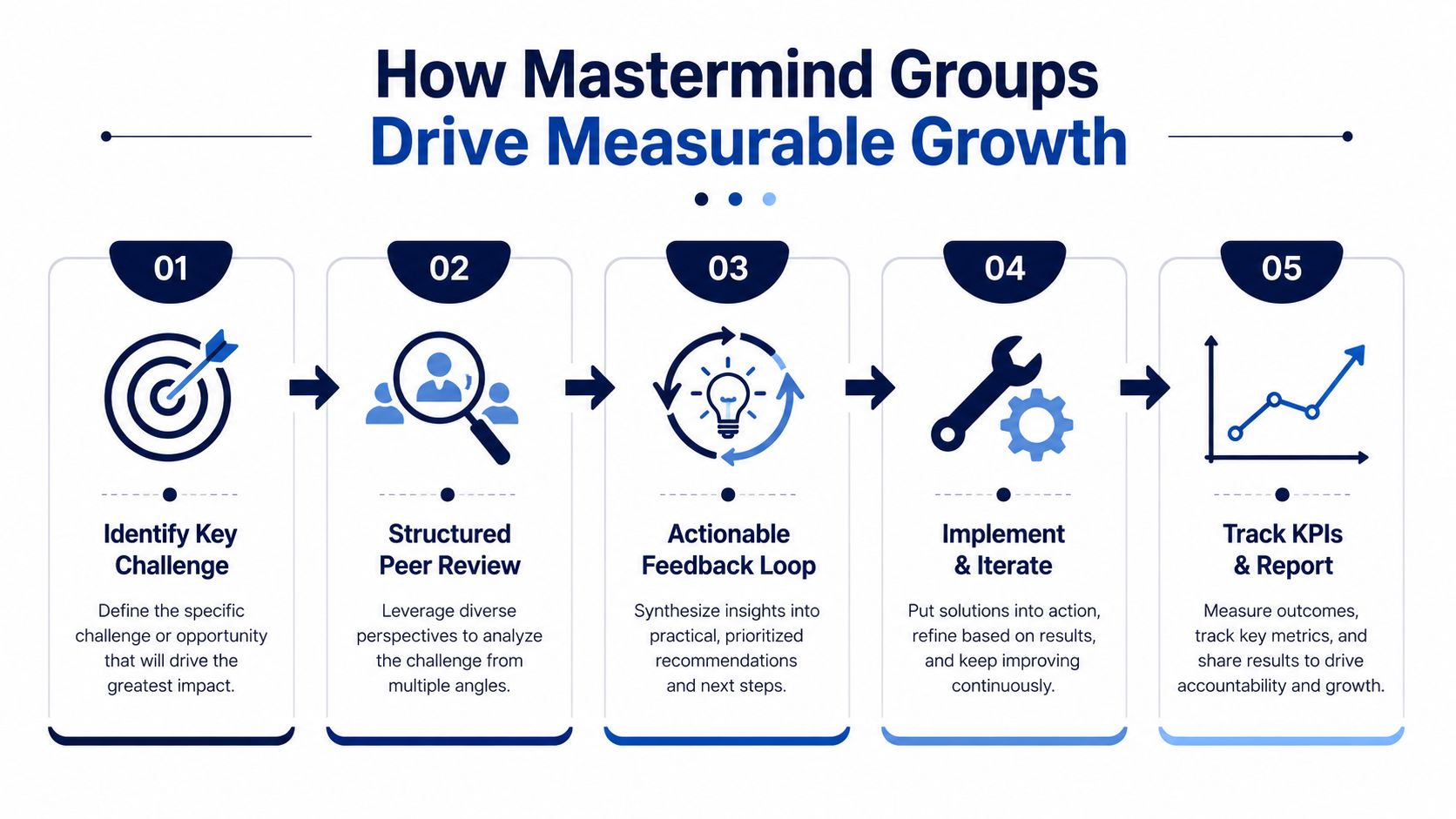
First, bring a defined problem. “We need more growth” invites generic advice. “Our paid channel is producing sales but weakening contribution after fulfilment and returns” gives peers a decision to examine.
Next, provide enough operating context. Relevant inputs might include customer acquisition cost, conversion rate, contribution margin, stock position, pricing history, or the assumptions behind a proposed hire. You don't need to disclose every internal document, but you do need to expose the constraint that makes the decision difficult.
Then let peers challenge the framing. A member who has faced similar margin compression may ask whether the issue is traffic quality, discounting, product mix, or fulfilment cost. Another may point out that the proposed solution solves the visible symptom while increasing inventory risk.
The highest-value discussions usually involve decisions that cross functions:
The group's advantage comes from reciprocal transparency. Members have an incentive to be candid because they expect useful candor in return. That makes the conversation different from a sales call, where the adviser may benefit from recommending a particular tool or service.
A strong session ends with an owner, a next action, and a measure to review. The following meeting should examine what changed, what failed, and whether the original diagnosis was correct.
The broader peer networks and communities are mapped in this overview of ecommerce communities, which is useful when you're comparing a structured mastermind with broader operator groups.
A short visual explanation of the operating loop is available below.
A founder can reach a point where general ecommerce advice stops being useful. The difficult question may involve marketplace policy, advertising efficiency, inventory exposure, and channel strategy at the same time. Million Dollar Sellers shows how an ecommerce-specific mastermind can address that level of operating complexity.
The organization began as the 50k Plus Group and later rebranded as Million Dollar Sellers. Its invite-only community brings together ecommerce entrepreneurs operating Amazon, DTC, and omnichannel brands. The publisher currently describes members as collectively generating over $8 billion in annual revenue across those channels, with access to peer discussions, strategy sharing, curated events, mastermind calls, private forums, and vetted service recommendations.
The community is aimed at experienced operators, including 7-, 8-, and 9-figure founders, rather than people looking for introductory ecommerce education. As noted earlier, an independently reported benchmark describes a different reporting context, including 700+ vetted founders, $14B+ in combined annual revenue, a $6.5M median member TTM revenue, and 5+ years of average tenure. These figures should not be treated as one current total. They reflect different descriptions or measurement periods, so applicants should confirm which population and date each figure covers.
The practical lesson is narrower than “every established seller needs MDS.” A peer network earns its cost when the members face comparable commercial constraints and the decisions carry enough downside to justify expert input.
An Amazon seller may benefit from peers who have dealt with marketplace policy, advertising efficiency, and inventory timing. A multichannel founder may need informed discussion about channel conflict, reporting, and working-capital allocation. A DTC operator may get more relevant feedback on retention economics, creative testing, and fulfilment experience than from a broad founder community.
The model also clarifies the limits of cheaper alternatives. AI can summarize options and produce an action plan. Public communities can supply tactics and examples. Neither automatically provides confidential comparisons with operators carrying similar exposure, and neither requires the founder to report back on implementation.
Fit still determines the value. A large network provides more possible connections, but the experience depends on whether the available peers match the business model, stage, and decision in front of you. For an earlier-stage seller, focused coaching, specialist communities, documentation, or AI-assisted analysis may cover the need at lower cost. For an established operator facing a high-consequence decision, comparable peer judgment can justify the membership.
You are preparing to cut a major advertising channel while inventory is already committed. Your finance lead has one view, your agency has another, and the decision affects pricing, hiring, and cash flow. That is the point at which a high-stakes judgment problem may justify a mastermind. A peer room with relevant operating experience can expose risks that a specialist focused on one function may miss.
Confidential benchmarking is another clear signal. You may need to compare reporting practices, supplier-risk decisions, or responses to margin compression with operators facing similar exposure. Open forums rarely support that level of commercial detail. A vetted group gives members better conditions for direct discussion.
Accountability has practical value too. Founders can understand the required change and still delay it when the decision affects a team member, sales channel, or long-standing product assumption. Regular peer review creates a specific point when you must explain what you changed, what happened, and what you will do next.
Earlier-stage sellers often have better options. Focused coaching, specialist communities, documentation, or AI-assisted analysis may cover tactical questions at lower cost, especially while the business model is still changing. These formats also fit founders who have limited experience to contribute in return.
Established operators should assess whether a group matches their commercial complexity, not just whether its members have impressive revenue. Before applying, list three decisions you expect to face, the cost of getting them wrong, and the evidence you would need from peers. Use this guide to finding a mastermind group to structure the search and compare candidate communities.
Ask yourself: Will I prepare fully, contribute consistently, and implement what the group recommends? If the answer is no, defer membership. A mastermind can reinforce disciplined execution, but it cannot supply that discipline.
If you are evaluating an established-seller network, Million Dollar Sellers describes an invite-only ecommerce community with mastermind calls, private discussions, curated events, and shared operating insight. Review the membership model at Million Dollar Sellers, then compare its peer access with the decisions, stage, and exposure your business faces.
Join the Ecom Entrepreneur Community for Vetted 7-9 Figure Ecommerce Founders
Learn MoreYou may also like:
Learn more about our special events!
Check Events


