
Chilat Doina
June 19, 2026
Most advice about the best ecommerce communities is wrong. It treats community like a contact list problem. Get into the right room, meet the right founders, trade a few tactics, and growth follows.
That's incomplete.
The main advantage inside serious operator groups isn't access alone. It's the quality of operational intelligence being shared. Strong communities don't just give you people to know. They give you better ways to read your business, faster ways to spot risk, and sharper benchmarks for deciding what to fix next.
If you're looking for the best ecommerce communities, you're probably not looking for another public forum full of recycled advice. You want signal. You want operators who've already solved the inventory issue, margin squeeze, ad volatility, catalog mess, or channel conflict you're dealing with now.
That's why selective groups matter. One industry profile notes that Million Dollar Sellers gathers over 700 entrepreneurs with revenues from $1 million to over $500 million, representing over $7 billion in sales through a revenue-gated peer network where operators can discuss benchmarks with far more specificity than open communities allow, according to this industry profile of ecommerce communities.
What makes rooms like that useful isn't prestige. It's shared context.
When everyone in the room runs at a meaningful scale, the conversation changes. People stop talking about hacks and start talking about contribution margin, inventory turns, blended acquisition cost, cash conversion timing, and how channel decisions affect the P&L two quarters later.
Practical rule: The best ecommerce communities are not built around motivation. They're built around comparable operating realities.
That's also why founders who benefit most from communities usually approach them like a system, not a social club. They ask better questions, bring cleaner numbers, and know what they're trying to learn before they join. If you're evaluating whether a mastermind is even the right fit, this guide on how to find a mastermind group is a useful starting point.
The deeper truth is simple. Elite communities are valuable because they normalize Business Intelligence, not as a software category, but as a management discipline. The founders scaling into 8 figures usually aren't guessing less because they're smarter. They're guessing less because they've built a better operating lens.
Brands usually hit a ceiling for the same reason. Their data lives in pieces.
Shopify shows one story. Amazon Seller Central shows another. Google Analytics reports a third version of reality. Ad platforms claim credit for revenue that finance can't reconcile. Email reports look healthy while gross margin gets worse. The founder ends up making expensive decisions from partial truth.
That approach works for a while. It doesn't hold at scale.
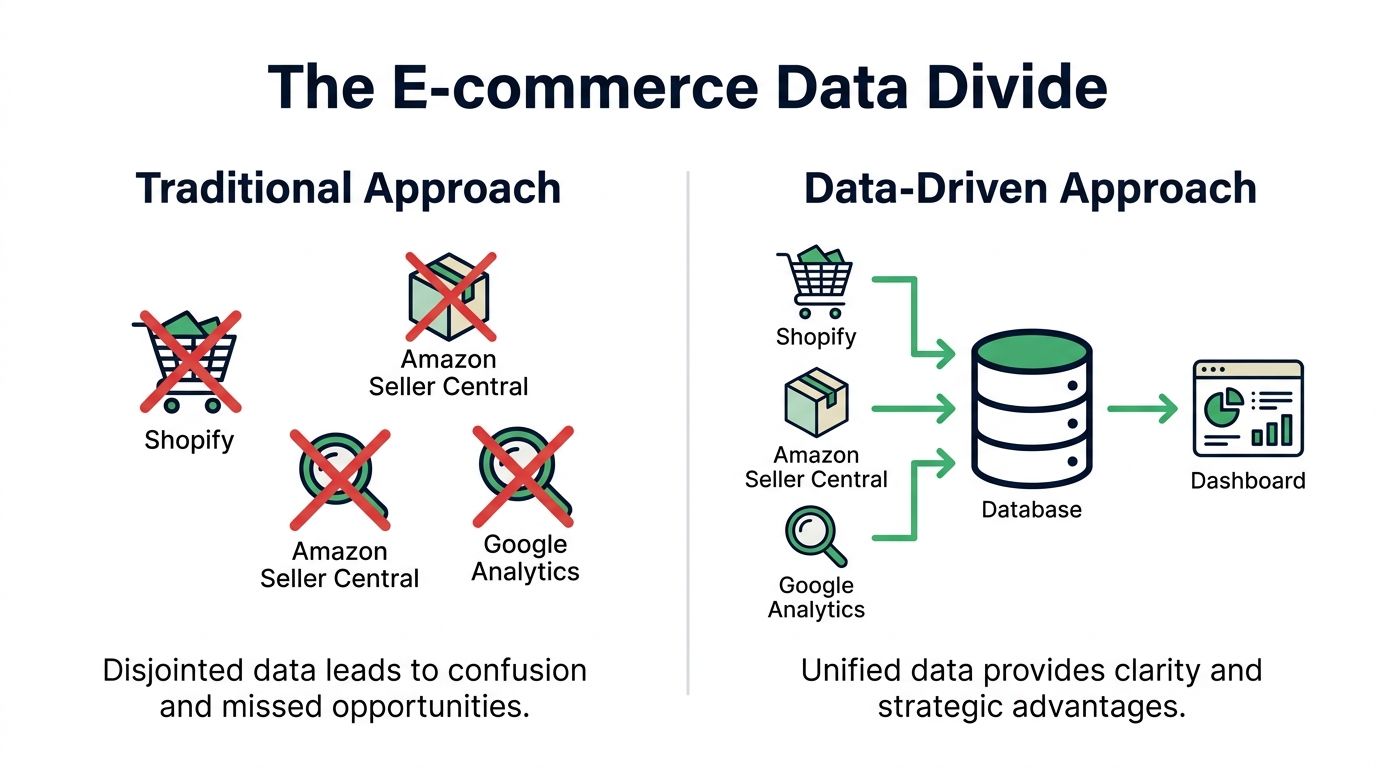
The pressure is only getting higher. Global retail ecommerce reached $6.42 trillion in 2025 and is projected to rise to $6.88 trillion in 2026, which is why operational efficiency and data-driven decision making matter more than ever in online retail, based on Statista's ecommerce market overview.
For an ecommerce operator, BI isn't a dashboard you show investors once a month. It's the mechanism that answers questions like these every day:
Without that layer, a founder is flying by feel. With it, the business gets instruments.
A useful frame for teams early in this transition is understanding analytics impact. Not because everyone needs a complex stack on day one, but because maturity starts when the team stops asking, “What happened in each platform?” and starts asking, “What's true across the business?”
Communities develop strategic importance. High-level operators don't just share tactics. They share definitions, metric logic, report structures, and decision rules. That's why peer advice lands differently in stronger rooms. Everyone is discussing the same underlying mechanics.
If you want a cleaner operating framework for that shift, the discipline starts with data-driven decision-making. The key move is building one trusted view of performance, then forcing major decisions through it.
Running an ecommerce brand without unified data feels manageable until channel complexity turns every meeting into a debate about whose numbers are right.
Founders who break through the next tier rarely do it by consuming more content. They do it by reducing ambiguity inside the business.
Most founders hear “data architecture” and assume it's an enterprise project. It isn't. It's just the structure that prevents your team from asking the same unanswered questions every week.
A modern ecommerce stack has three layers. If one is missing, the system weakens.
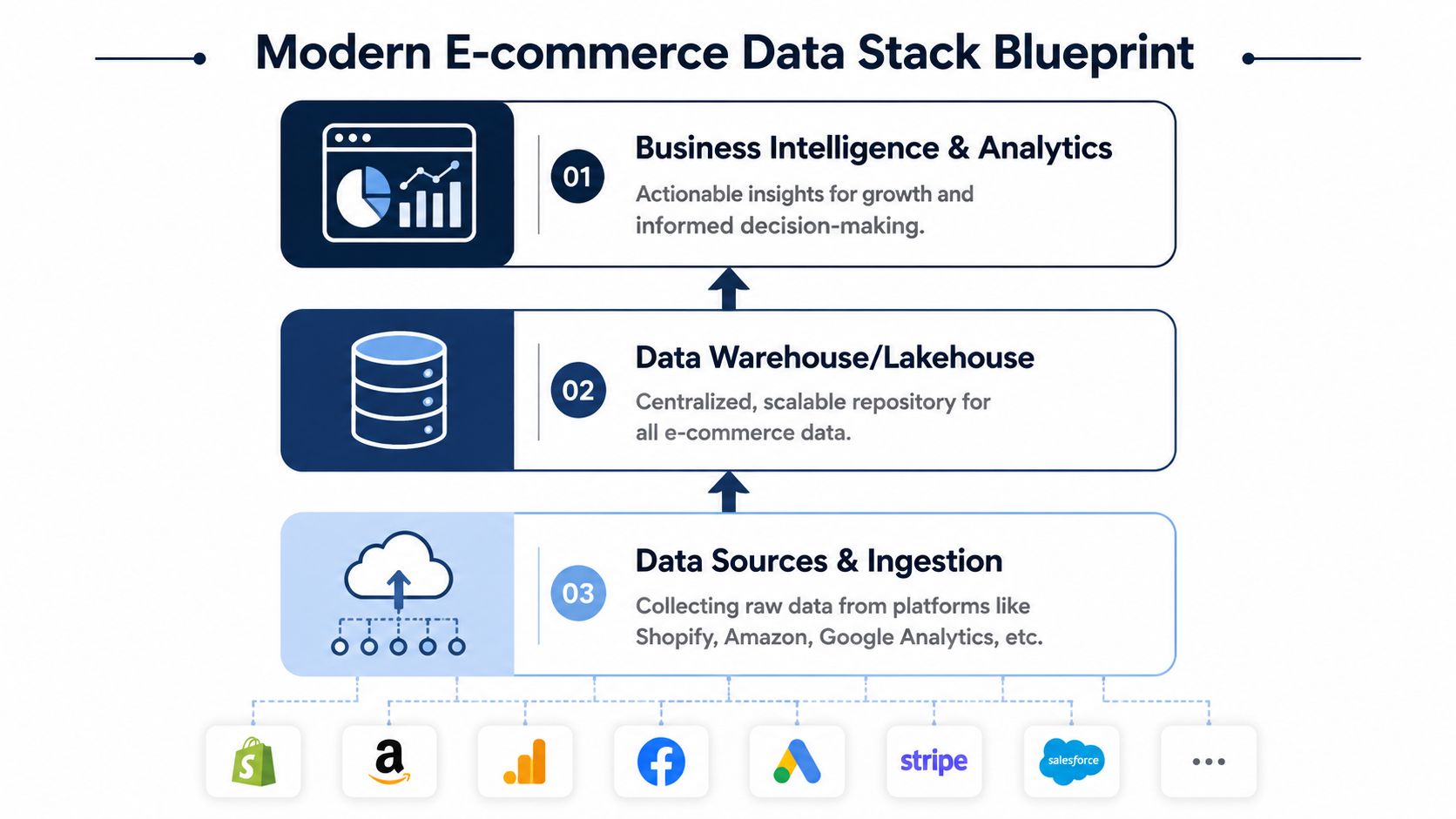
This is how raw data gets collected from the platforms that run the business. Think Shopify, Amazon, Klaviyo, Google Analytics, Meta Ads, payment processors, return tools, inventory systems, and help desk platforms.
If ingestion is weak, your team starts exporting CSVs, cleaning files by hand, and reconciling logic in spreadsheets. That's where version control breaks and trust disappears.
What matters here is reliability, not novelty.
This is the central brain. Tools like Snowflake or BigQuery sit here because they're built to store and organize large volumes of data across systems.
The warehouse matters because platform dashboards answer platform questions. Operators need business questions answered.
A warehouse lets your team define one set of logic for things like new customer revenue, refunded orders, blended CAC, SKU margin, repeat purchase behavior, and channel contribution. Without it, every team invents its own definitions.
Operator note: If finance, growth, and operations each use different logic for revenue, none of the dashboards matter.
Here's the simplest way to think about the stack:
| Layer | Job | Common failure when missing |
|---|---|---|
| Ingestion | Pull data from source systems | Manual exports and stale reporting |
| Warehouse | Standardize and store truth | Conflicting definitions across teams |
| Visualization | Turn data into decisions | Reports exist, but nobody uses them |
This is the layer founders usually see first. Looker, Tableau, Power BI, and other dashboard tools make the warehouse usable.
But dashboards only work when they're tied to decisions. A pretty chart that doesn't trigger action is decoration.
Strong visualization does three things well:
A lot of brands buy reporting tools before they define the management questions. That's backward. Start with recurring decisions. Then design the stack to support them.
The right BI setup isn't the one with the most charts. It's the one that helps you make hard decisions without waiting for a custom analysis every time.
The capabilities that matter are the ones tied directly to money, inventory, and demand quality.

Cohorts tell you whether customer acquisition is producing durable value or just buying temporary revenue. Looking at customers by first purchase period, channel, product entry point, or promotion path helps you see which groups come back and which groups disappear.
Many teams realize their top-line growth hid a retention problem. New customer volume looked strong, but repeat behavior weakened.
At scale, catalog decisions create more profit than many marketing wins. BI should make it easy to see:
That's one reason conversion work has to connect to downstream economics. If your team is focused on merchandising and storefront performance, this guide on how to improve Shopify conversion rates is useful because it pushes beyond surface tweaks and into decision areas that affect actual buying behavior.
A founder shouldn't need five meetings to understand whether the month is on track. A good pacing dashboard answers that fast.
It should show revenue trajectory, spend trajectory, margin pressure, and inventory risk in one place. More important, it should flag variance early enough to act. Late reporting creates fake control.
The simplest litmus test is this: can your team explain why today's result differs from plan without opening six tools?
For teams building those management views, a solid performance metrics dashboard framework helps because it forces prioritization around operator metrics instead of vanity reporting.
Here's a practical walkthrough on using data to sharpen ecommerce decisions:
Good BI shortens the distance between seeing a problem and assigning the next action.
Most dashboards fail because they overweight revenue and underweight economics. At scale, we need channel metrics, but we also need a blended view that tells us whether the whole machine is becoming healthier or just busier.
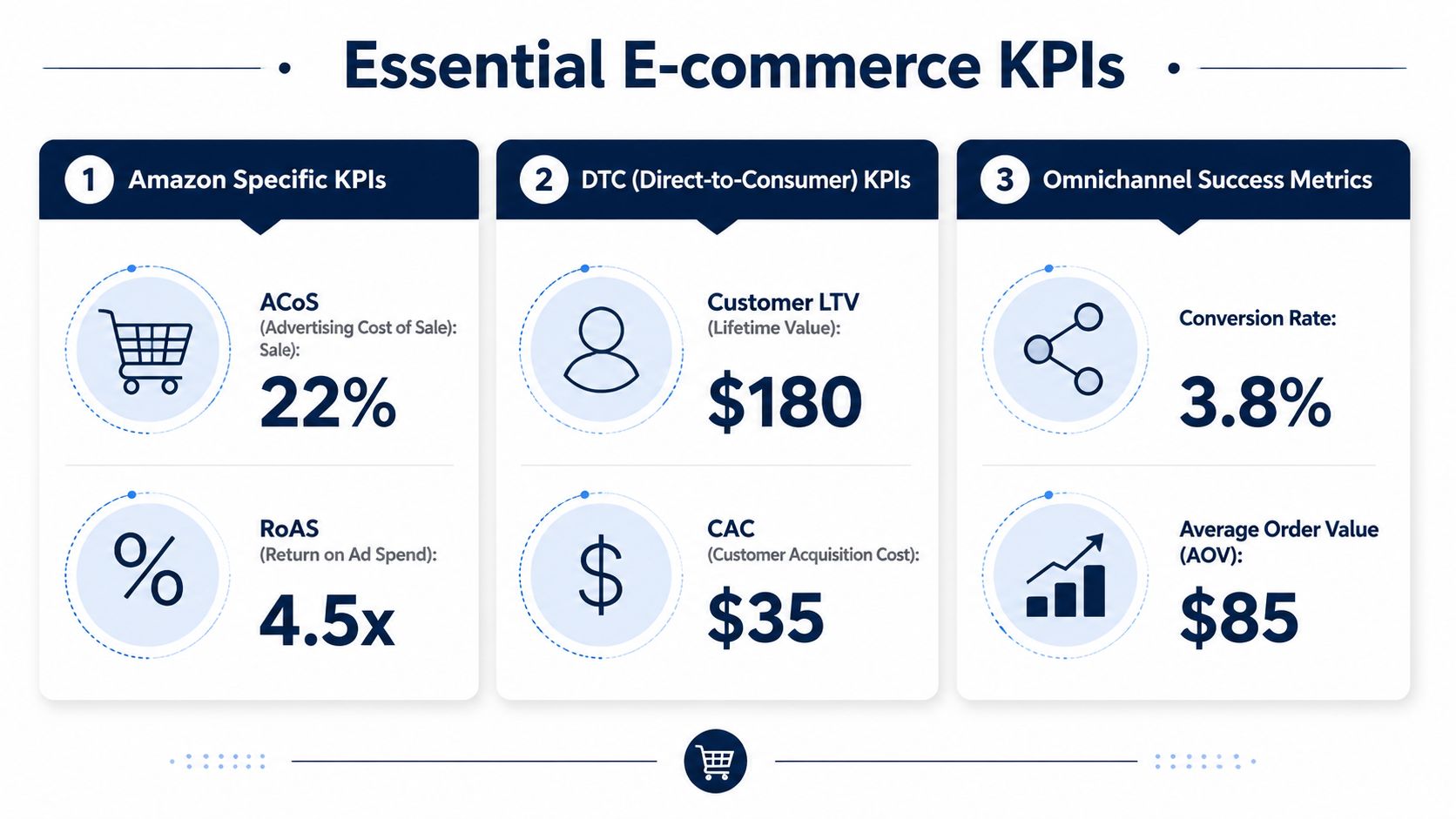
Amazon operators often get trapped in ad metrics that look clean inside the console but don't explain the business. You still need to watch ad efficiency, but the better questions are broader.
Focus on relationships such as:
Amazon also keeps adding surfaces that affect economics. For brands exploring creator-led demand and marketplace media, understanding onsite commissions can help clarify how traffic and conversion incentives interact inside the Amazon ecosystem.
DTC performance needs a tighter link between acquisition and retention. Most brands watch CAC. Fewer watch whether CAC bought the right type of customer.
The strongest DTC dashboards usually include:
| KPI | Why it matters | Common mistake |
|---|---|---|
| CAC | Shows customer acquisition cost by source | Looking at platform-reported CAC without refund or cohort context |
| LTV by cohort | Reveals whether acquired customers stay valuable | Using a blended number that hides weak acquisition periods |
| Repeat purchase behavior | Shows retention quality | Tracking repeat rate without segmenting by first product or offer |
| Discount dependency | Exposes fragile growth | Treating promo revenue as equal to full-price demand |
A high-converting first order isn't enough. We need to know whether that order came from a customer segment worth reacquiring.
This is the KPI layer that separates channel managers from operators.
A blended view should answer questions like these:
What is contribution margin per order across the business?
Not just gross revenue. Not just channel-level ROAS. Actual order economics after the major variable costs that shape profitability.
What is blended CAC?
If Amazon, DTC, creator programs, and retail all influence demand, acquisition cost has to be considered in aggregate, not just by last-click platform.
What is NMV or net merchandise value after revenue leakage?
Gross sales can hide discounts, refunds, returns, and marketplace deductions. Net views force clarity.
Where is cash getting trapped?
Revenue growth with weak inventory discipline or poor reorder timing can still strain the business.
The most useful KPI is the one that changes a decision this week. If it doesn't affect budget, inventory, pricing, or staffing, it probably belongs lower on the dashboard.
The best ecommerce communities tend to push founders toward these blended views because that's how serious operators compare businesses across channels without getting distracted by platform-specific storytelling.
Founders usually do not buy the wrong BI stack because they lack options. They buy the wrong one because they shop for reporting before they define the operating system the business needs.
A polished demo can hide a weak model. Fast integrations can hide broken metric logic. Six months later, the team stops using the dashboard because finance, growth, and ops no longer trust the same numbers.
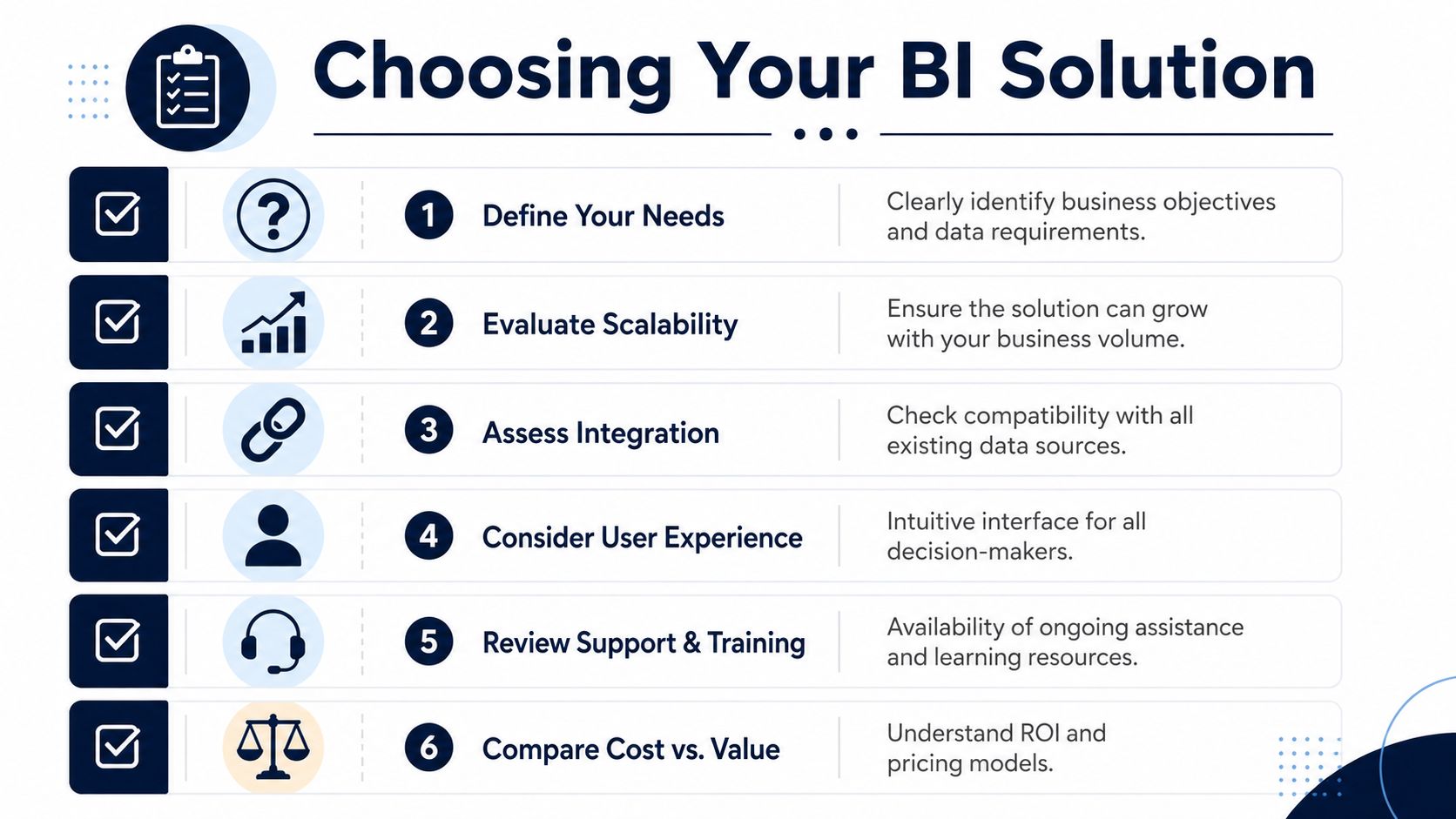
The right selection process starts with the decisions you need to improve every week. If the platform cannot make those decisions faster and cleaner, it is overhead.
Write the scorecard before you talk to vendors.
Start with four inputs:
Then score every option against the same criteria:
| Criteria | What to ask |
|---|---|
| Integration fit | Does it connect to our current systems without brittle workarounds or manual patch jobs? |
| Definition control | Can we define margin, CAC, refund treatment, and attribution logic our way? |
| Scalability | Will it still hold up as channels, order volume, and team usage increase? |
| Adoption | Can operators use it in weekly reviews without needing an analyst in the room? |
| Support model | Who fixes breaks, updates logic, and handles source changes after launch? |
| Total cost | What are the real software, setup, maintenance, and internal time costs over the next year? |
Good operators know the trade-off here. Flexibility usually brings more setup time and more need for internal ownership. Simplicity gets faster adoption, but often at the cost of weaker customization.
Sales calls should focus on failure points, not feature tours.
Ask them to show how the system handles returns, refunds, cancellations, and marketplace fees. Ask how Amazon and Shopify orders reconcile when naming conventions, SKU mappings, and settlement timing do not line up cleanly. Ask how long it takes to change a metric definition after finance challenges the logic. Ask what breaks most often after implementation, and who is responsible when it does.
Those answers matter more than another dashboard tab.
Community feedback can still help here, but the useful signal is operational, not social. In founder groups such as Million Dollar Sellers, the best vendor discussions usually sound less like recommendations and more like postmortems. Who still trusts the numbers after quarter-end close. Who needed custom work to get contribution margin right. Which partner responds fast when a source schema changes.
Buying rule: If a vendor cannot explain how their reporting handles the messy parts of ecommerce data, they built for the demo, not the decision.
The best ecommerce communities don't make founders smarter by proximity. They make them more disciplined. They push better questions, cleaner operating reviews, and tighter decision loops.
That's the ultimate standard to aim for.
If your business still runs on fragmented platform reporting, don't wait for the perfect stack before changing behavior. Start with the decisions that create the most impact. Usually that means customer acquisition quality, SKU profitability, inventory exposure, and blended contribution.
A practical next move for the next month is simple:
That sequence matters because software won't fix unclear thinking. It only scales it.
You don't need to become a data engineer to operate like a stronger founder. You do need a culture where numbers are trusted, definitions are consistent, and every major discussion ties back to business reality rather than platform narratives.
That's what elite operator communities really model. Not access for its own sake. A shared standard for how serious sellers run the company.
If you want a peer environment built around that standard, Million Dollar Sellers is an invite-only community for established ecommerce founders across Amazon, DTC, retail, and omnichannel. It's designed for operators who want candid strategy sharing, vetted peer discussion, and sharper decision-making at scale.
Join the Ecom Entrepreneur Community for Vetted 7-9 Figure Ecommerce Founders
Learn MoreYou may also like:
Learn more about our special events!
Check Events