Chilat Doina
December 27, 2025
If you've hit a plateau in your home market, I've got good news: you're not out of runway. You've just outgrown your local playground. Taking your brand international isn't just a "nice to have" anymore—it's the core growth strategy for any ambitious ecommerce brand looking to scale. This is how you go from being a local favorite to a global force.

The data tells a pretty compelling story here. Sticking to your home turf means you're walking away from a massive pile of cash. The global consumer base is gigantic, always online, and getting more comfortable with cross-border shopping every single day. For seven- and eight-figure sellers, this isn't some trend to keep an eye on; it's the main lever you have left to pull for serious growth.
The numbers are just wild. By 2025, global ecommerce sales are expected to land somewhere between $6.42 trillion and $7.4 trillion. That’s a huge slice of the entire retail pie. Cross-border ecommerce alone is on track to hit $2.4 trillion in 2025, which proves that customers are actively looking for products outside their own countries. You can dig deeper into the numbers in this breakdown of global ecommerce statistics.
To put this in perspective, here's a quick look at what some of the major international markets bring to the table.
The global ecommerce landscape is made up of diverse, high-growth regions, each with its own set of opportunities. The table below offers a high-level overview to help you spot potential hotspots for your brand's expansion.
RegionProjected 2025 Market SizeKey Growth DriversDominant MarketplacesAsia-Pacific$4.2 TrillionRising middle class, mobile-first commerce, digital payment adoption.Alibaba, JD.com, Shopee, LazadaNorth America$1.8 TrillionMature market, high consumer spending, fast delivery expectations.Amazon, Walmart, eBayEurope$1.3 TrillionStrong cross-border trade, high internet penetration, diverse local markets.Amazon, Zalando, OttoLatin America$195 BillionRapidly growing internet access, increasing consumer confidence in online shopping.Mercado Libre, Amazon, Americanas
This is just a snapshot, but it clearly shows the sheer scale of the opportunity waiting for brands that are willing to look beyond their own borders. Each region has its own quirks and consumer habits, but the overall trend is undeniable: ecommerce is booming everywhere.
Putting all your eggs in one domestic basket is a risky play. One local economic slump, a sudden shift in consumer tastes, or a new, aggressive competitor can completely derail your growth. When you start selling internationally, you diversify your revenue streams and build a much more resilient business.
Think about it this way: what if sales dip in North America during a slow season? At the same time, it could be the peak shopping period in Australia or a major holiday in India. Spreading your presence across different geographies creates a much more stable, year-round cash flow.
"The difference between companies that nail global expansion and those that crash and burn? It’s not luck. It’s knowing what can go wrong before it does—and having a plan to handle it."
This isn't just a defensive move; it's a powerful offensive one. By entering markets where your products feel fresh or your brand story really connects, you can often grab market share faster and enjoy healthier margins than you would by fighting tooth and nail for every inch of a saturated home market.
Your ideal customer isn't confined to your country's borders—they're everywhere. Many international markets have a rapidly expanding middle class, which means millions of new shoppers with disposable income and a hunger for unique, quality products.
Here's why this matters:
By thinking globally, you stop capping your brand's potential. The real question isn't if you should expand internationally, but where you're going to plant your flag first.
Picking your first international market is a massive decision. Get it right, and you’ve built a launchpad for global growth. Get it wrong, and you’ll burn through cash and morale faster than you can say “customs hold.”
The trick isn’t to find the biggest market. It’s to find your best beachhead market—a place where you can land, establish a strong foothold, and start winning before you take on more complex regions. This means ditching the guesswork and embracing a solid, data-driven validation process.
The easiest place to start is by looking for clues you already have. Where is your organic traffic coming from? Dive into your website analytics, check your social media followers, and even look at the rogue international orders you’ve had to cancel. These are your warmest leads, the absolute lowest-hanging fruit.
Once you have a shortlist of countries that seem interested, it’s time to dig in. A huge mistake brands make is assuming what sells at home will fly off the shelves abroad. Cultural nuances, buying power, and local trends can completely change the game.
For instance, a US-based supplement brand might find an easy transition into the UK because the wellness culture is pretty similar. But an American fashion brand trying to break into Japan? They’d need to do some serious homework on local styles, sizing, and seasonal tastes, which are worlds apart.
Here’s how you can start sniffing out demand without spending a fortune:
This initial discovery is all about connecting the dots. You're looking for proof that the problem you solve exists and is a priority for customers in a whole new part of the world.
Finding demand is just one piece of the puzzle. You also need a clear picture of who you’ll be fighting against and if the numbers even work. A market with red-hot demand might be a bloodbath if it’s saturated with cheap local competitors.
Look at both the local heroes and other international players already there. How are they positioning themselves? What are their prices? Most importantly, read their customer reviews. Their weaknesses are your openings.
Don’t underestimate the economic nuances. A seemingly attractive market can quickly become unprofitable if you haven't accounted for all the hidden costs. Currency volatility, local taxes, and import tariffs can eat into your margins before you’ve made a single sale.
Getting a handle on these costs early is non-negotiable. You absolutely have to learn https://milliondollarsellers.com/blog/how-to-calculate-landed-cost to see if a market is actually profitable. For regions with tricky legal setups, detailed guides like this one on Starting a Business in Dubai as a Foreigner can be a lifesaver for navigating local rules.
Once your research points to a winner, it’s time to put it to a real-world test. Before you start setting up legal entities and shipping pallets of inventory, run a lean experiment to see if people will actually pull out their wallets.
The simplest way is to create a localized landing page for your target country. Translate the copy, show prices in the local currency, and craft a compelling "coming soon" offer. Then, run some highly targeted Meta or Google ads aimed squarely at users in that country.
The goal here isn't to make sales just yet—it's to measure real intent. You’ll want to track a few key metrics:
If you see a strong response—a healthy CTR, a manageable CPC, and a good number of email sign-ups—that's a powerful signal. It’s the data-backed confidence you need to go all-in on a full launch.
Alright, you've done the research, the numbers look good, and you've validated your target market. Now it's time to roll up your sleeves and shift from spreadsheets to real-world execution.
This is the part where you build the operational machine that actually gets your products into the hands of new international customers. It’s definitely less glamorous than market research, but honestly, it’s far more critical for your long-term success.
Your entire global operation will stand on three pillars: legal and tax compliance, supply chain and fulfillment, and your financial infrastructure. Get one of these wrong, and your international dream can come to a grinding halt.
Before you can even think about making your first sale, you need to get your legal and tax house in order. This is completely non-negotiable. Trying to cut corners here is a guaranteed recipe for disaster down the road, as the rules can be wildly different from one country to the next.
Your first major decision is choosing a legal structure. Are you going to set up a foreign subsidiary? Register as a foreign entity? Or maybe use a partner as an importer of record? Each path has massive implications for your liability, tax burden, and day-to-day operational complexity.
Then comes the fun part: taxes. Specifically, Value Added Tax (VAT) or Goods and Services Tax (GST). Registering for, collecting, and remitting these taxes is a must-do in most countries.
A huge piece of this puzzle is figuring out how to hire international employees correctly. Local labor laws are another minefield where you absolutely need professional guidance.
Getting your products to customers quickly and affordably is the entire game in international logistics. Let's be real—your domestic fulfillment setup probably isn't going to cut it. High shipping costs and painfully long delivery times are conversion killers.
I've seen it time and time again with nine-figure founders: success comes from mastering logistics. It’s no surprise the global fulfillment services market is projected to hit $140.1 billion by 2025. Around 60% of retailers are already outsourcing to handle international shipping, which tells you just how critical this piece is.
You've got a few proven models to pick from, each with its own trade-offs.
Fulfillment ModelBest ForKey ConsiderationsExtend Domestic 3PLInitial testing, low-volume markets.Higher shipping costs, longer delivery times, complex customs clearance.Amazon FBA (e.g., Pan-EU)Brands heavy on Amazon.Excellent for marketplace sales but can be complex for DTC orders.Regional 3PL PartnerBrands committed to a region (e.g., EU, APAC).Faster shipping, better customer experience, requires more initial investment.
From my experience, working with a third-party logistics (3PL) partner located inside your target region is usually the most balanced and scalable approach. If you want to dive deeper, we have a guide on finding the best 3PL for ecommerce to help you grow.
The goal is to create a delivery experience that feels local. A customer in London shouldn't feel like they're ordering from a company halfway across the world. Fast, reliable, and affordable shipping is the new standard, period.
The final piece of the operational puzzle is all about the money. This means setting up payment gateways that local customers actually use and trust, handling currency conversions without getting killed on fees, and building a pricing strategy that makes sense locally.
First off, you have to accept local payment methods. Sure, credit cards are nearly universal, but many regions have their own preferences, like iDEAL in the Netherlands or SEPA direct debits across the EU. Offering these builds instant trust and cuts down on abandoned carts.
Second, you have to manage foreign exchange (FX) risk. Currency values are constantly in flux. A price that looks profitable today could turn into a loss tomorrow if the exchange rate swings the wrong way. A multi-currency bank account or a currency hedging service can be a lifesaver here.
Finally, your pricing has to be localized. And I don't just mean converting your US price to the local currency. You have to factor in:
Building out this operational framework is a heavy lift, no doubt. But it’s the foundation your entire international business will stand on. Get it right, and you'll have a scalable system that’s ready for explosive growth.
Simply translating your website and calling it a day is a rookie mistake. It's one that costs brands millions. True international success comes from deep localization—the art and science of making your brand feel completely native to a new market.
When you stop acting like a foreign company and start behaving like a local one, you build the trust and connection needed to win over customers for the long haul.
Think of it this way: localization is about showing respect for your customer's culture. You're not just selling a product; you're entering their world, and you need to do it on their terms. This means going far beyond basic language translation and adapting your product, marketing, and customer experience to align perfectly with what local shoppers expect.
It’s an investment that pays off, big time. Research shows that a staggering 76% of online shoppers prefer to buy products with information in their native language. Even more telling? 40% will never buy from websites in other languages. This isn't just a slight preference; it's a hard-and-fast rule that dictates where customers spend their money.
The first layer of localization starts with your physical product. Something that works perfectly in your home market might be confusing, non-compliant, or even culturally insensitive somewhere else. Ignoring this is a surefire way to get your products stuck in customs or, worse, completely ignored by shoppers.
Start with the non-negotiables: regulatory compliance. For example, if you're selling into the European Union, you absolutely must adhere to strict labeling laws like CE marking for certain products and specific allergen information for food items. In Canada, your packaging will often need to be bilingual (English and French).
Beyond the legal stuff, you have to nail the cultural preferences:
Once your product is dialed in, your digital storefront needs the same meticulous attention. This is where you connect with customers through words, images, and video. A direct, machine-translated product listing is jarring and screams "foreign company."
Professional human translation is non-negotiable for every single piece of customer-facing text. This includes:
But it's more than just words. Your visual content has to be localized, too. If you're selling outdoor gear in Germany, showcase images of the Black Forest, not the Grand Canyon. If you're selling kitchen appliances in Japan, your lifestyle photos should depict a kitchen that looks like one a local customer would actually have. This simple change makes your brand instantly more relatable and trustworthy.
True localization isn't about being understood; it's about making your customer feel understood. It's the difference between a transaction and a relationship.
The final, and arguably most critical, piece of the puzzle is localizing the entire customer journey, from checkout to post-purchase support. This is where you seal the deal and earn long-term loyalty. A clunky, foreign-feeling checkout process is one of the fastest ways to lose a sale you worked so hard to get.
Focus on creating a seamless and familiar experience:
I saw this firsthand with a US-based electronics brand that launched in France. Initially, they only offered English support. After they switched to a French-speaking support team and added a local phone number, their customer satisfaction score jumped 30% and repeat purchases climbed right alongside it. That’s the power of making customers feel at home.
Alright, you’ve laid the groundwork and your operational backbone is in place. Now it’s time for the exciting part: the launch. A powerful go-to-market strategy isn’t just about flipping a switch and hoping for the best. It’s a carefully timed sequence of moves designed to build momentum right out of the gate. This is where all that deep research and localization effort really starts to pay dividends.
One of your first big calls is deciding on your entry channel. Are you going to lead with a global marketplace like Amazon to tap into its massive, ready-made audience? Or will you launch a dedicated direct-to-consumer (DTC) site to keep total control over your brand and customer data? There’s no single right answer here, and honestly, many of the most successful brands end up using a hybrid approach.
The channel you pick first will fundamentally shape your initial customer experience and your growth path. Each one comes with its own set of pros and cons, which you need to weigh against your brand’s strengths, budget, and where you want to be in a few years.
To make this a bit clearer, here's a quick framework I use to help brands think through this decision.
ChannelSpeed to MarketControl over BrandingInitial InvestmentBest ForGlobal MarketplaceFastLimitedLow to ModerateBrands seeking quick validation and access to a large, high-intent audience.Direct-to-Consumer (DTC)SlowerTotalModerate to HighBrands focused on building long-term customer relationships and owning their data.Retail PartnershipVariesModerateHighEstablished brands with proven product demand and the ability to manage wholesale.
For a lot of brands expanding business internationally, leading with a marketplace like Amazon is a smart, lower-risk play. It’s the perfect way to test the waters, get some early sales velocity, and gather priceless customer feedback before you go all-in on a standalone DTC site. To really nail this, you have to get familiar with the specific quirks of selling on Amazon internationally.
A great launch never happens by accident. It takes a coordinated push across your marketing, operations, and customer support teams, all mapped out on a clear timeline. The goal is to build some hype, drive that initial wave of traffic, and convert those first visitors into happy, paying customers.
I’ve found that a structured 90-day plan brings the focus needed to execute without a hitch.
This whole process—from localization to launch to support—is a connected flow.
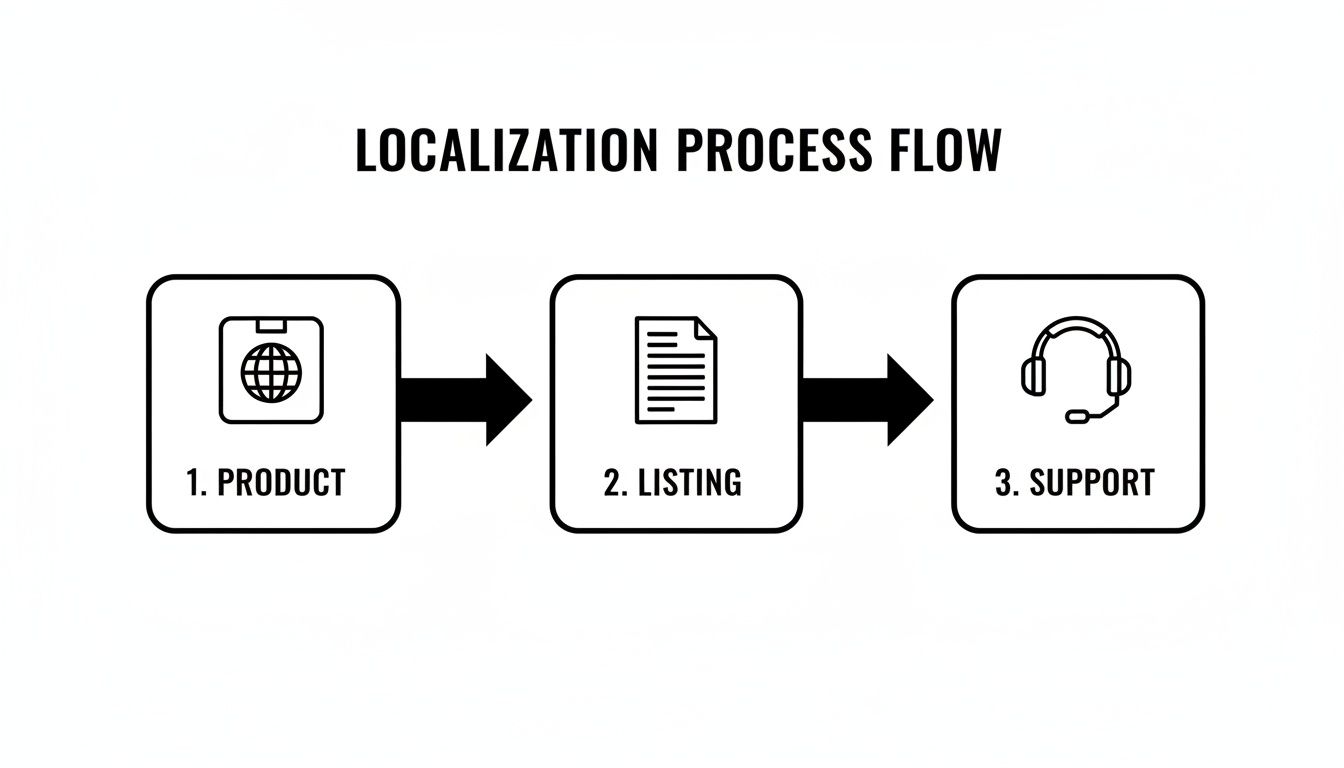
As you can see, a killer launch is built on getting the product, the listing, and the support right for the local market from day one.
The launch is just the first step. The real work begins as you move from that initial traction to sustained, profitable growth. This demands a relentless focus on data and being ready to pivot based on what you’re learning. Your initial assumptions will be challenged, and the market will quickly tell you what it really wants.
Get a market-specific analytics dashboard running immediately. Track your key performance indicators (KPIs) like customer acquisition cost (CAC), conversion rates, and average order value (AOV). How do these numbers stack up against your home market? Big gaps are flashing signs that you need to tweak your marketing funnel or pricing.
Your initial profits in a new market are your growth engine. The smartest brands don't extract this cash immediately; they reinvest it directly back into the market to accelerate their momentum and solidify their position.
This means systematically plowing your earnings back into the channels that are already working. If your PPC campaigns are delivering a strong return on ad spend (ROAS), feed them more budget. If influencer posts drove a huge chunk of your launch sales, formalize it into an ambassador program. This creates a powerful flywheel effect where every sale funds the next customer, driving powerful, compounding growth. This cycle of optimization is the core discipline for any brand serious about expanding business internationally.
Even with the best playbook in hand, taking your business across borders can feel like a leap into the unknown. It’s totally normal to have those nagging “what if” questions popping into your head.
Let’s tackle some of the most common hurdles and hesitations we see from entrepreneurs on the verge of expanding. Think of this as the final gut-check you need to move forward with confidence.
This is the big one. We’ve all heard the horror stories—a sudden currency crash vaporizes your profits, or surprise taxes turn a hot market into a black hole for cash. These risks are very real, but they're also very manageable if you're smart about it.
Your first line of defense is a dynamic pricing model. You can't just set your prices and walk away. A solid model needs to account for ever-changing currency exchange rates, local taxes like VAT or GST, and any import duties. Using financial tools that automatically tweak your prices based on real-time data is crucial for protecting your margins from disappearing overnight.
Another pro move is currency hedging. It sounds more complicated than it is. Essentially, you're just locking in an exchange rate for a future date. By working with a financial service that offers hedging, you can guarantee that the revenue you earn in Euros or Pounds converts back to your home currency at a predictable rate. It takes a huge variable off the table when you're forecasting.
Don't let financial unknowns paralyze you. The difference between a successful expansion and a failed one often comes down to proactive risk mitigation. Knowing what could go wrong is the first step to ensuring it doesn't.
Finally, a simple but critical tip: never mix your funds. Open a separate, local bank account in your new market from day one. This makes accounting a breeze, simplifies tax payments, and gives you a crystal-clear view of how that market is actually performing on its own.
This is another major crossroad. Do you go all-in and set up a foreign subsidiary from the jump, or is there a leaner way to test the waters? For most brands, the answer depends on your long-term goals and how much risk you're willing to stomach.
Our advice? Start with a more flexible model. For the vast majority of ecommerce brands, this means finding a great regional third-party logistics (3PL) partner instead of leasing your own warehouse space. A good 3PL can handle everything—warehousing, fulfillment, and returns—letting you offer a fast, local-like delivery experience without the massive upfront cost.
Here’s a quick breakdown of the common entry models:
The key is to match your operational footprint to your actual sales volume. Start lean, prove the market has potential, and then scale up your investment in infrastructure as your revenue climbs.
Beyond the big strategic decisions, there are a few common mistakes that can trip up even the most well-thought-out expansion plans. Just being aware of them is half the battle.
The most frequent stumble we see is underestimating localization. Just translating your website copy isn't going to cut it. You have to adapt your marketing imagery, your payment options, and even your product descriptions to fit local cultural norms. A campaign that crushes it in the US could completely flop—or worse, be offensive—to customers in Japan. You have to invest in true localization, not just a cheap translation.
Another major tripwire is compliance. It's tempting to kick the can down the road on legal and tax registration, but that's a massive mistake. Getting on the wrong side of local labor laws, import regulations, or tax authorities can lead to crippling fines and even get your operations shut down. Bite the bullet and engage local legal and accounting experts from day one. It's a non-negotiable cost of doing business abroad.
Finally, get the "set it and forget it" mentality out of your head. Your international business is not a passive income stream. It needs constant attention, data analysis, and optimization. You have to treat each new market like its own distinct business, giving it the active management it needs to truly succeed.
At Million Dollar Sellers, we know that expanding your business internationally is one of the most powerful levers for growth. Our exclusive community connects you with top ecommerce entrepreneurs who have already navigated these challenges, offering the playbooks and peer support you need to scale smarter and faster. Learn more about how MDS helps you stay ahead of the curve.
Join the Ecom Entrepreneur Community for Vetted 7-9 Figure Ecommerce Founders
Learn MoreYou may also like:
Learn more about our special events!
Check Events