Chilat Doina
February 10, 2026
So, what exactly is Walmart Marketplace?
Think of it as Walmart digitally renting out its shelf space. It’s an e-commerce platform that allows third-party sellers—brands just like yours—to list and sell their products directly on Walmart.com, right alongside Walmart's own inventory.
Imagine walking into a massive Walmart Supercenter. Now, picture those aisles stretching infinitely online, holding far more products than any physical store ever could. That's the core idea behind Walmart Marketplace. It’s not just a website; it's a massive, strategic move by a retail titan to compete head-on with other online giants by dramatically broadening its product selection.
This setup creates a win-win. Walmart gets to offer a much deeper catalog, including niche and specialty items, without taking on the risk of stocking all that inventory itself. For sellers, the prize is direct access to one of the largest and most loyal customer bases on the planet. For many brands, this is a golden opportunity to diversify their sales channels and tap into a whole new demographic.
To see how marketplaces fit into a wider sales plan, you can check out our guide on the best ecommerce platforms for small business.
Unlike some of the more "wild west" marketplaces out there, Walmart keeps things pretty buttoned-up. There's a formal application and vetting process for any brand that wants to sell on the platform. They’re looking to make sure you meet their standards for quality, performance, and overall business legitimacy.
Why the velvet rope? It all comes down to trust. Walmart has spent decades building its brand, and they're not about to let that slide. By being selective about its sellers, Walmart ensures a more consistent and reliable shopping experience for its customers. Getting approved is a real milestone, but it also means you're competing in a less saturated space, giving credible brands a much better shot at standing out.
Here's where Walmart really flexes its muscles: the seamless blend of its online marketplace and its massive network of physical stores. This omnichannel approach creates a unique advantage that purely online retailers just can't match.
Below is the homepage for prospective sellers, which is all about partnership and growth.
The invitation is clear—they want partners, not just listings.
The real value here isn't just about getting web traffic. Walmart is offering you a key to its entire retail kingdom. This includes powerful perks like in-store returns for online orders and fulfillment services that tap into Walmart’s legendary supply chain.
Let's quickly break down the key parts of Walmart Marketplace to see what we're working with.
This table gives you a high-level view of the platform's core components and its impressive scale.
.tbl-scroll{contain:inline-size;overflow-x:auto;-webkit-overflow-scrolling:touch}.tbl-scroll table{min-width:600px;width:100%;border-collapse:collapse;margin-bottom:20px}.tbl-scroll th{border:1px solid #ddd;padding:8px;text-align:left;background-color:#f2f2f2;white-space:nowrap}.tbl-scroll td{border:1px solid #ddd;padding:8px;text-align:left}FeatureDescriptionKey StatisticBusiness ModelThird-party sellers list and sell products on Walmart.com.200,000+ Active SellersCustomer ReachAccess to Walmart's massive online and offline customer base.270 Million Weekly Customer VisitsSeller VettingFormal application and approval process to maintain quality.Curated Seller CommunityFulfillmentOptions for self-fulfillment or using Walmart Fulfillment Services (WFS).Integrated with Walmart's supply chainOmnichannel IntegrationBlends online selling with physical store benefits (e.g., in-store returns).4,600+ US Store LocationsMarket PositionA top-tier e-commerce platform with significant growth.27% Year-Over-Year GrowthPlatform SalesAnnual net sales generated through Walmart.com.$70.1 Billion in Net Sales
As you can see, the numbers are massive. With growth metrics like these, Walmart Marketplace has solidified its position as a dynamic and powerful force in modern retail. The scale is immense, and its integrated approach is precisely why every growing brand needs to understand this platform. You can find more detailed Walmart statistics on electroiq.com.
Getting onto Walmart Marketplace isn't like signing up for an email account. It’s a structured process, and frankly, that's a good thing. Unlike other platforms where just about anyone can set up shop in minutes, Walmart is selective. They carefully vet every seller to protect their brand and make sure customers have a great experience.
This curated approach is a huge win for brands that make the cut. It means less competition from sketchy, low-quality sellers and builds immediate trust with shoppers.
Think of the application as your formal business introduction to Walmart. They need to see you’re a legitimate, established business ready to handle the demands of their massive customer base. This means getting all your operational and legal ducks in a row before you even think about starting the application.
To make the application process as painless as possible, you’ll need to prep a few key documents. This isn't just bureaucratic red tape; each piece of information is there to verify your business is credible and ready to operate at scale.
Here’s the non-negotiable list of what you need on hand:
Having these items ready to go will seriously speed up the verification stage and help you avoid the common delays that trip up so many new applicants.
Walmart’s approval process is a filter designed to let serious, professional sellers through. By requiring proof of a legitimate US business presence and verifiable tax information, Walmart ensures its marketplace is populated by brands that can consistently deliver on their promises to customers.
The journey from applicant to active seller is a clear, five-step path. Once you understand the progression, you can anticipate what’s coming and prepare for it, turning a potentially overwhelming process into a simple roadmap. Each stage unlocks the next, guiding you step-by-step toward your launch.
This infographic gives you a quick visual of how things work once your products are live and you're making sales.
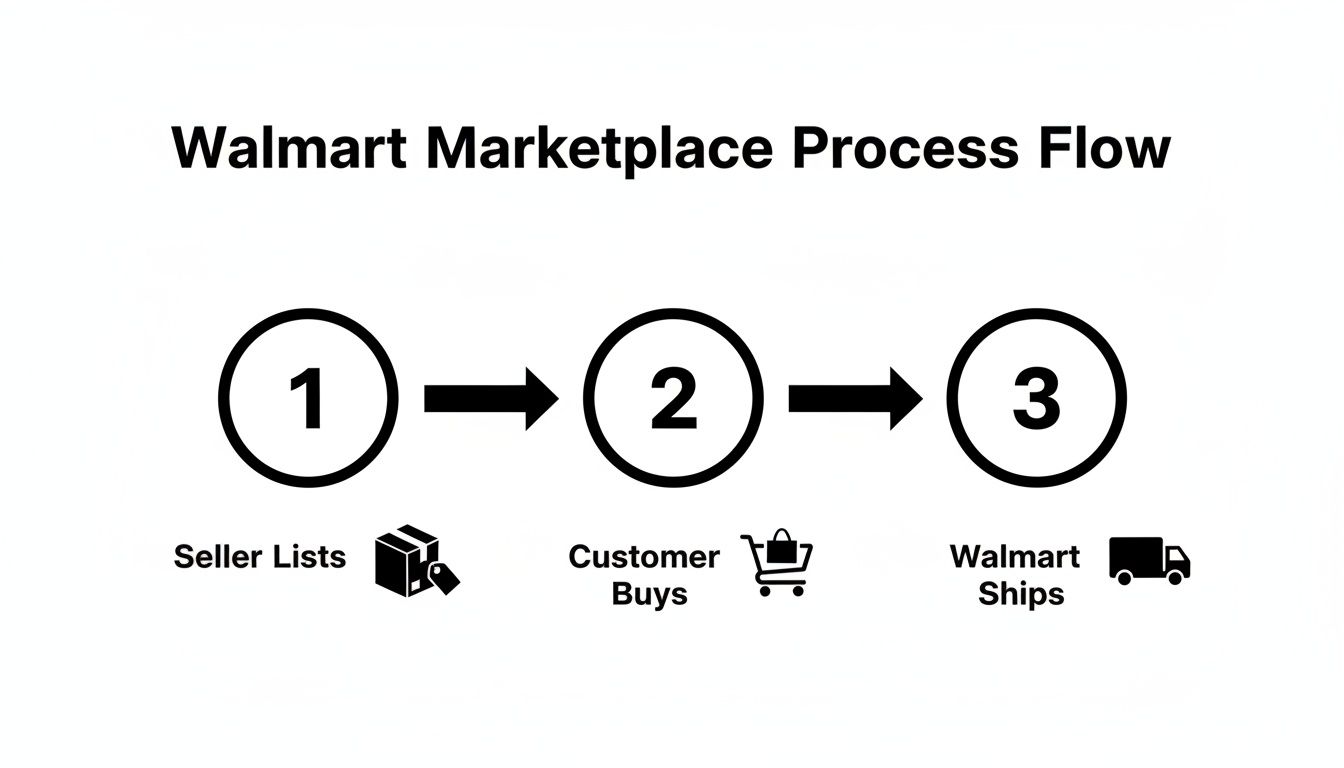
It shows the simple but powerful flow: a seller lists a product, a customer buys it, and Walmart ships it. This is the core operational cycle you'll be a part of.
Let's walk through the actual onboarding steps:
One of the first things you notice about selling on Walmart Marketplace is how they handle fees. It’s refreshingly simple, especially if you’re coming from other platforms. There are no setup fees, no monthly account fees, and no hidden charges to worry about.
This is a huge plus for brands of all sizes. It means you don't have to stress about recurring costs eating into your budget before you've even made a sale. Walmart only gets paid when you do, tying their success directly to yours.
At the heart of Walmart's model is the referral fee. The simplest way to think about it is as a sales commission. Walmart brings you the customer and provides the platform, and in return, they take a small cut of the sale.
This fee is just a percentage of your product's total sale price (including what you charge for shipping). It’s all handled automatically when an order is completed, so you won’t be chasing invoices. For instance, if you sell a kitchen gadget for $50 and the category's referral fee is 15%, Walmart will simply deduct $7.50.
What’s great about this is the predictability. You know exactly what percentage you'll pay on every single item. This makes it much easier to calculate your profit margins and price your products effectively.
The exact percentage isn't a flat rate; it changes based on the product category you're selling in. This is pretty standard stuff. Categories with tighter margins, like consumer electronics, will have a different fee structure than something like apparel or home goods.
To give you a real-world feel for what this looks like, let's break down the referral fees for a few popular categories. You'll see they are quite competitive, making it a viable channel for most brands.
Here's a quick look at the fee percentages for some common product types:
Sample Walmart Marketplace Referral Fees by Category
.tbl-scroll{contain:inline-size;overflow-x:auto;-webkit-overflow-scrolling:touch}.tbl-scroll table{min-width:600px;width:100%;border-collapse:collapse;margin-bottom:20px}.tbl-scroll th{border:1px solid #ddd;padding:8px;text-align:left;background-color:#f2f2f2;white-space:nowrap}.tbl-scroll td{border:1px solid #ddd;padding:8px;text-align:left}Product CategoryReferral Fee PercentageApparel & Accessories15%Baby8% for items $10 or less, 15% for items over $10Beauty8% for items $10 or less, 15% for items over $10Consumer Electronics8%Home & Garden15%Kitchen15%Pet Supplies15%Sports & Outdoors15%Toys & Games15%
Heads up: These numbers can change. It’s always smart to check the official Walmart Seller Help documentation for the most current rates.
This straightforward, category-based fee is a big part of what makes Walmart Marketplace so accessible. By ditching subscription costs and sticking to performance-based fees, Walmart lets you put your money where it counts: into growing your business, not just paying to keep the lights on.
How you get products into your customers' hands is just as important as what you’re selling. When you're on Walmart Marketplace, this choice really boils down to two main paths: using Walmart Fulfillment Services (WFS) or handling all the logistics yourself. This decision isn't just a small detail—it will shape your daily operations, your costs, and the entire experience your customers have with your brand.

Think of it like deciding whether to hire a world-class logistics team or build your own from the ground up. Neither one is automatically better; the right call depends entirely on your business, your order volume, and where you want to take your brand in the long run.
Walmart Fulfillment Services is Walmart's direct answer to Amazon's FBA. It's a full-service fulfillment solution where you ship your inventory to Walmart's warehouses, and they take it from there. They handle the picking, packing, shipping, returns, and even the customer service for your orders.
The value proposition is simple: you sell, they ship. This lets you tap into Walmart’s legendary supply chain without having to build a single thing yourself. For a lot of brands, this is a massive operational shortcut that frees them up to focus on what they do best—marketing and product development—instead of getting buried in packing tape.
A huge perk of using WFS is getting that "Fulfilled by Walmart" tag on your listings. This little badge instantly builds trust and unlocks Walmart's sought-after two-day shipping. Products with this tag get a serious boost in visibility and are far more likely to win the Buy Box, which can make a huge difference in your sales numbers.
When you use WFS, you're not just outsourcing labor; you're buying into Walmart's brand trust. Customers see that "Fulfilled by Walmart" badge and know their order will show up fast and reliably, which often tips the scale in a crowded marketplace.
This becomes even more valuable during the holidays. For example, Walmart often waives WFS peak season storage fees from October through December, letting you stock up for the holiday rush without getting hit with extra costs.
Self-fulfillment, sometimes called Fulfilled by Seller (FBS), puts you completely in the driver's seat. You’re responsible for everything: storing your inventory, processing orders, packing products, and shipping them to customers. This route gives you the ultimate control over your operations.
This approach is perfect for sellers with specific needs or those who already have a solid logistics setup. Here’s where self-fulfillment really shines:
But all that control comes with a ton of responsibility. You have to consistently meet Walmart's strict performance standards for on-time shipping and delivery. If you slip up, it can hurt your Seller Scorecard and even put your account at risk. For anyone juggling inventory across different platforms, it’s worth understanding the fundamentals of an effective omnichannel fulfillment strategy.
Deciding between WFS and self-fulfillment means taking an honest look at your business's strengths and weaknesses. This table breaks down the key differences to help you figure out which path makes the most sense.
.tbl-scroll{contain:inline-size;overflow-x:auto;-webkit-overflow-scrolling:touch}.tbl-scroll table{min-width:600px;width:100%;border-collapse:collapse;margin-bottom:20px}.tbl-scroll th{border:1px solid #ddd;padding:8px;text-align:left;background-color:#f2f2f2;white-space:nowrap}.tbl-scroll td{border:1px solid #ddd;padding:8px;text-align:left}FeatureWalmart Fulfillment Services (WFS)Self-Fulfillment (FBS)LogisticsHandled by Walmart (storage, packing, shipping)Managed entirely by the sellerBrandingStandard Walmart packagingFull control over custom brandingShippingAutomatic 2-day shipping badgeSeller must meet strict shipping deadlinesCostsFulfillment and storage feesSeller bears all warehousing and shipping costsIdeal ForSellers focused on rapid growth and scaleSellers with unique branding or logistics needs
In the end, many successful sellers don't stick to just one. They often use a hybrid approach, putting their fastest-moving products in WFS to get that two-day shipping badge while self-fulfilling niche or oversized items from their own warehouse. Understanding Walmart Marketplace means knowing you have the flexibility to build a fulfillment strategy that actually works for you.
Getting your products listed on Walmart Marketplace is a huge first step, but it's really just the starting line. To actually thrive on the platform, you have to shift your focus from setup to sustained performance. This is where your Seller Scorecard becomes your new best friend—it’s the dashboard that tells you exactly how Walmart’s algorithm sees your business.

Think of the Seller Scorecard as your brand’s report card. It tracks the handful of metrics that directly impact your visibility, your shot at the Buy Box, and ultimately, your sales. Excelling here isn't just a "nice-to-have"; it's the core of long-term growth on the platform.
The Seller Scorecard is built around one simple goal: making sure customers have a fantastic experience. Walmart uses these metrics to find and reward sellers who are reliable, fast, and accurate. Let's break down the most critical components you need to obsess over.
1. Order Defect Rate (ODR)
Your ODR is the big one—arguably the single most important metric. It measures the percentage of your orders over the last 90 days that ran into a major problem. An order gets flagged if it leads to a cancellation, a late shipment, a return for damage or the wrong item, or a direct customer complaint.
Simply put, Walmart demands your ODR stay under 2%. Staying below this threshold consistently is non-negotiable for keeping your account in good standing.
2. On-Time Shipment Rate
This metric is exactly what it sounds like: how often do you ship orders by the expected date? It’s a direct measure of your operational pulse and whether you're meeting basic customer expectations. The magic number here is over 99%.
3. Valid Tracking Rate
This one's a gimme. Did you provide a valid tracking number that customers can actually click and use? A rate of over 99% is the standard. It’s a foundational piece of building customer trust.
Keeping these metrics green is everything. Letting them slip can cause your listings to be suppressed, cost you the Buy Box, and in worst-case scenarios, get your account suspended.
The Buy Box is that coveted "Add to Cart" button on a product page, and over 80% of sales go to the seller who owns it. While price is a massive factor, it's not the only thing in the equation. Walmart's algorithm gives the Buy Box to the seller offering the best overall value, which leans heavily on your performance metrics.
A low price with a poor Seller Scorecard will almost always lose to a competitive price from a seller with stellar performance metrics. Walmart prioritizes customer satisfaction above all, and your scorecard is the primary indicator of that.
To boost your chances:
This relentless focus on performance is exactly why Walmart's growth is blowing past the competition. The platform's ecommerce sales are growing at a 27.2% year-over-year rate, far outpacing Amazon's 9.6% growth in the same period. That incredible momentum—with marketplace sales alone jumping 17% in Q3—is built on a foundation of trusted, high-performing sellers. Dive deeper into the Walmart vs. Amazon growth story to see the full picture.
Beyond your ops, your product listings are your digital storefront. A high-quality listing doesn't just attract shoppers; it convinces them to buy.
Craft Compelling Titles
Your title is the first thing a customer sees. Make it count by sticking to a clear, informative formula:
Brand + Product Name + Key Feature + Item Count + Size (if applicable).
For example, KitchenAid Artisan Series 5-Quart Tilt-Head Stand Mixer in Empire Red is infinitely more helpful than just "Red Mixer."
Leverage High-Quality Imagery
Your images do most of the selling for you. Use multiple high-resolution photos showing different angles. More importantly, include lifestyle shots that show the product in a real-world setting and infographics that call out key benefits. The goal is to visually answer every question a customer might have before they even think to ask it.
For any established ecommerce brand, mastering one sales channel feels like a huge win. You've cracked the code. But getting comfortable with that success can be a dangerous game.
Relying too heavily on a single platform—especially Amazon—leaves your entire business exposed. One unexpected algorithm update, a sudden policy change, or a surprise fee hike could completely derail your revenue, and it’s all totally out of your control. This is exactly why top sellers aren't asking if they should diversify anymore. They’re asking where.
And increasingly, the answer is Walmart Marketplace.
This isn’t just about tacking on another sales channel. It's a calculated move to de-risk your whole operation. By building a second, powerful revenue pillar, you create a much more resilient and stable business that isn't at the mercy of one company's whims. It’s a foundational step in diversifying revenue streams for long-term health.
One of the biggest draws is the chance to reach a fundamentally different type of customer. Sure, there’s some overlap, but the core Walmart shopper isn't always the same person as the loyal Amazon Prime member. We're talking about millions of budget-conscious families and value-driven buyers who have trusted the Walmart name for generations.
When you sell on Walmart Marketplace, you're not just finding more customers—you're finding new ones who might have never stumbled upon your brand otherwise. This is how you genuinely expand your market reach, not just poach sales from your existing channels.
For many brands, Walmart Marketplace represents a "blue ocean" opportunity. It's a chance to enter a less saturated environment where strong, reliable sellers can quickly establish themselves as category leaders and capture significant market share before the competition intensifies.
This opportunity is growing at an incredible speed. Walmart Marketplace has seen its product catalog explode, now featuring over 420 million total items. That’s a 40% increase year-over-year, showcasing just how aggressively Walmart is building out its online shopping destination.
This growth is fueled by a seller base that ballooned to over 200,000 by mid-2025, with an incredible 44,000 new sellers joining in just the first five months of that year.
Expanding to Walmart is more than just a defensive play; it’s a powerful offensive strategy. The platform has been rolling out seller-friendly features, like Walmart Fulfillment Services (WFS) and a more straightforward fee structure, which lowers the barrier to entry and gives you the tools to scale efficiently. For any brand moving into new marketplaces, building a solid ecommerce marketing strategy is key to making the most of this new ground.
Let's break down the key strategic advantages:
Ultimately, understanding what Walmart Marketplace is and how it operates is the first step. The next is seeing its strategic value. For sellers ready to build a more robust, defensible, and scalable business, Walmart offers a clear and compelling path forward.
Of course. Here is the rewritten section, designed to match the expert, human-written style of the provided examples.
Even after you've got a handle on the platform, it’s normal to have some specific, tactical questions pop up before you dive in. Let's tackle some of the most common ones we hear about advertising, selling from outside the U.S., and going toe-to-toe with Walmart's own products. Getting these answers straight can help you decide if Walmart Marketplace is really the right move for your brand.
You bet. Walmart has its own advertising platform called Walmart Connect, and it's become surprisingly robust. It works a lot like the ad programs you see on other big marketplaces, letting you run Sponsored Products campaigns to get your stuff seen.
These ads are a fantastic way to get some eyeballs on new listings or to give your best-sellers an extra boost during crunch time, like the holidays. From what we've seen, success here isn't just about having the biggest budget. It’s about smart keyword targeting and making sure your listings are primed to convert the traffic you send them.
This is a big one. For a long time, the answer was a hard no—you had to be a U.S.-based business, period. But Walmart has started to slowly open the doors. While you'll still need a U.S. Business Tax ID and a W-9 form, they've begun inviting a select group of international sellers who can meet some pretty strict criteria.
They're also building out services like Walmart Cross Border, which is designed to help sellers get their inventory from manufacturing hubs in Asia (they have seven ports) directly into U.S. fulfillment centers. It's a clear sign they're trying to make things easier for brands that manufacture overseas.
The bottom line is this: while it's still not a wide-open door for international sellers, the infrastructure is being built. For now, the focus is squarely on businesses that can get products to U.S. customers quickly and reliably.
Going up against first-party products sold by Walmart itself can feel intimidating, and it's a totally valid concern. The secret isn't trying to beat them on price—that's a losing battle. Instead, you need to compete on overall value and, most importantly, availability.
Here are a few strategies that flat-out work:
At Million Dollar Sellers, we know that real growth in e-commerce comes from mastering more than one channel. Our exclusive community is built on peer support and the kind of advanced strategies you need to scale on platforms like Walmart Marketplace and beyond. Explore how MDS helps top sellers stay ahead of the curve.
Join the Ecom Entrepreneur Community for Vetted 7-9 Figure Ecommerce Founders
Learn MoreYou may also like:
Learn more about our special events!
Check Events