Chilat Doina
December 12, 2025
Moving from domestic suppliers to sourcing internationally is a huge milestone for any Amazon FBA seller. It's exciting, sure, but it also throws a whole new layer of complexity into your operations—one that can bury even the most organized founder. This is the exact moment a freight forwarder goes from being a line-item expense to an absolutely essential partner.
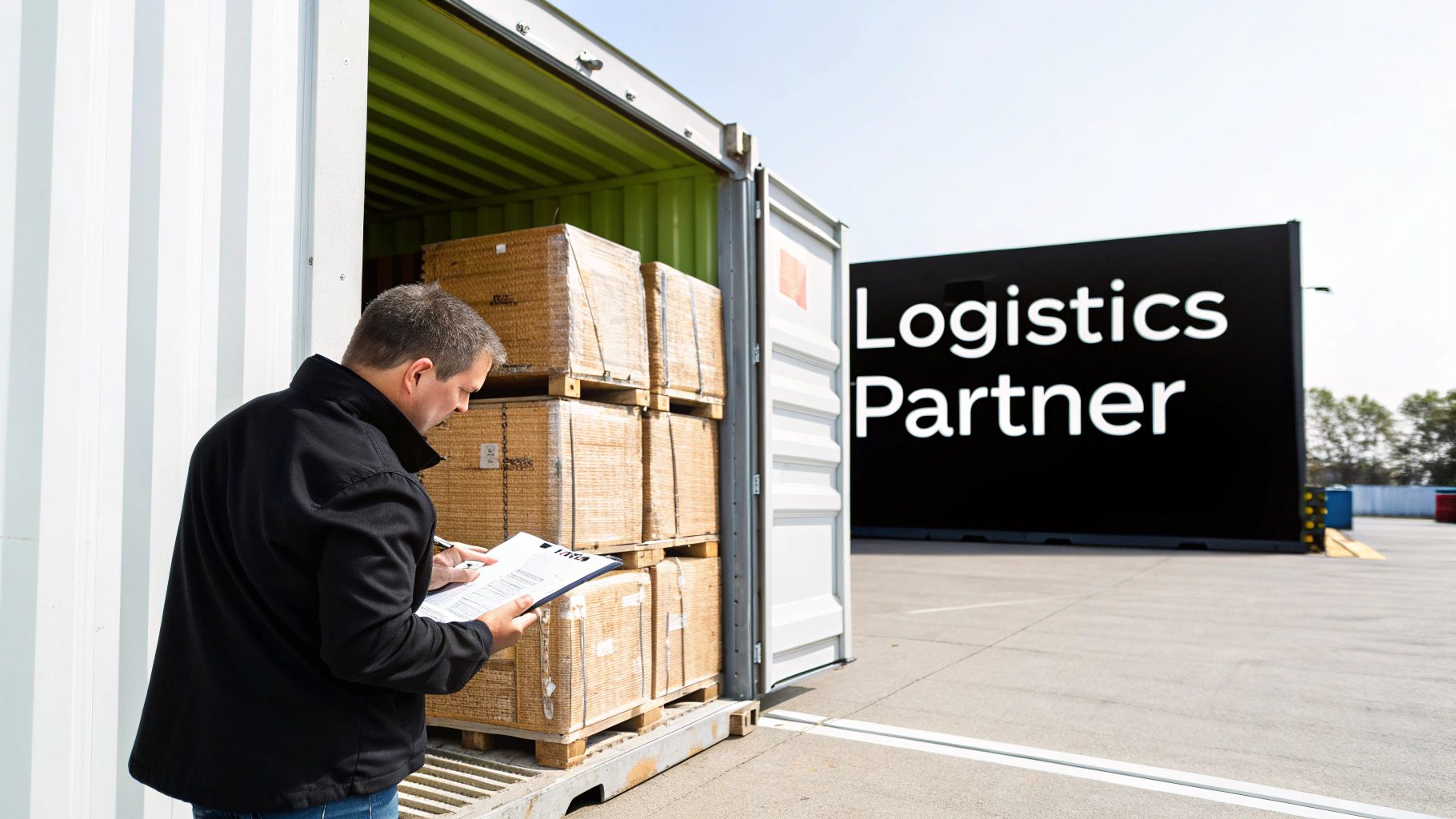
When you're just starting out, shipping a few small boxes with air express couriers like DHL or FedEx is perfectly fine. It's fast and relatively simple. But what happens when your sales explode and you need to jump from ordering 100 units to 1,000? All of a sudden, you're wrestling with customs declarations, import duties, and navigating language barriers with factories overseas.
So, when do you make the call? The tipping point usually hits when your shipment weight climbs past 150-200 kilograms. Around this mark, standard courier services become insanely expensive. The logistics and cost benefits of using a freight forwarder are just too big to ignore. Trying to DIY this kind of shipment is a recipe for a costly disaster.
Imagine your best-selling product getting stuck at a port for weeks because of a simple paperwork mistake. Or your supplier uses the wrong carton labels, and Amazon flat-out rejects your entire shipment at the warehouse door. These aren't just scare tactics; they're common, expensive lessons for sellers who underestimate global logistics.
A great freight forwarder doesn't just move boxes. They act as your operational arm, navigating the labyrinth of international trade so you can focus on marketing, product development, and growing your brand.
Seeing a freight forwarder as just another cost is a rookie mistake. A much better way to think about it is as an investment in efficiency, risk mitigation, and your ability to scale. Their expertise prevents delays, makes sure you're compliant with Amazon's notoriously strict receiving requirements, and ultimately protects your profit margins.
A good forwarder handles the mission-critical stuff you don't have time for:
This kind of streamlined process is the lifeblood for the millions of sellers building their businesses on Amazon's fulfillment network. In fact, over 82% of Amazon's 9.7 million active sellers use FBA, which makes a rock-solid inbound supply chain non-negotiable. As the platform gets more crowded, having a reliable logistics partner becomes an even bigger competitive advantage. You can find more 2025 key statistics about Amazon sellers and their deep reliance on FBA.
Ultimately, partnering with a freight forwarder for your Amazon FBA business is about buying back your time and bulletproofing your supply chain. It's what allows you to scale with confidence, knowing the complex journey from the factory floor to the fulfillment center is in expert hands.
Deciding between air and sea freight is one of those pivotal choices you'll make for your FBA business. It’s way more than just "air is fast, sea is cheap." This one decision ripples through your entire operation, hitting your cash flow, profit margins, and your ability to stay in stock—especially when it matters most.
Get it wrong, and you're either burning cash on shipping for a slow-moving product or, even worse, missing out on thousands in sales because your bestseller is sitting on a boat for six weeks. A sharp freight forwarder doesn't just quote you a price; they help you weigh this trade-off based on the total impact to your business.
Think of air freight as your strategic ace in the hole. It's your go-to for speed and urgency. Yes, it's a lot more expensive than shipping by sea—we're often talking 5 to 10 times the cost—but there are absolutely times when that investment pays for itself, and then some.
You'll want to pull the trigger on air freight when:
The perfect candidates for air freight are usually small, lightweight, and high-value products. It just makes financial sense to fly over a batch of high-end electronics or expensive jewelry because the shipping cost is a much smaller slice of the product's retail price.
Sea freight is the backbone of global e-commerce. It's the default, workhorse option for most of your planned FBA inventory replenishments. The cost savings are huge, especially for anything large, heavy, or bulky. The trade-off, of course, is time. Transit can take anywhere from 30 to 50 days, sometimes longer, depending on where you're shipping from, where you're going, and what's happening at the ports.
Sea freight is the undeniable champion for:
This is where your freight forwarder really earns their keep. They can run the numbers and help you decide between a Full Container Load (FCL), where you get a whole container to yourself, or a Less than Container Load (LCL), where your goods are consolidated with others. LCL is fantastic for smaller shipments, but just know it can sometimes add a week or two to the total transit time.
For a much deeper look into the entire end-to-end process, our guide on shipping from China to Amazon FBA is a great resource.
Putting it all together, let's break down the key differences in a simple table. This should help you visualize the trade-offs and make a more informed decision for your next shipment.
Imagine you're shipping 1,000 units, and each carton weighs 15 kg. Here’s how that might shake out:
FactorAir FreightSea Freight (LCL/FCL)Transit Time7-12 days35-50 daysCost Per KG~$7-12~$1-2Total Cost (est.)$10,500 - $18,000$1,500 - $3,000Best ForEmergency restocks, new launches, high-value itemsPlanned bulk orders, heavy items, maximizing profit
The cost difference is impossible to ignore. The smartest FBA sellers I know don't just pick one method; they use a hybrid approach. They rely on the cost-effectiveness of sea freight for the bulk of their inventory and strategically deploy air freight to plug inventory gaps, launch new products, or capitalize on unexpected sales spikes. It's about using the right tool for the right job.
Getting your products from a factory in another country to an Amazon FBA warehouse is more than just shipping boxes. It's a game of precision, and your playing field is a stack of critical documents. One tiny mistake on your paperwork can trigger a customs inspection, trapping your inventory for weeks and grinding your sales to a halt.
This is exactly where your relationship with a good freight forwarder for Amazon FBA pays dividends. They are the pros at navigating this paper trail, but as the business owner, you absolutely need to understand the key documents and the terms of sale that dictate who's responsible for what.
Think of these three documents as your product's passport. Without them, your goods are going absolutely nowhere. Your freight forwarder will handle the actual filing, but they rely on you and your supplier for the accurate info needed to create them.
Let's say you're shipping 500 silicone pet bowls. Your commercial invoice will state the total value is $2,500 ($5/unit). The packing list will confirm there are 25 cartons, each with 20 units inside and weighing 10 kg. The Bill of Lading then officially lists your forwarder as the party responsible for moving those 25 cartons. Any mismatch between these three documents is a guaranteed delay.
Incoterms are basically the universal language of global trade. These little three-letter acronyms define the exact point where your supplier's responsibilities end and yours begin. If you don't understand them, you can get hit with unexpected bills that completely wipe out your profit margin.
This diagram breaks down the shipping journey and the core choice you'll have to make with your forwarder's guidance.
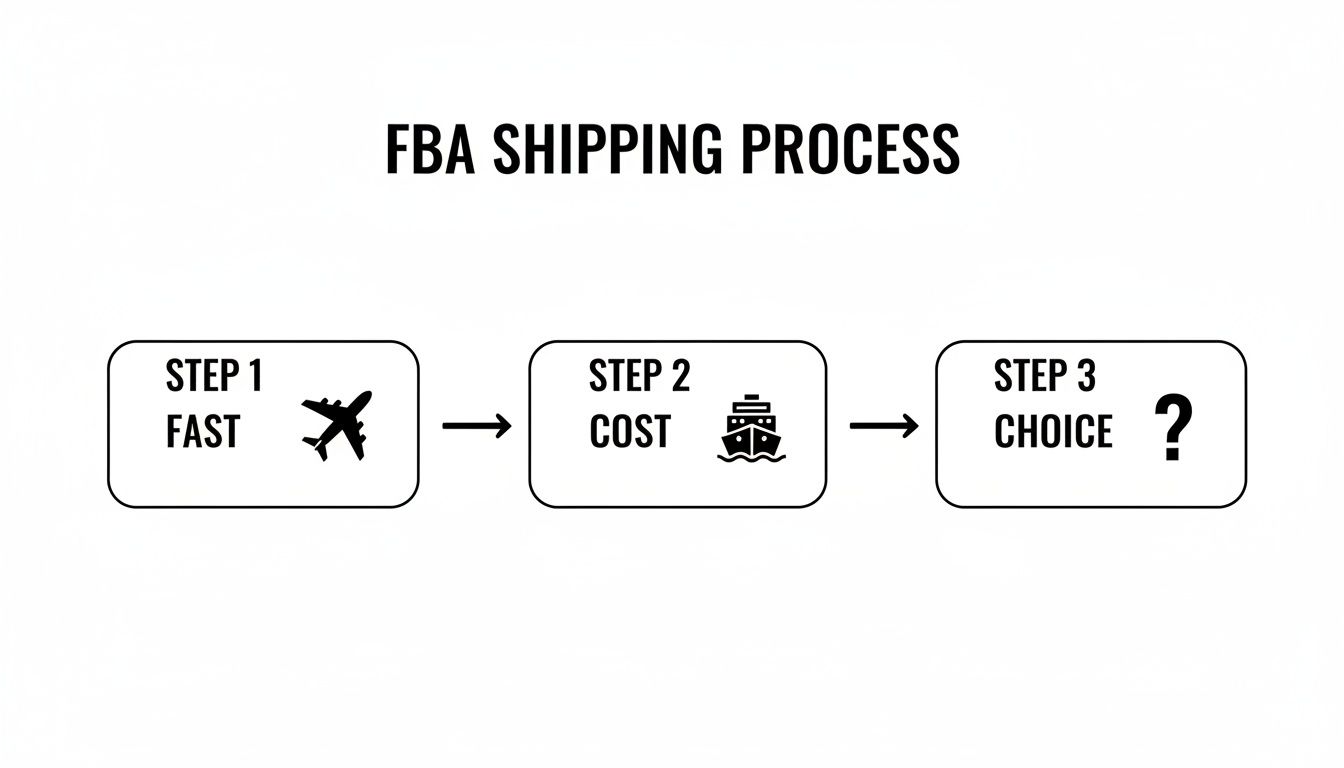
As the visual shows, weighing the speed of air freight against the savings of sea freight is a fundamental decision in your FBA logistics plan.
While there are a bunch of different Incoterms out there, you'll really only need to know three of them as an Amazon FBA seller.
With EXW, your responsibility begins the second your goods leave the factory floor. You (meaning, your freight forwarder) are on the hook for everything: picking up the inventory, trucking it to the port, clearing export customs in China, the main ocean or air journey, import customs in the destination country, and the final delivery to Amazon.
Here’s how it plays out: You agree to EXW terms with your supplier in Ningbo. Your freight forwarder now has to send a truck to that factory, load up your boxes, get them cleared for export at the Port of Ningbo, and manage every single step until they hit the dock at an Amazon warehouse in Texas. This gives you total control, but also total responsibility.
FOB is the most popular—and usually the most recommended—Incoterm for FBA sellers. With FOB, the supplier handles all the costs and risks until your goods are physically loaded on board the ship at the port of origin. They take care of the local trucking and getting it through China's export customs.
Once the cargo is on the vessel, the risk and cost flip over to you. This is a fantastic middle ground because it leaves the tricky local logistics to your supplier, who knows the area, the language, and the process inside and out.
DDP sounds like a dream. The supplier handles everything, all the way to the final destination—in this case, the Amazon FBA warehouse. They pay for all the shipping and all the import duties. Simple, right? But it's incredibly risky.
You give up all control over the shipping timeline and, more critically, the customs declaration. If your supplier decides to declare a lower value for your goods to save a few bucks on duties, you, as the legal Importer of Record, are the one who gets in trouble. This can lead to massive fines and penalties. Most veteran sellers and forwarders will strongly advise you to steer clear of DDP for FBA shipments because of this complete lack of control and transparency.
Let's be blunt: Amazon's fulfillment centers run like a military operation, and they don't have a lot of patience for mistakes. One tiny labeling error can get your whole shipment rejected, sent back to your forwarder, or slapped with unplanned service fees that chew right through your profits. Getting this final step perfect isn't just important—it's non-negotiable.
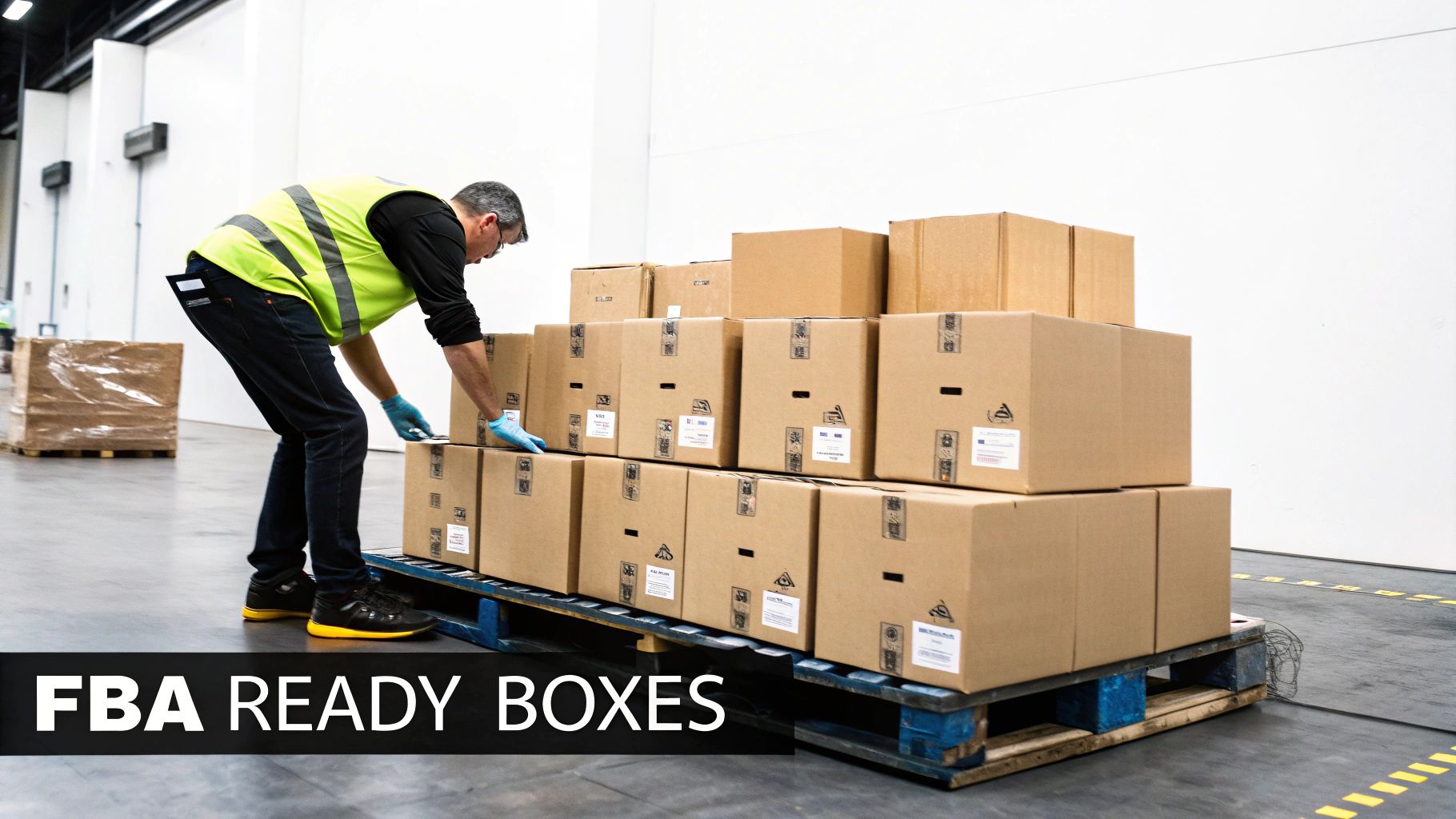
This is more than just sticking a label on a box. It's a precise checklist that lets your products move smoothly from the loading dock into Amazon's colossal inventory system. Any slip-up here can create delays that have a domino effect on your entire business.
Every single item you send to Amazon needs its own unique ID. This is the FNSKU (Fulfillment Network Stock Keeping Unit) label, an Amazon-specific barcode that ties that product directly to your seller account. It has to be the only scannable barcode on the item.
What does that mean in practice? If your product already has a manufacturer's UPC barcode, the FNSKU label must completely cover it up. No exceptions. Even a little bit of the old UPC showing through can confuse the scanners and cause major headaches at check-in. Your freight forwarder for Amazon FBA can handle this for you, but you'll need to give them the FNSKU files you generate from your FBA Shipping Plan in Seller Central.
Once your units are labeled, they get packed into larger master cartons. Each of these cartons also needs a specific label: the FBA Box ID label. This label, which you also get from your Shipping Plan, tells the warehouse crew exactly what's supposed to be inside that box.
The FBA Box ID label has to be placed on the side of the carton, away from any seams where a box cutter might slice through it. Never put it on the top or bottom. For bigger LCL or FCL shipments, these cartons will be stacked neatly on pallets.
Here are the critical pallet rules:
Don't treat these rules as mere suggestions. If you mess this up, Amazon can and will refuse the entire shipment at the door. Your freight forwarder will then have to haul it back to their warehouse to re-work everything, costing you a ton of time and money.
This is a big decision: do you trust your supplier to handle FBA prep, or do you pay your freight forwarder to do it? Both paths have their upsides and downsides.
Supplier Prep
Freight Forwarder Prep
For most sellers—especially if you're new to this—using your freight forwarder or a dedicated third-party prep center is the smarter, safer bet. That slightly higher cost is a small price to pay for insurance against a disastrous receiving error at Amazon. You can dig deeper into this in our guide on Amazon prep centers. Think of your forwarder as your final line of defense, making sure everything is flawless before it hits Amazon's doorstep.
That initial low-ball quote from a freight forwarder can feel like a massive win. But be careful—it’s often just the tip of the iceberg.
The world of international shipping is packed with hidden fees and surprise surcharges that can pop up and absolutely decimate your profit margins. Honestly, understanding the true, all-in cost of your shipment is one of the most critical skills you can develop as an FBA seller.
A quote isn't just one number; it's a collection of individual charges for every single step of the journey. Any reliable freight forwarder for Amazon FBA will give you a detailed, line-by-line breakdown. If they just hand you a single "all-in" price without explaining what's included, that’s a huge red flag.
To confidently compare quotes, you have to know what you’re looking at. Let's pull back the curtain on the common line items you'll see on a quote for a sea shipment from China to a US Amazon warehouse. These charges are usually grouped into three categories: origin, freight, and destination.
Typical Origin Charges:
Main Freight Charge:
Typical Destination Charges:
Never, ever assume a fee is included. Ask your forwarder directly: "Does this quote include all destination charges, customs clearance, duties, and final delivery to the Amazon FBA warehouse?" Get that confirmation in writing. It can save you from a massive surprise bill down the road.
Beyond the standard line items, plenty of other factors can unexpectedly inflate your final bill. These are the "gotcha" fees you need to anticipate. The volatility in the shipping industry has made budgeting more challenging than ever.
In fact, recent supply chain disruptions have created massive headaches. In 2025, shipping delays have become a major pain for Amazon FBA sellers, with the average delay spiking by 37% compared to pre-pandemic levels. That adds a whopping 23 extra days to transit times on average.
Freight forwarders are scrambling as costs have ballooned by 189% on major routes since 2022, forcing sellers to completely rethink their strategies. A staggering 78% of Amazon sellers reported these delays hammering their profitability over the past year. You can discover more insights about how these shipping delays are affecting sellers on amzprep.com.
These kinds of delays and cost surges highlight why you need to account for variables like:
You might think these rates are set in stone, but there's often room for negotiation, especially as you build a relationship with a forwarder. The key is clear communication. Be upfront and accurate about your shipment volume and how often you plan to ship. Asking for total price transparency is non-negotiable.
Of course, shipping isn't the only place to tighten up your finances. For a broader look at managing expenses, you might be interested in our guide on how to reduce shipping costs for small business.
Ultimately, the best way to manage shipping costs is to get multiple, fully itemized quotes and plan your inventory well in advance. This helps you avoid paying insane rates for last-minute air freight and gives you a buffer to absorb any unexpected delays or surcharges that come your way. The goal isn't just to find the cheapest quote, but the one that offers the most transparency and reliability.
Jumping into international shipping can feel like staring into a black box. You’ve got your product sorted, but now a whole new world of logistics, paperwork, and acronyms opens up. It’s totally normal to have a ton of questions, even if you think you have a solid plan.
Let's clear up some of the most common things sellers ask when they start working with a freight forwarder. Getting these answers straight will give you the confidence to manage your shipping partner like a pro and sidestep the costly mistakes that trip up so many sellers.
Think of choosing a freight forwarder less like shopping for a service and more like hiring a key team member. The lowest price is rarely the best deal. What you really need is a partner with proven, hands-on experience specifically with Amazon FBA shipments.
They need to know Amazon's strict receiving requirements like the back of their hand. Ask them point-blank about their process for FBA prep, labeling, and how they book those tricky delivery appointments. A good forwarder will walk you through their system without hesitation. Look for clear communication, transparent quotes, and reviews from other e-commerce sellers. This is a partnership, not just a one-off transaction.
Yes. Full stop. Don't even think about skipping it.
While carriers and forwarders offer a basic level of liability, it’s usually pennies on the dollar compared to your inventory's actual value. From massive storms at sea to a forklift mishap in a warehouse, a lot can go sideways between your factory and Amazon's fulfillment center.
Cargo insurance is a small price to pay to protect your much, much larger investment: your products.
Put it this way: you wouldn't run your business without liability insurance, right? So why would you ship tens of thousands of dollars worth of inventory across an ocean without protecting it? Always, always opt for all-risk cargo insurance that covers the full value of your goods.
Absolutely, and they should. Any freight forwarder worth their salt will either have an in-house customs brokerage or a rock-solid partnership with one. This isn't just a nice-to-have; it's a critical part of the service. A licensed customs broker is the specialist who makes sure your shipment is declared correctly, calculates duties and taxes, and files all the right paperwork.
Trying to handle customs yourself is a recipe for disaster. Let your forwarder manage this. It ensures you stay compliant and prevents your inventory from getting stuck at the border because of a simple paperwork error.
Your forwarder should give you a way to see where your stuff is. For sea freight, you'll usually get a container number that you can plug into the shipping line's website. For air freight, it’s an Air Waybill (AWB) number.
But honestly, the best forwarders have moved beyond that. Many now offer their own digital dashboards where you can see real-time updates, download documents, and chat with their team all in one place. This kind of visibility is gold, especially when you're trying to time your marketing campaigns with your inventory's arrival date.
As Amazon continues to build out its own logistics network, having a forwarder who can seamlessly navigate that system is more important than ever. Amazon Logistics is projected to handle 6.3 billion US delivery orders in 2024, and by 2026, Amazon Global Logistics (AGL) is expected to manage a staggering 96% of inbound FBA volume. Yet even with this massive scale, challenges like rising FBA fees—which jumped by an average of $0.22 in 2025—make a sharp, efficient forwarder indispensable. You can dig into more of these Amazon Logistics statistics on capitaloneshopping.com.
Getting clarity on these questions from the get-go builds a stronger relationship with your forwarder and makes your entire supply chain that much more reliable.
At Million Dollar Sellers, we believe in scaling smarter, not harder. Our exclusive community provides the peer support and high-level strategies you need to master challenges like global logistics and build a dominant e-commerce brand. Learn more about joining an elite circle of 7, 8, and 9-figure founders at Million Dollar Sellers.
Join the Ecom Entrepreneur Community for Vetted 7-9 Figure Ecommerce Founders
Learn MoreYou may also like:
Learn more about our special events!
Check Events