.webp)
Chilat Doina
December 23, 2025
If you're serious about your Amazon FBA business, a specialized freight forwarder isn't just another vendor on your payroll—they're a critical partner. Think of them as your frontline defense against costly mistakes like rejected shipments, customs nightmares, and surprise storage fees that a general forwarder might completely miss.
A true freight forwarder for Amazon FBA lives and breathes its complex logistics ecosystem.
Let's skip the generic definitions and get real about Amazon's logistics network. Sending inventory to Amazon isn't just about getting a box from point A to point B. It’s a precision operation where one small slip-up can derail your entire product launch or restock.
A general freight forwarder might be great at moving standard commercial cargo, but they often lack the deep, granular knowledge needed for FBA. The result? Your inventory shows up at a fulfillment center non-compliant, leading to immediate rejection, expensive return shipping, and weeks of delays.
I’ve seen this happen countless times: a seller's products finally arrive from China at an Amazon warehouse, but their forwarder failed to book a specific delivery appointment through Amazon's Carrier Central portal. The truck gets turned away.
Suddenly, you're paying daily storage fees at a third-party warehouse while scrambling to reschedule a delivery, which can take weeks during peak seasons like Q4. It's a disaster a specialized FBA forwarder would have seen coming a mile away.
They understand the entire end-to-end process, including:
The difference is stark: a general forwarder sees a shipment, but a specialized FBA forwarder sees your entire supply chain. They anticipate Amazon’s requirements before they become your problems.
At the end of the day, logistics is a massive driver of your bottom line. Delays mean lost sales velocity and a tanking IPI score. Unexpected fees chew into your margins. For any serious FBA business, accurately calculating your Amazon seller profit is a core focus, and a specialist forwarder protects it by minimizing these costly errors.
They become an extension of your team, managing the nitty-gritty details so you can focus on building your brand. While some sellers coordinate with a separate company for warehousing and prep, you can dive into the differences between partners in our guide on 3PL logistics for Amazon. Choosing the right partner from the get-go is fundamental to scaling your operations without constant headaches.
Finding the perfect freight forwarder can feel like searching for a needle in a logistical haystack. It's a huge decision that directly impacts your inventory, your cash flow, and ultimately, your brand's reputation on Amazon. The right partner is basically an extension of your own team. The wrong one? They create expensive bottlenecks that can sink you.
You have to move beyond just asking for quotes and start vetting for real, specific FBA expertise. A forwarder might dangle some attractive rates, but if they don't get the tiny details of Amazon's strict receiving rules, those "savings" will vanish. Think rejected shipments, surprise holding fees, and lost sales. Your vetting process needs to be a deep dive into how well they actually know their way around Seller Central.
With so many sellers relying on Amazon's network, picking the right partner is more critical than ever. As of early 2025, a staggering 82% of active sellers worldwide use FBA, and this trend is holding strong despite rising fees. In fact, 65% of the highest-earning sellers use FBA as their main fulfillment method, which just shows how baked into the system it is. Your freight forwarder is the very first, and arguably most important, link in this chain. You can learn how many sellers are succeeding on Amazon and see the data for yourself.
Before you even think about comparing quotes, you need a shortlist of forwarders who meet a baseline of FBA-specific skills. These are the absolute must-haves—the deal-breakers.
Your first round of cuts should focus on three core things:
Got your shortlist? Great. Now the real work begins. Your goal isn't just to find out what they do, but how they do it—especially when things inevitably go sideways. Generic questions get you generic, rehearsed answers. You need to hit them with operational questions that reveal their actual level of expertise.
A forwarder's response to a crisis is far more telling than their sales pitch. Ask them to describe a time an FBA shipment got stuck in customs and what specific steps they took to fix it for the seller. Their answer tells you everything about their communication style, problem-solving skills, and whether they take ownership.
To help you cut through the fluff, I've put together a list of essential questions. These are designed to get straight to the heart of their competence.
Before you sign any contract, use this checklist to make sure a potential forwarder truly understands the ins and outs of Amazon logistics. These questions are designed to test their practical knowledge, not just their sales pitch.
Question CategorySpecific Question to AskWhy It Matters for FBAAmazon SystemsHow do you manage Amazon Shipment IDs and FBA box labels across multiple cartons?Tests their understanding of the core tracking system Amazon uses. Incorrect labeling leads to lost or rejected inventory.CommunicationWhat is your standard procedure for communicating customs delays or port congestion?Delays are inevitable. You need a partner with a proactive, clear communication protocol, not one who waits for you to ask.Problem SolvingIf a shipment is rejected at an FBA warehouse, what is your immediate action plan?Reveals if they have a plan for rerouting, storing, and reworking shipments, saving you from exorbitant return fees.Cost TransparencyCan you provide a detailed, all-in quote including duties, taxes, and final-mile delivery?Hidden fees are common. This question forces transparency and helps you calculate your true landed cost accurately.
Getting clear, confident answers to these questions is a strong signal that you're talking to a partner who can handle the unique pressures of the FBA world.
One last thing to think about is the type of company that fits your business. You’ll generally find two camps: the massive global forwarders and the smaller boutique specialists. Both have their pros and cons.
A huge, global forwarder can often offer a wider network and maybe even better rates on high-volume shipping lanes just because of their sheer scale. The downside? You might feel like a small fish in a very, very large pond, getting less personalized attention when you need it most.
On the flip side, a boutique forwarder usually gives you a dedicated account manager and a much more hands-on approach. They tend to be more agile and better equipped to handle the specific, sometimes quirky, needs of a growing e-commerce brand. Ultimately, the choice comes down to your shipping volume, the complexity of your supply chain, and how much you value that direct, personal service.
Once you’ve locked in a freight forwarder, the real work begins. Moving your products from a factory floor to an Amazon fulfillment center is a game of precision. Every single detail matters, and a small mistake can have massive ripple effects. Get this stage right, and you're looking at a smooth inventory restock. Get it wrong, and you're staring down a logistical nightmare that will cost you time, money, and precious sales velocity.
It’s hard to grasp the scale of Amazon's operation. In 2024, their logistics network is projected to handle 6.3 billion U.S. delivery orders. That breaks down to over 717,200 orders zipping through their system every single hour.
That kind of volume is only possible because of an incredibly standardized, and frankly, unforgiving receiving process. Any shipment that deviates from their strict rules creates a bottleneck they just can't afford. You can see the staggering numbers behind Amazon's logistics operations yourself to understand why compliance isn’t just a suggestion—it’s mandatory.
Before a single box leaves the factory, you and your supplier have to agree on the Incoterms (International Commercial Terms). This isn't just jargon; it's a critical decision that defines who's responsible for the shipment—and who pays for what—at every single step. Picking the wrong one can slam you with surprise costs and logistical headaches you didn't see coming.
For most Amazon sellers, it boils down to three common terms:
I once saw a new seller get burned by DDP on a large shipment. The supplier's forwarder wasn't an FBA specialist and failed to book a proper delivery appointment. The truck was rejected, and the seller had no direct line to the logistics company to fix it. Their inventory was stuck in limbo for weeks, killing their launch.
Amazon’s fulfillment centers are marvels of automation, but that automation only works if everything is perfectly uniform. A good freight forwarder can help coordinate this, but you absolutely have to make sure your supplier gets it right from the start.
First, the packing list needs to be flawless. This document details the contents of every carton—the exact number of units, the weight, and the dimensions. Your forwarder needs this to create the Bill of Lading and clear customs. Any mismatch between the packing list and the actual goods is a huge red flag for a customs inspection, which means major delays.
Next up, labels. Every single item you sell needs a scannable FNSKU barcode. If your product already has a standard UPC barcode, you must cover it completely with the FNSKU label. Any competing barcodes will cause scanning errors at the warehouse.
Finally, each shipping carton needs an FBA box label, which you generate from your Shipping Plan in Seller Central. This label is critical—it tells Amazon exactly which shipment the box belongs to and what’s inside. If that label is missing or unreadable, your inventory will get shoved into a corner as "unfulfillable" until you can sort it out, which is a slow and painful process.
This entire process highlights why vetting and choosing a forwarder who lives and breathes these details is so crucial.
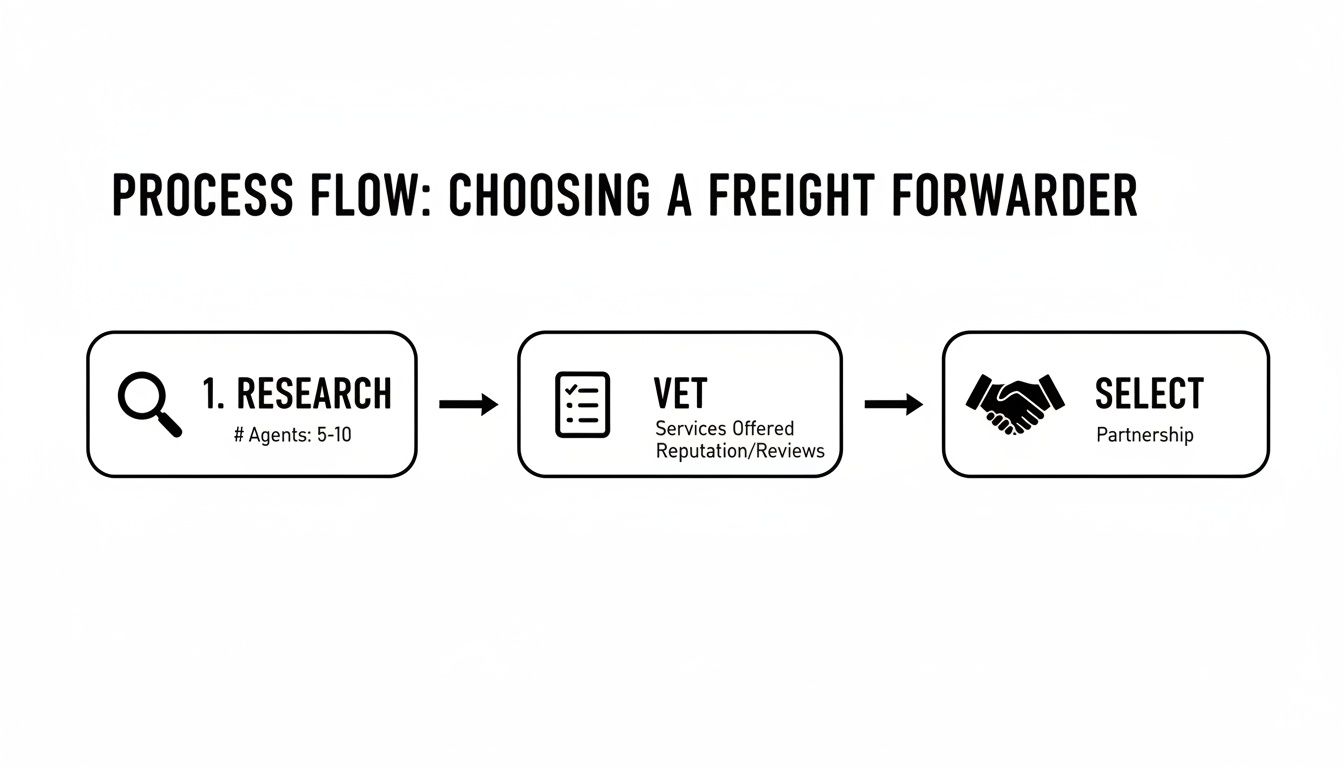
As the diagram shows, picking a partner isn't a quick decision. It's a structured process that demands thorough research and vetting before you commit.
If you’re moving a decent volume of inventory, your goods will probably be shipped on pallets. This is another area where Amazon's rules are incredibly specific, and a good freight forwarder can save your skin.
Here are a few non-negotiable rules:
If trying to manage this level of detail with your supplier overseas feels like too much of a risk, using a dedicated third-party prep center can be a game-changer. You can find out more in our guide on leveraging Amazon prep centers for a smoother process. These services specialize in making sure every last detail is FBA-compliant before your inventory even gets close to an Amazon facility.
Customs compliance can feel like the final boss battle in the world of importing. It’s where countless Amazon FBA shipments get stuck, racking up fees and delaying your inventory for weeks. But if you know the rules of the game, you can turn this complex hurdle into just another checkpoint.
The key is to stop thinking of customs as something to "get through." Instead, it's a process you manage proactively from the very beginning. Your freight forwarder is your guide on this journey, but they’re relying on you to provide them with the right map—accurate and complete information.
Before your goods can even sniff the air in their destination country, they need a paper trail. Think of these documents less as formalities and more as legal declarations about what you're importing, its value, and where it came from. Getting this stuff right is absolutely non-negotiable.
Your forwarder will be the one filing everything, but they can't do it without these core documents from you and your supplier:
Even a small discrepancy between these documents can trigger a customs inspection, which is a surefire way to get your shipment delayed.
Here's something many sellers don't realize: freight forwarders and customs brokers are technically different players, though most good FBA forwarders have an in-house brokerage or a very tight partnership with one. A customs broker is a licensed pro who acts as your agent, making sure your shipment ticks all the legal boxes for import.
Their most critical job? Assigning the correct Harmonized System (HS) code to your products. This 10-digit code is what determines the exact duty rate you'll pay. Getting this wrong can mean overpaying on duties or, even worse, underpaying and facing hefty fines down the road. An experienced broker can literally save you thousands just by classifying your product correctly.
Think of it this way: Your freight forwarder moves the boxes, but your customs broker moves the paperwork. You need both to clear customs without a hitch.
One of the most common rookie mistakes is only budgeting for the product cost and the main shipping fee. That almost always leads to a nasty shock when the final bill from the forwarder hits your inbox. You need to be thinking in terms of landed cost—the total expense to get a product from the factory floor to an Amazon fulfillment center, ready to sell.
To get an accurate number, you have to include everything:
Your freight forwarder should give you a quote that breaks these costs down, but it's your job to understand them and bake them into your profit calculations before you place your order.
Let me share a quick story. A seller I know was importing a batch of stainless steel water bottles. To try and save a few bucks on duties, they told their supplier to declare the value of each unit at $1.50 on the commercial invoice, even though they had actually paid $3.00 a piece.
Customs flagged the shipment. An agent took one look, did a quick search for similar products online, saw they were retailing for $25, and knew a $1.50 valuation was a fantasy. The entire shipment was put on hold for a full valuation review.
The result? The seller ended up paying the correct duties, plus a massive penalty for undervaluation. On top of that, their inventory was delayed by four weeks, completely wiping out the profit margin on their first big order.
The lesson here is simple: be transparent and accurate. A good freight forwarder for Amazon FBA will never advise you to misrepresent the value. Honesty is always the fastest and, in the long run, cheapest path through customs.
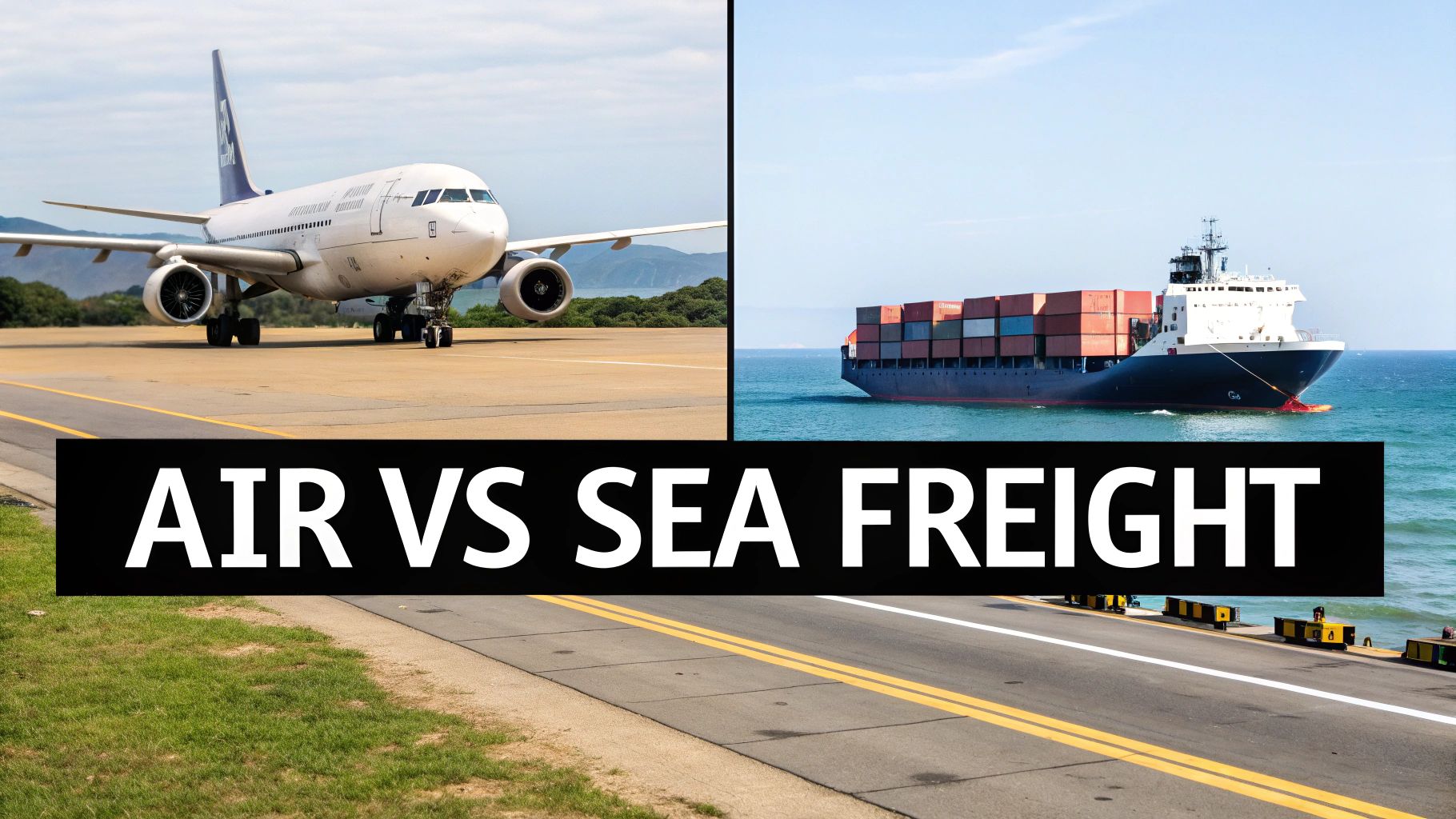
This is the classic logistics dilemma every single FBA seller runs into: do I ship my inventory by air or by sea? On the surface, the answer seems simple. Air is fast but expensive, and sea is slow but cheap.
But if you’re serious about scaling your Amazon business, that’s a dangerously oversimplified view. Getting this wrong can wreck your cash flow, trash your inventory health, and send your products into a stockout death spiral.
The right choice isn't just about this one shipment. It's about building a smart, resilient supply chain. A great freight forwarder for Amazon FBA won't just hand you two quotes and walk away. They’ll dig in and help you build a strategy that blends both shipping methods to optimize your business throughout the year.
This strategic thinking is more critical than ever, especially as Amazon pushes deeper into global logistics with programs like Amazon Global Logistics (AGL). The cost difference is huge—air freight can run you anywhere from $4 to $12 per kilogram for urgent shipments, while sea freight is closer to $100 per cubic meter. That makes the choice a major financial calculation.
Think of air freight as your emergency lever and your launchpad. Its biggest advantage is pure speed. We're talking about getting products from a factory in China to an FBA warehouse in the US in about 1-2 weeks, versus the 30-45+ days you'll wait for a boat. This speed is a game-changer in a few specific scenarios.
You should definitely lean on air freight when you're:
While air freight is for putting out fires, sea freight is the workhorse of your FBA supply chain. For the vast majority of your inventory replenishment, its cost-effectiveness is just unbeatable. That longer transit time simply means you need to get better at planning and forecasting.
Sea freight is the go-to for your core, predictable inventory needs. A good freight forwarder will help you manage the two main flavors of sea shipments:
If you want to go deeper on this, our guide on shipping from China to Amazon FBA breaks down the entire process.
Pro Tip: Stop thinking of it as an either/or choice. The smartest seven- and eight-figure sellers use a hybrid strategy. They send the bulk of their inventory (80-90%) via sea freight well in advance. Then, they ship a smaller portion (10-20%) by air to cover any inventory gaps and prevent stockouts while the main shipment is still on the water.
To make a truly informed decision, you have to look beyond just the freight cost. You're balancing speed, cash flow, and planning. Using an online shipping calculator is a good first step to compare the hard numbers, but you also need to weigh the strategic factors.
This table breaks down the key variables that should guide your choice.
FactorAir FreightSea FreightKey Consideration for FBATransit Time7-14 days (port-to-door)30-45+ days (port-to-door)How urgently do you need the stock? Is it a new launch or a routine restock?CostHigh per kilogramLow per CBMSea freight is almost always cheaper for anything other than very small, light items.Inventory PlanningAllows for reactive, short-term planningRequires proactive, long-term forecastingSea freight forces you to become a better inventory manager, which is a good thing.Cash FlowTies up less cash due to faster turnoverTies up capital for 30+ days while goods are in transitCan you afford to have inventory paid for but unavailable to sell for over a month?
Ultimately, the right answer changes based on your product, your cash position, and your sales velocity. The goal isn't just to pick the cheapest option; it's to build a flexible logistics strategy that keeps you in stock without draining your bank account. A forwarder who truly gets these FBA-specific dynamics is worth their weight in gold.
Once you start digging into international logistics, a ton of questions always come up. It's just part of the game. Here are some of the most common ones we see from Amazon sellers, with straight-up answers to help you handle the day-to-day grind of FBA freight forwarding.
It’s tempting, I get it. Your supplier offers to handle everything with a simple DDP (Delivered Duty Paid) shipping term. It feels easy, totally hands-off. But for an Amazon seller, letting your supplier manage your shipping is almost always a massive mistake.
Here’s the thing: your supplier is an expert in manufacturing, not FBA logistics. They'll just find the cheapest local forwarder they can, who likely has zero clue about Amazon's notoriously strict receiving requirements. This path is paved with rejected shipments, radio silence when problems pop up, and a bunch of hidden costs you didn't know were baked into your product price. You effectively give up all control and visibility over your own supply chain.
Think of your freight forwarder as the general contractor for your shipment. They’re the project manager coordinating the physical movement of your inventory—booking the trucks, reserving space on the ship or plane, and managing the entire journey from the factory floor to the warehouse door.
Your customs broker, on the other hand, is the legal eagle. They’re licensed specialists who live and breathe import paperwork. Their job is to make sure your import declaration is filed correctly, the proper HS codes are used, and all duties and taxes are paid on time. Most top-tier FBA forwarders either have an in-house customs team or a rock-solid partnership with one, but their roles are fundamentally different.
Your freight forwarder gets your stuff from Point A to Point B. Your customs broker makes sure it gets done legally. You absolutely need both working in sync for a smooth import process.
Yes. Full stop. This is completely non-negotiable.
It might be rare, but things can and do go sideways in transit. Containers fall off ships, cargo gets crushed during loading, or a forklift driver has a bad day at the warehouse. If your entire shipment disappears and you don't have insurance, you have almost no way to recover that loss. We're talking tens of thousands of dollars just gone.
Your freight forwarder will offer cargo insurance, and the cost is a tiny fraction of your inventory's value. Think of it as a non-optional business expense that protects your capital. Skipping it to save a few hundred bucks is a high-stakes gamble you simply can't afford to take.
Delays are an unavoidable reality of international shipping. Port congestion, random customs inspections, bad weather, carrier screw-ups—they all happen. The real test isn't whether delays occur, but how your freight forwarder for Amazon FBA handles them.
A great partner will:
This is where a forwarder with killer communication proves their weight in gold. They can turn a potential disaster into a manageable bump in the road.
At Million Dollar Sellers, we know that mastering logistics is a cornerstone of scaling an e-commerce brand. Our exclusive community is built for top-tier founders who share real-world strategies on everything from supply chain optimization to brand building, helping you bypass common pitfalls and accelerate your growth. If you’re an established seller ready to connect with a network of elite peers, find out more about joining us.
Learn more about Million Dollar Sellers
Join the Ecom Entrepreneur Community for Vetted 7-9 Figure Ecommerce Founders
Learn MoreYou may also like:
Learn more about our special events!
Check Events