Chilat Doina
August 14, 2026
You're probably sitting on a shelf full of product, a decent-looking launch deck, and a calendar that says “go live” before the numbers say you're ready. That's how most ecommerce founders light cash on fire. The fix isn't more creative energy, it's a tighter go to market strategy that treats launch like a financial instrument, with clear owners, hard signals, and fast course correction.
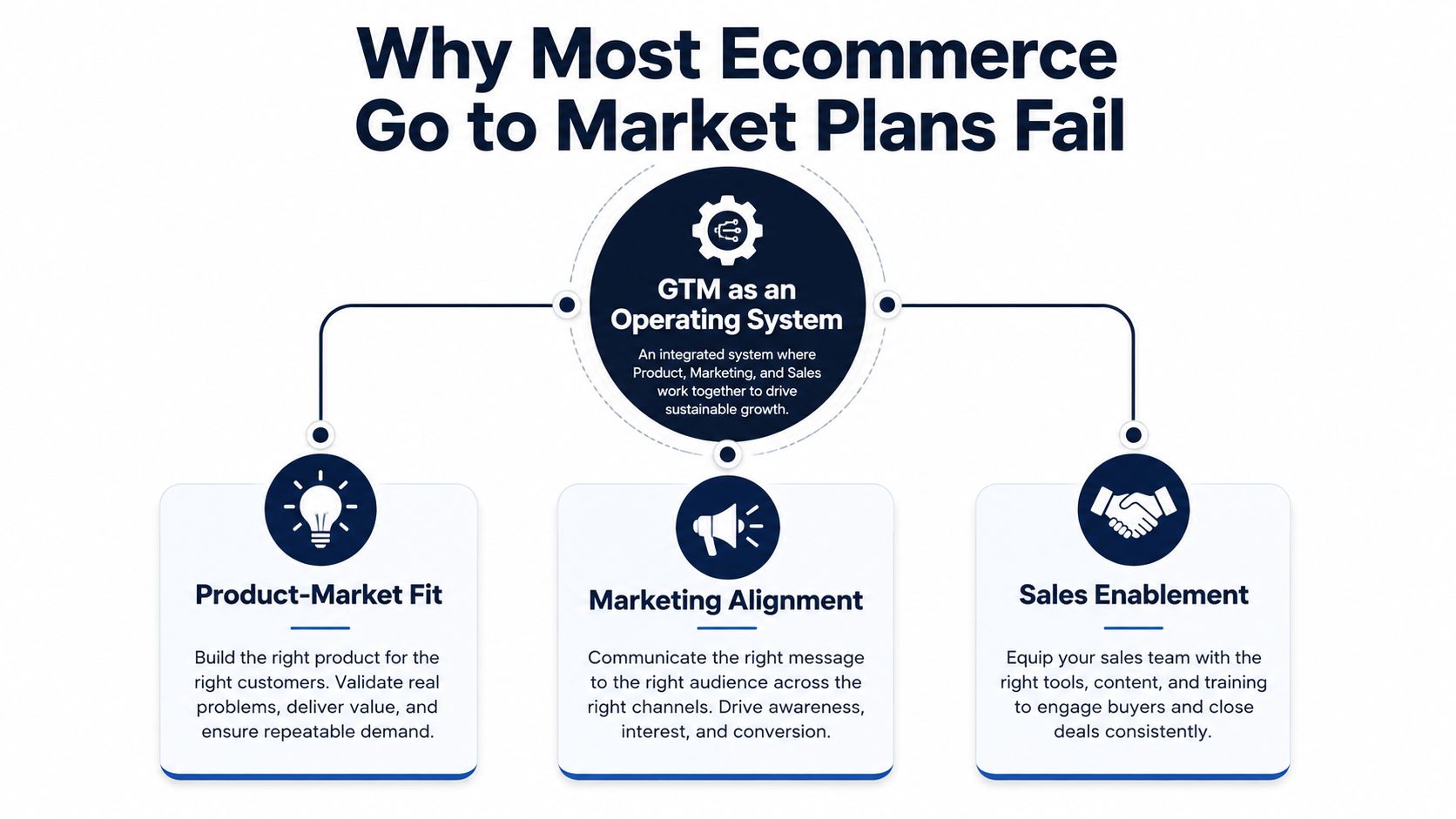
Most brands don't fail because the product is bad. They fail because the launch isn't run like an operating system. In a 2025 survey summarized by GTM Folio, 72% of companies reported operating without a formal, documented GTM strategy, while documented strategies were said to create a 3.4x higher chance of a successful launch. The same body of research identified strong alignment between product, marketing, and sales as the #1 indicator of GTM success, with aligned companies growing 36% faster. The point is blunt, if your team is improvising, your ad spend is doing the work of strategy.
A launch plan without documentation is just organized anxiety. You need owners, weekly reviews, and a written definition of what success looks like before you spend on inventory or traffic. The historical benchmark is even uglier, a 2024 SiriusDecisions GTM Performance Report cited by The Starr Conspiracy found that 77% of B2B product launches missed revenue targets in year one. That's why treating GTM as a creative exercise is expensive nonsense.
If you can't name the three numbers that prove your current GTM is working, you don't have a strategy, you have a hope. For ecommerce, I'd watch contribution margin, conversation volume, and reorder behavior. Those three tell you whether demand is real, whether messaging is landing, and whether the business survives after the first purchase.
A lot of founders obsess over top-line attention because it feels productive. It isn't. Attention without margin is noise, and traffic without repeat behavior is a tax on your balance sheet. A cleaner way to think about it is to ask whether each launch decision improves one of the three numbers above or just makes a slide deck prettier.
Practical rule: if a launch move doesn't improve margin, conversation quality, or reorder signals, it's usually vanity spend.
That's why a disciplined GTM looks a lot like inventory forecasting. You don't guess the warehouse balance and hope the pallets work out. You publish assumptions, assign a cadence, and review the gaps before they grow. For a practical product-market-fit lens, I'd also keep product-market fit validation in front of the team so no one confuses excitement with evidence.
For operators building retention into the plan, a useful companion read is email and retention tactics for DTC brands. That's where many launches either stabilize or decay after the first order.
Generic ICP work is where too many launches die. “Women 25 to 44” and other lazy segments don't help you decide where to spend, what to say, or which channel deserves the first dollar. The better move is to pick a segment using behavior, purchase context, and the actual friction customers already live with.
Use cross-purchase patterns, observed workarounds, and a real conversation set before you write a segment brief. The underserved-segment research points to a harder truth, successful companies often have to mine local market information, adapt to community realities, and use partnerships to overcome structural barriers. It also suggests that behavioral data and qualitative interviews uncover unmet needs that standard competitive analysis misses. That's the kind of work that finds a profitable niche instead of a cute persona.
I'd want at least 20 customer conversations before I call a segment real. Not because 20 is magic, but because it's enough to hear repeated language, repeated objections, and repeated workaround behavior. If buyers are already stitching together a solution with adjacent products, that's not a theoretical market. That's a segment with pain.
Don't ask whether a segment is interesting. Ask whether it deserves capital. Score each niche on three questions. First, do buyers already use workarounds? Second, do they show willingness to switch if your offer removes friction? Third, can they support your price without forcing ugly margin trade-offs?
A segment is worth pursuing when the pain is obvious, the workaround is clumsy, and the economics still work after acquisition costs.
A one-page scorecard is enough. Put the primary segment at the top, a secondary segment below it, and a short note explaining every segment you refused to chase. That write-down matters because it keeps the team from wandering back into broad-market drift six weeks later. For a clean framework on the mechanics, keep what market segmentation means close at hand while you make the cuts.
The decision should feel slightly ruthless. If a segment is hard to reach, low margin, and vague about the pain, it's not underserved, it's underqualified.
Most messaging fails because it sounds like every other brand in the category. That's not a creative problem, it's a market-awareness problem. In a survey of 200 B2B buyers, 62% said most vendor messaging sounds the same, and 71% said brands lose relevance when they don't adapt to buyers' current priorities. That's the cleanest proof I've seen that weak positioning is usually the primary leak.
Stop writing “premium, customer-first” sludge. Write a positioning hypothesis and test it in small segments. Your first version should answer four things, target, alternative, value, and proof. If you can't explain why someone should switch from what they're already doing, your message isn't positioned, it's decorative.
Use the template like this.
Target: who exactly you're talking to.
Alternative: what they use instead.
Value: what changes for them.
Proof: why they should believe you.
That structure maps cleanly into DTC homepage copy, Amazon bullets, and wholesale sell sheets. It also gives creative a usable brief instead of vague brand direction. If the first version doesn't land, don't “optimize” it forever. Kill it and move on.
You don't need a giant media budget to learn whether a message works. You need a controlled segment, a tight offer, and a decision rule. Run buyer interviews first, then use the strongest angle in a narrow test window. If the market can't distinguish your offer from the alternatives, pumping more spend into the same copy just buys louder invisibility.
A clear kill criterion keeps teams honest. If a message fails to trigger qualified interest after the defined test spend, retire it and write a new angle. That discipline matters more than cosmetic brand polish.
For a useful companion on sharpening the value angle, see what a customer value proposition is. They don't need more adjectives. They need a sharper reason to buy now.
Channel choice is where founders reveal whether they understand economics or just prefer control. Amazon, DTC, and wholesale all solve different problems, and the wrong one can make a decent product look weak. I'd score each channel on signal speed, control, and margin, then choose the one that best matches your cash position and operational tolerance.
| Channel | Signal Speed | Control | Margin | Best Use Case |
|---|---|---|---|---|
| Amazon | Fast | Low to medium | Medium after fees and ad pressure | Fast demand discovery, category validation, broad shopper intent |
| DTC | Medium | High | Often strongest if paid acquisition is disciplined | Brand storytelling, repeat purchase, bundle economics |
| Wholesale | Slow to medium | Low | Usually tighter but can move volume | Retail distribution, credibility, expanded reach |
Amazon gives you the fastest market signal, but you don't control the shopper experience the way you do on your own site. DTC gives you the best control, but it punishes weak media economics fast. Wholesale can be a strong scale channel, but it usually asks you to trade control and margin for shelf access.
If you need fast evidence and don't yet know whether the product will convert, start where buyers already shop. If you need brand control and want to build repeat purchase behavior, DTC is the cleaner learning environment. If you already have strong retail pull or category credibility, wholesale can extend the business without forcing you to invent demand from scratch.
The mistake is trying to run all three motions with equal intensity on day one. That's how teams double their complexity and halve their focus. Pick a primary channel, define the test budget, and promote the channel only after you see acceptable contribution margin after fulfillment. If the best channel isn't the highest-control one, don't get sentimental. Follow the money.
Operating rule: the channel that wins your launch is the one that gives you the fastest trustworthy signal at a margin you can defend.
For sellers building an omnichannel stack, the hard question isn't which channel is best in theory. It's which one gives you evidence fast enough to stop wasting capital.
A founder I worked with wanted to price off a competitor's shelf tag because it “looked marketable.” That is how brands undercut themselves before the product has any real chance. Start with landed cost and the margin you need to survive the learning phase, then set the price that keeps the business alive long enough to improve it.
Start with landed cost, then map the economics for each channel. Amazon changes the math with fees and ad pressure. DTC changes it with shipping, returns, and paid acquisition. Wholesale changes it by forcing you to leave room for the retailer's margin, which shrinks your own room to breathe.
If the product cannot carry the channel, the problem is not the shopper. Either the price is wrong, the offer is wrong, or the channel is wrong. I prefer testing price with coupon structures or launch offers instead of permanent MSRP cuts, because a discount test shows demand without training the market to wait for a sale.
Your launch price needs enough cushion to absorb early inefficiency. That does not mean you should accept bad economics forever. It means you should know how much CAC the plan can tolerate before a price or channel correction becomes unavoidable. Once that ceiling is hit, stop rationalizing and change the model.
If the launch only works when everything is perfect, it does not work.
Use a simple margin model with named inputs. List landed cost, channel fees, shipping, promo allowance, and expected acquisition cost. Then mark the minimum contribution margin you will defend. That is the number your team has to respect when creative wants to keep testing campaign after campaign. A launch that ignores margin is a fundraising story, not a business model.
Compare Amazon, DTC, and wholesale side by side before you commit budget. The fastest channel is not always the best one, because speed without margin just gives you faster losses. The right choice is the channel that gives you a usable signal, a controllable cost structure, and enough contribution margin to keep learning.
For Amazon, watch fee drag and ad pressure closely. For DTC, watch shipping, returns, and paid acquisition together, because a strong conversion rate can still hide weak unit economics. For wholesale, price for the retailer's margin first, then decide whether the remaining contribution margin is worth the shelf access. If it is not, walk away and protect capital for a channel that can scale.
Most launch playbooks say “test channels,” which is useless advice. You don't need a vague test. You need a sequence that tells you where demand shows up, what it costs to buy, and when to stop feeding a dead channel. I'd split the first 90 days into ignition, validation, and optimization.
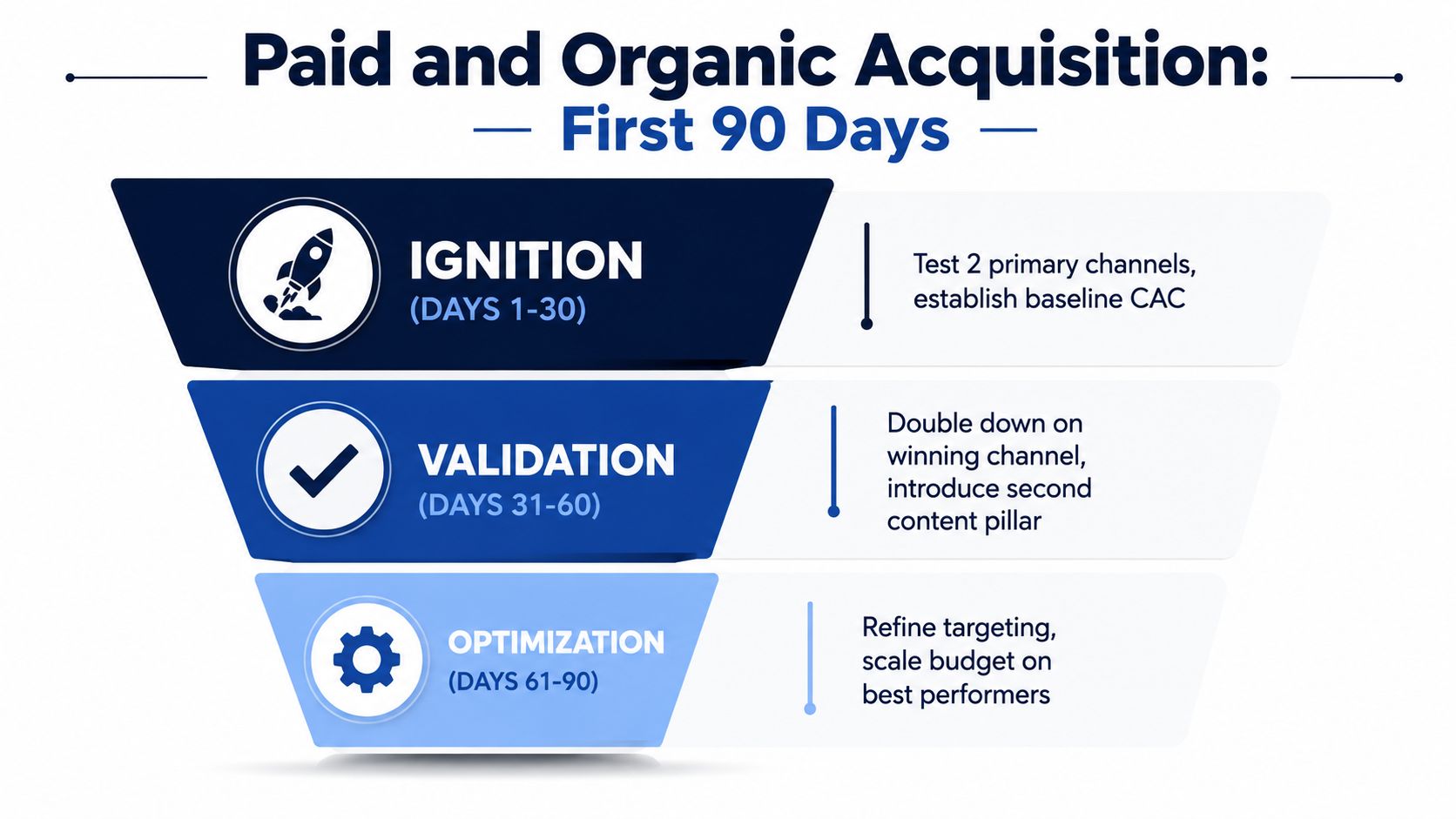
In days 1 to 30, run two primary channels, not six. If you're on Amazon, that usually means PPC plus listing optimization. If you're DTC, it's often Meta plus a content or creator seeding layer. If you need a deeper framework for budget discipline, the guidance on how to optimize ad spend for ecommerce is useful because it focuses on spend that supports signal, not spend that flatters dashboards.
Days 31 to 60 are for validation. At that point, double down on the winner and add a second content pillar or adjacent acquisition source. By days 61 to 90, you're optimizing targeting, refining creative, and scaling only what gives you acceptable economics. If a channel can't generate meaningful conversion volume, kill it before it burns the launch budget.
Paid tells you what converts now. Organic tells you what compounds. Use SEO, content, and creator seeding to support the same value proposition you're buying traffic with, not a separate brand project nobody can measure. If your channel mix creates traffic but no decision-making clarity, you're just collecting vanity metrics in different places.
The budget should be simple. Fund enough paid spend to generate clean data, then use organic assets to lower dependency over time. Don't confuse cheap impressions with cheap learning. The goal is conversion-volume truth, not bargain hunting.
Operations is the part of GTM that saves the business after the launch high wears off. If the 3PL is messy, if packaging breaks, if returns are slow, or if support isn't trained, you'll spend the next month cleaning up avoidable damage. The smartest teams treat ops readiness like launch infrastructure, not back-office admin.
Inventory buy depth matters because demand is useless if you stock out too early. Your 3PL needs to be selected before volume shows up, and the packaging has to be compliant with the channel you're selling through. Customer service also needs scripts, training, and escalation paths before the first complaint lands.
For production assets, the guidance at launch production assets guidance is a solid reminder that launch prep includes more than a creative brief. It's the unglamorous stuff that protects velocity. If you skip it, your team will waste time fixing preventable errors instead of learning from real customers.
A launch checklist should be tied to measurable signals, not optimism. For Amazon, watch review velocity. For DTC, watch repeat purchase behavior. For wholesale, watch sell-through. If the signal isn't moving, don't pretend the process is fine.
That checklist is boring on purpose. Boring beats emergency mode. The goal is to make sure every function knows what success looks like, who owns the next decision, and what signal tells you to keep going or stop.
If you want sharper launch decisions, faster peer feedback, and operators who've already made these mistakes at scale, visit Million Dollar Sellers. MDS gives ecommerce founders a private room for hard truth, proven launch thinking, and the kind of cross-channel experience that makes a go to market strategy hold up in the world.
Join the Ecom Entrepreneur Community for Vetted 7-9 Figure Ecommerce Founders
Learn MoreYou may also like:
Learn more about our special events!
Check Events