
Chilat Doina
June 17, 2026
You can usually tell when a brand has hit the ceiling on broad marketing. Spend goes up. Conversion gets noisy. New customer performance softens. Repeat rate looks fine in one pocket of the business and weak everywhere else. Amazon still moves units, but you can't clearly say which buyers are your best buyers. DTC gives you more data, but your email, paid social, landing pages, and retention flows still talk to too many people the same way.
That's the point where founders start asking what is market segmentation, not as a textbook exercise, but as an operating question. Which customers deserve more budget? Which products should be bundled for whom? Which audience is driving profit, not just top-line revenue?
Segmentation is how mature operators stop buying traffic for an average customer who doesn't exist. They build for distinct groups instead. If you want a useful outside primer, this guide to ecommerce segmentation is a solid refresher. If you're already pushing personalization across the stack, segmentation is the input that makes that work, especially when paired with a strong ecommerce personalization strategy.
At a small scale, broad messaging can hide a lot of mistakes. One hero SKU, one main promise, one decent acquisition channel, and the business still grows. At a larger scale, that same approach turns expensive fast.
Your best customers aren't the same as your highest-volume customers. Your Amazon buyers don't behave like your Shopify subscribers. The person who buys your premium bundle after reading three emails is not the same customer as the one who converts off a discount ad and never comes back. If you market to all of them the same way, you flatten your economics.
Usually, three things go wrong at once:
That's why market segmentation matters. It divides a broad market into smaller groups with shared needs using criteria like demographic, geographic, psychographic, behavioral, and in some businesses, firmographic data. This process transforms audiences into something you can size, prioritize, and execute against.
Segmentation is not a branding exercise. It's resource allocation.
A practical way to think about it is this. You're not trying to describe your customer base in a prettier deck. You're trying to decide where the next dollar of ad spend, inventory, lifecycle effort, and product attention should go.
Operators who scale well stop asking, “Who is our customer?” and start asking sharper questions:
That last point is huge in ecommerce. Amazon gives you demand and velocity, but limited customer-level visibility. DTC gives you richer first-party behavior. Omnichannel introduces more complexity, but also better opportunities if you can connect signals across touchpoints.
A lot of bad segmentation work starts and ends with demographics. Age, gender, household income, done. That's too shallow for a serious ecommerce business.
The four levers that matter most in practice are demographic, geographic, psychographic, and behavioral. You don't use them equally in every brand, and you don't need each one to be perfect. But together they move segmentation from generic audience labeling to usable operating logic.
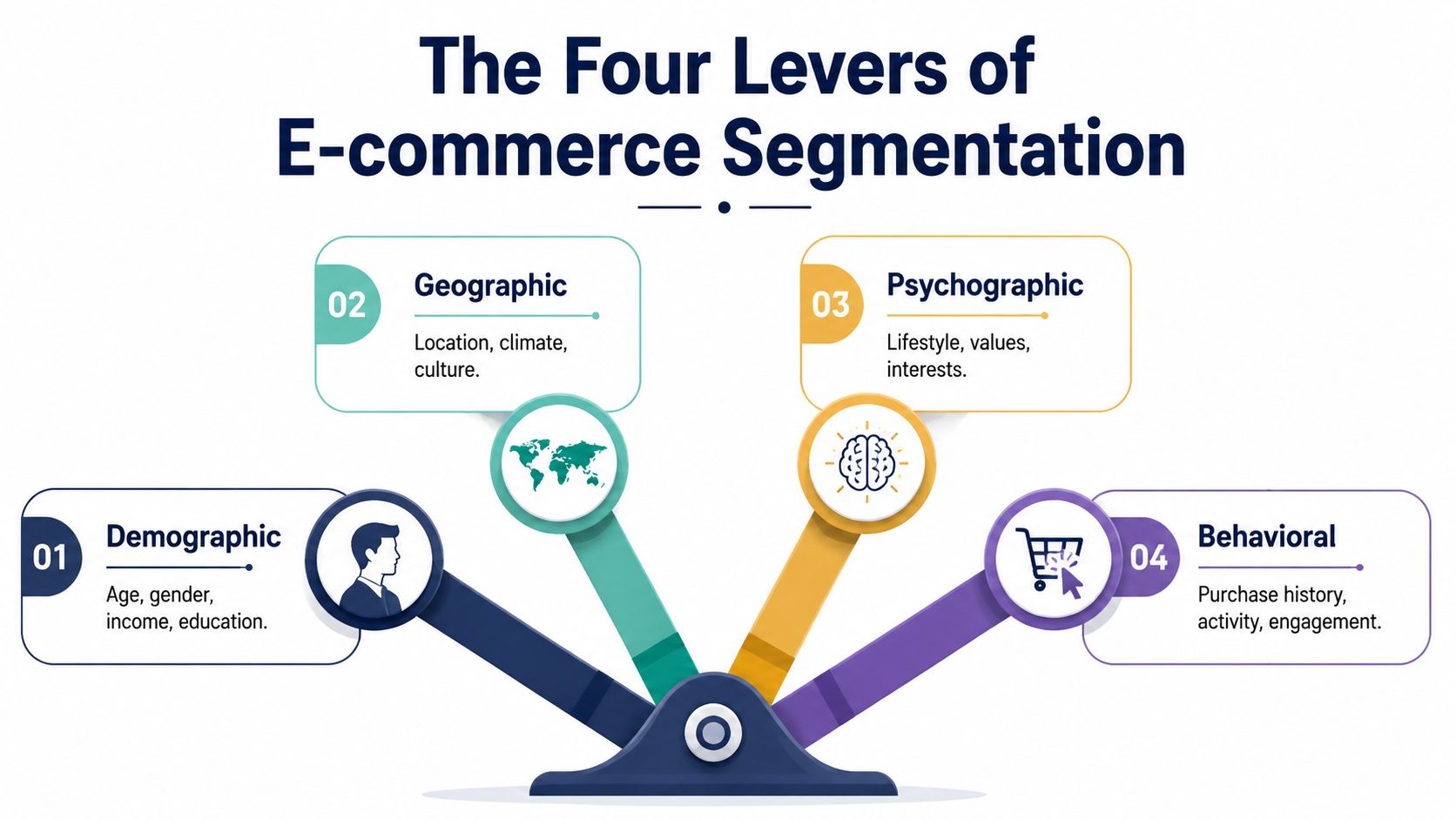
A university marketing guide example cited by Qualtrics uses U.S. college students as a segment of about 20 million people, which shows how segmentation turns an abstract audience into a measurable market you can evaluate for size, purchasing power, and reachability before committing resources, as explained in this Qualtrics overview of market segmentation.
This is the starting layer. It covers traits like age, gender, income, education, and life stage.
For ecommerce, demographics help with broad offer architecture. A premium skincare line may split messaging differently for younger buyers entering the category versus older buyers shopping for regimen depth. A home gym brand may separate creative for apartment dwellers versus households with dedicated workout space, even if the actual conversion driver turns out to be behavioral later.
Use demographic segmentation when you need to answer questions like:
Geography matters more than many founders think. Climate, shipping realities, seasonality, local norms, and even state-level demand patterns can change what should be promoted and when.
A hydration brand can push different bundles in hot-weather markets. A cold-weather apparel brand shouldn't launch outerwear messaging on the same cadence everywhere. If your margins are sensitive to freight or delivery times, geography also helps decide where to lean in and where to hold back.
In this context, category leaders separate themselves. Psychographic segmentation looks at lifestyle, values, interests, and identity. For many brands, this is what drives positioning.
Two customers can share the same income and age but buy for completely different reasons. One coffee buyer wants convenience and caffeine. Another wants ritual, quality, and equipment mastery. Same category. Different message, different creative, different retention path.
Operator view: Demographics explain eligibility. Psychographics explain resonance.
This is usually the highest-signal lever in ecommerce because it reflects actions, not assumptions. Purchase history, browsing depth, bundle selection, subscription status, repeat cadence, discount sensitivity, and email engagement all live here.
If you sell running shoes, “men age 25 to 40” is broad and weak. “Urban marathon runners who reorder performance socks, open training content, and buy higher-margin accessories” is actionable.
Here's the simple comparison:
| Segmentation Type | What It Answers | Example Data Points | Use Case for E-commerce |
|---|---|---|---|
| Demographic | Who is buying | Age, gender, income, life stage | Set pricing tiers, top-level offers, broad creative angles |
| Geographic | Where demand differs | Country, region, climate, urban or suburban location | Localize promotions, shipping strategy, seasonal merchandising |
| Psychographic | Why they buy | Lifestyle, values, interests, identity cues | Sharpen brand messaging, creative themes, product positioning |
| Behavioral | What they do | Purchase history, browsing, repeat rate, bundle selection, engagement | Build retention flows, upsells, audience exclusions, VIP logic |
The mistake is treating these as separate boxes. The core value comes from combining them. That's when a broad persona becomes a segment you can target, stock, and monetize.
Brands that don't segment tend to spend like tourists. They buy reach, hope the algorithm sorts it out, and call the results “blended.” That works until cash discipline matters again.
Segmentation fixes that because it narrows execution to the buyers and use cases that deserve focused attention. This isn't just a marketing improvement. It changes how you allocate budget, plan inventory, and decide which products should get more oxygen.
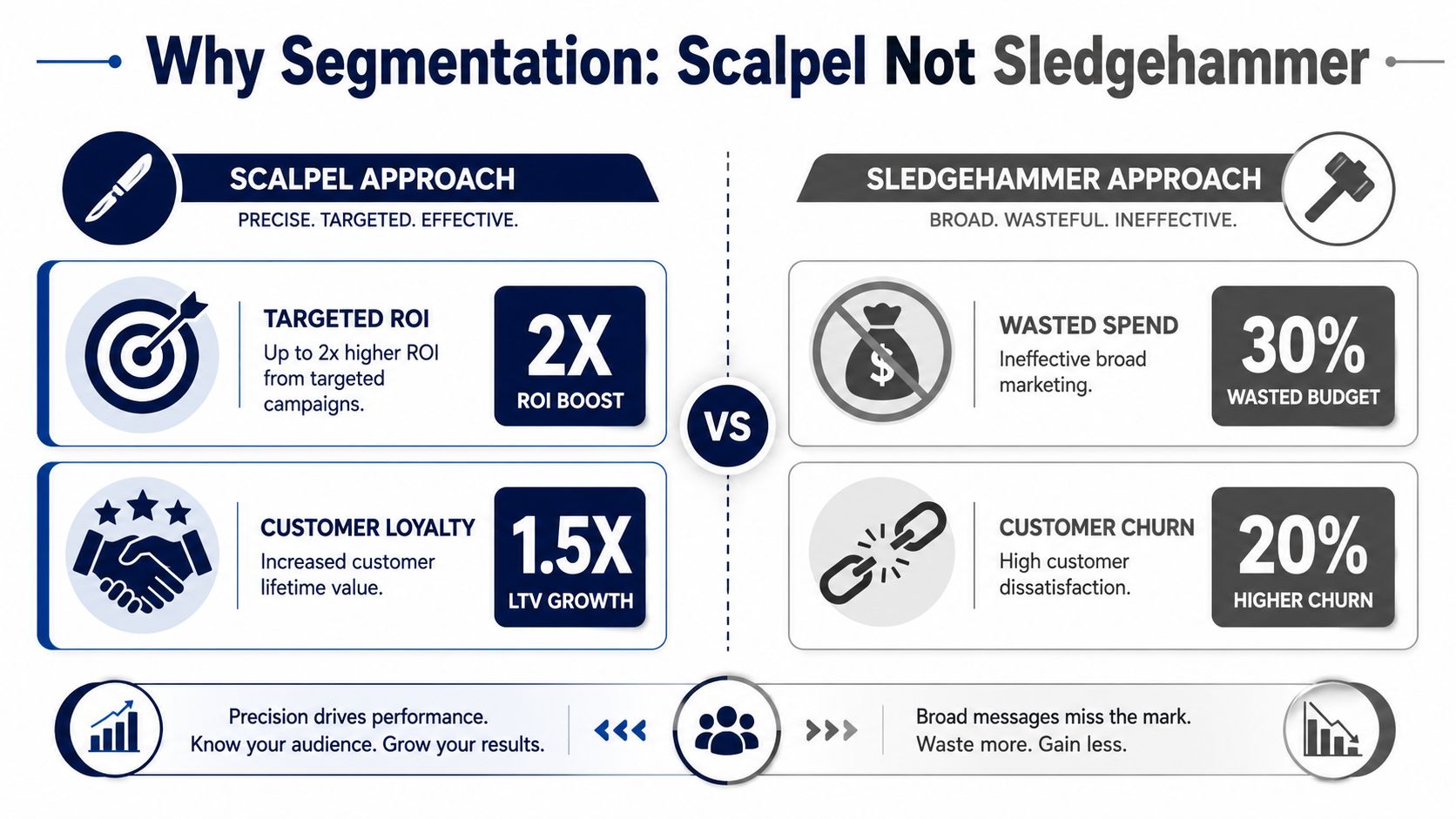
Industry data compiled by Coursera notes that 70% of marketers use market segmentation, and 80% of companies using segmentation say it increased sales, which is a useful signal that segmentation is now a mainstream operating model rather than a niche theory, according to this Coursera article on market segmentation.
The first benefit is cleaner acquisition. When you know which segments produce strong repeat behavior, you stop optimizing only for front-end conversion and start acquiring buyers who fit the business you want to build.
The second benefit is improved retention. Different segments need different post-purchase journeys. A first-time buyer of a consumable product should not get the same lifecycle sequence as a customer who just bought a premium gift set. One needs habit formation. The other may need education, accessories, or replenishment timing.
The third benefit is better product and inventory decisions. If a segment consistently prefers bundles, larger pack sizes, or premium variants, you can stock and feature accordingly. If another segment only appears during heavy promotion, you know not to overbuild the business around them.
Founders often think segmentation is for campaign managers. It's not. It's for whoever decides where capital goes.
Ask these questions:
If a segment doesn't justify different action, it isn't a useful segment.
That's the core distinction. Segmentation is only valuable when it creates a better decision than a broad-market approach would have produced. If all it gives you is prettier language for the same generic campaign, it's a waste of time.
Organizations often overcomplicate segmentation at the start and underbuild the data foundation underneath it. The right sequence is simple. Unify the signals you already have, identify repeatable patterns, create segments you can act on, then refine based on performance.
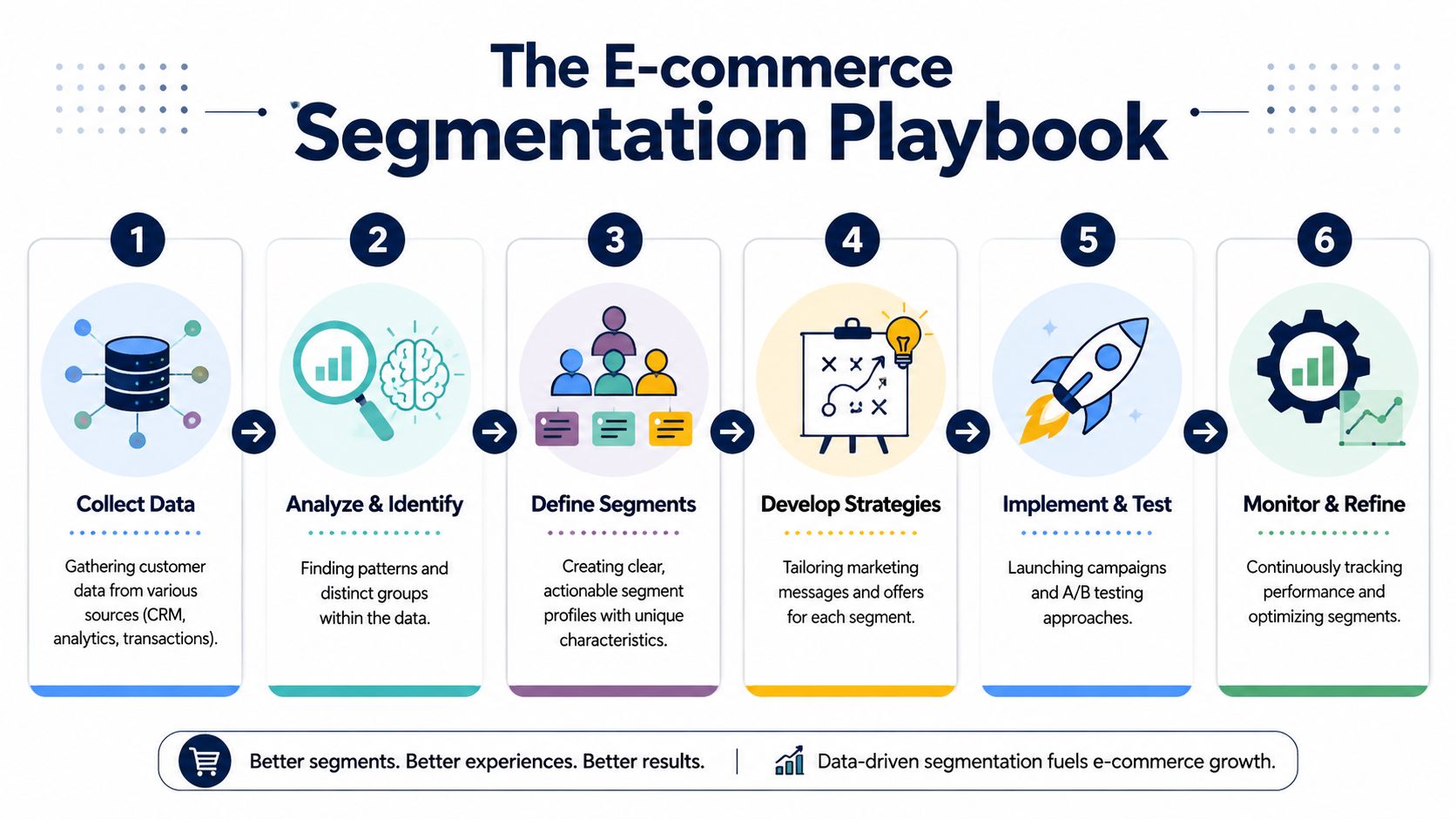
Salesforce recommends harmonizing data from multiple sources into unified profiles, and both Salesforce and Adobe emphasize that segments should be treated as iterative hypotheses tested and refined against performance and ROI, which is a strong operating principle in this Salesforce guide to customer segmentation.
For DTC brands, the usual stack is enough to build useful segments:
On Amazon, the data is thinner, but not useless. Amazon Brand Analytics, search term behavior, SKU-level conversion patterns, review themes, and repeat purchase behavior by product can still help you infer distinct buyer groups. You won't get the same customer-level depth as DTC, so your segments often need to be product- and intent-led instead of identity-led.
For most ecommerce brands, RFM analysis is the workhorse.
RFM stands for:
Recency
How recently someone purchased
Frequency
How often they purchase
Monetary
How much they spend
This model is useful because it ties directly to profit behavior. You don't need a data science team to start. Export customer order history, score buyers across those three dimensions, then group them into practical tiers.
A basic structure might look like this:
Each of those groups should get different treatment. Best customers get early access, premium bundles, and retention-first messaging. Promising customers get education and product discovery. At-risk customers get win-back sequences tied to what they previously bought. Low-value deal seekers may get controlled promotion exposure, but not your best margin-eroding offers.
Practical rule: If your segment logic can't map to a concrete email flow, ad audience, landing page, or merchandising rule, it's still too theoretical.
For abandoned cart and recovery-focused segments, it also helps to pressure-test your lifecycle setup against a tactical resource like app store research's recovery playbook, especially if cart intent varies a lot by product type or price point.
Once the business has larger datasets and cleaner customer records, clustering methods can add depth. K-means clustering is a common example. It groups customers based on similarity across multiple variables, not just three.
That can uncover patterns RFM misses, like a segment that buys infrequently but always purchases high-margin launches, or a segment that engages heavily with content before converting. The trade-off is complexity. These models are harder to explain, easier to overfit, and useless if your data is fragmented.
For most sellers, the progression should be:
| Stage | Best Method | Why It Works |
|---|---|---|
| Early to mid scale | Manual rule-based segments | Fast to deploy, easy to activate |
| Established DTC | RFM analysis | Clear tie to purchase behavior and retention |
| Larger datasets | Multi-variable clustering | Finds deeper patterns across behaviors |
| Omnichannel maturity | Unified customer profiles plus iterative testing | Connects channel signals into one decision layer |
The winning habit isn't sophistication. It's iteration. Build the segment, run the action, measure the result, then tighten the model.
A segment sitting in a spreadsheet has no value. It starts paying for itself when it changes execution on Amazon, DTC, and in the gaps between channels.

The challenge is that each channel gives you different visibility. DTC gives you direct behavior. Amazon gives you less identity and more marketplace signal. Omnichannel gives you more opportunity, but only if your systems can connect the dots.
On Amazon, you usually can't build the same rich customer segmentation you can on Shopify. So don't force it. Work with what the channel gives you.
A useful approach is to segment around:
If one ASIN mainly attracts replacement buyers and another attracts first-time category entrants, those products shouldn't share the same creative logic in Sponsored Brands, listing images, or Store layout. Segment at the product and intent level when customer-level identity is thin.
DTC is where segmentation becomes a real operating advantage. You can trigger flows, suppress offers, and tailor on-site experiences based on actual behavior.
A few examples:
This is also where search behavior is becoming more useful. As AI-driven discovery changes how people browse and refine product choices, segment-level intent will matter even more. If you're thinking through that shift, this piece on the future of AI search in ecommerce is worth reading.
Later in the funnel, channel orchestration matters too:
Omnichannel segmentation breaks when teams treat each sales channel as a separate business. It works when you use one signal to improve another channel.
If a customer repeatedly buys a product online and later appears in retail or marketplace demand, that pattern should influence offer sequencing, timing, and merchandising. If a segment responds to education-heavy email before converting online, that can inform retail packaging claims and in-store messaging too.
For brands trying to coordinate those touchpoints, a clear omnichannel marketing strategy matters more than another dashboard.
Smaller, more precise segments aren't automatically better. A segment has to be distinct, reachable, and large enough to support repeatable execution.
That last point is where many brands go wrong. Product Marketing Alliance notes that over-segmentation creates audiences too small for efficient testing or media buying, especially as privacy shifts make tiny audiences harder to activate at scale, as explained in this Product Marketing Alliance article on market segmentation.
If you need separate creative, separate landing pages, separate flows, and separate spend to support a segment, that segment needs to be economically meaningful. Otherwise, you're building operational drag, not advantage.
Most segmentation projects fail for a simple reason. Teams define groups, launch campaigns, and never prove whether those segments changed the economics of the business.

An effective segmentation model should prioritize groups based on attractiveness factors like size, growth potential, profitability, and accessibility, because the point isn't just to group customers. It's to guide targeting and resource allocation, as outlined in this Simon-Kucher guide to segmentation strategy.
If you want segmentation to survive contact with finance, track metrics that tie to profit:
If your team needs a tighter scorecard, use a practical set of ecommerce KPIs and break them out by segment instead of reviewing only blended totals.
The first mistake is using static segments. Customers move. Their buying patterns, interests, and price sensitivity change. If the segment never updates, the campaigns get stale while the dashboard still looks organized.
The second mistake is choosing segments because they're easy to describe. “Women 25 to 34” is easy. It may also be commercially weak if it doesn't map to distinct behavior or margin.
The third mistake is poor data hygiene. Duplicates, missing order history, disconnected tools, and inconsistent product naming ruin segmentation quality. Teams then blame the model when the input was the problem.
Good segmentation should make the business simpler to run, not harder.
That's the ultimate test. If your segmentation framework produces sharper decisions on spend, retention, merchandising, and product focus, keep investing in it. If it only creates more slides, more audiences, and more edge-case campaigns, cut it back and rebuild around segments that truly matter.
Serious sellers don't need more theory. They need sharper decisions, vetted operators, and real conversations with founders who've already solved the next problem. Million Dollar Sellers is where 7, 8, and 9-figure ecommerce entrepreneurs across Amazon, DTC, and omnichannel share what's working behind the scenes so you can scale smarter.
Join the Ecom Entrepreneur Community for Vetted 7-9 Figure Ecommerce Founders
Learn MoreYou may also like:
Learn more about our special events!
Check Events