Chilat Doina
February 6, 2026
Product-market fit validation is just a fancy way of saying you've confirmed people actually want your product before you sink your life savings into inventory and marketing. It’s about gathering real-world proof that customers will open their wallets for what you’re selling, so you don't end up with a garage full of stuff nobody wants.

The silent killer of countless ambitious e-commerce brands isn't a bad marketing campaign or a weak social media game. It's something far more fundamental: building a product nobody was asking for in the first place. This is the single biggest reason promising launches end with a whimper instead of a bang.
We all get caught up in our own excitement, convinced our idea is the next big thing. But the numbers tell a much more sobering story.
Of the 305 million startups created every year, a staggering 90% fail. And the top reason isn't a lack of funding or fierce competition—it's building something for a market that simply doesn't exist. Research consistently shows that between 35% and 42% of failed startups point directly to a lack of market need as their downfall.
That’s why a structured product-market fit validation process isn't just a business school buzzword. It's a survival tool, whether you're scaling on Amazon or building a DTC brand from the ground up.
Instead of seeing validation as another hurdle to jump, think of it as the best insurance policy you can buy for your time, energy, and capital.
Every dollar you spend on pre-launch experiments can save you thousands in unsold inventory and wasted ad spend down the road. The whole point is to de-risk your investment by answering one simple question with confidence: "Do people want this enough to actually pay for it?"
A solid validation framework turns your launch from a blind gamble into a calculated business decision. It's about swapping assumptions for hard evidence.
"Every time you work on something new, whether it’s a new feature, a new product, or a new product line, recognize that you are searching for incremental product-market fit." - Brad Feld
Getting this mindset right is everything. To avoid those quiet failures, brands need robust Ecommerce Growth Strategies that focus on revenue and retention. By validating your idea first, you ensure all your future growth efforts are built on solid ground. And if you're gearing up for a launch, our guide on building a product launch strategy is a great next step: https://www.mds.co/blog/product-launch-strategy-template.
Every successful product journey starts long before you build a landing page or launch a clever ad. It begins with a simple, powerful blueprint—the strategic groundwork you lay before a single dollar leaves your bank account.
This is about moving beyond a fuzzy idea and into a concrete framework. It’s how you turn your gut feelings and assumptions into sharp, testable questions.
Jumping straight into experiments without this prep work is like trying to build a house without plans. Sure, you might get a wall up, but it’s probably wobbly and in the wrong spot. The goal here is to get surgically precise about who you're serving and what you're promising them.
First things first: you need a razor-sharp Ideal Customer Profile (ICP). Generic demographics like "women aged 25-40" are totally useless. You have to dig way deeper into the psychographics—the beliefs, pains, and real motivations of a very specific group of people.
Your ICP should be so detailed you feel like you know this person. For example, instead of a broad target, you might define your ICP like this:
This level of detail isn't just a creative exercise. It directly informs your ad targeting, your messaging, and the features you decide to build. A critical step in crafting your blueprint is understanding how to do product research for dropshipping, as these initial insights can heavily influence your ICP. When you know "Sarah," you know exactly where to find her and how to speak her language.
Once you have a crystal-clear ICP, you can craft a value proposition that actually resonates. Here’s a secret: customers don’t buy features, they buy solutions to their problems. Your job is to translate what your product does into what it does for them.
Think of it this way:
This value proposition becomes the core message for all your marketing and testing. It’s the hook that grabs your ICP's attention and makes them feel like you get them.
Now it's time to bring it all together. You combine your ICP and value proposition to create clear, testable hypotheses. This is where your product-market fit validation plan really takes shape. A strong hypothesis isn't just a guess; it's a specific, falsifiable statement about your customer, their problem, and your proposed solution.
A good hypothesis usually follows a simple structure: "We believe [specific customer segment] will [take a specific action] because of [specific value]."
The Power of a Well-Formed Hypothesis
A strong hypothesis acts as your North Star for every experiment. It stops you from getting distracted by vanity metrics and keeps you focused on answering the most critical question: "Are we right about who wants this and why?"
Here are a few real-world examples for different e-commerce models:
Each hypothesis contains a specific audience, a measurable action, and a clear "why." This structure makes them easy to prove or disprove with low-cost experiments, which is the whole point of this planning stage. To discover more about selecting the right items for your brand, check out our guide on how to find winning products.
Okay, you've got your blueprint. Now it's time to stop theorizing and start testing. This is the part where we move from educated guesses to real-world evidence, using low-cost experiments to see if people actually want what you're selling. Assumptions are cheap; data from real customers is gold.
The goal here isn't to launch a perfect, fully-baked product. Not even close. We’re building the absolute minimum required to test our core hypothesis. We need to answer one critical question: will someone take a meaningful action that signals they’re willing to pay for our solution?
This whole validation journey really boils down to three key phases: figuring out the customer, deeply understanding their problem, and only then testing your proposed solution.
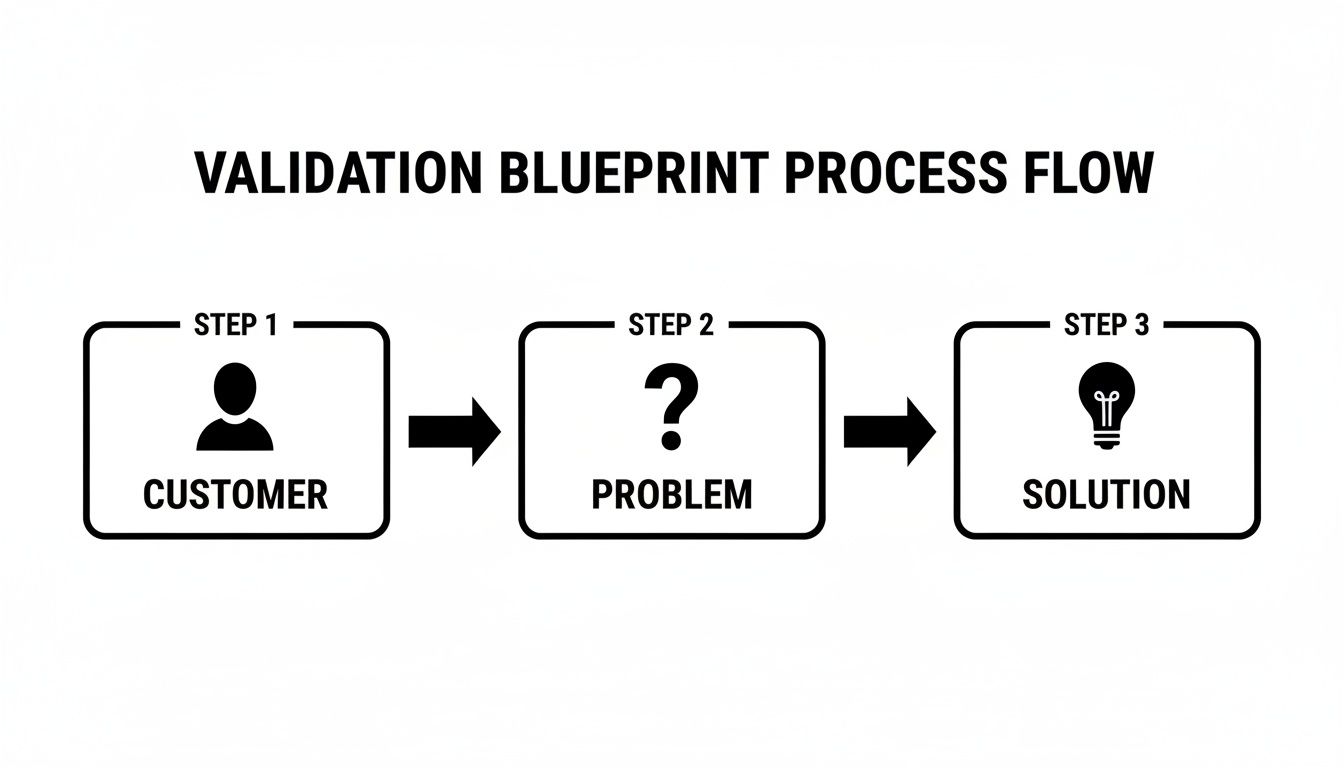
As you can see, it all starts with the customer. The product is the final piece of the puzzle, and it should only be built after you have solid proof that you've found a painful problem for a very specific group of people.
One of the quickest and most effective ways to gauge demand is with a simple landing page. This isn't your full-blown website. It's a single, focused page with one job: to sell the idea of your product and convince visitors to hand over their email address or even pre-order.
Think of it as a digital storefront for a product that doesn't technically exist yet. The trick is to make it look and feel completely real. Use compelling mockups or product renders, write sharp copy that speaks directly to your ideal customer's pain points, and have a crystal-clear call-to-action (CTA).
Your main metric here is the conversion rate. A solid benchmark for a "coming soon" page is a 5-15% email signup rate. If you can get into that range or higher, you've got a powerful early signal that your value proposition is hitting the mark.
Emails are great, but nothing screams validation like someone pulling out their credit card. A pre-sale or a small-batch launch is the ultimate test of purchase intent. It confirms that customers find your price point acceptable and trust your brand enough to pay for something they can’t have immediately.
You don't need to order a massive inventory run. In fact, starting small is much smarter.
This approach keeps your financial risk incredibly low while giving you undeniable proof of demand. If you can sell out a small batch, you’ve just seriously de-risked your big launch.
Expert Insight: True validation isn't about sign-ups. It's about confirming people will actually pay. A successful pre-sale, no matter how small, is one of the strongest positive signals you can possibly get.
So, how do you get eyeballs on your landing page or pre-sale offer? Small, hyper-targeted ad campaigns on platforms like Facebook, Instagram, or TikTok. This isn't about scaling—it's about learning.
You have two main objectives here:
Set a tiny daily budget. Seriously, even $20-$50 per day is plenty to start gathering meaningful data. Test different ad angles, copy, and audience segments based on the hypotheses you came up with earlier. For example, you could run an ad focused on sustainability against one focused on convenience to see which message truly resonates.
These lean experiments are the heart of the product market fit validation process. They turn your assumptions into hard data, guiding you toward a product people don't just "like," but one they genuinely want to buy.
So, your experiments are live. You're starting to see clicks, sign-ups, and maybe even your first few pre-order dollars rolling in. This is where the rubber meets the road. All that data is the raw material for your big go/no-go decision, but it's totally useless without a framework to make sense of it all.
This is the quantitative side of product-market fit validation. It's all about turning those raw numbers into clear, undeniable signals that people actually want what you're selling.
Forget vanity metrics like social media likes or a spike in website traffic. Those won't help you here. We need to zero in on the key performance indicators (KPIs) that have a direct line to your profitability and long-term survival as an e-commerce brand.
These numbers tell a story. They’ll show you whether your product is just a "nice-to-have" or an absolute "must-have" for the customers you’re trying to reach.
One of the most powerful and direct ways to gauge this is the Sean Ellis Test. It’s a beautifully simple survey that cuts straight to the heart of the matter with one crucial question: "How would you feel if you could no longer use this product?"
The magic number you're looking for is 40%. If at least 40% of your early users say they would be "very disappointed," you've probably hit on a strong signal of product-market fit. Anything less than that is a clear sign you’ve got more work to do, whether that's tweaking the product or rethinking your entire target audience.
This isn't just some random theory; it's a proven benchmark that some of the fastest-growing startups have used to find their footing. It’s a gut check that forces you to be honest about whether you've created a vitamin (nice to have) or a painkiller (essential).
The Sean Ellis Survey Template
You can send this out via email or use a simple pop-up after a customer has had enough time to really experience your product's core value.
Don't sleep on those follow-up questions. That's where you'll find the gold—the "why" behind the numbers.
Beyond the Sean Ellis test, you need to keep a close eye on a few core financial and engagement metrics. These numbers provide the business context for your validation. For B2C e-commerce brands, this process gives much quicker feedback from buyers compared to the often painfully long sales cycles in B2B.
Ignoring this early validation is a fast track to burning cash and failing. Nailing it, on the other hand, can set the foundation for massive growth.
Here are the essentials you need to be tracking:
Tracking these numbers gives you a clear, data-backed picture of your product's real potential. It helps you understand not just if people are interested, but if that interest can actually be turned into a profitable, sustainable business.
To get a better handle on these calculations, check out our guide on what unit economics are and why they're so critical for your brand's success.

Metrics like LTV:CAC and conversion rates are great for telling you what is happening with your product. But they can never tell you the one thing you really need to know: why.
This is where talking to your customers becomes your secret weapon in the whole product market fit validation game. It’s about stepping away from the spreadsheets and actually getting inside the heads of your very first, most enthusiastic buyers. Their stories, their frustrations, and the unexpected ways they use your product hold the keys to your next big move.
Honestly, the insights you can pull from just a few real conversations are often worth more than thousands of data points. You might just discover a killer feature you’d completely missed or a core benefit you weren’t even marketing.
I get it—talking to your first buyers can feel a little intimidating. But it's easily the most powerful way to uncover those deep, game-changing insights. The goal here isn't to sell them anything else; it's just to listen with genuine curiosity.
Your mission is to understand their world, their problems, and how your product actually fits into their lives. You want them to tell you the full story, from the moment they realized they had a problem to how they felt after your product arrived.
Keep it casual. You’re not conducting a formal interrogation; you’re just having a chat with someone who believed in your idea enough to hand over their cash.
Pro Tip: Always offer a small incentive for their time, like a gift card or a discount on their next order. It’s a small gesture that shows you value their input and will dramatically boost your participation rates. Respecting their time is everything.
Whatever you do, avoid simple yes/no questions. Your entire goal is to get them talking. You need open-ended prompts that encourage them to tell a story. And always focus on what they have done in the past, not what they say they might do in the future—past behavior is where the truth lives.
Here are a few of my go-to, open-ended questions to get the conversation flowing:
As they talk, listen for recurring themes, the specific words they use, and any moments of hesitation or excitement. Those are the breadcrumbs that lead to real understanding.
While you're gathering feedback, it helps to understand the two main types you'll encounter. Both are crucial, but they serve different purposes in your validation journey. Quantitative data gives you the hard numbers, while qualitative feedback provides the context and the story behind those numbers.
.tbl-scroll{contain:inline-size;overflow-x:auto;-webkit-overflow-scrolling:touch}.tbl-scroll table{min-width:600px;width:100%;border-collapse:collapse;margin-bottom:20px}.tbl-scroll th{border:1px solid #ddd;padding:8px;text-align:left;background-color:#f2f2f2;white-space:nowrap}.tbl-scroll td{border:1px solid #ddd;padding:8px;text-align:left}Feedback TypeWhat It AnswersPrimary ToolsBest ForQuantitativeWhat is happening? How many?Analytics platforms (Google Analytics, Shopify), A/B testing tools, financial metricsMeasuring performance at scale, identifying trends, validating high-level hypothesesQualitativeWhy is it happening? How do customers feel?Customer interviews, open-ended surveys, support tickets, reviewsUnderstanding user motivation, uncovering pain points, getting ideas for new features
Think of them as two sides of the same coin. The numbers tell you that your conversion rate dropped, but a customer interview is what tells you it's because the "add to cart" button is hard to find on mobile.
While interviews give you depth, automated post-purchase surveys are all about getting breadth. They let you capture immediate reactions from a much wider range of customers and get a pulse on their entire buying experience.
You can easily set up a simple survey to go out via email a few days after their order is delivered. The timing is key here—it’s late enough that they’ve had a chance to try the product but soon enough that the purchase is still fresh in their mind.
Here’s a simple template you can steal and adapt:
Whether you're sifting through survey responses or interview notes, you're looking for patterns. When you hear the same surprising benefit mentioned by three different customers, or the same point of confusion pops up in multiple survey responses, you’ve struck gold. This is the stuff that, when paired with your hard metrics, gives you the complete picture you need to confidently validate your product market fit.
Even with a solid framework, hitting product market fit is never a perfectly straight line. It’s messy. Founders constantly bump into the same roadblocks and second-guess their next move. Let's walk through the most common questions I hear and give you some direct, no-fluff answers to keep you moving.
These aren't just hypotheticals—they're the real-world snags that can kill your momentum. Getting a handle on them now will save you a ton of aspirin later.
Everyone wants a magic number, but there isn't one. That said, for a B2C e-commerce product, you should be able to get strong signals one way or the other within 3 to 6 months.
The real key isn't the calendar; it's how fast you're learning. Your goal should be to run quick, focused experiments that teach you something new every single week.
Unlike B2B, where you might be stuck in a year-long sales cycle, e-commerce gives you feedback almost instantly. The focus needs to be on shortening your "build-measure-learn" loop, not hitting some arbitrary deadline.
For instance, you could run a one-week ad sprint just to test a new value proposition. The very next week, you’re digging into the data and launching another sprint with tweaked messaging. This kind of agile approach is what separates the winners from the rest.
Look, the most important thing is getting to statistical significance in your tests. It's far better to spend another month gathering clear data than to make a massive financial bet based on a handful of wishy-washy results.
First off, don't panic. Mixed results aren't a failure—they're a signal from the market telling you to dig deeper and iterate. Honestly, they’re incredibly common and often point you toward a much better, more refined strategy.
When you're staring at a spreadsheet that doesn't make sense, it's time to start slicing up your data to find the hidden pockets of success.
Here’s how to read the tea leaves on common mixed signals:
Unclear results just mean it’s time to sharpen your hypothesis, not abandon ship.
Absolutely. In fact, using Amazon's massive ecosystem is one of the smartest ways for a private label seller to de-risk a new product. While Amazon doesn't offer a traditional pre-order page for new sellers, you can get creative.
A killer tactic is to create a "ghost listing." This means you build out a fully optimized product detail page—I’m talking high-quality images, sharp copy, compelling A+ content—all without having any active inventory.
Once your listing is live, you can drive targeted external traffic to it from places like Facebook, TikTok, or Google Ads. You won't make any sales, obviously, but you can track crucial backend metrics. The number of people who click "Add to Cart" is a powerful proxy for real purchase intent at your target price.
Another great move is to use the Amazon Vine program with a tiny initial batch of inventory (under 30 units). This gets you early, honest reviews from trusted reviewers, giving you invaluable qualitative feedback before you commit to a huge, expensive FBA shipment. This is lean validation at its best.
At Million Dollar Sellers, we see top entrepreneurs wrestle with these validation challenges every single day. Our community is built on sharing the exact, in-the-trenches strategies that work for scaling 7-, 8-, and 9-figure brands. If you're ready to learn from the best in the business, see if you qualify to join us.
Join the Ecom Entrepreneur Community for Vetted 7-9 Figure Ecommerce Founders
Learn MoreYou may also like:
Learn more about our special events!
Check Events