
Chilat Doina
August 7, 2026
Most ecommerce brands get customer value proposition wrong because they treat it like copy, not strategy. A homepage headline can be polished and still be useless if it doesn't help you decide what to price, what to build, and what to stop saying in ads.
The better question is simple, what is customer value proposition in a business that has to win customers, keep them, and survive margin pressure? In practice, it's the filter that tells you which promise is worth making, which product change deserves investment, and which message will sound credible when a buyer is comparing you against the next-best alternative.
The most common mistake is reducing the CVP to a slogan. A brand says it sells “premium quality,” “fast shipping,” or “made for busy people,” but none of that helps a shopper decide whether the offer is meaningfully different from the other tabs already open in their browser. In crowded ecommerce, vague value gets ignored fast.
A stronger way to think about it comes from the historical shift in CVP thinking. The literature moved from broad “all benefits” language toward a more disciplined focus on the value that matters most relative to the customer's next-best alternative. That matters because customers don't buy the longest feature list, they buy the offer that feels most relevant to their job, pain, and expected gain. The 2017 Journal of the Academy of Marketing Science article on CVP shows that the field matured over decades into this more selective approach, including the distinction between “all benefits,” “favorable points of difference,” and a “resonating focus” that concentrates on the few things that matter most. Journal of the Academy of Marketing Science article on CVP evolution
On Amazon and DTC, feature dumps usually fail for the same reason. They describe the product, but they don't make the buying decision easier. Customers already assume your competitors can say something similar, so “high quality materials,” “lab-tested,” or “designed in California” only work if they connect to a specific outcome that shoppers care about.
Practical rule: If your proposition doesn't help a customer choose between you and the next option in under a few seconds, it's not doing its job.
That's why a CVP should act like an operating filter, not a marketing garnish. It should shape pricing, because the right promise supports a higher willingness to pay. It should shape product roadmap decisions, because not every request deserves engineering time. It should shape retention, because a proposition that only converts first orders won't protect repeat revenue.
For teams sharpening message discipline, the practical side of this work often lives in conversion testing, not brainstorming. A useful resource is the 2026 conversion optimization course, especially if your team needs to pressure-test claims on product pages instead of just debating them in Slack.
If your current CVP sounds nice but doesn't influence what you build, what you charge, or what customers come back for, it's not a strategy yet. It's just copy.
A customer value proposition is the statement of value a firm creates for a specific market segment. The segment choice matters because value is always relative, customers judge you against their next-best alternative, not against your internal feature list. That's why a CVP that tries to appeal to everyone ends up meaning almost nothing.
The clearest modern framing is simple. A CVP should identify the target segment, the customer job-to-be-done, and the few points of difference that matter most over the foreseeable future. That's the operational version, the one useful for pricing, positioning, and roadmap decisions, not just brand copy.
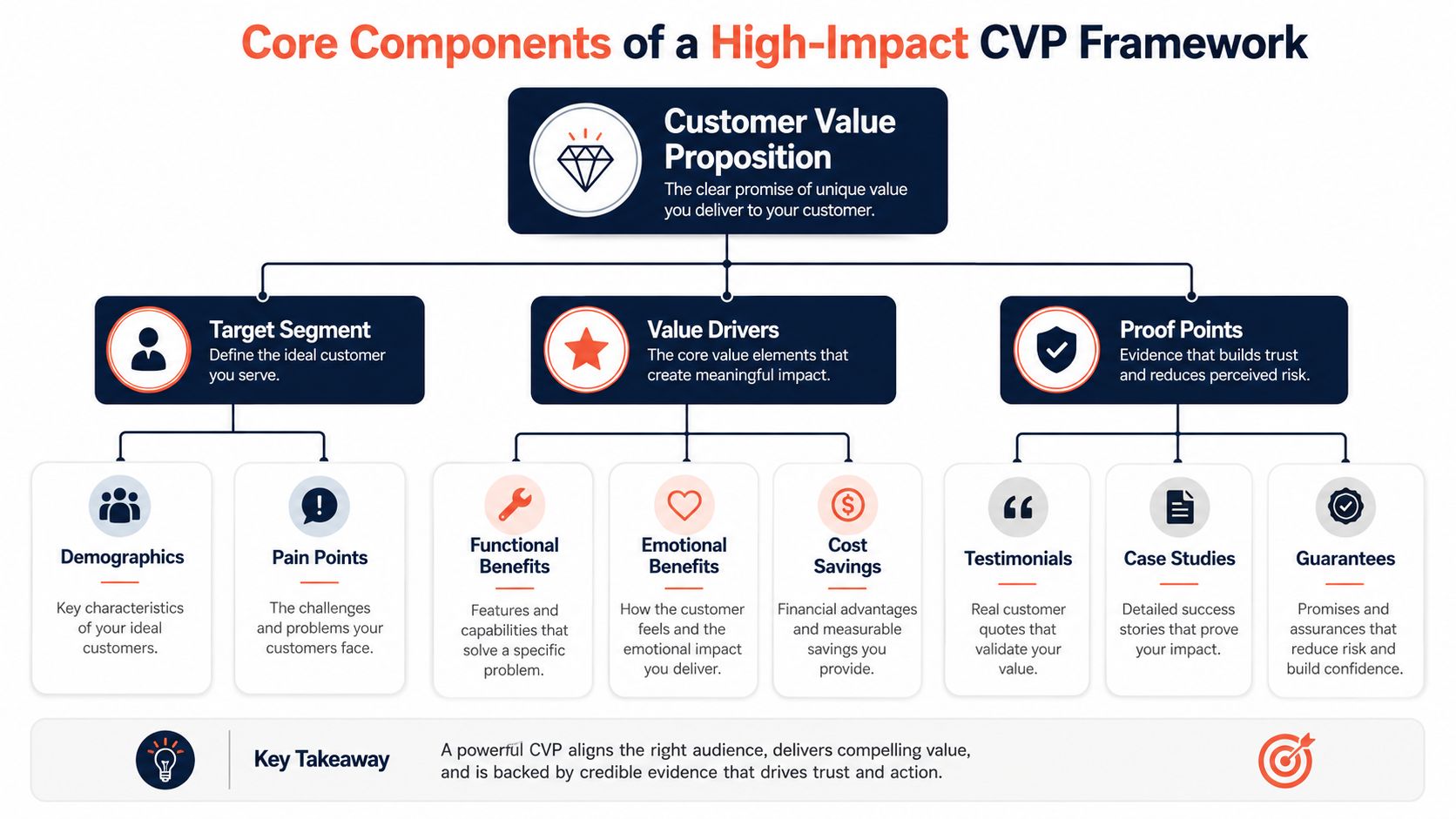
The biggest strategic mistake is writing one message for every buyer persona. That usually creates a mushy promise that sounds safe but performs badly. A better CVP is narrow enough to be believable and differentiated, while still strong enough to shape choice in a competitive market.
That's why the phrase “customer job-to-be-done” matters more than product category. A buyer doesn't want a skincare cleanser, a supplement, or a shoe. They want clearer skin, less friction, better comfort, fewer returns, or lower risk. Once you know the job, you can write a proposition that maps to what the customer is trying to accomplish.
A useful companion resource for translating strategy into sharper messaging is these brand voice examples for 2026. Voice matters because the best CVP still has to sound like your brand, not like a template.
An academically strong CVP isn't just aspirational language. It has to be evidence-backed and outcome-oriented. That means tying the promise to functional, economic, or experience value, then proving it with something real, like testimonials, sales data, or customer feedback. Salesforce's guidance on customer value propositions points in the same direction, a good CVP should name the target customer, the pain point, the solution, the benefits, the differentiation, and proof. Salesforce guidance on customer value propositions
For ecommerce operators, that credibility becomes a business advantage. Shoppers move fast, compare easily, and don't reward fuzzy claims. If your proposition can't survive comparison, it doesn't matter how polished the wording is.
For brand-level positioning work, the same logic applies across the broader business, not just the PDP. The way a CVP fits into an overall growth plan is closely related to ecommerce brand strategy, because message, offer, and operating model have to line up.
A working CVP has five moving parts, and they need to fit together cleanly. First, the target segment. Second, the specific customer job. Third, the differentiating benefits. Fourth, the proof that makes the promise believable. Fifth, the competitive contrast that explains why your offer wins.
A lot of brands stop at the first three and wonder why conversion is inconsistent. The missing pieces are usually proof and contrast. If the shopper can't tell why your offer is different, or can't trust that difference, the proposition won't move them.
Start with the result the customer wants. On ecommerce teams, that often means translating a feature into a practical payoff, then into a buying reason. The feature matters, but only because it creates a better outcome.
Here's the working pattern:
Operator's note: If a benefit is table stakes in your category, it doesn't belong at the center of the CVP. It can support the offer, but it can't carry it.
That also separates stated value from credible value. A proposition only works when the business delivers it through a distinct activity system, not just stronger copy. Harvard Business School's strategy guidance makes that point clearly, a unique value proposition is hard to copy when it is tied to how the business operates, not just how it advertises. Harvard Business School strategy guidance on unique value propositions
Ecommerce leaders separate themselves from operators who only think in campaigns. If the CVP says “faster delivery,” but your warehouse SLA can't support it, you're creating a promise problem. If the CVP says “premium fit,” but product reviews are full of sizing complaints, the proposition is already breaking.
Use the framework as a checklist before launch, before a price increase, and before a roadmap commit. If the segment is unclear, the message is too broad. If the proof is thin, the claim is too ambitious. If the contrast with competitors is missing, the market will decide for you.
Pricing, product roadmap, and retention all sit inside that same filter. A seller who understands product differentiation examples can see which claims are real advantages, which are only slogans, and which ones deserve investment because they support higher CLV.
A weak CVP usually sounds like a category label. “Quality shoes.” “Natural supplements.” “Fast home goods.” Those phrases describe the shelf, not the reason to buy. They don't help a shopper understand who the product is for or why it's worth switching.
A strong CVP sounds more like a buying outcome. “We help busy professionals find comfortable shoes that last.” That version is narrower, more believable, and easier to place against alternatives. It speaks to a real job, not a generic product claim.
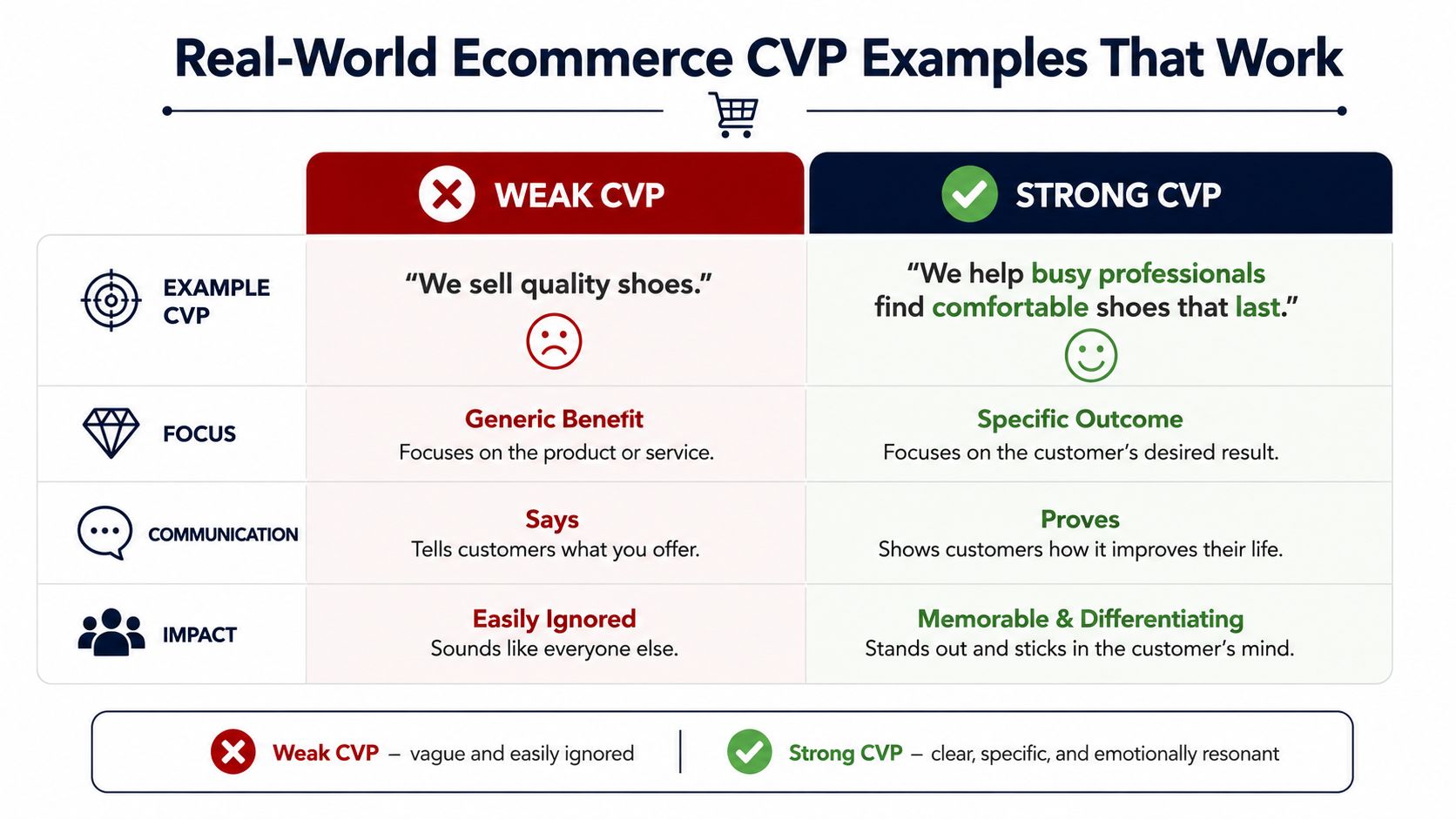
The brands that win with CVP usually do three things well. They name the customer in plain language. They describe a result the customer can picture. They prove the result with something beyond a marketing claim.
That proof can be quiet. It doesn't need to be flashy. A credible warranty, product reviews that repeat the same outcome, clear usage instructions, or an explanation of why the product is less likely to fail can all do the job. The point is to reduce doubt before the customer has to reach for the cart button.
Weak propositions often make one of three mistakes. They speak too generally, they sound interchangeable with competitors, or they lean on features that customers can't turn into a buying decision. “Made with premium ingredients” doesn't land if every serious competitor says the same thing.
The better test is blunt. If you removed the brand name, would the proposition still sound specific to your business? If the answer is no, the message isn't differentiated enough. If the answer is yes but the claim can be copied instantly, the business still doesn't have enough defensibility.
On marketplaces, that defensibility matters even more because shoppers are surrounded by similar offers. A CVP that survives comparison doesn't need to be loud, it needs to be precise. It should signal the right fit before the customer starts shopping by feature, price, or star rating.
A value proposition only matters if it changes customer behavior in a way the business can see. That's why customer lifetime value (CLV) is such a useful validation tool. CLV tells you how much revenue you can expect from a customer over the relationship, so it forces you to judge the proposition on more than first-order conversion.
The ecommerce reality is straightforward. CLV often ranges from $100 to $300 across industries, while some sectors are dramatically higher, including a 2026 marketing summary that reports an average CLV of $1.13 million for architecture firms. That spread is a reminder that the proposition has to fit the economics of the category, not just the taste of the brand team. The same source says existing customers spend 67% more than new customers. CLV growth stats for marketing leaders
Traffic can rise while the business gets weaker. A polished landing page can lift clicks and still attract the wrong customers, the kind who buy once, discount-shop, and never return. CLV tells you whether the proposition is bringing in the right people and supporting repeat behavior.
That's why a strong CVP should show up in loyalty, repeat purchase behavior, and expansion. It should make customers feel like the brand understands their priorities well enough that returning is easier than re-shopping. If that doesn't happen, the message may be attractive but not durable.
The most useful metrics are the ones that reveal customer preference over time. Repeat purchase behavior matters. Customer support themes matter. Refund patterns matter. The words customers use in reviews and replies matter too, because they show whether the promise matches the experience.
A CVP that only improves the first click is unfinished. A CVP that improves retention is working as a business asset.
For teams that want to connect this back to financial modeling, the practical counterpart is customer lifetime value calculation. Once the economics are visible, it gets easier to decide which promise deserves more inventory, more ad spend, and more merchandising support.
The best ecommerce operators don't treat CVP as a branding exercise. They use it as a test of whether their offer is pulling in the right customer and encouraging the right repeat behavior. If a revised proposition improves customer quality but lowers click volume, that can still be a win. If it spikes acquisition but weakens retention, it's probably the wrong message.
Start with the customer outcome, not the product pitch. High-revenue ecommerce brands build CVPs by finding the outcomes that are still underserved for a specific segment, then checking whether the business can own that gap through pricing, product, and retention. A practical research approach is outcome-based segmentation, where you compare importance versus satisfaction and look for the places where customers care a lot and still feel let down.
The framework is simple to describe and hard to execute. If a need is important but already satisfied, it is table stakes. If it is important and underserved, it can become the basis of a strong proposition. The cited framework describes outcomes with scores above 12 as significantly underserved and 10 to 12 as table stakes. Outcome-based value proposition design framework
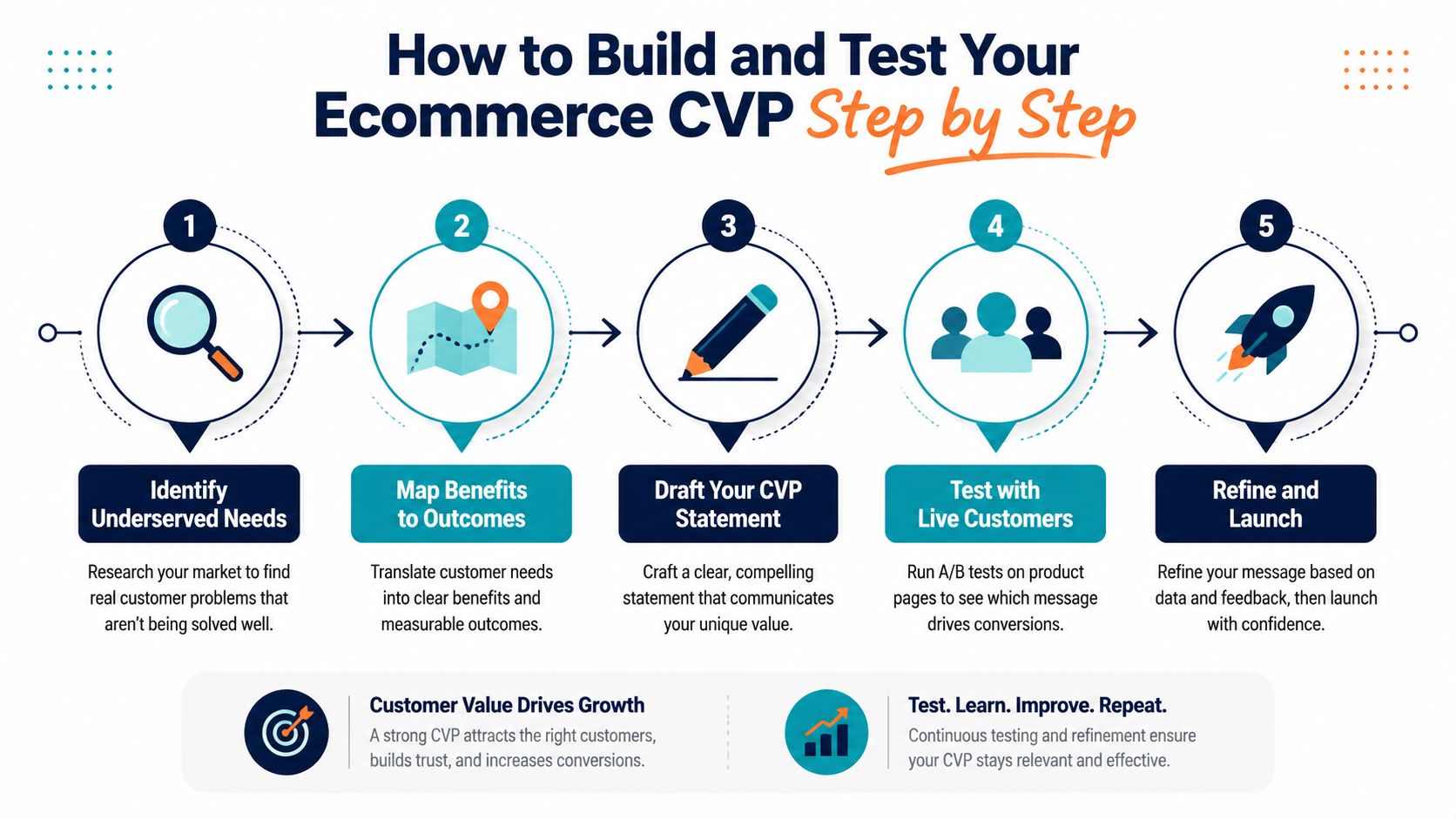
A practical build process looks like this:
That sequence works because it puts evidence ahead of intuition. Many teams try to write the perfect sentence first. Better teams start by learning which customer problem is worth owning, because that choice affects pricing power, product roadmap, and how much room you have to retain the customer after the first order.
A good CVP should be hard to copy without operational change. If a competitor can repeat the same promise tomorrow without changing sourcing, fulfillment, or service, the proposition probably is not strong enough. Defensibility usually comes from how the business runs, not from cleaner ad copy, so the promise has to match an operating advantage that is real enough to survive comparison in the market.
Use customer language, not internal jargon. Keep one primary promise, not five. Do not scale a claim until you have seen that it holds up in reviews, support interactions, and repeat behavior. When the message lines up with CLV and the outcomes that are underserved, it becomes a decision filter for the whole business, not just a tagline.
The worst CVP mistake is overpromising without proof. Ecommerce teams do this when they push aggressive claims onto a page before the product, fulfillment, or service model can support them. The result is predictable, conversion may look fine at first, but returns, complaints, and low repeat purchase follow.
Another common mistake is talking to everyone. If the message is broad enough to fit every shopper, it's too vague to persuade anyone. That usually happens when teams confuse category desirability with actual differentiation. The buyer sees the same promise from multiple brands and defaults to price, familiarity, or convenience.
A feature is not automatically valuable. A customer doesn't care that the fabric is brushed, the pack is insulated, or the app has another setting unless those details solve a meaningful problem. Value only exists when the feature changes the customer's experience in a way they can feel or measure.
The final trap is failing to distinguish stated value from credible value. A proposition can sound attractive and still be easy to ignore if it isn't tied to a unique operating advantage. That's why the best brands make their promise hard to copy, not just easy to read.
If a competitor can borrow your message without changing how they operate, your CVP is too shallow.
The goal isn't to make the CVP louder. It's to make it sharper, more believable, and more useful to the business. If your current proposition can't guide pricing, product decisions, and retention work, it's not pulling its weight.
If you want to sharpen your CVP with operators who think in margins, retention, and defensible differentiation, join Million Dollar Sellers. It's where serious ecommerce founders compare what's working across Amazon, DTC, and omnichannel brands, then use that insight to scale with more clarity and less guesswork.
Join the Ecom Entrepreneur Community for Vetted 7-9 Figure Ecommerce Founders
Learn MoreYou may also like:
Learn more about our special events!
Check Events