Chilat Doina
December 3, 2025
Figuring out your true product cost means adding up every single direct and indirect expense that goes into getting one unit from the factory floor into your customer's hands. This includes materials, labor, packaging, shipping, channel fees, and even a slice of your business overhead.
Getting this number wrong is one of the fastest ways I've seen brands accidentally lose money on every single sale they make. It's a silent killer for profitability.
Before you can even think about setting a price, you need a rock-solid, almost painfully detailed, understanding of what "product cost" actually is. Trust me, it's way more than just the number on the invoice from your manufacturer.
True product costing forces you to dig past the obvious expenses. You have to uncover all the little hidden fees that quietly chip away at your margins. The best way to start this is by splitting your costs into a few simple categories. This framework is the foundation for everything else.
First, let's look at where the money goes.
Next, we need to understand how these costs behave when your sales volume goes up or down. This distinction is crucial for figuring out how your business will perform as you scale.
The core idea is simple but powerful: some costs follow your sales volume, while others stay the same no matter what. Nailing this concept is the first step toward building a pricing strategy that protects your profits in both slow and busy seasons.
For example, your packaging cost is variable—you only pay for a box when you actually sell a product. Your accounting software fee, on the other hand, is fixed. You pay the same amount whether you sell 10 units or 10,000.
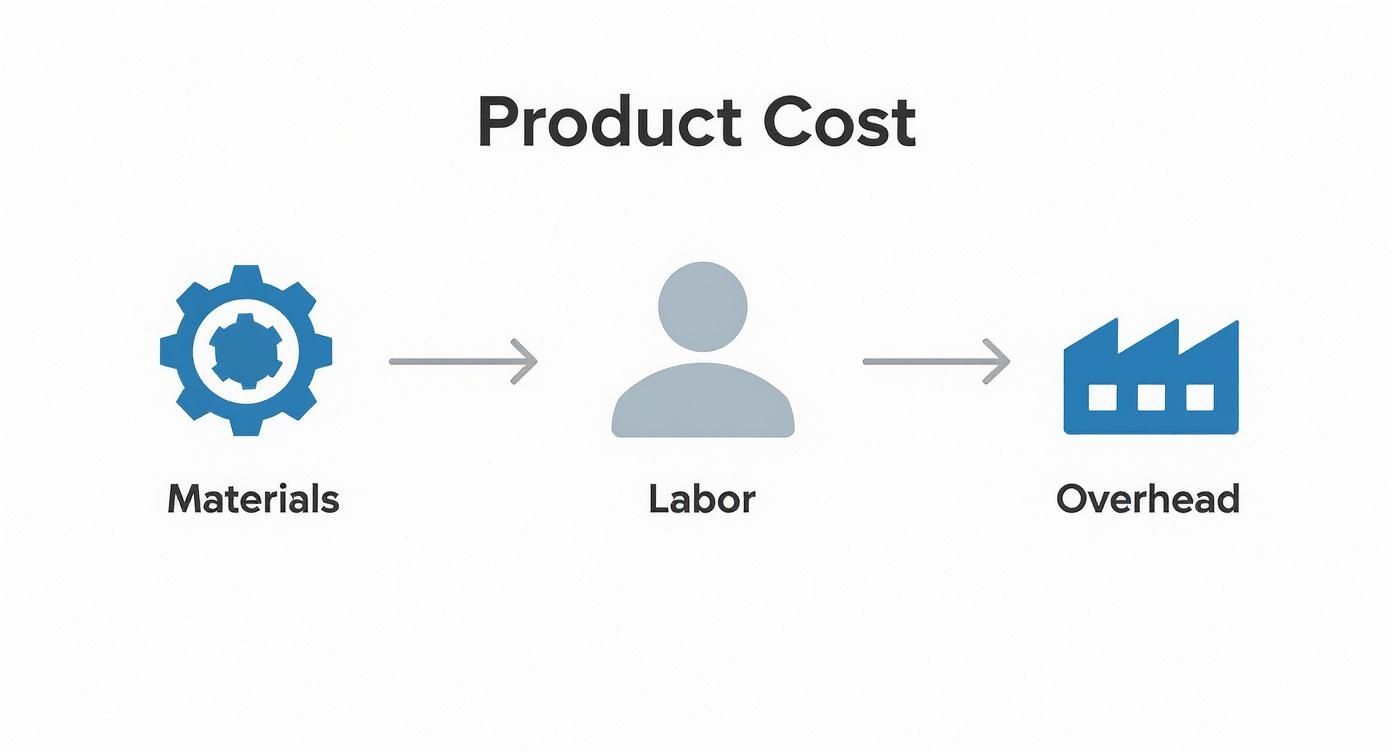
This is the basic flow of how your primary direct costs—materials, labor, and factory overhead—come together to form your starting product cost. We'll build on this foundation throughout the guide.
Managerial accounting has used similar methods for decades to separate these expenses. There's even a classic formula for it: Y = f + vX. Here, Y is the total cost, f is your total fixed costs, v is the variable cost per unit, and X is the number of units you produce. It's a simple way to model how your costs will change with production.
To make this crystal clear, here’s a quick breakdown of the key cost components you’ll need to track.
Cost CategoryDescriptionExamplesDirect CostsExpenses directly traceable to the production of a single unit.Raw materials, components, assembly labor wages, unit-specific packaging.Indirect Costs (Overhead)General business expenses that are not tied to a single product.Warehouse rent, administrative salaries, marketing software, utilities.Fixed CostsExpenses that remain constant regardless of production volume.Monthly software subscriptions, rent, insurance premiums, salaried employees.Variable CostsExpenses that fluctuate in direct proportion to production volume.Cost of goods sold (COGS), shipping fees, credit card processing fees.
Think of this table as your cheat sheet. As we go through the calculation steps, you'll be able to slot every expense into one of these buckets, ensuring nothing gets missed.
Alright, this is where the rubber meets the road. To get a real handle on your product's profitability, you have to nail down your Cost of Goods Sold (COGS). This isn't some abstract accounting term; it’s the sum of every direct cost that goes into making one unit of your product.
Let's make this tangible. Imagine you're running a direct-to-consumer (DTC) brand selling custom-printed t-shirts. To figure out your true cost per shirt, we need to dissect every single component that goes into its creation.

First up, and the most obvious piece of the puzzle, are your raw materials. This isn't just about the main item; it’s everything that physically makes up the product your customer receives.
For our t-shirt brand, that means we need to list out and price each individual item:
Add it all up, and your starting raw material cost for a single t-shirt is $5.45.
The key here is to be meticulous. Small things like labels, thread, or hang tags feel insignificant, but they add up across thousands of units and can quietly eat into your margins. Never estimate when you can calculate.
Next, you have to factor in the human touch—the hands-on work that turns those raw materials into a finished product. This is your direct labor cost. It only includes the wages for employees who are physically assembling or creating the product.
This is a step I've seen countless entrepreneurs skip, especially when they're the ones doing the work. Your time has value, and you must account for it.
For our t-shirt, this includes:
Let's say your production crew earns $20 per hour. If they can process 40 shirts in that hour, the direct labor cost per shirt is a straightforward $0.50 ($20 / 40 shirts).
Our running total is now $5.95 ($5.45 in materials + $0.50 in labor). If you want to go deeper on this, our guide on what is Cost of Goods Sold breaks it down even further.
Now for the tricky part: manufacturing overhead. These are the indirect factory costs—the expenses that are essential for production but aren't tied to a single, specific unit. Think of the factory's electricity bill, the rent on your workshop, or the depreciation of your printing press.
To get this number, you’ll add up all your monthly manufacturing overhead costs and then divide that total by the number of units you cranked out that month.
Let's say your monthly overhead expenses look something like this:
Overhead ExpenseMonthly CostFactory Rent & Utilities$1,500Machine Depreciation$300Production Supplies (cleaners, etc.)$100Total Monthly Overhead$1,900
If you produced 5,000 t-shirts that month, your manufacturing overhead per unit is $0.38 ($1,900 / 5,000 units).
The final piece of your COGS puzzle is the packaging. This covers every single item used to get your product ready for shipment. It's a direct cost because you only use these materials when an item is actually sold and shipped.
For our t-shirt, that might include:
That brings the total packaging cost per unit to $1.55.
Now, we can put it all together to find our true COGS for one t-shirt: Raw Materials ($5.45) + Direct Labor ($0.50) + Manufacturing Overhead ($0.38) + Packaging ($1.55) = $7.88.
This $7.88 is your COGS. It’s the foundational number you need before you can even think about marketing, overhead, or profit.
The $7.88 Cost of Goods Sold (COGS) we just calculated is a huge piece of the puzzle, but it only gets your product made and boxed up. It doesn't touch the complex—and often expensive—journey from the factory floor to your fulfillment center. This next layer of expenses is what we call your landed cost, and getting it wrong is one of the fastest ways to torpedo your profits.
Simply put, your landed cost is the total price you pay to get a product from your manufacturer into your possession, ready to be sold. Think of it as the all-in cost of having that inventory on your shelf, which includes shipping, handling, taxes, and all the little fees that pop up along the way.

To get an accurate landed cost per unit, you need to add up every single expense tied to a specific shipment and then divide that grand total by the number of units you received. It's a simple average, but the devil is in the details—you have to be meticulous about tracking every line item.
Most of the time, these costs will include:
If you're serious about getting this right, you need to understand who's responsible for what costs and when. This is all defined by international trade terms. For a good primer, check out this guide on Incoterms 2025 Explained. It's critical for nailing an accurate landed cost.
Let's apply this to our t-shirt example. Imagine you ordered 5,000 units, and the total bill to get them from the factory to your U.S. warehouse came out to $4,000.
To find the per-unit cost, we just do the math: $4,000 / 5,000 units = $0.80 per shirt.
Now we add this to our COGS. Our new running total is $8.68 ($7.88 COGS + $0.80 Landed Cost). See? We're already getting a much clearer picture of our true costs.
Once your inventory is finally sitting in a warehouse, you're ready to sell. But that introduces a whole new set of costs: channel fees. It doesn’t matter if you're running your own Direct-to-Consumer (DTC) store on Shopify or leveraging the power of Amazon's FBA program—every sale comes with a fee that cuts directly into your margin.
This is where so many brands get tripped up. They assume a product that’s profitable on their website will perform just as well on a marketplace like Amazon. That’s rarely true. The fee structures can be worlds apart. For a really deep look at the Amazon side, you can explore the real https://milliondollarsellers.com/blog/cost-to-sell-on-amazon and see how quickly the numbers add up.
Let's compare the channel fees for our t-shirt, which we're pricing at $30.
The platform you sell on has a massive impact on your bottom line. Below is a simple breakdown comparing a typical DTC setup on Shopify versus selling through Amazon FBA for our $30 t-shirt.
Cost ItemDTC Store (Shopify)Amazon FBASelling Price$30.00$30.00Payment Processing$1.17Included in FBA FeeFulfillment/Shipping$5.00$4.00Referral FeeN/A$5.10Storage FeeIncluded in 3PL$0.10Total Channel Fees$6.17$9.20
This side-by-side comparison makes it painfully clear: your sales channel isn't just a marketing decision, it's a financial one. The exact same product can have a cost structure that differs by over $3.00 per unit depending on where you sell it. You have to bake these specific fees into your calculations from the start.
So you’ve nailed down your landed cost. Great. But if you stop there, you’re missing a huge piece of the puzzle—the cost of actually getting customers in the door and dealing with the inevitable returns.
These aren't just minor afterthoughts. Promotions, marketing spend, and returns are dynamic forces that can quietly drain your profits. If you aren't accounting for them from the start, you might find out you're losing money on a supposedly profitable product.
Running sales is a classic move to drive volume, but every discount you offer eats directly into your margin. You need a simple way to bake this reality into your unit cost.
Pull up your historical sales data. Let's imagine you sell a $30 t-shirt. Last quarter, you ran a "20% Off" sale, and it applied to 30% of your total orders. That means for every 100 shirts sold, 30 of them went out the door with a $6 discount ($30 x 20%).
To figure out the average promotional cost, you can spread that discount across every unit sold:
(30 discounted units / 100 total units) * $6 discount = $1.80
This $1.80 is your average promotional cost per shirt. Think of it as another variable cost and add it to your running total. This approach smooths out the spiky impact of sales and gives you a much more accurate picture of your true unit cost over time.
Beyond one-off discounts, you’re spending money every day just to get people to your store. This is your Customer Acquisition Cost (CAC), and it absolutely needs to be assigned back to the products you sell.
First, tally up your total marketing spend for a specific period, say, last month. This should include everything from ad spend to influencer fees. Let's say it all adds up to $5,000.
Now, how many new customers did that spending bring in? If your campaigns snagged 500 new customers, your CAC is a clean $10 ($5,000 / 500). If a typical new customer buys one t-shirt on their first order, you have to add that $10 to the cost of that shirt to know if you made money on that critical first sale.
Quick tip: CAC is most important for that first purchase. The long-term goal is to make that money back (and then some) over the customer's lifetime. But for your initial profitability math, you need to know if you're in the red or black on day one.
Finally, we have to talk about returns. For any ecommerce business, this is a major expense that goes way beyond just refunding the purchase price.
First, you need to know your average return rate. If you sell 1,000 t-shirts and 80 come back, your return rate is 8%.
Next, calculate the real cost of a single return. It’s more than you think:
To get the average return cost per unit, just multiply your return rate by the cost per return: 8% * $11.00 = $0.88. This means you need to add $0.88 to the cost of every single t-shirt you sell, whether it gets returned or not, to cover this expense.
In today's fast-paced ecommerce world, you can't just guess. These kinds of calculations are part of a broader set of statistical modeling techniques that smart businesses use for pricing. A solid model integrates costs from the entire sales funnel to forecast profitability. If you want to go deeper, it's worth learning more about how statistical methods inform modern pricing and help brands stay ahead.
By baking these numbers into your product cost, you’re shifting from wishful thinking to a robust financial model that reflects the real world.

So far, we’ve meticulously tracked every direct cost you can think of, from the first thread of cotton to the cost of a customer return. But there's one last piece of the puzzle we need to put in place to see the real number: your fully loaded product cost.
This is where we account for the indirect costs—the overhead—that keep your business running in the background. Think of things like your office rent, that Shopify subscription, salaries for your non-production staff, and your internet bill. These are the expenses that are there whether you sell one t-shirt or ten thousand. If you ignore them, you're flying blind on your actual profitability.
The goal here is simple: assign a small slice of your total monthly overhead to every single product you sell. Doing this ensures that each sale is pulling its weight and contributing to keeping the lights on. It’s a basic but incredibly powerful way to get a handle on your business's true financial health.
First, you’ll need to add up all your monthly business expenses that aren't directly tied to making the product. This list usually includes things like:
Let’s imagine your total monthly overhead adds up to $10,000.
Next, grab your average monthly sales volume. If you’re consistently selling around 5,000 units per month, you can figure out your overhead cost per unit with some quick math.
$10,000 (Total Monthly Overhead) / 5,000 (Units Sold) = $2.00 per unit
That $2.00 is the portion of your general business expenses that each product needs to cover before you can call it profitable. It's a solid method for most e-commerce brands, though it can get more complicated for businesses with huge, diverse product catalogs.
Alright, let's bring it all home. We'll stick with our t-shirt example and add this final overhead cost to the running total we’ve been building.
Add all that up, and you get your grand total: $19.53. This is it—your true, fully loaded cost per unit. This number tells you exactly what it costs to not only make and sell one t-shirt but also to support the entire business operation around it.
With a fully loaded cost of $19.53 and a selling price of $30.00, your net profit per unit is $10.47. This is the real money you make on each sale—the number that actually matters for growth and sustainability.
Once you have your fully loaded cost locked in, you can finally set an intelligent target profit margin. Your profit margin is simply the percentage of your revenue that's pure profit. A healthy margin is the lifeblood of your business; it’s what gives you the cash to reinvest, innovate, and survive the slow months.
The formula is super simple:
Net Profit Margin = (Net Profit / Revenue) x 100
For our t-shirt:
($10.47 Net Profit / $30.00 Revenue) x 100 = 34.9%
A 34.9% net margin is pretty fantastic for a direct-to-consumer apparel brand. This number should become your north star. After all the hard work of calculating your costs, the next big step is learning how to set prices to hit that margin. You can dig deeper into calculating profit margins for your business to really fine-tune your strategy.
The final piece of this strategic puzzle is a break-even analysis. This calculation tells you the exact number of units you need to sell each month just to cover all your costs—both the per-unit costs and the fixed overhead. It's the point where you stop losing money, and every single sale after that is pure profit.
If you want a more detailed walkthrough, we have a whole article on the profit margin calculation formula.
Here’s the formula:
Break-Even Point (in units) = Total Fixed Costs / (Selling Price per Unit - Variable Costs per Unit)
Let's plug in our numbers:
$10,000 / ($30.00 - $17.53) = 802 units
This means you have to sell 802 t-shirts every single month just to break even. The 803rd t-shirt you sell is where you finally start making actual money. Knowing this number is incredibly empowering. It helps you set realistic sales goals and make smarter decisions on everything from pricing to marketing, ensuring your business stays healthy and profitable for the long haul.
Even with the best spreadsheet in hand, you're going to hit some tricky spots when calculating your product costs. It happens to everyone. Let's walk through some of the most common questions I see founders wrestle with.
Getting these concepts locked down will save you from the kind of simple mistakes that can quietly drain your profits.
Getting this right is fundamental. It's the bedrock of scaling your business intelligently.
Variable costs are tied directly to your production volume. The more you make, the more you spend. Think raw materials, the labor to assemble your product, and the box it ships in. If you sell 100 units, you pay for 100 units' worth of materials. If you sell zero, these costs (in theory) drop to zero, too.
Fixed costs, on the other hand, are the expenses that hit your bank account every month, no matter what. This is your warehouse rent, your Shopify subscription, and your bookkeeper's salary. They’re the cost of keeping the lights on.
Understanding this split is how you figure out your break-even point and make smart calls about when and how to grow.
Your cost breakdown isn't a "set it and forget it" number. The market, your suppliers, and your sales channels are always in motion, and your numbers need to reflect that reality.
As a baseline, you should do a full, deep-dive review of your product costs at least once a quarter. But you need to be ready to recalculate immediately whenever a major expense shifts.
What counts as a major shift? Keep an eye out for these triggers:
Keeping your costs fresh is the only way to make sure your pricing is actually profitable. Outdated numbers lead to bad decisions.
I see this one all the time, and it's the most dangerous mistake a founder can make: ignoring the "hidden" costs. It's so easy to get tunnel vision, focusing only on the obvious stuff like materials and manufacturing, and completely glossing over everything else it takes to actually sell the product.
This creates a false sense of security. You look at your numbers and think you're killing it, but in reality, you might be losing money on every single sale.
Here are the costs people almost always underestimate or forget entirely:
If you don't account for every single penny it takes to get that product from the factory to a customer's front door, you're flying blind. True cost accounting is the only way to build a business that lasts.
Ready to join a community of top e-commerce founders who have mastered their numbers and are scaling to 7, 8, and 9 figures? At Million Dollar Sellers, we connect you with elite entrepreneurs who share proven strategies for maximizing profitability and growth.
Apply for your invitation at https://milliondollarsellers.com.
Join the Ecom Entrepreneur Community for Vetted 7-9 Figure Ecommerce Founders
Learn MoreYou may also like:
Learn more about our special events!
Check Events