Chilat Doina
January 15, 2026
If you’ve already found your footing and built a successful Amazon business in your home country, the idea of expanding globally can feel a bit daunting. Like starting all over again.
But the reality is, it's the most logical—and powerful—next step for building a truly resilient, long-term brand. Sticking to just one marketplace leaves you vulnerable. You're at the mercy of a single market's competition, shifting consumer tastes, and economic dips. Going global is how you hedge your bets and build an empire.
The numbers don't lie. In 2024, Amazon's international net sales hit roughly $143 billion, a solid 9% jump from the year before. For serious sellers, tapping into Amazon's Global Selling program across its 20+ countries isn't just an option anymore; it's a core part of the playbook.
Just look at the US-based sellers who averaged over $290,000 in annual sales last year. More than 55,000 of them blew past the $1 million mark, and a huge chunk of that success comes from smart, multi-market strategies. You can dig into more of these numbers in these Amazon seller statistics on Threecolts.com.

One of the best-kept secrets of international expansion? It breathes new life into your existing products.
A product that’s already peaked in a crowded market like the US could be a brand-new, in-demand blockbuster in an emerging marketplace like Australia or the UAE. You get to generate a whole new stream of revenue from assets you’ve already invested in.
Here’s what that actually looks like:
The question for established Amazon sellers is no longer if you should expand globally, but when and where. The mindset that separates seven-figure sellers from the eight- and nine-figure brands is viewing international marketplaces as an integral part of your growth engine, not just an afterthought.
This guide is your playbook for making that happen. We're cutting through the fluff and getting straight to the 'how'—giving you the actionable steps you need to make smart, data-driven expansion decisions and nail the execution.
Choosing where to go first can feel like throwing a dart at a map. This table gives you a quick snapshot of the opportunities out there to help you narrow down your options.
Each region offers a unique flavor of opportunity. The key isn't to be everywhere at once, but to make a strategic first move based on your products, risk tolerance, and growth ambitions.
Deciding where to take your Amazon business next feels like a huge commitment, but it doesn't have to be a blind leap. The goal isn’t to just plant your flag in the biggest market; it's about finding the right market for your products, right now. A smart, phased rollout is how you minimize risk and give yourself the best shot at a profitable expansion.
It's tempting to jump straight into the deep end—massive, competitive arenas like Germany or the UK. While those are fantastic long-term goals, they come loaded with serious logistical and regulatory headaches. A much savvier path often starts a lot closer to home.
For sellers based in the US, the easiest first move is to simply look north and south. Canada and Mexico present the absolute lowest barriers to entry, all thanks to Amazon's North America Remote Fulfillment (NARF) program.
This program is a game-changer. It lets you fulfill orders in Canada and Mexico directly from your existing US FBA inventory. You don't have to ship a single box to another country, deal with foreign tax registration (at least not initially), or untangle complex international logistics. It’s the ultimate way to test the waters.
By flipping on NARF, you can see real-world demand for your products in these countries without committing a single dollar to new inventory. Think of it as pure market research that actually pays you.
Pro Tip: Don't just "set it and forget it" with NARF. Watch your sales data like a hawk. If a specific product suddenly takes off in Canada, that’s your signal. It's time to seriously consider sending a dedicated FBA shipment there to get that Prime badge and slash delivery times. That one move can pour gasoline on your sales.
Once you’ve got some wins in North America, it’s time to look further afield. This is where you need to put on your analyst hat. The right decision is a calculated balance of opportunity, complexity, and whether your product actually makes sense there.
Start by digging into the data on three key pillars for each market you're considering:
By methodically expanding your business internationally, you can weigh these factors to build an expansion roadmap that’s based on data, not just a gut feeling.
Instead of just picking one country, think in tiers. This framework helps you scale your global presence in a way that doesn't overwhelm you.
This tiered approach turns a daunting world map into a manageable set of steps. Start with Tier 1 to build confidence and collect data. Use the profits and insights from that to fund your jump into a more complex Tier 2 market. Once you have solid systems in place, you can start targeting the really exciting growth opportunities in Tier 3.
Your international supply chain is the engine that drives your entire global business. I've seen it firsthand—nailing your logistics is what separates a smooth, profitable expansion from an absolute nightmare of lost inventory, customs delays, and furious customers. The fulfillment model you choose isn't just a small detail; it directly impacts your costs, delivery speed, and the overall experience your new customers will have.
Let's walk through the main ways you can get your products to international buyers on Amazon. Each has its own benefits and drawbacks, and the right choice really boils down to your scale, how much risk you're comfortable with, and which specific marketplace you're targeting.
For sellers just dipping their toes into international waters, Amazon offers a couple of brilliant, low-commitment ways to test the market.
FBA Export: This is the easiest starting point, period. You just enable FBA Export in your home marketplace (like the U.S.), and suddenly, international customers can buy your products directly from your existing FBA stock. Amazon handles all the messy customs paperwork and international shipping. The customer foots the bill for it, making this a fantastic, zero-risk way to gauge where you have demand.
North America Remote Fulfillment (NARF): If you're in the U.S. and looking at Canada and Mexico, NARF is a game-changer. It lets you sell in those countries using your U.S. FBA inventory. Your listings get Prime eligibility, and you get to sidestep the headache of shipping stock or registering for taxes abroad, at least for a while.
The key takeaway here is that you can start selling internationally without sending a single box to a foreign warehouse. NARF and FBA Export are powerful tools for collecting real-world data. They show you exactly where the demand is before you sink a single dollar into a big international shipment.
This flowchart gives you a great visual of that initial decision-making process for a U.S. seller. It highlights those first critical choices between staying in North America or venturing into Europe.
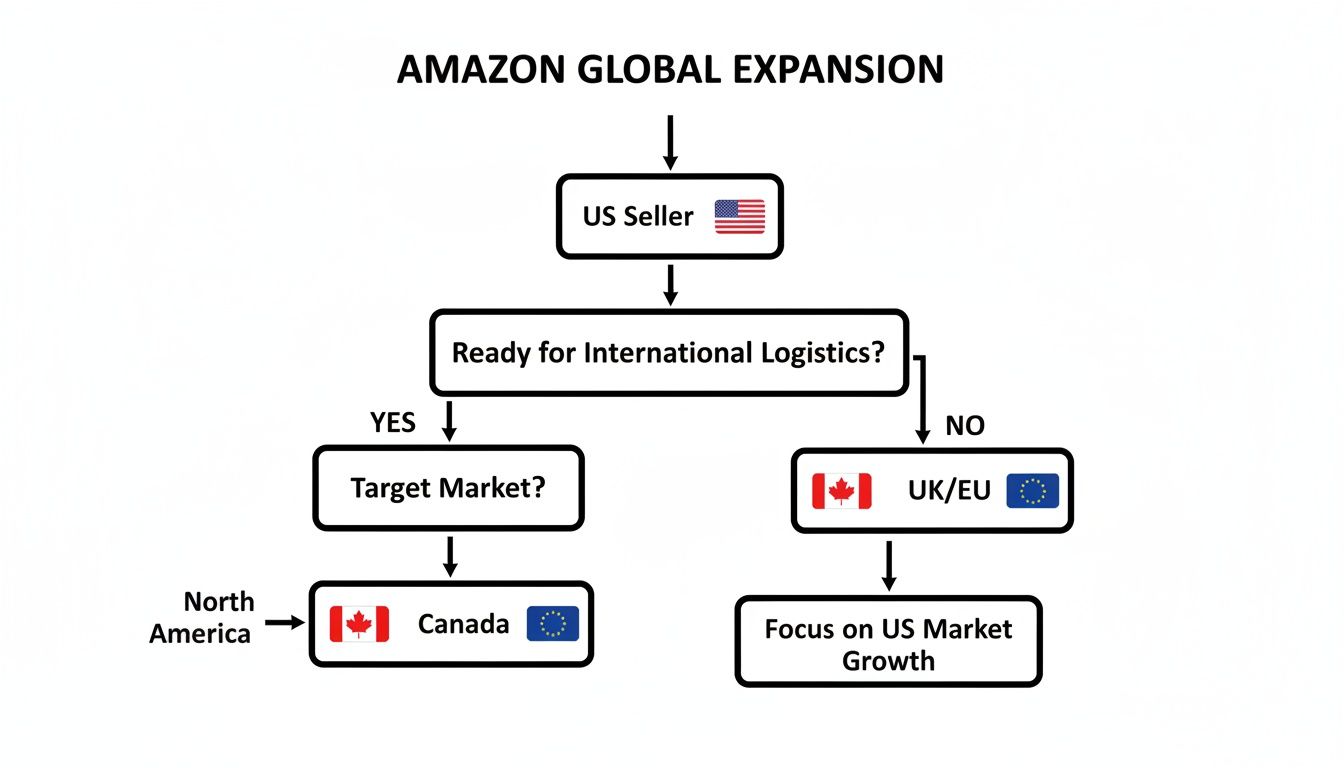
As you can see, the path of least resistance often starts close to home, using the inventory you already have before you commit to the more complex world of overseas logistics.
Once you’re ready to take on the massive—but complicated—European market, your fulfillment options get a lot more interesting.
European Fulfillment Network (EFN): This is the next logical step up. You send your inventory to an FBA warehouse in just one European country (Germany or the UK are popular choices), and Amazon fulfills orders across all its EU marketplaces from that single location. It’s way simpler to manage, but be prepared for higher cross-border fulfillment fees.
Pan-European FBA (Pan-EU): This is the holy grail of FBA in Europe. You ship your products to one country, and Amazon takes over, strategically moving your inventory across its network of warehouses based on where it predicts demand will be. This gets your products closer to customers, which means faster Prime delivery and lower local fulfillment fees. The big catch? You have to register for VAT in every single country where Amazon stores your inventory.
Multi-Country Inventory (MCI): Think of this as a more controlled version of Pan-EU. You get to decide exactly which countries to store inventory in and how much to send to each one. This is a great middle-ground if you know your sales are heavily concentrated in just a few countries and you want to avoid the massive VAT obligations of the full Pan-EU program.
No matter which model you choose that involves sending stock overseas, you will have to deal with customs. This is where so many new international sellers get tripped up. There are two concepts you absolutely have to understand: duties and HS Codes.
Customs Duties are simply taxes on imported goods. Your "landed cost"—the final, all-in price to get your product sitting in a foreign warehouse—has to include these duties. Forgetting to factor them in can wipe out your entire profit margin before you even make a sale.
Harmonized System (HS) Codes are universal numerical codes that customs officials worldwide use to classify products. Getting this wrong is a classic rookie mistake that can get your shipment held up for weeks, rejected, or hit with the wrong tax rate. For example, a men's cotton t-shirt is typically classified under HS Code 6109.10.
While you're at it, don't forget your packaging. Your products need to survive a much rougher journey across borders. It’s often a smart move to look into specialized e-commerce packaging solutions to prevent damage and avoid a flood of costly returns.
Finally, how do you physically get your inventory from your supplier to an international FBA warehouse? You’ve got two main options here.
Amazon Global Logistics (AGL) is Amazon's own freight forwarding service. It's incredibly convenient because it's built right into Seller Central, which makes booking shipments pretty straightforward.
A Third-Party Freight Forwarder, on the other hand, is a specialized logistics company. It’s a bit more hands-on, but a good forwarder can often find you better rates on certain routes, offer more personalized service, and give you more flexibility. For a really deep dive on this, this guide on how to pick a freight forwarder for Amazon FBA is an excellent read.
Ultimately, the choice comes down to balancing convenience against cost and control. For your first couple of international shipments, AGL is probably the easier route. But as you start to scale up, getting quotes from third-party providers can save you a serious amount of cash.
Getting the numbers wrong can absolutely torpedo an otherwise perfect international launch. Botch your pricing, and your margins evaporate. Ignore your tax duties, and you’re looking at suspended accounts or crippling fines.
When you’re selling on Amazon internationally, getting a handle on your finances isn't just a good idea—it’s everything.
So many sellers get caught up in the excitement of logistics and marketing that they push tax compliance to the back burner. This is a massive mistake. International taxes, especially Value Added Tax (VAT) in Europe and Goods and Services Tax (GST) in places like Australia, are a complex beast, and you can't afford to ignore them.
Here’s the golden rule: the moment you store inventory in a foreign country, you almost certainly trigger a tax obligation. This is the tripwire most sellers don’t see.
For instance, using Pan-European FBA is a dream for logistics. But it also means Amazon is scattering your inventory across fulfillment centers in multiple countries, which requires you to register for VAT in each one of those locations.
So, what does this actually mean for you?
If you want to offload the headache of global tax, compliance, and payments entirely, look into Merchant of Record services. They essentially act as the seller on paper, shouldering the burden of local tax compliance so you don't have to.
If your idea of an international pricing strategy is just converting your US price into the local currency, you're going to lose money. Fast. A smart international price has to be built from the ground up, factoring in every single new cost you're about to face.
Your mission is to protect your profit margin while staying competitive in a new market. To do that, you need a crystal-clear picture of your "landed cost"—the all-in total it costs to get one unit from your factory into your international customer's hands. We've got a detailed guide on how to calculate landed cost that breaks it all down.
Your new pricing formula needs to account for a bunch of new variables:
Your international price isn't a simple currency conversion; it’s a whole new financial formula. Start with your cost of goods, then layer on every new international expense—shipping, duties, FBA fees, taxes, and marketing—before you even think about your profit margin. This is the only way to avoid the trap of losing money on every sale.
Great, you're making sales! Now, how do you get that money home without getting killed on fees? Amazon gives you a couple of ways to handle your foreign currency earnings.
Amazon Currency Converter for Sellers (ACCS)
This is the default, out-of-the-box option. It’s undeniably easy. Amazon takes your earnings in euros, pounds, or yen, converts them to your home currency (like USD), and drops the cash right into your bank account.
Third-Party Payment Services
This is the pro move. Services like Payoneer or WorldFirst let you open virtual receiving bank accounts in foreign countries. Amazon pays you in the local currency (EUR, for example) to your virtual account. You can then hold that currency and choose when to convert it to your home currency at a much better rate—often with a fee closer to 1-2%.
Taking this extra step can easily save you thousands of dollars a year in conversion fees. For any serious global seller, optimizing currency conversion isn't just a minor tweak; it’s a major lever for boosting your bottom line.

If you think you can just run your US product listing through a translation app and call it a day, you're setting yourself up for failure. It's a classic rookie mistake. International customers can spot a lazy, machine-translated listing from a mile away, and it's an instant trust-killer for your brand.
Real success on the global stage comes from deep localization. This is about making your brand feel like it was born and raised in that market. It goes way beyond avoiding embarrassing translation gaffes; it’s about genuinely understanding and adapting to the local culture, how people search, and their unique buying habits.
A shopper in Berlin searches for products differently than a shopper in Tokyo. They're drawn to different kinds of imagery and care about different product features. Nailing these details is what separates the global power players from the sellers who quietly retreat after one bad launch.
The entire foundation of a killer Amazon listing is solid keyword research. The problem is, a direct translation of your top US keywords will almost certainly miss the mark. Local shoppers use slang, regional terms, and entirely different phrases to find what they're looking for. You have to start thinking like a local, not just translating like a machine.
For example, a US shopper looking for a portable light will search for a "flashlight." But in the UK, they're overwhelmingly searching for a "torch." Trying to sell a kitchen "spatula" in Germany? You'd better be targeting "pfannenwender." These aren't just tiny differences—they are the very key to getting your product seen by the right people.
Here’s how to get it right:
The goal of international keyword research isn't just to find the literal translation of your US terms. It's to uncover the actual words and phrases local customers are typing into the Amazon search bar to solve the problem your product addresses.
Your product photos and A+ Content are your most powerful sales tools, and they absolutely need a local makeover. Imagery that resonates with an American audience might feel completely alienating to customers in Japan or the UAE.
Take a hard look at the models in your lifestyle photos. Do they look like the local population? Are the backgrounds and settings familiar? If you're selling outdoor gear in Germany, showcasing it in a lush, green forest will connect far better than a shot from the Arizona desert.
This same principle applies to your entire visual brand. Everything from the color palettes in your A+ Content to the style of your product videos should be viewed through a cultural lens. For instance, the bright, bold colors that work so well in Mexico might come across as gaudy in the more minimalist design culture of Sweden.
Social proof is everything on Amazon. Launching with zero reviews in a new marketplace is a massive hurdle, so you need a game plan to get those first few crucial ratings to build trust and get the algorithm on your side.
Here are a few proven tactics to get the ball rolling:
Just as critical is your customer service. When you go global, you must provide support in the local language and within a reasonable local time zone. Fumbling customer questions with poorly translated, robotic responses is a fast track to a tanked seller rating.
If you can't manage this in-house, leaning on FBA to handle the bulk of customer service isn't just a convenience—it's an essential move to protect your account health and reputation.
Jumping into international markets always brings up a ton of questions. Even with a perfect plan on paper, the real-world hurdles can feel massive. So, let’s tackle some of the most common sticking points we see sellers hit when they first decide to expand.
Think of this as your quick-fire FAQ for the big stuff.
Short answer: Nope. You generally don't need to spin up a whole new business entity in every country you launch in.
Your US-based company, like an LLC, is perfectly fine for selling across unified regions like North America (US, Canada, and Mexico) or all of the EU marketplaces. This keeps the corporate structure simple while you're testing the waters.
But here’s the crucial part: taxes are a different story. The second you decide to store inventory in a European country to use FBA, you trigger a Value Added Tax (VAT) obligation. This is non-negotiable. You have to register for a VAT number in that specific country before your products even land there.
So while you don't need a new company, you absolutely need local tax registration. Setting up a foreign subsidiary is a much more advanced move, something you’d look at way down the road for tax optimization once you're doing serious volume. For now, stick with your home entity and find a good tax compliance partner.
Returns can be a logistical nightmare that quietly bleeds you dry. Shipping a single returned product back across the ocean? Forget it. The cost is almost never worth it.
By far, the simplest approach is to let Amazon's FBA handle the returns processing in each local marketplace. When a customer sends something back, it goes to a local Amazon warehouse. They deal with the customer, and you're hands-off. It’s a huge relief.
If you want more control and a chance to salvage your returned inventory, a third-party reverse logistics provider (3PL) in that region is a game-changer. These guys are specialists who can:
A good 3PL can turn your returns from a profit-sucking headache into a streamlined, recoverable part of your operation.
This is where so many sellers go wrong. They just translate their US PPC campaigns, hit "go," and then wonder why they're burning cash. This almost never works because it completely ignores local search habits, different competitors, and wildly different ad costs.
Don’t just copy your campaigns. You need to start from scratch with native keyword research for every single language. A literal translation of "patio umbrella" probably isn't what a shopper in Spain is actually searching for. Build totally separate campaigns for each marketplace so you have full control over your bids, budgets, and targeting.
Here's the key: You have to analyze the performance data for each country on its own. The Cost-Per-Click (CPC) in a mature, competitive market like the UK could easily be 2-3x higher than in a growing one like Poland for the exact same product. Start with a small test budget, figure out what actually converts, and only then start pouring more money into it.
Compliance isn't optional—it's a minefield. One wrong move can get your inventory seized and your account shut down. We see sellers get tripped up most often in a few key categories:
Before you ship anything, use the compliance tools inside Seller Central. And seriously, consider getting an expert to double-check that your product and its packaging meet every single local rule. An ounce of prevention here is worth a ton of cure.
At Million Dollar Sellers, we know the best advice comes from people who are actually in the trenches, doing the work every day. Our private community is where elite Amazon and e-commerce founders share the unfiltered, real-world strategies they use to solve complex problems like global expansion, supply chain headaches, and brand scaling. If you're ready to grow your business alongside the best in the game, see if you qualify for MDS.
Join the Ecom Entrepreneur Community for Vetted 7-9 Figure Ecommerce Founders
Learn MoreYou may also like:
Learn more about our special events!
Check Events