Chilat Doina
December 26, 2025
Before you even dream about a logo or a catchy tagline, you need to lay the groundwork. A powerful brand isn't just about cool visuals; it's the intentional, strategic plan that shapes how customers see you, forges real emotional connections, and gives you a lasting edge.
In a sea of millions of online stores, a rock-solid strategy is what separates a fleeting trend from a resilient, iconic brand.
This guide is your tactical playbook for building that foundation. We're skipping the abstract theories and diving straight into the actionable steps every ecommerce founder needs to take. You'll learn how to turn raw market data into a sharp positioning statement, craft a brand personality that clicks with your ideal buyer, and build an identity that turns casual shoppers into die-hard fans.
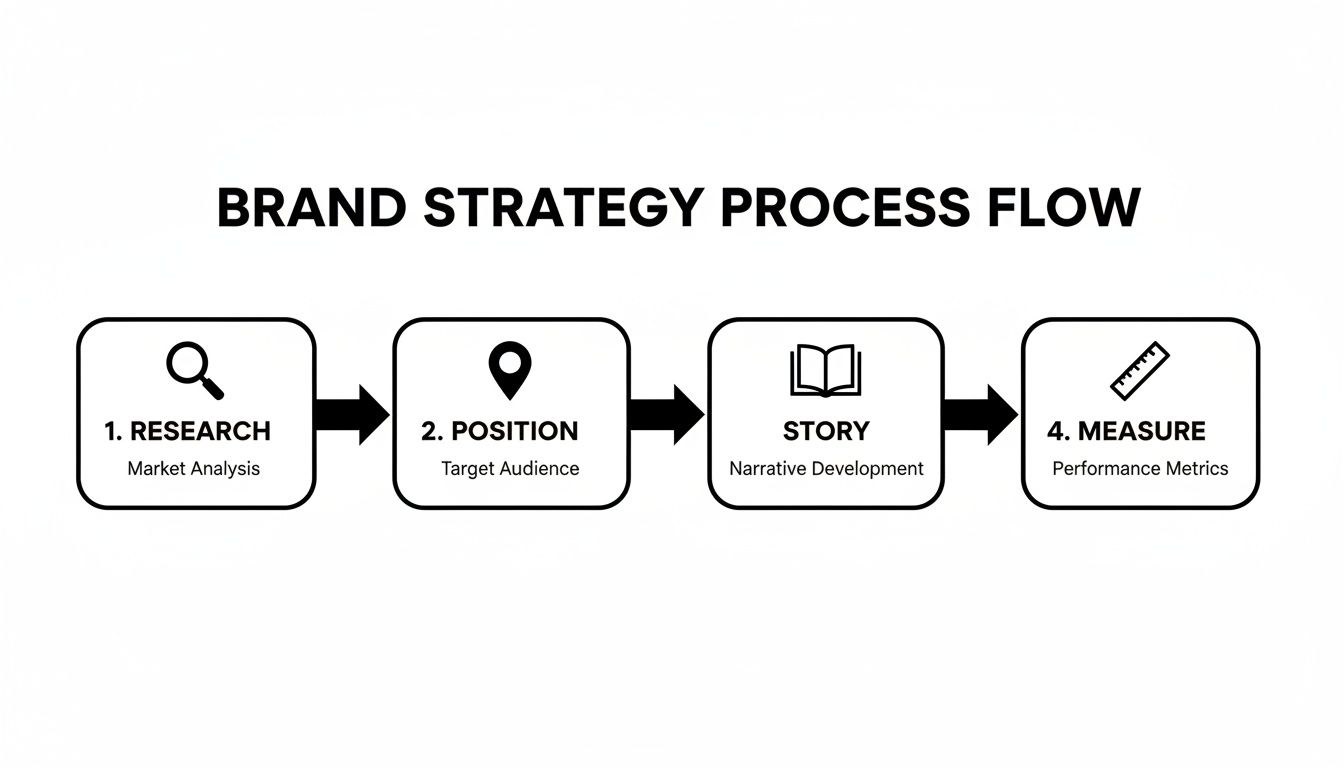
This whole process boils down to a few core pillars. Think of them as the load-bearing walls of your brand—each one supports the next, creating a structure that's built to last.
Here’s a quick rundown of what we’ll be building, piece by piece.
To give you a clearer picture of how these pieces fit together, I've mapped them out in a simple framework. It's a high-level look at the journey from initial research to a fully realized brand.
PhaseCore ObjectiveKey Outcome1. Research & DiscoveryTo gain a deep understanding of the market, competitors, and target customers.A comprehensive report on market trends, competitor analysis, and detailed customer personas.2. Positioning & Value PropTo define the brand's unique place in the market and its core promise to customers.A clear positioning statement, a unique value proposition, and defined brand differentiators.3. Brand Identity & MessagingTo develop the brand's personality, voice, and visual elements that resonate with the audience.A brand voice and tone guide, core messaging pillars, and a creative brief for visual identity.4. Implementation & MeasurementTo roll out the brand strategy consistently and track its performance against key metrics.A detailed launch plan, a set of brand KPIs (e.g., awareness, loyalty), and a reporting system.
This table isn't just a checklist; it's a roadmap. It ensures you’re building your brand on a solid foundation of insight, not just guesswork. Every phase builds on the last, creating momentum and clarity for your team.
This disciplined approach is what a lot of founders miss, but it's crucial. For a deeper dive into the different models you can follow, check out these Top Brand Development Strategies. The data doesn't lie: a staggering 76% of consumers say they're more likely to buy from a brand they feel an emotional connection to. That connection doesn't happen by accident—it’s the direct result of a well-executed strategy.
To build an e-commerce brand that actually stands out, you have to start with a deep, unfiltered understanding of the world your business lives in. It’s about knowing your competitive landscape so well that their next move feels predictable. It’s also about identifying your ideal customer with such clarity that you can speak directly to their unspoken needs.
This isn't just about ticking a box for "market research." This is the strategic deep dive that shows you exactly where you can win. When your brand is built on real insight, not just assumptions, every decision you make—from marketing to product development—becomes sharper and more confident.
You need to get a handle on what your direct competitors are doing and, more importantly, why it's working—or not working—for them. This isn't about copying them; it's about spotting the strategic openings they've left for you.
Forget just looking at their products. You need to analyze their entire customer experience.
This isn't just data collection; it's about finding the gaps. If a big competitor gets tons of praise for product quality but is constantly slammed for slow shipping, that's your opening. If their messaging is stiff and corporate, a more relatable, human brand voice could be your killer advantage.
"Your brand has an opportunity to stand out from the crowd. Mimicking a competitor's strategy is not a winning approach. Research them to understand where they are strong, where they are weak, and where your brand is different."
This intelligence gathering helps you map the entire ecosystem. From there, you can start to carve out a space that is uniquely yours, setting the stage for a powerful positioning strategy.
Once you’ve mapped the competitive terrain, it’s time to plant your flag. Your brand positioning is the single, unique space you occupy in the mind of your target customer. It’s the answer to the all-important question: "Why should I choose you over all the other options?"
To get this right, you first need to understand what brand positioning really is. It’s a core piece of your entire brand strategy, and it has to be clear, defensible, and genuinely valuable to your audience.
A positioning statement is an internal tool—think of it as your brand's North Star. It’s not a public-facing tagline, but a concise declaration that guides every single decision you make. It usually follows a simple formula:
For [Target Customer], [Your Brand] is the [Category] that provides [Main Benefit/Point of Difference] because [Reason to Believe].
Let’s make this real. Imagine a fictional ecommerce brand selling sustainable, durable outerwear for kids.
Put it all together, and the positioning statement looks like this:
"For environmentally-conscious parents of active kids, Terra Tots is the outdoor apparel brand that provides durable, all-weather protection you can feel good about, because our gear is made from 100% recycled materials and backed by a lifetime repair program."
See how this statement becomes a compass? It guides product development (materials must be recycled), marketing messages (we talk about durability and sustainability), and even customer service (we have to honor that repair program).
For more inspiration on how the pros do it, check out these brand positioning statement examples. It's a crucial step in turning all that research into a concrete, actionable strategy.
If your positioning statement is the strategic blueprint for your brand, think of personality as the part where it actually comes to life. This is where you move past the spreadsheets and translate your core message into a relatable, human identity that people can connect with. It’s about figuring out if you want to be the witty friend, the wise mentor, or the adventurous guide in your customer's life.
This isn’t just fluff. Your brand’s personality is a critical piece of the puzzle, dictating how you sound, look, and act across every single touchpoint. A consistent personality builds trust and makes your brand unforgettable in a sea of competitors.

This whole process kicks off with getting to know who you’re talking to on a much deeper level. Demographics are just the starting line; you need to truly grasp their motivations, frustrations, and what they really aspire to.
To nail a personality that clicks, you have to create detailed customer personas first. I’m not talking about vague descriptions like "millennial shoppers." A truly useful persona is a semi-fictional character, grounded in your market research, who represents your ideal customer.
Give them a name. A job. A backstory. What does their average day look like? What podcasts are they listening to on their commute? And most importantly, what are the biggest headaches in their life that your product can solve?
For each persona, try to build out these key areas:
Putting together two or three of these detailed personas will give you a crystal-clear picture of who you're trying to reach. That clarity is what keeps you from building a generic brand that speaks to everyone but resonates with no one.
Okay, with your personas in hand, you can start defining your brand voice. Think of it like this: personality is what you are, but voice is how you express it. Your brand voice is the specific communication style you use—the words you choose, how you structure your sentences, and the overall emotional tone.
Is your brand…
Whatever you choose, that voice needs to show up everywhere—from the main headline on your homepage to the tiny microcopy on a checkout button. It’s this consistency that builds a powerful sense of reliability and trust.
Your brand voice is your unique way of communicating that reflects your personality and values. This style needs to be consistent across channels and uses to build recognition and trust.
Making this voice feel personal is a massive part of what makes it work. Shoppers today are hunting for authenticity and a real connection. In fact, 41% of retailers are planning to focus on personalization in 2025 to keep up. The data also shows that 86% of shoppers are looking for authenticity, and 68% are swayed by a great brand story.
All of this thinking needs to be written down. You can't just cross your fingers and hope everyone on your team magically "gets" the brand voice. A simple document is non-negotiable for keeping things consistent as you grow.
This guide should include a few key things:
Documenting this stuff makes sure that anyone creating content for your brand—whether it’s a freelance writer or a new social media manager—can execute it perfectly. To really dig into this, check out our complete guide on how to create brand guidelines. Think of it as your single source of truth for keeping your brand's voice clear, consistent, and powerful.
Once you’ve nailed down your brand's personality and voice, it's time to give it a face. For an ecommerce brand, the visual experience isn't just a nice-to-have; it's often the very first—and most powerful—impression you make. This is where all that strategic groundwork becomes something tangible your customers can see and remember.
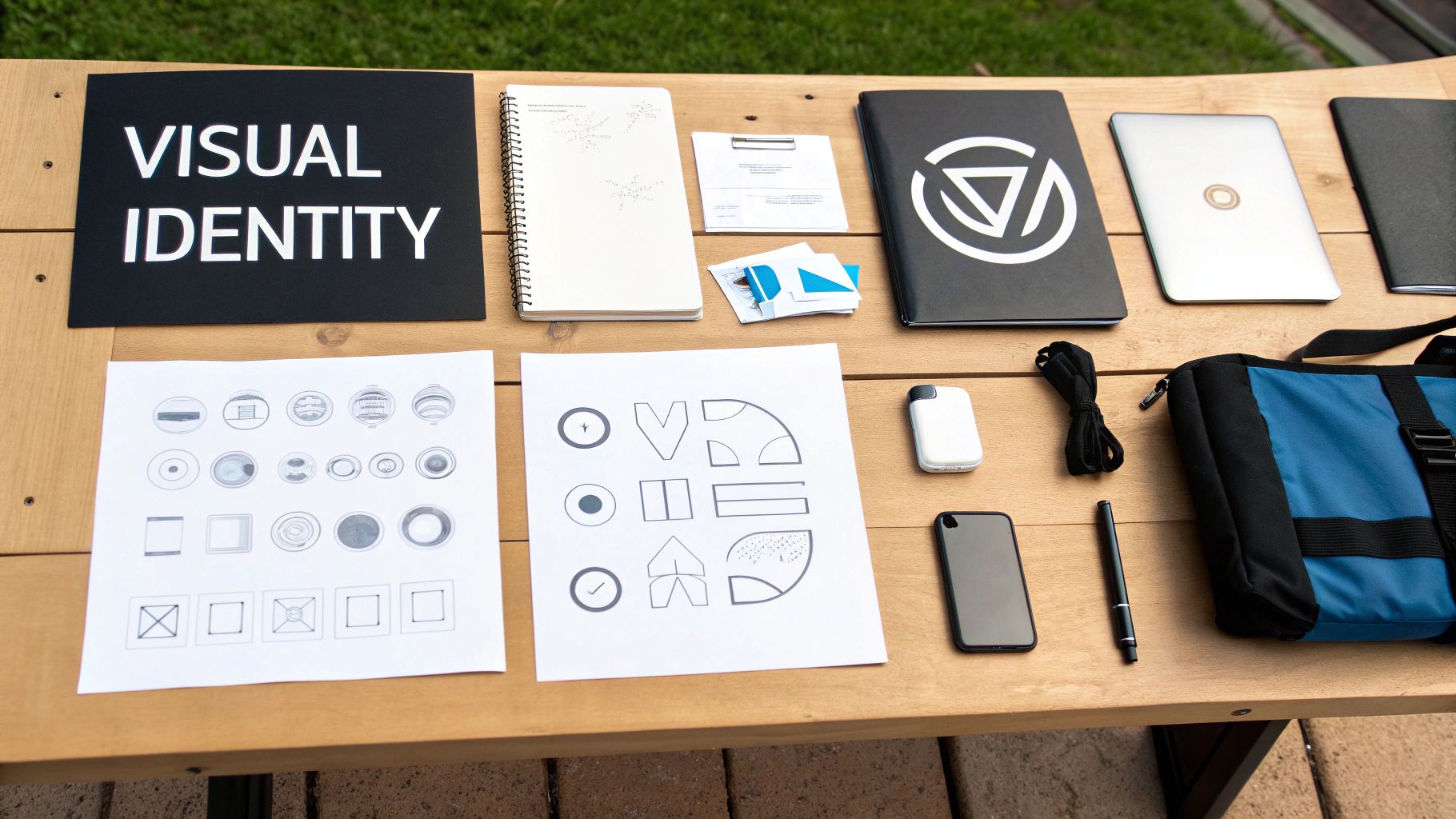
A cohesive visual identity is way more than just a logo. It’s the strategic blend of color, typography, and imagery working in concert to communicate who you are at a glance. When you get this right, you build instant recognition and trust, making your brand stand out in a crowded social feed or a packed inbox.

Think of your logo as the signature, but your color palette and typography as the distinct handwriting that makes your brand recognizable everywhere. These elements carry a ton of psychological weight and should be chosen with intention, not just because you like a certain shade of blue.
Strategic Color Selection:
Colors tap directly into emotions. A luxury watch brand might stick to black, white, and gold to signal sophistication. On the other hand, a company selling natural baby products would probably use soft, earthy tones to make customers feel a sense of safety and calm.
Purposeful Typography:
Fonts have personalities, too. A serif font can feel traditional and established, while a clean sans-serif font often comes across as modern and approachable. The goal is to pick a primary and secondary font that not only match your brand’s personality but are also super legible on any screen, from a desktop monitor to a tiny phone.
The images you use are a window into your brand's world. Your product photos, social media graphics, and website banners all need to feel like they belong together. This creates a seamless experience that reinforces what you're all about.
You need to define a clear direction for your visuals. Are your product shots stark and minimalist on a white background? Or are they lifestyle photos showing your products in the wild? Consistency is everything here. If you sell rugged outdoor gear, your photos better feature adventurous landscapes and authentic action—not sterile studio shots.
A strong visual identity is your brand's silent ambassador. It communicates your value, personality, and professionalism in a single glance, long before a customer reads a single word of copy.
This visual consistency is absolutely critical on social media, where you have mere seconds to grab someone's attention. Building a killer brand strategy for an ecommerce empire depends on winning on social. Today, 77% of shoppers are more likely to buy from brands they follow online, and 51% of Gen Z use these platforms to research products. A distinct visual style makes your content instantly recognizable as someone scrolls through their feed. You can learn more about how shoppers behave online and find other key ecommerce statistics on SellersCommerce.com.
The final piece of the puzzle is applying this visual system religiously across every single customer touchpoint. From the biggest billboard to the tiniest favicon, consistency is what builds brand equity and makes you look like a pro.
Just think about all the places your brand shows up:
By creating and sticking to a simple set of visual guidelines, you ensure every interaction reinforces the same core identity. This repetition is what turns a business into a brand people remember.
Look, a brilliant brand strategy is just a fancy document until you actually bring it to life and see how it performs in the wild. This last part is where all the theory gets real, fast. A solid rollout makes sure all your hard work shows up as a consistent, impressive experience for your customers. Then, the measurement tells you what’s actually hitting the mark and where you need to course-correct.
The launch isn't a one-and-done event; it’s a process. And tracking success is about way more than just staring at your sales numbers. It’s about keeping a finger on the pulse of your brand's health and influence over time, making sure it’s still connecting with people and building real loyalty.
I've seen it happen too many times: founders rush the launch and end up with a confusing, watered-down message. A structured, phased approach is the only way to go. It ensures everyone, from your internal team to your newest customer, gets the brand exactly as you intended.
Start inside your own four walls. Your team members are your first and most critical brand ambassadors. They need to get it, believe in it, and be able to live it every day. Kick things off with an internal meeting to walk everyone through the new brand guidelines, the positioning, and the tone of voice. Get them excited.
Once your team is on board, it’s time to turn your attention outward. This is more than a new homepage design—it's a synchronized effort across every single channel.
This kind of structured rollout creates a smooth transition and hammers your brand’s message home with clarity and impact right from the jump.
So, how do you know if any of this is actually working? You have to track the right metrics. Vanity metrics like social media likes feel good, but they don't tell you if you're building a brand that can last. You need to focus on Key Performance Indicators (KPIs) that measure what your customers are thinking, feeling, and doing.
The strongest brands are powered by a mix of creative clarity and data-driven precision. Your KPIs provide that precision, turning brand health from a vague feeling into a measurable asset you can actively manage and improve.
Here are the essential KPIs every ecommerce founder should be obsessed with:
These metrics give you a clear, data-backed picture of how your brand is really doing. They help you see how all the strategy work is paying off in tangible results. Tracking them consistently lets you make smart, informed tweaks along the way.
For anyone who wants to go deeper and connect this to the bottom line, the next step is learning how to measure brand equity. That’s when you move beyond campaign metrics and start to see the total financial value your brand adds to the business—which, at the end of the day, is what it's all about.
Even with a solid playbook in hand, building a brand strategy from the ground up can feel like navigating a maze. As a founder, you're already juggling a million things, and it’s easy to get snagged on the details.
Let’s clear up some of the most common questions we hear from ecommerce entrepreneurs. These aren't just hypotheticals—they're the real-world hurdles that can stall progress. Getting straight answers will help you move forward with confidence.
This is the classic "it depends" question, but I can give you a realistic ballpark. The timeline really comes down to the size of your business and how deep you need to go.
For a new startup or a small ecommerce shop just getting started, you can knock out the foundational work in about 4 to 6 weeks. That's usually enough time to cover the essential research, lock in your positioning, and get your core messaging nailed down.
But for an established brand doing a major overhaul? That’s a different beast. A full-blown project involving deep market research, team workshops, creative development, and the start of implementation can easily take 3 to 6 months. The key is to see it as a deliberate investment, not a sprint.
This is a big one, and the confusion here can derail your entire effort. Getting this distinction right changes everything.
Here’s the best way I’ve found to explain it: think of building a house.
Your brand strategy is the architectural blueprint. It’s the deep thinking that defines the why. Who is this house for? What makes it strong and unique in its neighborhood (your market position)? What’s the fundamental layout and purpose of each room (your values and messaging)? It's the core logic behind everything.
Brand strategy is the 'why' and the 'who.' It’s the core logic and intent behind your brand. Branding, on the other hand, is the tangible 'what' and 'how'—the sensory experience that brings the strategy to life for your customers.
Branding, then, is the interior design and curb appeal. It’s the paint on the walls (your logo and color palette), the furniture (your website design), and the way people talk inside the house (your brand voice). It's the tangible execution that makes your strategy visible, felt, and experienced by the outside world.
You can’t have great branding without a solid strategy to guide it.
Your brand strategy should be a living, breathing guide—not a dusty binder on a shelf. Markets shift, customers evolve, and your business grows. Your strategy has to keep up.
As a general rule, you should conduct a formal review at least annually. This carves out dedicated time to check your performance against your KPIs, see what competitors are up to, and make sure your message is still hitting the mark.
Beyond that yearly check-in, you absolutely need to revisit your strategy whenever a major business event happens, like:
Let me reframe that: a small business can't afford not to have a strategy.
The magic of brand strategy is that it's about smart thinking, not big spending. It’s the roadmap that ensures every single dollar you spend—on ads, on packaging, on a new hire—is working as hard as it possibly can. A clear strategy is your best defense against wasting money on marketing that just doesn't connect.
You can execute the most important parts on a shoestring budget. Customer research can be as simple as sending out surveys and obsessively reading online reviews. Competitive analysis just requires your time and a sharp eye. And nailing your positioning statement? That's a brain-power exercise, not a budget one.
At Million Dollar Sellers, we know that building a powerful brand is the key to scaling past seven figures and beyond. Our exclusive community connects you with top ecommerce founders who have mastered this process, sharing the exact strategies that work today. Apply to join MDS and start building your brand alongside the best in the business.
Join the Ecom Entrepreneur Community for Vetted 7-9 Figure Ecommerce Founders
Learn MoreYou may also like:
Learn more about our special events!
Check Events