Chilat Doina
November 30, 2025
When you hear "warehouse efficiency," it's easy to picture a complex web of conveyor belts and robots. But at its core, it’s simply about optimizing your space, your team's time, and your tech to get more done with less—less cost, fewer errors, and less wasted effort.
It’s about streamlining every single step, from the moment a shipment hits your receiving dock to the final scan before it leaves for a customer's doorstep. Nailing this means your operation can flex with unpredictable demand without dropping the ball on speed or accuracy. A tight, efficient warehouse isn’t just a cost-saver; it’s a powerful engine for a better customer experience.

In the hyper-competitive world of e-commerce, the performance of your warehouse is no longer just an internal concern. It's a direct reflection of your brand promise. Customers today don’t just want their orders fast; they expect it. Any hiccup, delay, or mistake can instantly shatter their trust and send them clicking over to your competition.
This intense pressure completely changes the game. Your warehouse stops being a simple cost center and becomes one of your most critical strategic assets for growth.
Think about a scenario I've seen play out dozens of times: the inventory numbers in your system say you have 10 units, but there are only 8 on the shelf. This one little discrepancy unleashes a torrent of problems. A customer buys an item you don't actually have, forcing a frustrating order cancellation. At the same time, your pickers are burning precious minutes hunting for a ghost product, which slows down every other order in the queue and jacks up your labor costs.
These seemingly small cracks in your operational foundation can quickly become massive chasms that threaten your business.
From my experience, achieving true operational excellence comes down to three core pillars that have to work in lockstep. If you let one of them slide, the other two will crumble, and you’ll never hit your peak performance.
The industry is clearly pushing toward modernization. The biggest drivers for warehouse automation are labor shortages (25%), ongoing supply chain disruptions (22%), and the explosive growth of e-commerce (18%). To keep up, a whopping 43% of businesses plan to invest in advanced information systems by 2025 just to boost their efficiency.
By focusing on improving warehouse efficiency, you're not just cutting expenses—you're building a resilient and responsive supply chain. This becomes a powerful differentiator that enables faster delivery, fewer errors, and a stronger bottom line, which are essential components for developing your competitive advantage strategies. This guide provides the playbook to make that happen.
You can't fix what you don't measure. Before you even think about new software or fancy robots, you need a crystal-clear picture of your current performance—the good, the bad, and the ugly. A real performance audit isn’t about sitting in an office staring at spreadsheets; it’s about getting your boots on the ground to see how work actually gets done.
This whole process kicks off with what the lean manufacturing folks call a 'gemba walk.' All that means is going to the place where the action happens. You'll want to walk the exact path an order takes, from the moment a truck hits the receiving dock all the way through to shipping. Trust me, this firsthand observation is your most powerful tool for finding the hidden clogs in your system that data alone will never show you.
When you're walking the floor, your job is to be an observer, not a manager. You're looking for the subtle signs of friction that quietly kill your team's productivity. Are pickers constantly swerving around pallets left in the aisles? Do you see a small crowd of employees just waiting around in one area for the next step? These are classic symptoms of much deeper issues.
Pay close attention to the physical flow of both goods and people. Inefficient picker paths, for instance, are a massive productivity vampire. It's estimated that walking can eat up over 50% of an order picker's time. If your team is trekking from one end of the warehouse to the other for a single-item order, you've just found a huge opportunity staring you in the face.
Keep an eye out for these common culprits:
Observation is critical, but you need hard data to prove your theories and set a performance baseline. This is where you combine what you saw on your walk with cold, hard numbers. You don’t need anything fancy to get started; a simple stopwatch, a clipboard, and access to your Warehouse Management System (WMS) are usually more than enough.
The goal here is to collect raw data for the key performance indicators (KPIs) that actually move the needle. Start by timing the core tasks. For example, use a stopwatch to record your dock-to-stock time—how long it takes for newly received inventory to get put away and become available for sale. A long dock-to-stock time means your cash is just sitting on a pallet instead of being ready to sell.
Here are a few essential KPIs to measure for your baseline:
By combining qualitative observations from your 'gemba walk' with hard data, you create a powerful, data-backed roadmap. This audit doesn't just tell you that you have problems; it pinpoints exactly where they are and how severe they are.
Once you have this baseline, you can start to visualize your performance. Many sellers find it incredibly helpful to build a custom dashboard to track these numbers over time. To get a head start, check out our guide on creating a performance metrics dashboard that gives you real-time insights into your operation. This baseline is the non-negotiable first step toward making targeted, high-impact changes that will genuinely boost your warehouse efficiency.
Once you've got a clear picture of what's slowing you down, it's time to get your hands dirty and redesign the physical heart of your operation—the warehouse layout and workflow. The path your team and your products take from receiving to shipping is the single biggest lever you can pull to impact labor costs and fulfillment speed. A clunky layout sends your team on long, meandering walks, burning hours on wasted travel. A smart one creates a direct, efficient superhighway.
The name of the game is minimizing travel time. It’s that simple. Remember, studies consistently show that walking can account for over 50% of an order picker's time. Every extra step they take to hunt down an item is a direct hit to your bottom line. Optimizing your layout is all about turning that wasted motion into productive, value-adding work.
This visual breaks down a straightforward, effective way to audit your current workflow to spot those opportunities.
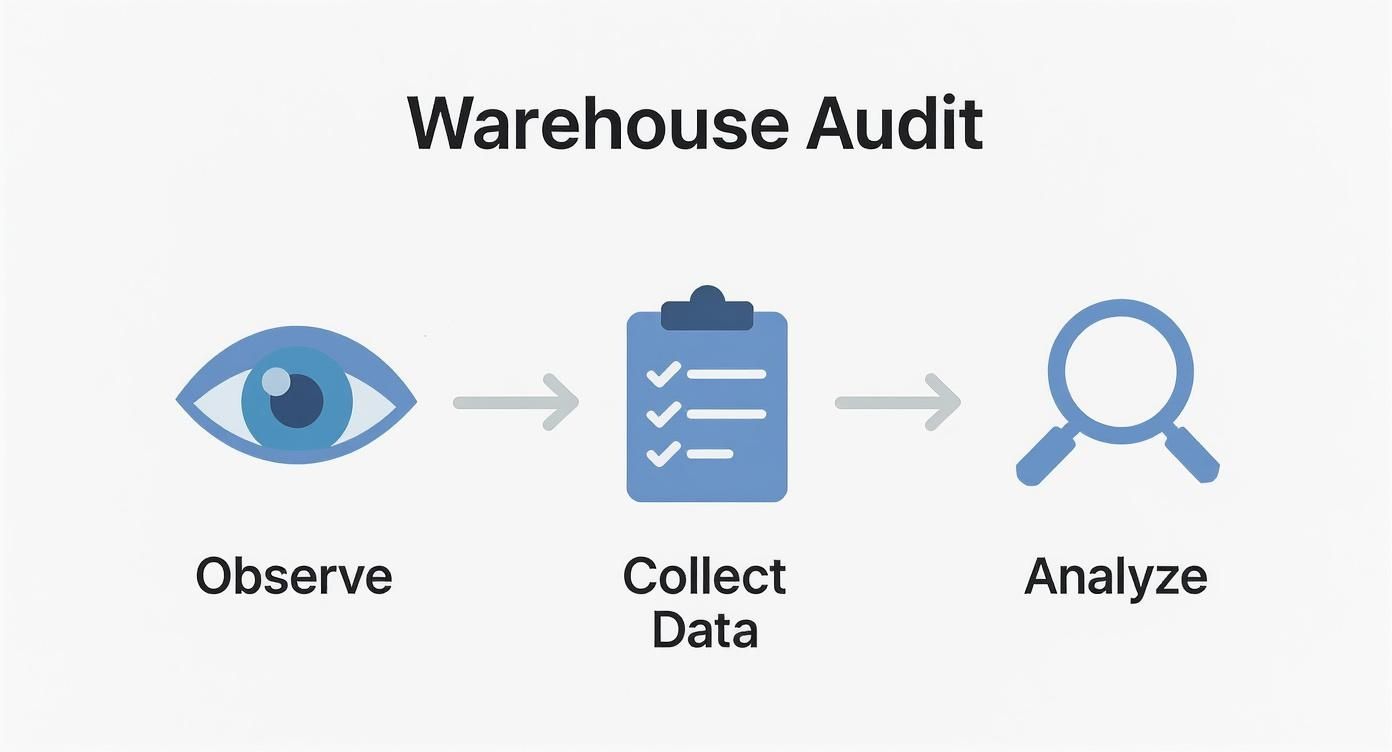
This observe, collect, and analyze framework is your blueprint for finding where the layout is creating friction before you start the heavy lifting of moving racks.
One of the quickest wins you can get is through slotting. This is just a fancy term for strategically placing inventory to slash picker travel time. The core idea is incredibly powerful: put your fastest-moving products in the most accessible, easy-to-reach locations—usually right next to your packing and shipping stations.
To do this right, you need to run an ABC analysis, a classic method for categorizing inventory based on its sales velocity.
Using data this way ensures your pickers are spending their energy on the products that actually move your business forward. A solid slotting strategy is a non-negotiable part of inventory management best practices.
How you tell your team to grab items for an order is just as critical as where those items are stored. Different strategies are built for different types of businesses, and matching the right one to your order profile can send your throughput soaring.
Here's a look at some of the most common methods, along with a table to help you compare them.
This table compares common order picking methods to help businesses choose the best fit based on their specific operational needs and order profiles.
Picking StrategyBest ForProsConsBatch PickingHigh volume of small, single-item ordersDrastically reduces travel time per order; highly efficient for e-commerce.Can be complex to sort items into individual orders at the end.Zone PickingLarge warehouses with high SKU countsPickers become experts in their area, increasing speed and accuracy.Potential for bottlenecks if one zone is slower than others.Wave PickingOperations needing to sync with ship schedulesExcellent for managing workflow and preventing backlogs at packing/shipping.Can be less flexible if order volumes fluctuate unpredictably.
Ultimately, choosing the right strategy isn't a one-time decision. You have to adapt as your business grows.
A huge mistake I see all the time is brands sticking to one picking method long after they’ve outgrown it. An e-commerce seller that starts with simple, single-order picking will see their efficiency absolutely tank as order volume explodes. You have to be willing to re-evaluate and switch to something like batch picking to keep up.
Finally, take a hard look at the physical bones of your warehouse. Your racking system has a direct impact on how much you can store and how easily you can get to it. Standard selective racking is flexible because it gives you access to every single pallet, but it eats up floor space with wide aisles.
On the other hand, a Very Narrow Aisle (VNA) layout uses specialized lifts to operate in much tighter corridors, potentially boosting your storage capacity by up to 50%. It’s a bigger upfront investment, but for warehouses where every square foot counts, it can be a brilliant move.
Don’t just stop at the racks, though. Look at the entire flow of materials, starting the moment a truck backs up to your receiving dock. Getting the inbound process right sets the tone for everything that follows. For a deeper dive, this guide on choosing the right dock leveler is a great resource for ensuring goods move safely and smoothly into your facility from the get-go.

Once your physical layout is humming, the next big leap forward in improving warehouse efficiency is layering in the right tech. This isn't about chasing every shiny new gadget. It’s about being deliberate—systematically killing off manual errors, cranking up the speed, and basically giving your team superpowers.
Think of technology as the central nervous system for your whole operation. It’s the conductor of the orchestra, making sure every pick, pack, and shipment happens in perfect harmony. Flying blind with paper-based systems is a recipe for expensive mistakes and guesswork. The right tools turn a good process into a great one.
The absolute bedrock of any modern warehouse is a solid Warehouse Management System (WMS). This software is the brain of your facility. It gives you real-time eyes on every single piece of inventory, every order, and every employee's task. It’s the critical difference between reactive chaos and proactive control.
A good WMS doesn't just track things; it directs the action. It tells your team exactly where to find an item, the fastest path to get there, and what to do with it next. It’s the foundational layer that makes everything else—from clever picking strategies to full-blown robotics—even possible.
Emerging technologies are also changing the game. Tools like Augmented Reality in Warehouse Operations are showing huge promise by overlaying digital picking instructions right into a worker's line of sight, which helps slash errors and training time even further.
The word "automation" can feel intimidating, but you don't need to transform your facility into a fully robotic operation overnight. The smart play is to phase it in, starting with tech that solves your biggest, most painful problems first. This way, every dollar you spend delivers a clear, measurable return.
Start with the basics that give you the biggest bang for your buck:
With these fundamentals locked down, you can start looking at more advanced automation that targets your specific bottlenecks.
The most successful automation projects I've seen start with a clear problem statement. Don't ask, "Should we get robots?" Instead, ask, "How can we cut our picker travel time by 40%?" That question forces you to find a solution that delivers a specific business outcome.
When you're ready to really level up, advanced automation can completely reshape what your facility is capable of. These systems are built to handle the most labor-intensive, physically demanding tasks in the warehouse, freeing up your people for higher-value work.
Here are a few high-impact options to consider:
The journey into warehouse technology is a marathon, not a sprint. Start with a solid WMS foundation, solve your most immediate pain points with proven tools like barcode scanners, and then strategically scale into robotics. By tying every investment to a specific operational goal, you'll build a smarter, faster, and more profitable warehouse.
Even the slickest robotics and a perfectly optimized layout will fall flat without a skilled, motivated team running the show. Your people are the real engine of your warehouse. Giving them clear processes, the right training, and smart incentives is a direct investment in improving warehouse efficiency—and it's what turns your workforce into a serious competitive advantage.
Technology is great for handling the grunt work, but it's your team that manages exceptions, solves unexpected problems, and keeps an eye on quality. A disengaged or poorly trained crew will inevitably create bottlenecks, no matter how much you spend on new gear. On the flip side, a confident, well-supported team will always find ways to make good processes even better.
The first step to empowering your team is to get rid of the guesswork. Standard Operating Procedures (SOPs) are your playbook for consistency, making sure every critical task gets done the same way, every single time. This is huge for reducing errors, making training a breeze, and setting a clear baseline for performance.
Don't just stop at picking and packing. Your SOPs need to cover every key workflow in the building so nothing is left to chance.
And please, don't let these be dense, dusty binders on a shelf. Use simple language, add photos, and even embed short videos to make them dead simple for anyone to follow.
With well-documented SOPs in hand, you’ve got the foundation for a killer training program. A solid onboarding process gets new hires up to speed faster and with fewer mistakes—a must-have in an industry known for high turnover. But training can't just be a "one and done" thing during the first week.
A classic mistake I see is treating training as a single event. The most efficient warehouses I’ve worked with embrace continuous learning. They hold regular refreshers on safety and new procedures, which keeps skills sharp and shows the team you're invested in their growth.
To build a truly resilient and flexible operation, start a cross-training program. Teaching employees multiple roles—like training a picker to work in receiving—creates incredible agility. When a key person calls in sick or you get a surprise surge in returns, you have a team that can shift gears seamlessly to handle the pressure. It’s a game-changer for reducing bottlenecks and it also boosts morale by giving people new skills and a break from the daily grind.
Motivation is the final piece of the puzzle. Fair pay is the baseline, of course, but smart incentive programs can push the specific behaviors you want to see. The trick is to reward more than just raw speed.
Think about a program that balances productivity with accuracy. For example, you could offer a bonus to pickers who beat their hourly pick rate while keeping their accuracy at 99.8% or higher. This encourages speed without sacrificing the quality that prevents costly returns and unhappy customers. Done right, these kinds of programs have been shown to boost individual employee performance by as much as 22%.
Finally, never, ever underestimate the power of a strong safety culture. A safe warehouse is an efficient warehouse, period. When your team feels protected, they can focus on their jobs without hesitation. Regular safety training, well-maintained equipment, and clear protocols slash accident rates, which in turn minimizes downtime and turnover. It builds a positive environment where people feel valued—and a valued team is always a more productive one.
True efficiency isn't a project you can just check off a list; it’s a culture of continuous improvement you have to build. After you’ve dialed in your layout, tech stack, and team, the real work begins: creating a system that keeps the momentum going. This is all about building a feedback loop to track performance in real-time and constantly hunt for smarter ways to operate.
Without it, even the most brilliant plans will start to unravel. The goal is to make data-driven decisions a daily habit, not just a once-a-year review.
To make tracking progress feel less like a chore, you need a central performance dashboard. Think of it as your mission control, giving you an at-a-glance view of your most important KPIs. By plugging it directly into your WMS and other systems, you can keep a live pulse on the health of your operation and spot trouble the second it pops up.
Every business is different, so your dashboard should reflect what truly matters to you. That said, a few KPIs are non-negotiable for just about any e-commerce operation:
The point of a dashboard isn’t just to spit out numbers; it’s to tell you a story about your performance. When a KPI flashes red, it should immediately trigger the question: "What just happened, and how do we fix it?" That's the core of a continuous improvement mindset.
As you get better at fine-tuning your operations, a new frontier for efficiency opens up: sustainability. "Green warehousing" isn't just about feeling good or being environmentally responsible; it's a straight-up strategic move that delivers serious cost savings and gives your brand a nice reputational boost. The whole idea is to cut waste in all its forms—from electricity to packaging.
The opportunities for savings are huge. For example, using software to figure out the smallest possible box for each order can slash your shipping and material costs. A solid recycling program for cardboard and plastics can even turn what was once a waste expense into a small revenue stream.
Energy is another gold mine. Switching to LED lighting can cut a warehouse's power consumption by up to 75%, and smart climate control systems can optimize heating and cooling based on who's in the building and what the weather is doing outside. Some facilities are even going all-in with solar panels to get to net-zero energy use. You can discover more insights about these essential warehousing trends and see the financial impact for yourself.
By weaving sustainability into your daily operations, you’re not just being eco-friendly; you’re building a leaner, tougher warehouse. You’ll cut operating costs while building a forward-thinking business that today’s shoppers actually want to support. The endgame is to create a culture where every single person on your team is on the lookout for smarter, more efficient, and more sustainable ways to get the job done.
At Million Dollar Sellers, we know that building an efficient, scalable operation is what separates the good e-commerce brands from the great ones. Our exclusive community connects top entrepreneurs who share proven, real-world strategies for mastering logistics, supply chain, and everything in between. If you're ready to learn from 8- and 9-figure sellers who have already solved the challenges you're facing, find out if you qualify to join our network at https://milliondollarsellers.com.
Join the Ecom Entrepreneur Community for Vetted 7-9 Figure Ecommerce Founders
Learn MoreYou may also like:
Learn more about our special events!
Check Events