
Chilat Doina
January 10, 2026
To stop running out of stock, you have to fundamentally shift how you think about inventory. It's about moving away from reactive, last-minute purchasing and building a proactive, data-driven system instead. This means really getting a handle on demand forecasting, nailing your reorder points and safety stock calculations, and building a supplier network that won't flake on you. When you get this right, operational excellence becomes a serious competitive advantage.

A stock out is so much more than a temporary blip in your sales chart. For a growing brand, it's a direct hit to your hard-won momentum. The immediate lost revenue is obvious, but it's the hidden, secondary damages that can truly cripple your growth long after you're back in stock.
For any brand scaling up, the "gut-feel" reordering and messy spreadsheets that got you through the early days quickly turn into massive liabilities. In today's market, with its constant supply chain chaos, that old way of doing things just doesn't cut it anymore.
When a potential customer lands on your product page, excited to buy, only to be met with that dreaded "Out of Stock" notice, the fallout goes way beyond that one lost sale. The damage is multi-layered and it stings.
The last few years have really put this vulnerability under a microscope. Between 2020 and 2023, supply chain shocks sent stockout rates through the roof. A staggering 80% of organizations reported a major disruption in 2024 alone.
The financial hit is brutal. Research shows a single stockout can slash a product's sales by 21–43% over several weeks. Even worse, up to 40% of customers will just give up and buy from your competitor. You can dig into more of the latest supply chain statistics to see the full picture.
The real costs start to pile up when you look at the domino effect of a single stock out. The table below breaks down just how quickly the damage can spread from one empty shelf.
As you can see, what starts as a simple inventory issue quickly spirals, impacting everything from your marketing budget to your brand's reputation.
The core lesson for modern ecommerce brands is that preventing stock outs requires a resilience-first inventory strategy. It's not just about ordering more; it's about ordering smarter with a system designed to absorb shocks.
This playbook will walk you through the exact tactics successful sellers use to protect their growth and turn rock-solid inventory management into their secret weapon.
If you're still relying on guesswork for your inventory, you're setting yourself up for failure. Plain and simple. To get out of the reactive ordering cycle and actually prevent stock outs, you have to get predictive with your planning. Think of accurate demand forecasting as your first, and most critical, line of defense.
It all boils down to understanding the unique sales rhythm of every single product you carry. That hot-selling, trendy item that just blew up on TikTok is a completely different beast than your steady, year-round essential. If you use the same forecasting model for both, you’re either going to stock out on your winner or, just as bad, sink a ton of cash into a slow-mover that just sits on the shelf.
The trick here is to match the forecasting method to the product's actual behavior. Let's ditch the dense academic theory and get practical—this is about what works for a real ecommerce business.
Here are the models I see work best in different situations:
Moving Averages for Steady Sellers: This is your bread and butter for products with consistent, predictable sales. It just averages out your sales data over a set period—say, the last 30, 60, or 90 days—to smooth out any small blips and predict what's coming next. It's simple, it's reliable, and it's perfect for your core, evergreen products.
Exponential Smoothing for Trending Products: When a product suddenly takes off, a simple moving average just can't keep up. Exponential smoothing is designed for this exact scenario because it gives more weight to your most recent sales data. This makes it way more responsive to new trends, which is exactly what you need when a product goes viral or gets a shout-out from a major influencer.
Seasonal Decomposition for Annual Peaks: Selling swimwear, holiday gear, or back-to-school supplies? This model is non-negotiable. It intelligently breaks down your sales data into three core components: the baseline trend, the seasonal pattern, and all the random noise. This is how you anticipate and plan for those predictable yearly peaks and valleys with a much higher degree of accuracy.
The goal isn't to find one perfect formula to rule them all. It's about building a flexible toolkit. You might use a 90-day moving average for your best-selling black t-shirt, but you'll want to switch to exponential smoothing for that new, limited-edition colorway that's suddenly gaining traction.
If you're ready to go a bit deeper, exploring various inventory forecasting methods will give you a much richer view of how to apply these models to your specific business. This is foundational stuff for building a resilient supply chain.
Forecasting isn't just about looking at past data; it's also about looking at what you're about to do. Marketing campaigns, flash sales, and new product launches all create artificial demand spikes. If you don't account for them, they can absolutely wreck an otherwise solid forecast.
I've seen this happen a hundred times: a marketing team runs a massive promotion without ever talking to the operations team. Marketing celebrates a record sales day, while the warehouse is left scrambling. The result? An inevitable, lengthy stock out that completely erases any gains from the sale.
To stop this from happening, you have to actively manage and smooth out your demand.
Your marketing calendar needs to be a primary input for your inventory plan. Before any campaign goes live, you need to be asking some hard questions:
When you get this proactive alignment right, marketing stops being a source of inventory chaos and becomes a predictable, manageable driver of growth.
Launching a new product can feel like a total shot in the dark. How many units do you order for that first run? Order too many, and your cash is tied up. Order too few, and you stock out on day one, killing all your launch momentum.
This is where pre-orders become your secret weapon.
Instead of guessing, you let customers purchase the product before it's in stock. This gives you real-world, validated demand data—not a forecast, but actual orders. It tells you exactly how much inventory to order for your initial stock and helps you build a much more accurate forecast from the get-go.
Once you’ve got a handle on your demand forecast, it's time to put that insight to work. This is where we stop planning and start doing by figuring out the two most critical numbers in your inventory playbook: your Reorder Point (ROP) and your Safety Stock.
These aren't just numbers on a spreadsheet; they are the triggers that protect your cash flow and keep your customers happy. Getting these right is how you finally stop guessing and start building a resilient supply chain that tells you when it’s time to restock.
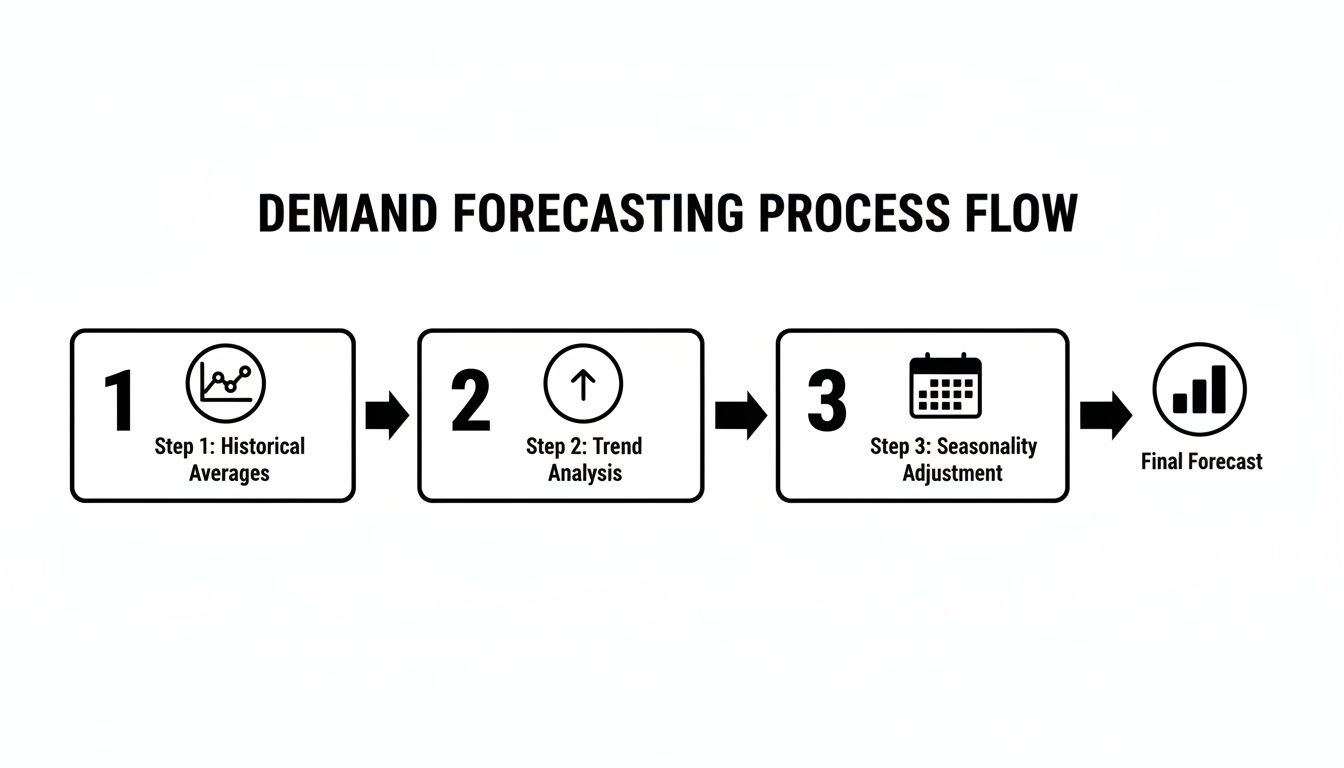
As you can see, a solid forecast—the foundation for all your calculations—is much more than just a simple average. It's a blend of historical data, current sales trends, and any seasonal patterns you know are coming.
Think of safety stock as your brand's insurance policy against chaos. It’s that extra buffer of inventory you keep on hand specifically to absorb two of the most common shocks to the system: a sudden surge in customer demand or an unexpected shipping delay from your supplier.
Without it, even a minor hiccup can send you spiraling into a stockout, killing your sales velocity and tanking your rankings.
The goal here isn't to just pick a number that feels safe. A proper safety stock calculation is rooted in the actual variability you see in your sales and lead times. A product with unpredictable demand and a supplier who is consistently late needs a much bigger cushion than a steady seller with a reliable partner.
For any serious e-commerce operator, the data makes one thing crystal clear: avoiding stockouts is no longer about intuition. It's about statistically sound demand forecasting, risk-adjusted safety stock tied to specific service levels (like 95% or 99%), and real-time visibility into what your suppliers are doing. For a deeper dive into the numbers, check out these supply chain statistics and trends.
The standard formula for safety stock can look a bit intense at first glance, but it's actually pretty straightforward once you break it down.
Safety Stock = Z-Score × Standard Deviation of Lead Time Demand
Let’s unpack those terms:
Pro Tip: Don't apply a blanket service level across your entire catalog. You might be perfectly fine with a 90% service level on a low-margin, slow-moving accessory. But for your high-velocity, high-margin hero product? You’ll want to push that up to 99%.
Let's walk through a real-world example to see how this calculation works in practice.
Here's a step-by-step breakdown for a hypothetical skincare serum, showing how to combine sales and lead time data to find the right safety stock buffer.
This calculation tells us we need to keep 600 units on hand purely as a buffer. This isn't inventory we plan to sell; it's our shield against unexpected delays and demand spikes.
Now that you have your safety stock number, calculating your reorder point is the easy part. The ROP is the exact inventory level that should trigger a new purchase order with your supplier. No more guessing, no more waiting until you feel like you're running low.
The formula is simple:
Reorder Point = (Average Daily Sales × Average Lead Time) + Safety Stock
Let's stick with our skincare serum example:
This number is your new best friend. The second your inventory for this serum drops to 2,850 units, that's the signal to cut a new PO.
This removes all the emotion and guesswork from replenishment. It creates a systematic, data-driven process that ensures your next shipment lands just as you need it, having dipped into—but not fully depleted—your safety stock. It's the key to perfectly timed inventory flow.
Your demand forecasting can be perfect and your safety stock calculations flawless, but none of it means a thing if your suppliers can't deliver. A solid inventory plan is only as strong as its weakest link—and for many brands, that weak link is an over-reliance on a single manufacturing partner.
The key is to move away from a simple transactional relationship and start building a strategic network that can handle the inevitable shocks of a global supply chain. This all starts with intentionally diversifying your supplier base.
Relying on one factory, no matter how great they are, creates a single point of failure that can shut down your entire business. A multi-layered approach to sourcing is your best defense against unexpected factory shutdowns, shipping logjams, or quality control disasters.
Smart brands structure their network with clear roles for each partner:
The modern supply chain is incredibly fragile. In 2024, a staggering 76% of European shippers reported major disruptions, with nearly a quarter of them dealing with over 20 separate incidents in that year alone. A diversified network isn't just a best practice anymore; it's a necessity for survival.
Knowing your true lead time is absolutely critical for preventing stockouts. And I'm not just talking about the time a container spends on the water. It’s the entire journey, from the moment you send a purchase order to the second your inventory is checked in and ready to sell.
You need to break it down and track each stage separately:
When you track these phases separately, you can pinpoint exactly where delays are happening and hold suppliers accountable with real data. If production consistently takes 10 days longer than quoted, you can adjust your reorder points accordingly. This detailed tracking transforms your supplier conversations from subjective complaints to objective, data-driven planning. Building this kind of system is a core part of effective supply chain risk management strategies.
It's also vital to understand how even seemingly unrelated supply chain disruptions can impact projects and pull lessons from them that apply to your own operations. The core principles of risk and delay are universal.
Ultimately, preventing stockouts means treating your suppliers like true partners. Share your forecasts with them so they can plan their own raw material purchases. Negotiate flexible terms, like staggered deliveries that allow you to smooth out cash flow and your warehouse receiving workload. When your suppliers have visibility into your plans, they can serve you better, creating a more responsive and resilient supply chain for everyone.
There comes a point in every growing brand's journey where manually tracking inventory in spreadsheets stops being scrappy and starts being a serious liability. It’s a ticking time bomb.
Human error, outdated data, and the sheer number of hours it takes to keep those sheets updated create the perfect storm for a stockout. The only way to sustainably scale is to bring in technology that automates, syncs, and gives you the clarity needed to make smart replenishment decisions.
This doesn't mean you need to jump straight into a six-figure Enterprise Resource Planning (ERP) system. The trick is to pick the right tool for where your business is today. The market is full of powerful, affordable solutions designed specifically for high-growth ecommerce brands that can get you out of spreadsheet hell and into a system built for real operational excellence.
First things first, you need to be crystal clear on what problems you're actually trying to solve. For most brands fighting to stay in stock, the most valuable features usually boil down to a few key areas:
The smartest operators I know have shifted from a "lean only" mindset to a resilience-first inventory strategy. The market is moving in the same direction—55% of supply chain organizations are planning new tech investments. We're seeing a massive jump in AI adoption, from 28% to a projected 82%, all driven by the need for better demand planning and safety stock optimization.
The big decision you’ll face is whether you need a dedicated Inventory Management System (IMS) or a full-blown Enterprise Resource Planning (ERP) system.
An IMS is a specialist. It’s built to do one thing exceptionally well: manage your inventory. These systems are typically more affordable, way faster to implement, and plug right into platforms like Shopify and Amazon without a fuss. For most sellers doing under eight figures in revenue, an IMS delivers all the power you need. Our guide on the best inventory management software for small business is a great place to start comparing the top contenders.
An ERP, on the other hand, is the all-in-one command center for your entire business. It handles inventory, but it also ties in accounting, CRM, HR, and even manufacturing into one massive platform. ERPs are incredibly powerful, but they come with a hefty price tag and a much steeper learning curve. They really only make sense for larger, more complex brands that need to unify data across every single department, not just the warehouse.
Before you make a call, it's worth the time to explore detailed features of inventory management software and see which capabilities truly line up with your long-term vision.

Even with the sharpest forecasting and a healthy safety stock, chaos is inevitable. A supplier misses a key deadline. A container gets stuck in customs. A product unexpectedly goes viral on TikTok. This is exactly when you need a crystal-clear Standard Operating Procedure (SOP)—your "break glass in case of emergency" protocol for when a stock out is no longer a risk, but a reality.
Having this plan documented before a crisis hits is everything. It swaps panic for a systematic, calm response, ensuring your team knows precisely which levers to pull to minimize the damage and get back on track, fast. This is the difference between a minor hiccup and a long-term disaster.
A rapid replenishment plan is so much more than just ordering more inventory. It's a coordinated, multi-departmental sprint designed to protect revenue, customer trust, and your hard-won market position.
First things first: an emergency plan is useless if you don’t know when to activate it. You need clear, data-driven triggers that automatically set the SOP in motion. This removes all the guesswork and hesitation when the pressure is on.
These triggers are almost always based on a metric called Days of Stock Remaining. If your system projects you have fewer than a certain number of days' worth of inventory—and your next shipment won't land in time—the alarm bells need to ring. For instance, if your typical lead time is 45 days, you might set a trigger at 60 days of stock remaining.
Common triggers we see brands use include:
The second a trigger is hit, the team needs to jump into action with a pre-defined plan. This protocol should lay out the specific logistical, financial, and communication steps to take, step by step.
A core piece of this is the expedited freight analysis. This means quickly running the numbers on the cost-benefit of switching a shipment from sea to air. Sure, air freight can cost 5-10 times more than ocean shipping. But that expense is often a drop in the bucket compared to the lost revenue and ranking damage from a prolonged stock out on a hero product.
Don't let the decision to expedite be emotional. It's just math. Is the high cost of air freight less than the projected total cost of the stock out (lost sales, wasted ad spend, and rank recovery)? For your bestsellers, the answer is almost always a resounding yes.
Your SOP should also include immediate operational moves. This could mean activating a backup supplier for a rush production run or reallocating inventory you already have. If you hold stock in a DTC warehouse, for example, consider transferring a chunk to Amazon FBA to keep your highest-velocity sales channel from going dark.
Finally, the plan must dictate internal communication. Marketing needs an instant heads-up to pause ad spend on that SKU, preventing you from burning cash. Your customer service team needs a script, and the "notify me when back in stock" feature on your product page needs to be switched on immediately.
Even with the best inventory systems in place, questions always pop up. Here are some quick, no-fluff answers to the common hurdles ecommerce operators hit when they’re trying to keep products on the shelf.
For your A-list, fastest-moving products, you need to be looking at these numbers monthly. Same goes for any time the market gets a little shaky. For your more stable, predictable sellers, a quarterly check-in is usually enough.
The real key is to reassess any time a major variable shifts. That could be a sudden change in your sales velocity, an updated lead time from your supplier, or a big market event like the Q4 holiday rush barreling down on you. Don't set it and forget it.
Honestly, there's no magic number. A "good" ratio is completely different depending on your industry and business model. For most DTC brands, a ratio somewhere between 4 and 10 is a healthy range to be in.
If your ratio is way too high, you’re probably under-ordering and living on the edge of a stockout. On the flip side, a ratio that’s too low is a classic sign you've got too much cash locked up in inventory that’s just collecting dust.
Forget chasing some universal benchmark. The most valuable data is your own. Track your turnover ratio over time and see how you stack up against your closest competitors to dial in the sweet spot for your business.
Unpredictable lead times are a nightmare, but you can tame the chaos with data. The first step is to track every single stage of the process—from the moment production starts, to transit time, to the final warehouse check-in. You need to pinpoint exactly where the delays are happening.
Once you have that data, you can calculate not just your average lead time, but also its standard deviation. This little number tells you how much variability to expect, and it's the secret ingredient for calculating a much smarter, more resilient safety stock that can actually absorb those delays. Build that buffer directly into your reorder point formula and you’ll be much better protected from your supplier's flakiness.
Ready to stop guessing and start scaling? Join Million Dollar Sellers, the exclusive community where 7-, 8-, and 9-figure founders share the exact strategies they use to build resilient supply chains and dominate their markets. Apply for your invitation at https://milliondollarsellers.com.
Join the Ecom Entrepreneur Community for Vetted 7-9 Figure Ecommerce Founders
Learn MoreYou may also like:
Learn more about our special events!
Check Events