Chilat Doina
January 16, 2026
If you want to raise your prices without sending customers running for the hills, the secret isn't some complex formula. It’s about being upfront and constantly showing the massive value you deliver, justifying the change long before it ever happens.
It’s a simple reframe: stop talking about cost and start a conversation about investment. This way, your best customers will see that a price adjustment is just fuel for the quality and innovation they already love.
Too many founders see a price increase as a defensive move—a last resort to fight inflation or protect shrinking margins. But seasoned operators know the truth: it's one of the most powerful offensive tools you have for growth.
Getting your pricing right is one of the fastest ways to signal your brand's quality, boost profitability, and bankroll your next big idea.
Let's be real, in a world where customer acquisition costs (CAC) seem to climb every single day, just chasing new buyers is a losing game. The real leverage comes from maximizing the value of the customers you’ve already earned. That's where strategic pricing comes in. This isn't about gouging your audience; it's about making sure your price tag actually reflects the incredible results your product delivers.
The biggest mistake I see is when brands tie their prices directly to their costs. Of course, you have to cover your expenses, but that’s table stakes. A value-based approach is way more powerful.
This shift forces you to answer one critical question: What is this outcome actually worth to my customer? When you can nail that down and communicate it clearly, the price becomes a non-issue compared to the value they're getting.
This guide is your playbook for getting it done. We'll walk through the core pillars of a smart price adjustment:
A well-executed price increase does more than just pad your bottom line. It has a funny way of filtering out the price-sensitive, high-maintenance customers, freeing you up to pour all your energy into serving your most loyal—and profitable—fans.
Your existing customers are the bedrock of any successful price increase. The data doesn't lie: companies that improve customer retention by just 5% can see profits jump by 25% to 95%.
It makes sense. Your loyal customers, the ones who've already bought from you, spend 67% more over time than brand-new shoppers. And with acquisition costing 5-7 times more than retention, protecting that loyal base during a price change isn't just a good idea—it’s everything. You can read more about the impact of customer retention rates on OpenSend.com.
Before you even think about touching your prices, you need a solid foundation. This checklist breaks down the essential pieces you should have in place to make sure you're ready.
If you can confidently check these boxes, you're not just ready for a price increase—you're ready to use it as a strategic lever for growth.
This playbook is for serious founders who get that pricing is a direct reflection of brand confidence. Let’s get into the tactical steps to nail it.

Before you touch a single price tag, you need to take a hard, honest look under the hood of your business. Successfully raising prices isn't really about the new number itself—it's about the strength of your brand and the loyalty you've built.
So, the first move is always a data-driven diagnostic. We need to figure out if your customers love you for your brand, or just for your price.
Let's start by digging into the numbers that reveal true customer loyalty. Don't just glance at them; you need to understand the story they're telling about your relationship with your buyers. Think of these metrics as your brand's report card.
The first two to pull up are your Customer Lifetime Value (LTV) and your repeat purchase rate. A high LTV is a massive green light, telling you that customers stick around and keep spending money over time.
Similarly, a strong repeat purchase rate (I like to see 30% or higher for most DTC brands) shows that your product has become a staple in their lives, not just a one-off experiment. If these numbers are solid, you've likely earned the right to ask for more. A low repeat rate, on the other hand, is a major warning sign. It suggests your customers are transactional and will jump ship for a cheaper alternative the moment you raise prices.
If your metrics are looking a little weak, it’s probably time to double down on your brand-building efforts. You can learn more about how to develop a brand strategy that fosters that kind of loyalty before making any pricing moves.
Another critical diagnostic is your Net Promoter Score (NPS). This simple metric tells you how likely customers are to recommend you to others. Your "Promoters"—the ones giving you a 9 or 10—are your biggest allies in a price change. They're far less sensitive to price and will often defend your value to others.
A study I came across found that improving your NPS by just 10 points can correlate to a 5-8% increase in customer retention. This isn't just a feel-good number; it's a direct indicator of your pricing power.
As you dig in, your data will quickly show you that not all customers are created equal. The next step is to segment your audience to find your ride-or-die fans—the ones who buy frequently, spend the most, and leave you glowing reviews.
These are the people who value your brand far beyond the price tag. Use your sales data to identify this cohort. Look for patterns in:
This analysis is your treasure map. It shows you exactly which customers to protect and which products have the most pricing power. A blanket price increase is a rookie mistake. A segmented, strategic approach is how the pros do it without torching their customer base. For instance, your most loyal segment might barely blink at a 10% increase on your hero product, while new customers could balk at a 5% bump on an entry-level item.
Once you know who your best customers are and what they love, you can start testing price elasticity. It sounds complicated, but all we're doing is finding the tipping point where a higher price starts to significantly hurt demand. And you don't need a team of data scientists to pull this off.
For DTC brands, running a simple A/B test is a fantastic place to start. Just create a duplicate product page with the new, higher price and send a small percentage of your traffic there. Let it run for a week or two and compare the conversion rates. If the conversion rate on the higher-priced page holds steady or only dips slightly, you've just confirmed you have room to move.
Amazon sellers can use a similar cohort-based approach. If you have a product with multiple variations (like different colors or sizes), try testing a price increase on a less popular variation first. Keep a close eye on its sales velocity and Best Sellers Rank (BSR). This lets you gather valuable, real-world data on market reaction without risking your top-performing ASINs.
This diagnostic work isn't just a suggestion—it's the essential foundation for any successful pricing strategy.
Once you’ve dug through the data and you’re confident a price change is the right move, you’ve hit the most delicate part of the entire process. How you tell people about the price increase is just as important as the change itself. A clumsy, apologetic, or non-existent announcement can torpedo years of goodwill. But get it right, and you can actually make your customer relationships stronger.
The goal isn't to hide the price hike; it's to frame it. Your messaging should be a confident reminder of the value you provide, not some half-hearted apology for needing to charge what you're worth. When you nail this conversation, it reinforces your brand's quality and reminds customers exactly why they chose you in the first place.
Before you write a single word, you have to get inside your customer's head. Nobody likes paying more for the same thing. It's just human nature. However, people are surprisingly understanding when they feel respected and see the "why" behind it.
The biggest blunder you can make is making the announcement all about you—your rising costs, your squeezed margins, your need for profit. That's a one-way ticket to customer resentment. The smart play is to flip the script and make it all about the customer and the value they get.
The best price announcements don't talk about cost. They talk about a continued investment in the quality, innovation, and service that customers already love.
This is a subtle but powerful shift in perspective. It moves the conversation from "we're charging you more" to "we're investing more to make your experience even better."
A generic email blast is a terrible idea. You absolutely have to segment your communication based on the channel and the customer's relationship with your brand. A loyal DTC subscriber who's been with you for years deserves a much different message than a first-time browser on Amazon.
No matter the channel, consistency is everything. Your customer service team needs to be armed with scripts that are perfectly in sync with your public messaging. This prevents any confusing mixed signals and shows your entire brand is on the same page. If you want to dive deeper into this, our guide on how to build brand loyalty offers some great strategies for strengthening these critical relationships.
Your announcement needs to be clear, concise, and focused on value. Ditch the apologetic language—it just makes you look weak and undermines the whole reason for the change. Be direct and confident instead.
To give you a better idea of how this looks in practice, here’s a breakdown of how to structure your messaging across different scenarios.
This table compares messaging strategies across different channels, providing clear examples for various customer segments and business models.
Notice a pattern? None of these examples say "we're sorry." They all pivot to a positive outcome for the customer—better materials, an improved product, or maintained quality.
This small but vital distinction can turn a potentially negative event into a powerful confirmation of your brand's commitment to excellence. By communicating transparently and constantly reinforcing your value, you can successfully raise your prices without alienating the customers who matter most.
Rolling out a price increase isn't a "one-size-fits-all" deal. A strategy that works brilliantly for a subscription DTC brand could absolutely torpedo an Amazon FBA seller's business. You've got to be as strategic with the how as you were with the why.
This is where the rubber meets the road. Getting the execution right is all about meticulous planning—timing the change, getting your internal teams on the same page, and making the transition as smooth as possible for your customers. Let's dig into the tactical playbooks for the big three: Amazon, DTC, and coordinating the whole thing internally.
Raising prices on Amazon is like walking a tightrope. You're balancing profitability against an algorithm that worships sales velocity and conversion rates. A sudden, sharp price hike can kill your conversion rate, which in turn tanks your Best Sellers Rank (BSR) and basically makes your product disappear.
On Amazon, the name of the game is gradual and subtle.
Pro Tip: Whatever you do, never change your prices during a major sales event like Prime Day or the holiday shopping frenzy. The algorithm is way too volatile, and you risk losing crucial momentum. The best time is almost always during a slower, more predictable sales period.
When you're a DTC brand, you own the customer relationship. That gives you so much more flexibility in how you handle a price change. The goal is to lean into that relationship and make your customers feel valued, not milked for cash.
One of the most powerful moves in the DTC playbook is grandfathering rates for your most loyal customers. This means your existing subscribers or long-time buyers keep paying the old price, while all new customers see the updated pricing. It's an incredible way to reward loyalty and pretty much guarantees you won't lose your core customer base.
You could send a simple email that says something like, "As a thank you for being with us from the early days, your current price is locked in for life." That single gesture can transform a potentially negative event into a massive win for brand loyalty.
Another solid approach is the phased rollout. Instead of flipping a switch on your entire catalog overnight, you might implement the new pricing on just one product line first. This gives you a controlled environment to collect data and feedback before making the change across the board.
This whole process really boils down to three core communication steps: justifying the change, segmenting your audience, and then, finally, making the announcement.
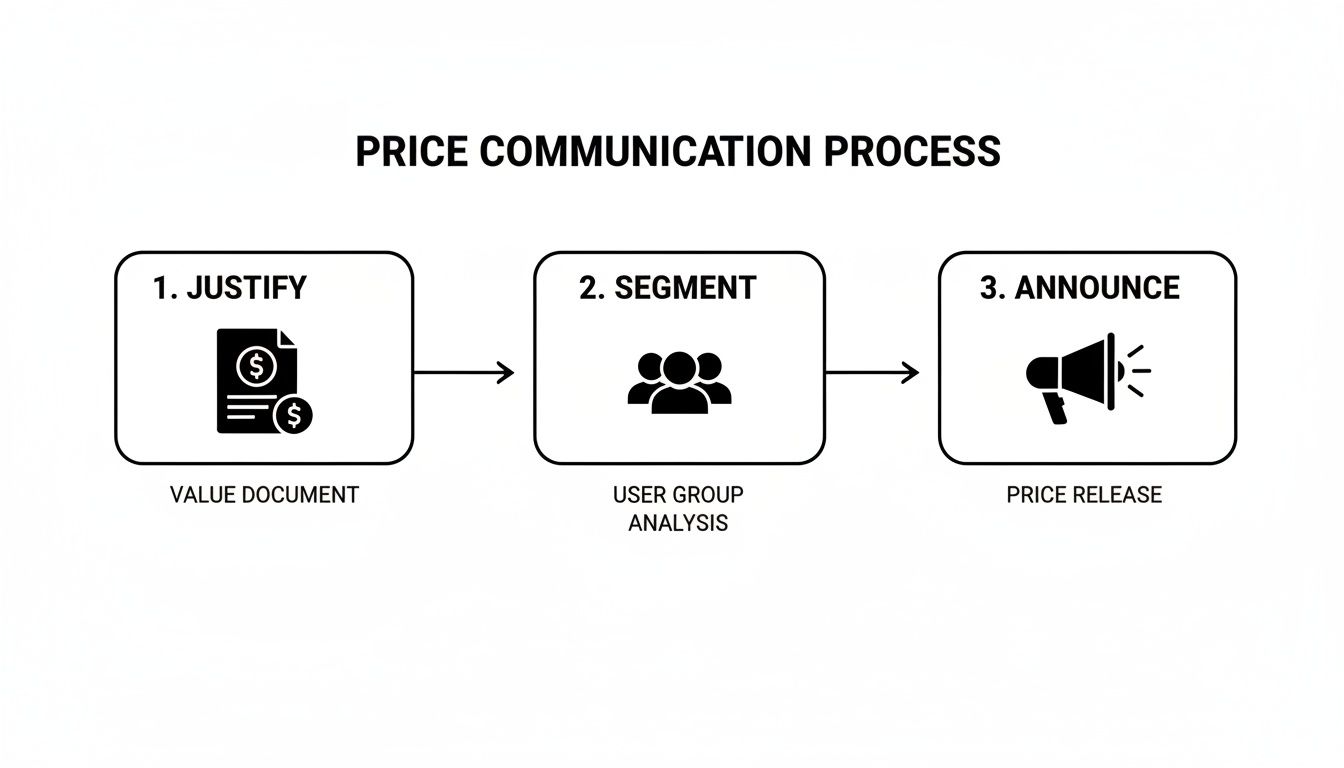
As the visual shows, a smooth rollout always starts with a rock-solid value justification and a clear understanding of your customer segments—long before you ever send a single email.
A price change can't happen in a silo. Your entire company needs to be prepared and singing from the same song sheet. Nothing undermines customer trust faster than getting conflicting information from a marketing email and a customer service agent.
Before you go live, get your house in order:
When you treat the rollout like a coordinated, cross-functional project, you present a united, professional front. This reinforces that your price increase is a deliberate, strategic decision—not a desperate, last-minute cash grab.
Getting your new pricing live isn't the finish line—it’s the starting gun for the most critical phase. The first 30 to 90 days are where all your careful planning and assumptions meet the real world. Now it's time to be a hawk, monitoring everything to make sure your price hike doesn't backfire and crater your sales or alienate your customer base.
The work shifts from strategy to observation. You need to relentlessly track performance against the benchmarks you set in the diagnostic phase. This isn't about hitting the panic button at the first sign of a dip. It’s about understanding new customer behaviors as they emerge and being ready to respond with data, not fear.
You can't fix what you can't see. As soon as the new prices are active, your entire focus needs to narrow down to a handful of key performance indicators (KPIs). Think of these as your early-warning system—they’ll tell you exactly how the market is really reacting.
Your dashboard needs to give you an immediate, at-a-glance health check on the business. For a deep dive into what that looks like, check out our guide on building an effective performance metrics dashboard. Getting this right is crucial for making smart, timely decisions.
Here are the metrics you need to watch like a hawk:
Ultimately, the real test of a successful price increase comes down to your customer retention metrics. Keeping this number healthy is what ensures you're not sacrificing long-term growth for a short-term cash grab.
Before things even have a chance to go sideways, you need to define exactly what "sideways" looks like. By setting specific triggers for action ahead of time, you take emotion and panic out of the equation. This isn't just about having a rollback plan; it's about having a smart adaptation strategy.
Think of your mitigation plan as a series of if-then scenarios. If the conversion rate drops by X% and stays there for Y days, then we will implement Z action. This removes emotion from the decision-making process.
Establish crystal-clear, numbers-based triggers. For example, if your overall conversion rate plummets by more than 20% for two straight weeks with no sign of recovery, it's time to act. If the cart abandonment rate jumps by 30%, that's another trigger pulled.
If you hit a trigger, you have a whole toolkit of smart moves to make that don’t involve a panicked race to the bottom. A full price rollback should be your absolute last resort. It can seriously damage your brand's perceived value and signals a lack of confidence.
Instead, pull one of these levers:
By monitoring performance obsessively and having a clear-headed mitigation plan in your back pocket, you turn a potentially risky move into a controlled, adaptable strategy. This is how you raise prices effectively without torching the customer relationships that built your brand.
Even with a rock-solid plan, raising prices kicks up a bunch of tactical, in-the-weeds questions. It's totally normal to feel a bit uncertain about the finer points of actually pulling the trigger.
Let's tackle the most common questions we hear from founders head-on. These are straight-up, practical answers grounded in what actually works, so you can navigate the final steps with confidence.
The perfect notice period really hinges on your business model and the relationship you have with your customers. There's no single magic number, but there are definitely some smart rules of thumb.
For any subscription or recurring service, 30-60 days' notice is the gold standard. It’s a sign of respect. You're giving people time to adjust their budgets without feeling ambushed, which is massive for maintaining trust.
If you’re a DTC brand selling mostly one-off products, a shorter heads-up of 1-2 weeks can work wonders. This actually creates a bit of urgency and often drives a last-minute sales rush at the old price. It's a slick way to clear out some inventory and let your loyal fans stock up one last time.
But on Amazon? The best announcement is often no announcement. A quiet, gradual increase is almost always the safest bet to avoid poking the platform's sensitive algorithm.
The real key here is to segment your approach. Your most loyal, long-term customers deserve a generous heads-up. For new or anonymous shoppers on a massive marketplace, a direct change is perfectly fine—and often the smarter move.
Look, no matter how perfectly you plan this, some negative feedback is going to happen. The secret isn't trying to avoid it—it's being prepared, empathetic, and relentlessly consistent in how you respond. The worst thing you can do is panic and start slinging discounts. That just torpedoes your whole strategy.
First, arm your customer service team with a clear, concise script. This script should never be apologetic. Instead, it needs to pivot immediately to the value behind the increase. Are you sourcing better materials? Investing in faster shipping? Upgrading the customer experience? Hammer that point home. Consistency is everything.
Next, keep a close eye on your social channels and review sites. When a public complaint pops up, respond with the exact same value-focused message. It shows other customers you’re confident in the decision and that you made it for the right reasons.
For high-value, long-time customers who reach out directly, empower your team to make a small, one-time gesture. A modest discount code for their next purchase or a small freebie with their next order can work wonders. This small act can flip a negative moment into one that actually reinforces their loyalty, all without backtracking on your new prices.
A blanket, across-the-board price hike is almost always a mistake. It’s a sledgehammer when you really need a scalpel. A segmented approach is way smarter and a whole lot less risky.
Start by digging into your product catalog to find your "hero" products. These are the items with die-hard fans, serious brand loyalty, and few direct competitors. They’re your strongest candidates for a price increase because their value is already cemented in your customers' minds.
Another play is to test the waters by raising prices on lower-volume or less visible products first. This lets you collect real-world data on customer reactions with minimal risk to your main revenue streams. Think of it as a low-stakes dress rehearsal.
For the best results, consider a tiered strategy:
This kind of strategic approach lets you lift your overall margin without scaring off new buyers or making your brand feel inaccessible.
Yes, you absolutely can—but you have to be careful and deliberate. The Amazon algorithm doesn't forgive easily, so you can't be reckless. A sudden drop in your conversion rate can send your sales rank into a nosedive, making your product practically invisible.
The safest way to do this is with A/B testing on listings that have multiple variations. If you sell a product in different colors or sizes, raise the price on a less popular variation while keeping your bestseller’s price the same. Watch the conversion rate and Best Sellers Rank (BSR) on that test variation like a hawk for 2-4 weeks. If it holds steady, you’ve got a green light.
Another solid tactic is the "slow creep." Instead of one big, jarring price jump, you increase the price by a tiny amount—sometimes just a few cents—every couple of days. This gradual climb helps you find the market's true ceiling without triggering a conversion drop that will slaughter your rank. It’s a patient game, but it’s one that protects the visibility you've worked so hard to build.
At Million Dollar Sellers, we know pricing is one of the most powerful levers for serious e-commerce growth. Our exclusive community is where 7-, 8-, and 9-figure entrepreneurs share the exact strategies they use to scale profitably—including mastering the art of the price increase. If you're ready to learn from the best in the business and accelerate your growth, see if you qualify to join our network.
Join the Ecom Entrepreneur Community for Vetted 7-9 Figure Ecommerce Founders
Learn MoreYou may also like:
Learn more about our special events!
Check Events