Chilat Doina
January 20, 2026
If you want to cut down on e-commerce returns, you have to stop thinking of them as just another transaction. The real win comes from digging in, finding out why customers are sending things back, and then fixing those root causes. This means getting serious about your product page details, tightening up quality control, and making your reverse logistics way more efficient. The goal is to turn that messy pile of return data into a clear, actionable feedback loop that protects your profit margins.
Too many sellers write off returns as just the "cost of doing business." It's a line item they expect to see, but that mindset misses the bigger, much more expensive picture.
A return isn't just a refund hitting your bank account. It's the start of a long, costly journey for that product, triggering a whole cascade of hidden expenses that bleed profits. Each returned item has to make its way back to your warehouse, and that trip is anything but free. We're talking shipping labels, labor costs for receiving and inspecting the item, and maybe even restocking fees.
And what if the product is damaged or the packaging is torn? You might have to repackage it, refurbish it, or liquidate it at a massive discount. Suddenly, that potential profit has turned into a guaranteed loss. These are the little operational drains that add up faster than you'd think.
This chart really puts it into perspective, showing just how much bigger the returns problem is for online stores compared to traditional retail.
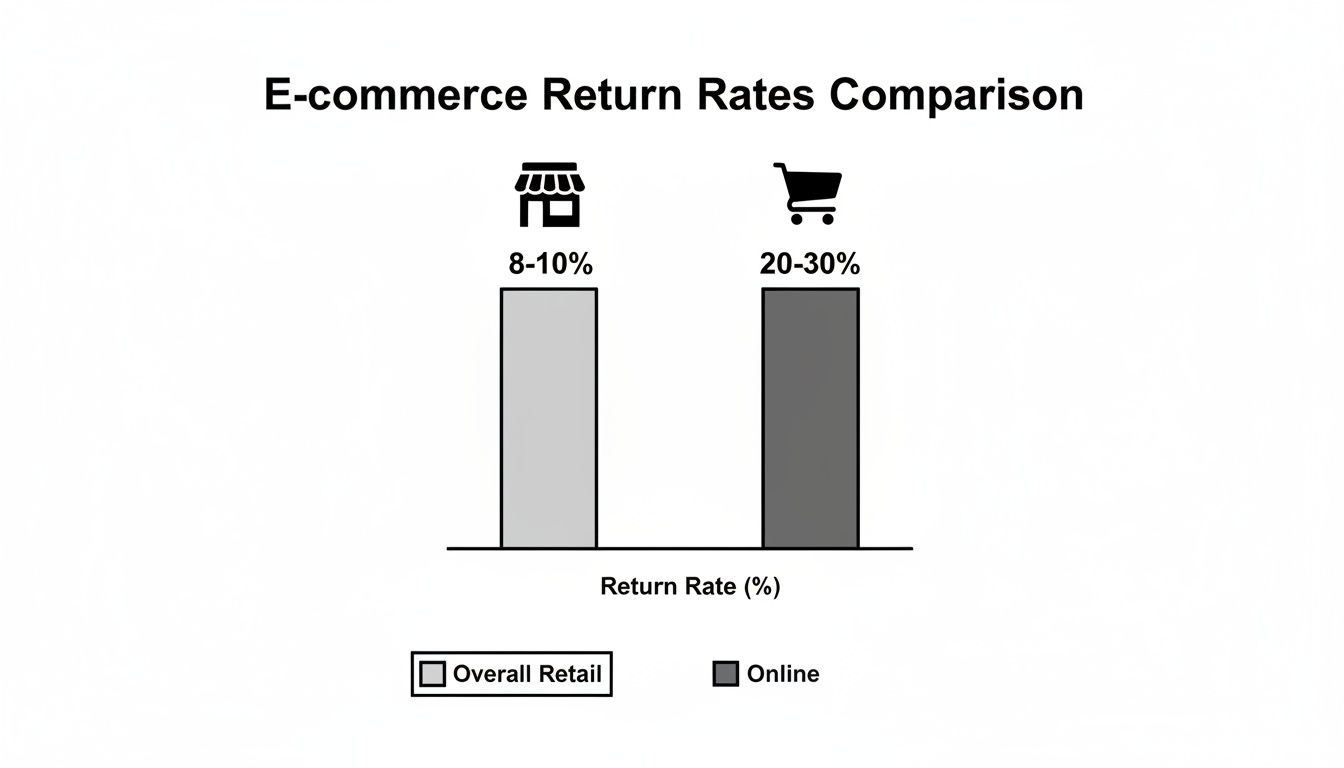
The data is crystal clear: if you're in e-commerce, you're dealing with a much higher return burden. That makes tackling this a top priority, not an afterthought.
The sheer scale of this problem is staggering. In 2024, U.S. retailers saw a jaw-dropping $890 billion in returned merchandise. That's about 16.9% of all sales.
For e-commerce sellers, the numbers are even worse, with online return rates projected to climb to 19.3% in 2025. And to add insult to injury, return fraud tacks on an extra $10.30 for every $100 of returned goods.
The true cost of a return isn't the refund amount. It’s the sum of shipping, labor, processing, repackaging, and the lost value of unsellable inventory. Each of these components chips away at your net profit.
Think about the operational drag. Your team might spend hours carefully picking, packing, and shipping an order, only for that same order to eat up even more time and resources on its way back. This is where concepts like inventory carrying cost come into play, as returned products tie up cash and valuable warehouse space that could be used for sellable stock.
Let's look at how this plays out for a hypothetical business.
This table breaks down the direct financial hit from different return rates, showing how quickly the costs of goods, processing, and lost sales can escalate.
The numbers speak for themselves. Even a few percentage points make a massive difference to the bottom line.
Getting a handle on your returns isn't just about playing defense; it’s one of the most powerful growth strategies you can implement. For a brand doing eight figures, dropping the return rate by just a couple of points—say, from 20% down to 18%—can free up hundreds of thousands of dollars.
That’s real cash you can plow back into the business. Think about what you could do with it:
Top sellers get this. They've stopped seeing returns as a nuisance and started treating them as a core KPI. They know that a low return rate is a direct reflection of a fantastic customer experience, accurate product listings, and a well-oiled operational machine.
If you're trying to solve your returns problem without data, you're just guessing. To actually make a dent in your return rate, you have to dig into the specific reasons customers are sending things back. Just knowing your return rate is high is like having a fever—it tells you something's wrong, but it doesn't tell you what's causing it or how to treat it.
The real shift happens when you stop thinking of returns as just a cost and start treating them as raw, unfiltered customer feedback. Every box that comes back to your warehouse holds a story about a mismatched expectation, a product flaw, or a hiccup in your fulfillment. Your mission is to capture that story.
This means you have to get rid of those generic, useless return reasons. Options like "not what I wanted" or "changed my mind" are data black holes. They give you absolutely nothing to work with and force you to guess what the real problem is.
To get the answers you need, you have to guide your customers to give you better feedback when they start a return. This isn't about making their life harder; it's about making their input genuinely useful. Your return portal needs to offer specific, structured options.
A well-designed system will neatly categorize returns into buckets that point a finger directly at a specific part of your business. For example:
This level of detail is what turns your return data from a painful expense into an incredible diagnostic tool. When you segment this data, you start seeing patterns you never would have caught otherwise.
Your return data isn't just a cost center; it's a direct feedback loop from your most honest critics. Listen closely, and it will tell you exactly where your product, marketing, and operations need improvement.
Once you're gathering better data, the real work begins: analysis. The goal is to connect the why (the return reason) with the what (the specific product SKU). This is where you can finally ask strategic questions that lead to real, money-saving solutions.
For instance, an apparel brand might discover that one specific SKU—a blue V-neck shirt—has a whopping 35% return rate because it "runs small." At the same time, the red version of the exact same shirt only has a 5% return rate. Suddenly, you realize it's not a problem with the shirt's design. It's almost certainly a problem with the blue dye lot or a bad batch from one specific factory run.
Or maybe an electronics store sees a spike in "arrived broken" returns for a particular model of headphones. By cross-referencing this with their shipping data, they could discover the problem only affects orders shipped by a specific carrier, pointing directly to a packaging or handling issue. A deeper dive into how to analyze sales data can give you a solid framework for spotting these kinds of trends across all your products.
To keep all this organized, a simple framework can work wonders. It helps you connect the symptom (the return reason) to the root cause and, most importantly, the team that can actually fix it.
Here’s a simple table you can adapt for your own business. It's designed to translate a customer complaint into a concrete action item for a specific department.
By systematically digging into the "why" behind every return, you stop reacting to problems and start preventing them. This data-first approach is the bedrock of any serious strategy to reduce ecommerce returns and turns a major cost center into a real opportunity for growth.
Let's be honest, the best way to handle a return is to stop it from happening in the first place. This isn't about tricky policies or restrictive rules; it's about building rock-solid buyer confidence and setting expectations so clear there's no room for confusion. Your battleground for this is the product page—it's your single best tool for closing the gap between what a customer thinks they're getting and what actually shows up at their door.
Think about this for a second: a staggering 65% of returns are because an item didn't fit. Another 31% get sent back simply because the product didn't match the online description. These aren't complicated supply chain failures. They're communication breakdowns on your website, and they are completely preventable. The mission is to give shoppers so much information and visual proof that hitting "buy" feels like a sure thing.
Those standard, flat product photos on a stark white background? They're table stakes now, but they won't get you to the finish line. Today's shoppers need a complete, almost tactile, sense of what they're buying online. You have to invest in a full suite of visual assets that leaves absolutely nothing to the imagination.
Your visual strategy needs to cover all the bases:
This kind of visual deep-dive is how you kill the dreaded "not as described" return. You're painting a complete, honest picture. To really nail this, you need to think strategically about effective product catalog management to keep everything consistent and accurate.
Your product description is your digital salesperson, and its job is more than just selling. It needs to anticipate and answer every single question a customer might have before they even think to ask it. Vague copy that just lists features is a one-way ticket to a higher return rate.
Instead, craft detailed, benefit-driven descriptions. Don't just list materials; explain how they feel. Don't just give dimensions; explain what that means for the user. Selling a jacket? Don't just say "polyester blend." Describe it as "a lightweight, wrinkle-resistant polyester blend that's perfect for tossing in a suitcase." If you need some inspiration, check out how top-tier brands are optimizing Amazon listings; you can adapt many of those frameworks.
Think of every unanswered question as a potential return. Your product page should be a self-contained encyclopedia for that item, preemptively squashing any concerns about fit, function, and feel.
For anyone selling apparel or shoes, sizing is the undisputed king of returns. A generic size chart is a start, but it's just not cutting it anymore. The brands that are winning this battle are using a whole arsenal of tools to help customers find their perfect fit on the very first try.
You should be implementing a mix of these solutions right now:
By getting serious about sizing with better data and real-world feedback, you're directly attacking the #1 cause of returns in the fashion space.
Finally, some of the most frustrating returns have nothing to do with your product page at all. They’re caused by simple mistakes that happen in your warehouse before the box is even sealed.
There are two operational areas that demand your attention. First is quality assurance (QA). You need rigorous, multi-point inspection checks before anything goes out the door. A simple checklist can ensure every item is free from defects and, crucially, matches the SKU on the order slip.
Second is packaging. Nothing guarantees a return faster than an item that arrives broken. Take a hard look at your packaging. Is it truly tough enough for the journey? You might need to switch to sturdier boxes, add more protective fill, or start slapping "Fragile" labels on everything. Preventing damage in transit is a cheap and incredibly effective way to slash your return rate and keep customers happy.

Let's be honest, your returns policy isn't just some boring legal text you hide in the footer. It’s a powerful tool that quietly shapes how customers shop, what they expect, and whether your profit margins shrink or grow. Too many sellers get stuck in a race to the bottom, thinking they have to offer "free returns for all" just to keep up.
But a thoughtless, overly generous policy can quickly turn into a financial black hole. The real art is finding that sweet spot—a policy that feels fair and easy for your customers but is also smart and sustainable for your business. It's time to move past the one-size-fits-all approach and start nudging customers toward better buying habits.
This balance is tricky, especially with today's shoppers. We know that 92% of global shoppers expect a pain-free return and will buy again from brands that nail it. But here's the kicker: an eye-opening 92% of those same shoppers admit to sending back up to 30% of what they buy online. If you want to dive deeper into this trend (and see how Gen Z is leading the charge), check out these return rate statistics.
The idea that every single return must be free is a myth that needs busting. While getting rid of free returns entirely might spook some shoppers, you can absolutely structure your policy to encourage more profitable outcomes. The main goal here is to keep the revenue you earned inside your business.
Try a hybrid model. It gives customers flexibility while subtly guiding them toward the choices you prefer.
This tiered approach is a genuine win-win. Customers who stick with your brand get rewarded with a seamless, free experience, while your business is shielded from the full financial hit of a straight-up cash refund.
Nothing kills the mood like a returns policy that’s confusing or impossible to find. Friction and frustration can turn a simple return into a brand-damaging nightmare. Your best friend here is clarity. Write your policy in plain English—no legal jargon—and make it dead simple to find from your product pages, checkout, and website footer.
Your return policy shouldn't be a maze. It should be a clear, simple roadmap that guides customers through the process, builds trust, and reinforces that you stand behind your products.
Don't bury the important stuff. Use clear headings and bullet points to spell out exactly what customers need to know.
Being this transparent up front prevents misunderstandings down the line. It shows customers you respect their time, which is huge for keeping the relationship positive even when a purchase doesn't work out.
Once a return is in motion, the experience you deliver can mean the difference between losing a customer for good and earning their loyalty for years. This is your chance to turn a potential negative into a surprisingly positive moment. Proactive communication and a smooth process are absolutely non-negotiable.
A self-service returns portal is a total game-changer. It puts customers in the driver's seat, allowing them to manage their own returns 24/7 without ever having to contact your support team. This cuts down on your operational costs and gives customers the instant action they crave.
Pair that portal with clear, automated communication. Send emails or texts at every key step: when the return is started, when the label is created, when the package is on its way back, and—most importantly—when the refund or exchange is processed. That level of transparency builds incredible trust and transforms a moment of disappointment into a professional, reassuring experience.
The moment a customer initiates a return, the clock starts ticking on a completely different game. Your focus has to pivot instantly from preventing a return to managing one with brutal efficiency. Welcome to the world of reverse logistics. Getting this right isn't just about plugging a hole in your profits—it’s about recovering every possible dollar and protecting the customer relationship you worked so hard to build.
Make no mistake, a clunky returns process is a silent profit killer. It's a black hole of hidden costs: wasted labor hours, items sitting in a "returns pile" for weeks, and disorganized inventory that throws your stock levels into chaos. A fast, intelligent process, on the other hand, can actually recover revenue and deftly steer customers toward an exchange instead of a refund.
One of the first forks in the road is deciding who physically handles the products coming back. Do you manage it all yourself, or do you partner with a third-party logistics (3PL) provider that lives and breathes returns? Each path has its own set of trade-offs.
Handling returns in-house gives you ultimate control. Your own team inspects every item, makes every call on repackaging, and decides its final destination. This is often the best route for brands with highly technical or specialized products that need an expert eye to assess their condition before they can be resold.
But for many, partnering with a returns-focused 3PL unlocks a new level of operational firepower. These companies are purpose-built for this work. They offer streamlined workflows, lightning-fast processing, and can often secure better shipping rates thanks to their sheer volume.
This isn't just an operational choice; it's a strategic one. In-house gives you total control, which is perfect for niche products. A 3PL offers scale and efficiency, freeing up your team to focus on growing the business, not managing its leftovers.
To figure out what’s right for you, just look at the key differences side-by-side:
For a huge number of growing brands, outsourcing reverse logistics is the logical next step. It transforms a messy, unpredictable operational headache into a clean, manageable line item on your P&L.
It doesn't matter if returns are handled in your back room or by a massive 3PL—a solid Return Merchandise Authorization (RMA) system is the absolute, non-negotiable heart of the operation. Think of the RMA as a unique digital passport assigned to every single return. It tracks the item's journey from the customer's click all the way back to your active inventory.
A good RMA system is more than a tracking number. It's the central hub that connects the product to the original order, captures the customer's reason for the return, and logs your team's final decision on what to do with the item. This data is gold for both day-to-day efficiency and for spotting wider trends in your return reasons.
When a returned box lands on the receiving dock, someone has to answer the question: "What now?" Without clear, pre-defined rules, this decision point becomes a massive bottleneck and a source of inconsistency. This is where disposition rules save the day.
These are just simple, "if-then" instructions that tell your team exactly how to handle a return based on its condition, its value, and even the reason it came back.
By putting these rules in place, you take the guesswork out of the equation. Your team can make fast, consistent decisions that squeeze the maximum possible value out of every single item that comes back.
Here's a powerful idea: not every return has to be a complete loss. With a smart disposition process, you can spin up an entirely new revenue stream from your "un-sellable" inventory. The best brands have been doing this for years by creating "Open-Box" or "B-Stock" sections on their websites.
This is where you can sell items that have been returned but are still in great shape, maybe with a slightly damaged box or a minor surface scratch. You offer them at a discount, being completely transparent about their condition to set the right expectations.
This strategy is a triple-win. You recoup a huge chunk of a returned item's cost, you attract savvy, bargain-hunting shoppers who might not have bought at full price, and you keep perfectly good products from being wastefully sent to a landfill. It's a sustainable, profitable second life for your returned inventory.
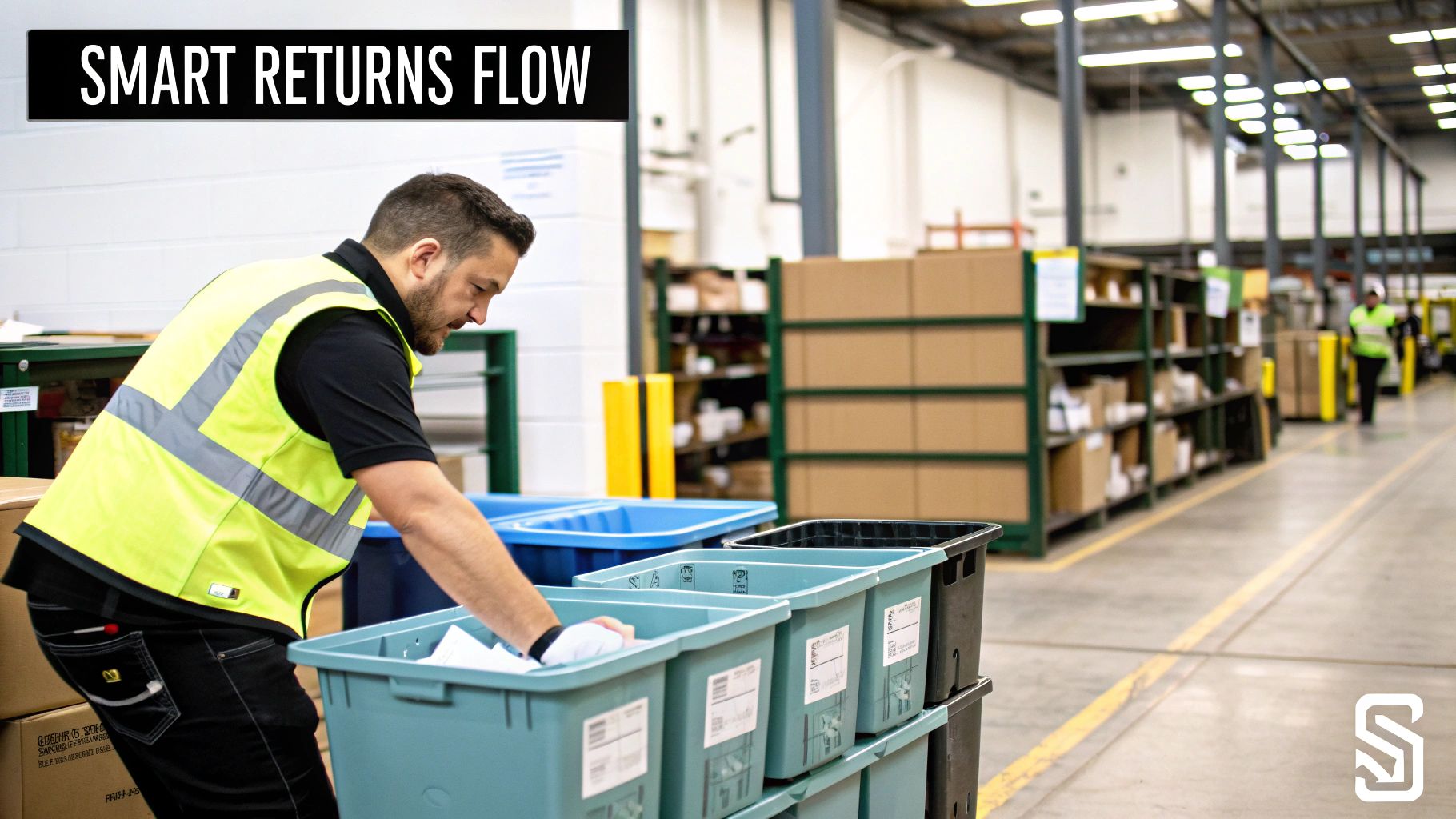
Wrestling with ecommerce returns brings up some tough questions. Here are some straightforward answers to the challenges ambitious sellers face when trying to get their return rate under control.
Trying to nail down a single “good” return rate is a bit of a trap—it really depends on what you sell. On average, you’ll see rates hover around 15-20%, but that number can swing wildly. Apparel and footwear can easily see return rates climb as high as 40%, while a category like home goods might sit comfortably below 10%.
Instead of chasing an industry average, you’re much better off benchmarking against your own historical data. The real win isn’t hitting some magic number; it's seeing a steady, quarter-over-quarter drop because you're actually solving the root causes of returns in your business.
Charging for returns is one of those levers you have to pull carefully, but it can be incredibly powerful for your bottom line. I’m not a fan of a one-size-fits-all fee. A smarter, more strategic approach is a hybrid model that keeps customers happy while protecting your margins.
This kind of model gives you flexibility and nudges shoppers toward outcomes that are better for business:
You can also frame free returns as a VIP perk for your best customers—maybe it's a benefit of your loyalty program or something that kicks in for orders over a certain amount. Whatever you decide, test it carefully and keep a close eye on both your return rate and your conversion rate.
Fighting return fraud requires a few layers of defense. "Wardrobing"—where someone buys an item, wears it once, and sends it back—is a frustratingly common and expensive problem, but you can definitely manage it.
First, your return policy needs to be crystal clear about the required condition of returned items. For clothing, I’m a big fan of using special security tags that have to be intact for a customer to get a full refund. It’s a simple but surprisingly effective deterrent for the "wear once and return" crowd.
You also have to leverage your data. Get good at identifying and flagging accounts that have an unusually high return frequency. For your more expensive products, get in the habit of documenting their condition with photos before you ship to protect yourself from bogus damage claims.
When you combine clear policies, physical deterrents, and smart data monitoring, you build a pretty solid defense against the most common types of return abuse.
Technology is easily one of your best allies in the battle against returns. On the front end, your goal is to shrink the gap between what a customer expects and what they actually get.
Look into implementing tools like:
On the back end, a modern returns management platform is non-negotiable. These tools automate the entire returns process, give your customers a slick self-service portal, and deliver the powerful analytics you need to make smarter decisions. By setting better expectations up front and making your operations more efficient, these technologies can massively lower both your return rate and your processing costs.
At Million Dollar Sellers, we believe the smartest sellers learn from each other. Our exclusive community is where top ecommerce entrepreneurs share the exact strategies they use to solve complex challenges like reducing returns, optimizing logistics, and scaling to 8- and 9-figures. If you’re ready to learn from the best in the business, find out if you qualify to join us. Learn more at https://milliondollarsellers.com.
Join the Ecom Entrepreneur Community for Vetted 7-9 Figure Ecommerce Founders
Learn MoreYou may also like:
Learn more about our special events!
Check Events