Chilat Doina
March 7, 2026
Right out of the gate, you need to understand one thing: Alibaba and AliExpress are built for completely different purposes. They're not interchangeable.
Think of Alibaba as your B2B wholesale connection, the place you go for bulk manufacturing and custom private label products. AliExpress, on the other hand, is a classic B2C retail platform, much like Amazon, where you can buy single items or test the waters with small quantities.
For e-commerce founders, this isn't about which platform is "better." It's about picking the right tool for the job you have right now. Getting this wrong from the start is a recipe for costly sourcing mistakes that can derail your growth before it even begins.
Put simply: Alibaba is for scaling your brand. AliExpress is for validating your ideas.
This quick summary is designed to give you that high-level strategic view so you can make a fast, informed decision before we get into the nitty-gritty details.
Alibaba is essentially a massive, global directory of manufacturers and wholesalers. It’s built for businesses that need to place large orders, create fully customized products from scratch, or build long-term relationships with suppliers. The entire platform is set up for direct negotiation on everything from pricing and materials to production timelines.
AliExpress works just like any online store you’ve used before. It connects you with thousands of sellers offering ready-made products you can have shipped straight to your door—or directly to your customers. This model is perfect for dropshipping or just dipping your toes in the water without sinking a ton of cash into inventory.
Key Takeaway: Use AliExpress to test market demand with minimal risk. Once you have a winning product, you graduate to Alibaba to scale up production, slash your cost of goods sold (COGS), and build a real, defensible brand.
To make the choice even clearer, this table breaks down the core differences. It's a quick, side-by-side view to help you see exactly which platform lines up with your immediate business needs.
This table really frames the entire Alibaba vs. AliExpress debate in practical terms. Alibaba is where you go to build a serious supply chain for long-term growth. AliExpress is your lean, agile lab for conducting real-world market research with actual sales data.
To really win the sourcing game—whether you’re pitting Alibaba vs. AliExpress or using them together—you have to get what makes each platform tick. They aren't just two sides of the same coin. They’re entirely different machines built for separate jobs, and that fact is baked right into their business models.
Alibaba.com is the B2B titan. Its whole purpose is to connect actual manufacturers and large-scale distributors with business buyers. Think of it as the engine room for global supply chains, built on volume and large-scale trade.
AliExpress, on the other hand, is the Alibaba Group's global retail spearhead. It operates just like any other e-commerce marketplace you've used, maybe like Amazon or eBay. It’s all about individual sales, shipping directly to consumers, and jumping on trends fast.
The numbers tell the story perfectly. The Alibaba Group pulled in a staggering 941 billion yuan (roughly $130.4 billion USD) for the fiscal year that ended in March 2024. A massive slice of that—414 billion yuan—came from its commerce platforms inside China.
Now, look at the international retail segment, which is where AliExpress lives. It contributed only 8% of the group's total revenue. You can dig deeper into these numbers with this overview of Alibaba's statistics.
But that massive revenue gap isn't a weakness; it's by design. While the B2B wholesale side of Alibaba is the stable foundation for established brands, AliExpress is seeing explosive growth. It posted a 60% year-over-year increase in its segment, proving just how effective it is at tapping into what global consumers want right now.
Strategic Insight: Let the financials guide your strategy. Alibaba’s massive, stable B2B engine is what you want for building a reliable, long-term supply chain. AliExpress’s explosive growth and retail focus make it the perfect playground for testing trends and validating new products with almost no risk.
These two different models lead to two completely different experiences for you, the buyer. On Alibaba, it’s all about negotiation and building relationships. You’re often talking directly to the factory, which gives you the power to negotiate pricing, customize products, and arrange for private labeling. The bigger your order, the more leverage you have. Our guide on how to buy from Alibaba breaks down the exact tactics for this.
AliExpress is the opposite. It’s a straightforward, what-you-see-is-what-you-get transaction. You see a price, you click buy, and the item gets shipped. There’s no back-and-forth on price and very little room for customization, but you get incredible speed for testing out a new product idea.
If you’re looking to build a real business using these platforms, it pays to understand the bigger picture. This guide to a modern import and export business is a great resource for that. Knowing the fundamentals of global trade helps you see how to use the unique strengths of each platform, whether you're just starting a dropshipping store or scaling a seven-figure brand. It turns the Alibaba vs. AliExpress debate from a simple comparison into a core business decision.
Picking between Alibaba and AliExpress is one of the first major decisions that will shape your brand's future. It goes way beyond the simple "B2B vs. B2C" label. This is a choice that directly impacts your cash flow, your ability to build a real brand, and how fast you can scale.
Let's break down the operational differences that truly matter when you're in the trenches, building a business from the ground up.
Here's how each platform really works under the pressure of growing an e-commerce brand.
The first and most obvious hurdle you’ll face is the Minimum Order Quantity (MOQ). This one factor pretty much decides which platform is even an option for you at your current stage.
On Alibaba, you’re playing in the wholesale world. Suppliers expect you to buy in bulk, with MOQs usually starting around 100-500 units. For more complex or customized products, that number can easily jump into the thousands. The payoff for this commitment? A much, much lower cost per unit, which is the only way to get healthy profit margins once you start scaling.
AliExpress, on the other hand, is a straight-up retail marketplace. The MOQ is almost always one single unit. You can buy products individually at a set price, making it the perfect, low-risk playground for testing new product ideas or running a dropshipping store with zero upfront inventory cost.
Strategic Insight: This comes down to cash and confidence. Alibaba is for when you're ready to invest in proven products to maximize profit. AliExpress is for spending as little as possible to see if an idea even has legs.
If you want to build a lasting brand, you can't just sell the same generic junk as everyone else. This is where the paths of Alibaba and AliExpress completely diverge.
For anyone serious about long-term growth, the ability to create a unique product is the single biggest reason to graduate to Alibaba.
How long it takes to get your hands on your product is another massive operational difference. It completely changes how you manage inventory and react to the market.
Placing an order on Alibaba is the start of a manufacturing journey. Production lead times can be anywhere from 15 to 45 days, sometimes longer for complex orders. Then you have to add shipping time, which is another 30-40 days if you’re using sea freight to keep costs down. You absolutely have to get good at forecasting.
AliExpress is all about speed. You're buying products that are already made and sitting on a shelf. The seller usually ships it in a couple of days. Standard shipping can still take a while (15-45 days), but you completely skip the entire production timeline.
To really understand the day-to-day impact, it helps to see these differences side-by-side. This table breaks down the core operational realities you'll face with each platform.
This table makes it clear: Alibaba is your partner for building a scalable inventory-based business, while AliExpress is your tool for agile market testing and validation.
You’d never commit to buying 1,000 units of a product you've never touched. The way you get samples to check quality is totally different on each site.
With Alibaba, ordering a sample is a formal step. You'll find a supplier, negotiate the sample order (which often costs more per unit than the bulk price), pay for it and the shipping, and wait for it to arrive. It's a critical part of vetting a factory you might work with for years.
With AliExpress, the "sample process" is just buying the product. You are the customer. This is an incredibly simple and fast way to get a bunch of different product options from various sellers to compare quality and find a winner.
Both platforms know you don't want to get ripped off, but their protection systems are built for two different worlds.
Ultimately, where you are in your business journey dictates your choice. Are you testing and validating? Go with AliExpress. Are you ready to build inventory and scale your margins? It's time to master Alibaba.
Let’s be blunt: a bad supplier can single-handedly destroy your brand. They can tank your reputation, torch your capital, and leave you with a garage full of defective products before you’ve even made your first sale. This is why risk management isn't just a buzzword; it's survival.
When you're comparing Alibaba and AliExpress, you're not just looking at two websites—you're dealing with two entirely different ecosystems for vetting and quality control.
Think of it this way: on Alibaba, you’re looking for a long-term manufacturing partner. On AliExpress, you’re just evaluating a retail seller for a one-off or dropshipping order. This fundamental difference changes how you approach everything.
Alibaba gives you a powerful set of B2B verification tools, but they're useless if you don't know how to read between the lines. Don't just get distracted by shiny badges on a profile; you need to understand what they actually represent.
Here’s what to look for:
Platform tools are a great starting point, but your due diligence can't stop there. Always request and pay for samples to see the quality for yourself. For any significant order, a factory audit is money well spent.
Since AliExpress is basically a giant retail mall, your vetting process feels more like being a smart online shopper than a C-suite executive. You're relying on social proof and seller history, not formal business audits. Your goal is simply to find a dependable vendor for dropshipping or small test runs.
Focus on these key indicators:
If you want to get serious about creating a repeatable process, our comprehensive supplier vetting checklist gives you a step-by-step framework you can adapt for either platform.
Crucial Insight: Alibaba offers more formal B2B verification, but the core principles of due diligence are universal. Whether you’re ordering 10,000 units or just one, proactive communication and crystal-clear quality standards are the only things that will protect your brand from costly mistakes.
Getting your products from a factory floor in China to a warehouse in the US is where the real money is made or lost. This isn't just about moving boxes; it's a critical part of your business that directly hits your profit margins. When you're weighing Alibaba against AliExpress, how you handle shipping is one of the biggest, most fundamental differences you'll face.
Think of it this way: Alibaba orders are commercial freight, a world governed by complex international trade rules. AliExpress orders are simple parcels, the kind you'd get from any online store, sent through regular mail or courier services.
Once you place a bulk order on Alibaba, you’re officially in the international freight game. This means getting familiar with Incoterms—the universal rulebook that dictates who is responsible for what, and when.
You’ll run into these three most often:
Strategic Insight: For most growing brands, FOB is the way to go. It lets you hire your own freight forwarder, which means you control the shipping costs and timeline without the headache of arranging local trucking inside China, like you would with EXW.
For any serious brand builder, getting a grip on logistics and import costs is non-negotiable. This involves a deep understanding of international supply chain management and how all the pieces fit together. Before you even think about placing a bulk order, you absolutely must know your total landed cost—the true per-unit cost after all shipping, customs, and fees are paid. Check out our guide on how to calculate landed cost to make sure you’re actually building a profitable business.
Shipping with AliExpress is a walk in the park by comparison. It’s built for single, direct-to-consumer orders, so there are no Incoterms or freight forwarders to deal with. You just pick a shipping option at checkout, simple as that.
These are the main choices you’ll have:
AliExpress's real power for a brand isn't just dropshipping; it's a live testing ground for what's trending with consumers in major markets like Brazil, Spain, and the US. Smart founders use AliExpress to see what’s selling with real-world, retail-speed data. Once a product proves itself, they switch over to Alibaba to scale up production and lock in much better margins.
So, Alibaba or AliExpress? This isn't just a one-time choice; it's a strategic decision that changes as your business grows. The right answer really boils down to one question: Are you testing a new product idea with as little cash as possible, or are you scaling up a proven winner to boost your profit margins?
Getting this right is the key to building a capital-efficient brand. This framework gives you a clear playbook for when to use each platform, making sure you’re always using the right tool for the job.
Think of AliExpress as your fast, low-risk entry into sourcing. It’s built for speed and validation, not for setting up your forever supply chain. It’s the perfect place to gather real-world data before you go all-in on a big inventory purchase.
You should be on AliExpress when your main goal is one of these:
By 2026, AliExpress is on track for serious growth, especially as it continues to capture emerging market trends. The platform is a goldmine for insights; for example, we're seeing explosive growth in Home & Garden categories like modular storage and smart home gadgets. For brand owners, it’s a real-time trend lab. You can check out the best-selling trends on AliExpress to see what's hot right now.
Once you have a product that sells consistently, your focus shifts from just testing to building a real brand and making real money. This is your cue to graduate to Alibaba. Alibaba is your heavy-duty manufacturing partner, built for bulk orders, customization, and creating a supply chain that can actually scale.
It's time to move to Alibaba when you're ready to:
The Founder's Playbook: Use AliExpress to quickly find and test what sells. Once you have a winner, switch to Alibaba to produce it at scale and build a real brand. This is the path to building a seven-figure business.
This decision tree clearly maps out your shipping options. Alibaba is for bulk freight, while AliExpress is for direct parcel shipping.
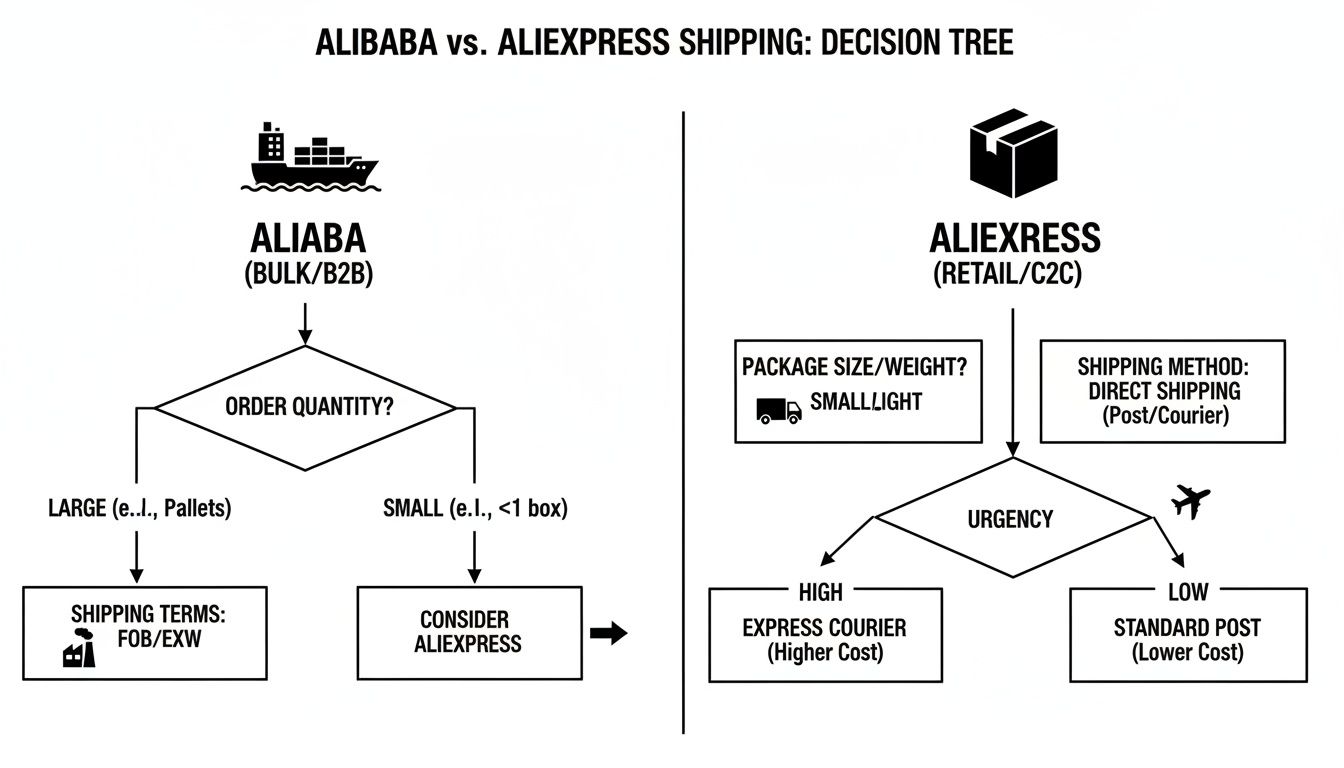
It really just highlights the fundamental difference: Alibaba is for planned, large-scale inventory buys, and AliExpress is for fast, single-item fulfillment.
Even with a solid game plan, you're bound to have questions when you're deep in the weeds of sourcing. Both Alibaba and AliExpress are beasts, but they have their quirks that can catch even seasoned sellers off guard. Let's clear up some of the most common hangups.
Yes. In fact, you're leaving money on the table if you don't. The sharpest brands we know use both platforms, just at different times for different reasons.
A typical winning strategy looks like this: You test a new product idea on AliExpress with a small, low-risk order. Once you have real sales data proving people actually want it, you move over to Alibaba. That’s when you place your bulk order, slash your cost per unit, and start private labeling to build a real brand.
You can’t exactly send an inspection team to an AliExpress seller’s warehouse. So, quality control on this platform is all about being a smart, selective buyer, not a production manager.
Here's the process:
Almost always, the answer is no. Think of AliExpress as a giant online retail store selling finished goods off the shelf. Real customization—like adding your logo (private labeling) or changing the product design (OEM/ODM)—is what Alibaba is built for.
You might find a random AliExpress seller willing to do some basic engraving on a few items, but it's not a scalable plan. If you're serious about building a unique brand, you have to graduate to Alibaba.
Key Insight: Stop trying to fit a square peg in a round hole. Use AliExpress for what it's great at: speed and testing. Use Alibaba when you’re ready to build something that's truly yours.
This is a huge one, and the work happens long before you even think about hitting "place order." Getting this wrong can mean getting your inventory frozen or your entire Amazon account suspended.
Your only real defense here is to do your homework. Dig into Amazon's Seller Central and find the most up-to-date list of restricted brands and categories. This list is always changing, so a product that was fair game six months ago might be gated today. If a product looks a little too much like a famous brand, even if it has no logo, just walk away. It’s never worth the risk.
At Million Dollar Sellers, we watch top entrepreneurs master this sourcing dance every single day, building 8- and 9-figure brands by using these platforms the right way. If you're a serious seller ready to scale smarter and join a vetted community of founders at your level, see if you have what it takes. Apply to join Million Dollar Sellers.
Join the Ecom Entrepreneur Community for Vetted 7-9 Figure Ecommerce Founders
Learn MoreYou may also like:
Learn more about our special events!
Check Events


