
Chilat Doina
April 23, 2026
You can feel when the business has outgrown gut-driven product decisions.
The team is shipping constantly, but each release seems to answer a different question. Support wants checkout fixes. Marketing wants landing page flexibility. Operations wants better inventory visibility. Amazon throws a policy change into the mix, and suddenly the quarter gets rebuilt around survival instead of strategy.
That’s the point where a backlog stops being useful.
A backlog is a parking lot for requests. A product roadmap is a decision system. If you’re figuring out how to develop a product roadmap for a serious e-commerce business, the actual job isn’t listing features. It’s deciding what deserves attention, what can wait, and what won’t make the cut even if someone important asked for it.
A lot of roadmap advice breaks down in e-commerce because it assumes a calmer operating environment than the one most founders live in. Amazon changes, merchandising shifts, paid media gets less efficient, inventory constraints hit, and your DTC store exposes weaknesses that were hidden when one channel carried the business.
In that environment, teams often confuse movement with progress. They launch more tests, add more tickets, and hold more meetings. But the business still feels scattered because nobody has translated strategy into a sequence of decisions.
That isn’t a small-team problem or a big-team problem. It’s an alignment problem. Over 50% of product teams with 50+ members report struggles with roadmap and process consistency, while 23% of product development investments fail due to unclear company strategies according to product development statistics from Tenet. Those two issues usually show up together. If strategy is fuzzy, prioritization turns political.
A real roadmap answers a few hard questions:
That’s why the strongest roadmaps feel narrower than many might expect. They don’t try to represent every idea. They tell the company where the brand is going and why.
Practical rule: If your roadmap can absorb every request without friction, it isn’t a roadmap. It’s intake.
For founders operating across Amazon, Shopify, retail, and other channels, the penalty for weak roadmapping is high. You don’t just waste dev hours. You create operational drag across merchandising, CX, acquisition, and fulfillment.
A useful companion to this thinking is Aakash Gupta’s guide on 8 Product Roadmap Best Practices. It’s worth reading because it reinforces a point many brands miss. Roadmaps work when they communicate decisions clearly, not when they become giant repositories of ambition.
Most weak roadmaps fail before prioritization starts. They begin with initiatives instead of outcomes.
If the roadmap opens with items like “launch subscription,” “redesign PDP,” or “rebuild loyalty,” you’re already too far downstream. Those are possible solutions. They aren’t the strategy.
The stronger move is to define the business result first, then let initiatives earn their place.

The most effective roadmaps operate on a 2-to-5-year horizon with quarterly flexibility, and a strong best practice is condensing the strategy into a single A4-sized document so executives and builders can align quickly, as outlined in Scandiweb’s strategic e-commerce roadmap guide.
That sounds simple, but it forces discipline. You can’t hide behind complexity on one page.
A practical one-page roadmap usually includes these layers:
Strategic themes
Broad areas of focus such as post-purchase experience, margin protection, customer retention, or international expansion.
Desired outcomes
What must improve if that theme succeeds. Think in business terms: stronger repeat purchase behavior, lower support burden, cleaner merchandising operations.
KPIs
The metrics the team will watch. If you need a clean reference point, this breakdown of e-commerce KPIs is a useful way to separate vanity metrics from operating metrics.
Initiatives
The actual work. Features, experiments, process changes, integrations, and operational upgrades all belong here.
Say a brand has solid traffic but weak repeat purchase behavior. A generic roadmap would fill up with broad ideas like SMS automation, loyalty, bundling, subscriptions, and UGC modules.
A better roadmap would frame the theme as increase customer lifetime value through stronger second-purchase behavior. That statement immediately changes the discussion. Suddenly each initiative has to prove it helps that specific outcome.
Here’s a simple way to pressure-test initiatives against the North Star:
If the answer is weak on any of those, the initiative probably belongs in discovery, not on the roadmap.
A roadmap should make trade-offs visible. If everything is strategic, nothing is.
Founders often over-index on engagement metrics because they’re easier to influence than commercial outcomes. That’s fine for diagnostics, but not for roadmap leadership.
In e-commerce, the roadmap has to stay tied to revenue, efficiency, and retention. If conversion is lagging, the answer may involve checkout, pricing presentation, offer structure, page speed, or trust signals. If you’re working that angle, a tactical resource like Shopify Conversion Rate Optimization can help sharpen the execution side. But the roadmap itself should still sit one level higher. It should answer why CRO matters now and where it fits relative to retention, margin, and channel mix.
A roadmap loses power when it becomes a deck nobody remembers. The one-page version works because it creates shared language across the business.
Use plain statements. Avoid internal jargon. Tie each initiative to one theme and one primary outcome. If an initiative needs three different justifications to survive, it probably shouldn’t survive.
That one-page constraint also protects the team from founder drift. New ideas will keep showing up. The roadmap gives you a standard response: good idea, but where does it fit, what outcome does it improve, and what should move out if it moves in?
The best roadmap inputs usually don’t arrive in a strategy offsite. They show up in fragments during normal operating chaos.
A support ticket mentions that customers can’t edit subscriptions without contacting the team. A merchandising manager notices that bundles are selling well on one channel but confusing customers on another. A marketplace tool flags a keyword shift that suggests a new variation opportunity. A founder hears a smart angle on a mastermind call and wants to run with it immediately.
None of those should go straight onto the roadmap.
They should go into an idea engine.
Continuous discovery matters because e-commerce signals are distributed. Useful insight lives in Zendesk, Gorgias, Shopify, Amazon reviews, post-purchase surveys, return reasons, and ad creative feedback. Your roadmap gets sharper when you collect problems from every operating surface, not just from the loudest stakeholder.
A practical capture system usually pulls from sources like these:
Customer support
Repeated tickets reveal friction faster than most dashboards do. If customers keep asking about delivery timing, returns, subscription edits, or product selection, there’s usually a systems issue behind it.
Store behavior
Shopify analytics, heatmaps, session recordings, and search terms often expose mismatches between what shoppers want and what the site makes easy.
Marketplace demand signals
Helium 10 and Jungle Scout can surface new opportunities, seasonal demand changes, and category pressure that should inform roadmap thinking.
Internal team feedback
CX, retention, paid media, operations, and supply chain teams all see different failure points. If product only listens to product, blind spots compound.
Good discovery doesn’t mean piling up more ideas. It means improving the quality of evidence behind each idea.
One useful filter is to log every input with four fields:
| Input | What to capture |
|---|---|
| Source | Where the signal came from, such as support, analytics, reviews, or ops |
| Problem | The customer or business friction being observed |
| Impact area | Revenue, retention, margin, operational efficiency, or customer experience |
| Confidence note | Why the team believes this is worth deeper exploration |
That structure changes conversations quickly. “Customers want a loyalty program” becomes “repeat buyers aren’t seeing enough reason to return within the window that matters to us.” That’s a far better problem statement.
For teams trying to improve signal quality, it helps to get sharper about what customers need, not just what they ask for directly. Customers often describe symptoms. Your job is to identify the underlying friction.
A strong idea engine still needs a gate.
Without one, every useful observation turns into a pseudo-priority and the roadmap bloats. That usually happens when teams skip synthesis. They collect inputs but never convert them into patterns.
A better rhythm is weekly intake, monthly clustering, and quarterly selection. During clustering, look for repeated problems across channels. If support tickets, site search, and conversion data all point to the same issue, you’re no longer looking at anecdote. You’re looking at a likely roadmap candidate.
One strong pattern beats ten isolated requests.
This is also where founders can use internal strategy work more effectively. If your team is trying to move beyond reactive iteration, these product innovation strategies are a useful complement to roadmap discovery because they force you to look at opportunity development, not just feature intake.
The practical standard is simple. Capture broadly. Diagnose carefully. Promote selectively.
Once the idea engine is working, the next problem shows up fast. You don’t have a shortage of good options. You have too many reasonable ones.
That’s where many organizations get exposed.
Founders say they want a roadmap, but what they really need is a way to settle arguments without turning every planning cycle into opinion theater. Prioritization frameworks help because they force the team to put assumptions on the table.
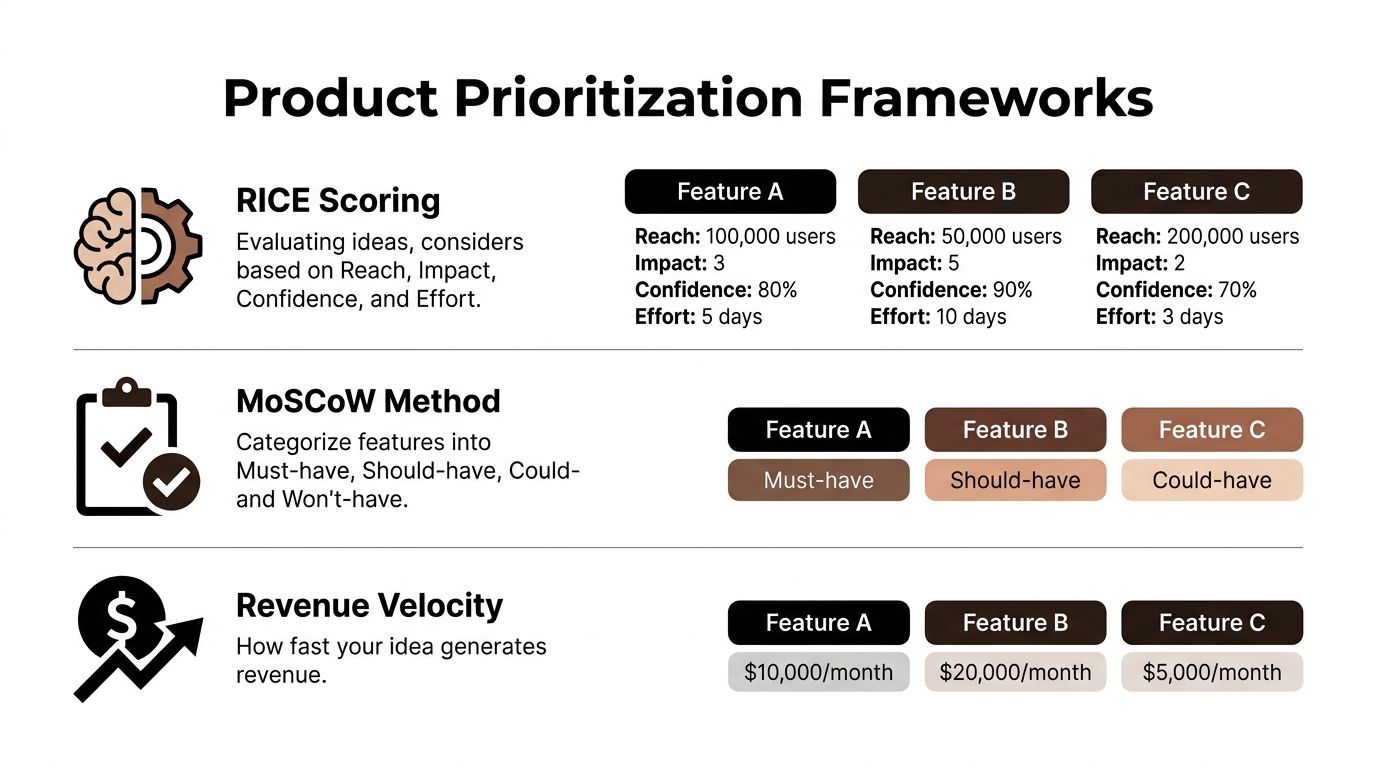
RICE is useful when you want comparative discipline. MoSCoW is useful when you need forced categorization.
Here’s the clean comparison.
| Criterion | RICE (Reach, Impact, Confidence, Effort) | MoSCoW (Must, Should, Could, Won't) |
|---|---|---|
| Primary use | Score competing ideas | Sort ideas by necessity |
| Strength | Brings evidence into prioritization | Creates simple decision buckets |
| Weakness | Can create false precision | Can become subjective fast |
| Best fit | Teams with enough data to estimate trade-offs | Teams needing a clear language for scope control |
| Common failure mode | Inflated assumptions on impact | Too many items labeled Must-have |
RICE is best when the team can estimate how broadly an initiative matters, how strongly it may affect an outcome, how confident they are in the logic, and how much effort it will take.
MoSCoW is cleaner for release planning. It asks a different question. Not “which idea scores highest,” but “what absolutely has to happen for this release or strategic objective to make sense.”
Take two common options:
RICE often favors checkout work if the brand has enough traffic and enough observed friction at checkout. It may reach more users immediately, affect conversion sooner, and demand less organizational change.
MoSCoW may also rank checkout as a Must-have if the business is leaking demand at the point of purchase, while loyalty becomes a Should-have because it matters, but not before you fix the current purchase path.
That said, both frameworks can still miss something critical in e-commerce. They don’t always account well for urgency created by channel volatility, merchandising windows, inventory timing, or fast-moving revenue opportunities.
That’s why high-growth operators often need a third lens.
For high-growth e-commerce, 68% of founders report roadmap failures due to unaccounted platform volatility, and shifting from generic themes toward revenue-velocity scoring can drive 42% faster scaling, according to Product School’s discussion of roadmap strategy and Shopify’s 2025 State of Commerce reference.
That idea matters because many e-commerce decisions are time-sensitive in a way SaaS product guides don’t reflect. A feature that enables merchandising speed before peak season may be worth more than a cleaner but slower-burn initiative. A retention upgrade may deserve higher priority if paid acquisition is getting more expensive and margin pressure is rising.
Operator lens: Prioritize by how quickly an initiative can improve a core commercial outcome without creating downstream complexity your team can’t absorb.
A practical revenue-velocity score usually weighs things like:
Direct revenue effect
Does this likely improve conversion, average order value, repeat purchase, or product mix?
Speed to impact
Will the business feel the result soon enough to matter in the current operating window?
Confidence from evidence
Is this based on observed behavior, testing, or repeated customer friction?
Operational drag
Will this create support burden, merchandising complexity, or engineering debt that offsets the win?
Channel benefit
Does the improvement help only one surface, or does it strengthen DTC, Amazon, retail, and retention systems together?
Frameworks are tools, not substitutes for leadership.
I’ve seen teams hide inside scoring because it feels objective. But if the assumptions are weak, the spreadsheet just gives false certainty a cleaner design. The right approach is to use frameworks to structure debate, then make a decision with commercial context.
If you want a broader view on how to make those calls under pressure, these decision-making frameworks are useful because they help separate urgent noise from decisions that change the business.
A good prioritization system should do three things well. It should make trade-offs visible, expose weak assumptions, and protect the roadmap from getting hijacked by recency bias.
A roadmap that only makes sense to the person who built it has already failed.
Most roadmap communication problems start with format. Teams build one giant spreadsheet, load it with dates, dependencies, notes, owners, and status labels, then wonder why nobody outside product engages with it. Executives don’t want to read a task tracker. Developers don’t want vague strategic slogans. Partners don’t need your sprint board.
They each need a different view of the same truth.
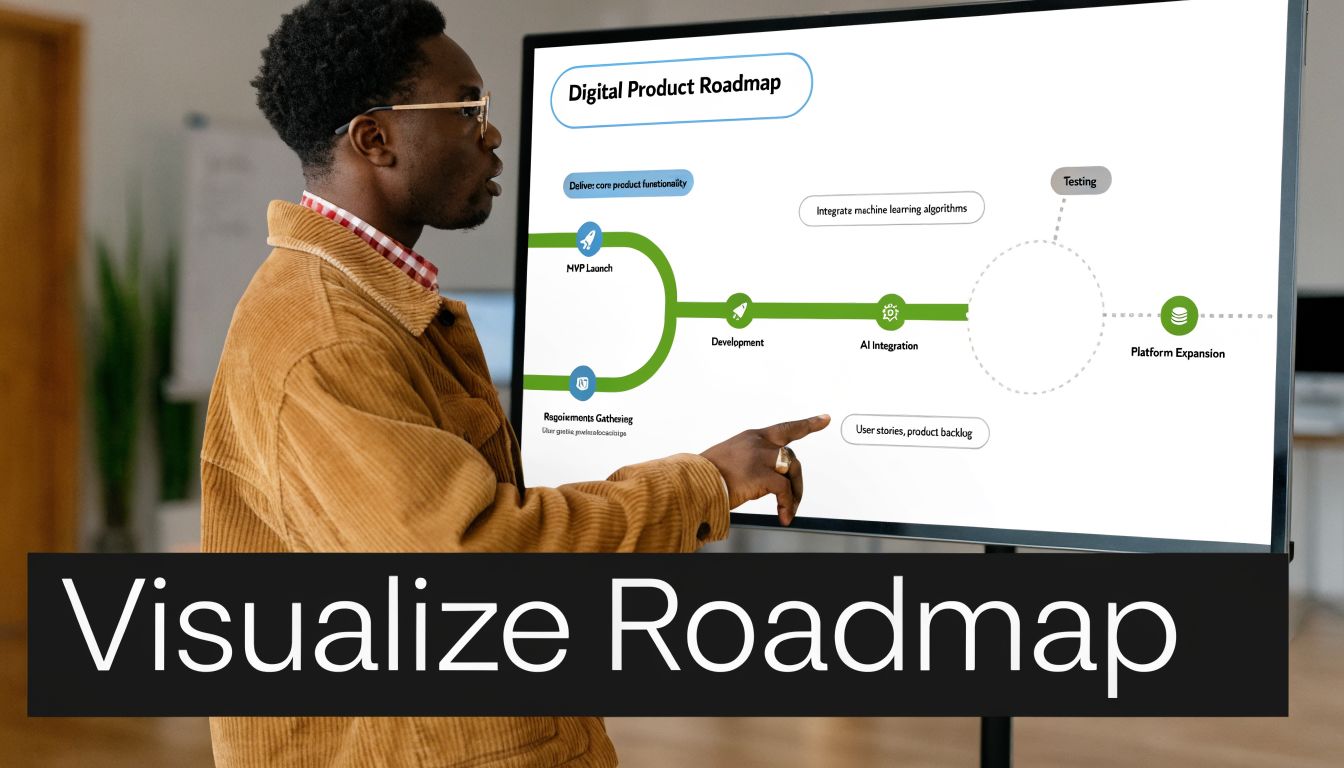
Three formats handle most e-commerce roadmap communication well.
This is the executive version. It shows major themes, key initiatives, and approximate sequencing. It’s useful for leadership alignment, budget discussions, and partner conversations.
Keep this version high level. Don’t promise exact delivery dates unless the team has real confidence. In most cases, quarter-based windows are safer and more honest than precise calendar commitments.
This is the strategy version. Group initiatives under themes like retention, conversion, merchandising efficiency, or post-purchase experience. This format is strong when the business needs to understand why work is happening, not just when.
A theme-based roadmap also helps stop feature fragmentation. Teams can see whether a new request fits the current strategic focus.
This is the execution view. Product, design, engineering, and operations teams need to understand status, blockers, and next actions. Jira, Linear, Trello, and ClickUp can all work here depending on your team’s complexity.
The mistake is forcing this view onto everyone else. A Kanban board is useful for builders. It rarely persuades stakeholders.
The best tool is the one your team will maintain consistently.
For earlier-stage brands or lean teams, Trello, Notion, or Airtable can be enough. They’re flexible, easy to update, and good for keeping roadmap discussions visible without heavy process overhead.
For larger or more technical teams, Productboard, Jira Product Discovery, Aha!, or Monday.com can make sense, especially when discovery, prioritization, and delivery need tighter linkage.
Use this checklist when choosing:
Clarity for non-technical teams
Can marketing, CX, and leadership understand the roadmap without a walkthrough?
Connection to execution
Can roadmap items connect cleanly to tasks, tickets, or sprint work?
Flexibility
Can the view change by audience without rebuilding everything manually?
Maintenance burden
Will someone keep it current, or will it go stale after one planning cycle?
A roadmap tool should reduce translation work, not create more of it.
A roadmap gets more credible when people can see what changed and why. Add simple status labels, note key shifts in priorities, and make updates visible during the quarter.
This short walkthrough is a useful example of how teams present roadmap thinking visually:
The roadmap should tell a story the business can repeat without you in the room.
That’s the standard. If your head of CX, growth lead, and engineering manager all describe the same roadmap in different words but with the same priorities, the format is doing its job.
A roadmap only creates value when the company uses it to run the business.
That’s where many teams fall short. They spend serious energy building the document, present it once, get agreement in the room, and then let normal operating chaos take over. A month later, the roadmap is technically still there, but decisions are being made through Slack pings, side meetings, and whoever argued hardest in the last leadership call.
That’s not a roadmap problem. It’s a governance problem.
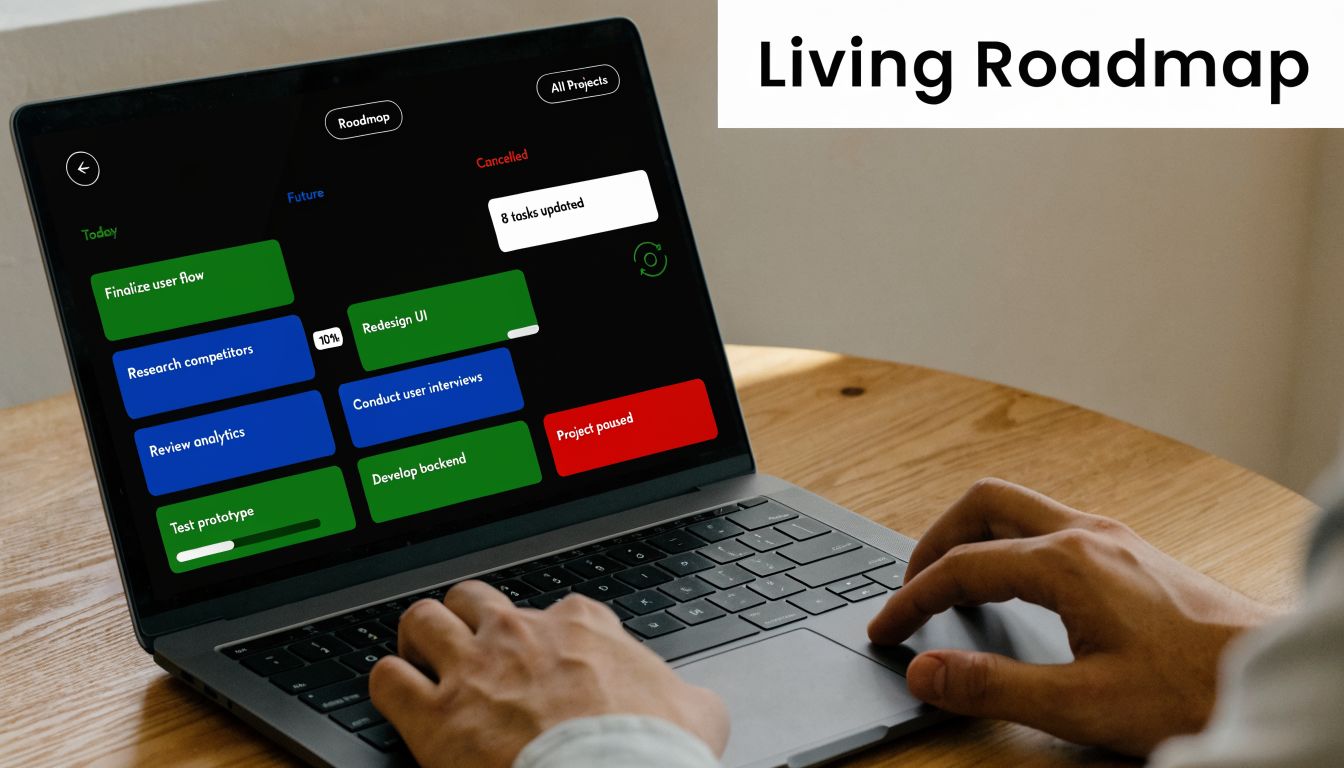
The roadmap needs an operating rhythm. Without one, it becomes a reference document instead of a decision tool.
The simplest governance model that works has three layers:
This is not a roadmap rewrite session. It’s a short operational review. Teams check progress, blockers, and delivery risk on current work.
Keep it tactical. Ask:
This meeting protects active initiatives from hidden drift.
Discovery, post-launch data, customer feedback, and market changes get reviewed here. The purpose isn’t to reshuffle priorities impulsively. It’s to identify whether the roadmap is still pointing at the highest-value problems.
This review matters in e-commerce because channel conditions change quickly. A sudden policy shift, supply constraint, merchandising issue, or customer behavior change may not justify a full reset, but it may justify investigation.
This is the core governance event. Leadership reviews outcomes, not just outputs. Which initiatives moved the intended KPI. Which bets underperformed. Which assumptions were wrong. Which opportunities deserve promotion into the next quarter.
That quarterly cadence works because it balances stability with flexibility. The team gets enough time to execute, but not so much time that the roadmap becomes detached from reality.
You don’t need a giant committee. You do need a defined decision group.
For most e-commerce brands, a useful council includes product leadership or the person acting as product lead, engineering, marketing or growth, CX or operations, and the executive owner responsible for commercial outcomes. Merchandising may also need a seat depending on the business model.
The council’s role is not to generate more ideas. It’s to make trade-offs and uphold standards.
A good council decides:
If nobody owns those calls, roadmap inflation starts immediately.
Saying no is part of roadmap quality. If the roadmap never gets smaller, the strategy isn’t getting sharper.
The worst time to invent roadmap rules is during a reactive moment.
Create a basic change policy upfront. It can be simple. For example, any initiative added mid-quarter must meet one of a few conditions: it addresses critical risk, responds to a material market shift, or clearly outperforms something already planned. If it comes in, something else likely moves out.
That last point matters. Teams are usually willing to add. They’re rarely willing to subtract. But capacity doesn’t expand because urgency appears.
A clear policy also helps founders avoid becoming the bypass channel. New ideas should go through the same standard as everything else. Capture the idea, define the problem, examine the impact, and compare it against current priorities.
Governance becomes real when initiatives are measured after launch.
Top-performing companies achieve 20% to 25% faster development cycle times by using data-driven roadmaps that prioritize customer-centric metrics, according to StudioRed’s product development statistics summary. In e-commerce, that matters because speed only helps if it improves retention, customer experience, or commercial performance.
Post-launch review should look at a small set of metrics tied to the original intent. Depending on the initiative, that may include adoption, support impact, cycle time, conversion behavior, repeat purchase signals, or operational efficiency.
The key is consistency. Don’t change the success criteria after launch because the result feels politically inconvenient.
One roadmap update should not be copied and pasted to every audience.
Executives need the business narrative. What moved, what changed, and what that means for goals. Builders need status, scope clarity, and dependency visibility. Cross-functional teams need to know what’s landing, when to prepare, and what customer impact to expect.
A clean communication pattern might look like this:
Leadership update
Brief summary of strategic movement, risks, and decisions
Team update
Detailed progress, dependencies, and near-term changes
Broader company note
Plain-language explanation of what’s coming and why it matters
That separation lowers confusion and prevents teams from drawing conclusions from the wrong level of detail.
A lot of teams use “agile” as an excuse for constant scope churn. That’s not agility. It’s lack of commitment.
Real agility means the roadmap keeps strategic direction while delivery stays iterative. Teams can run tests, adjust implementation details, and respond to evidence without losing the business outcome they’re trying to create.
That distinction matters. The roadmap should be stable at the level of themes and outcomes. It can stay flexible at the level of tactics, sequencing, and execution details.
When that balance is right, the company can adapt without thrashing. And that’s what founders need most in an omnichannel business. Not rigidity. Not chaos. Controlled responsiveness.
A scaling e-commerce brand doesn’t suffer from a lack of ideas. It suffers from too many ideas competing for finite attention.
That’s why learning how to develop a product roadmap matters. Not as a planning exercise, but as a way to run the business with sharper intent. A real roadmap gives the team a shared direction, a filter for incoming requests, and a mechanism for converting strategy into weekly execution.
The payoff isn’t aesthetic. It’s operational. Better alignment. Cleaner trade-offs. Faster response when the market shifts. Less wasted work on attractive distractions.
For founders in high-stakes e-commerce, that discipline becomes a real edge. The brands that scale cleanly usually aren’t doing more. They’re deciding better. They know which bets connect directly to revenue velocity, retention, and execution capacity, and they use the roadmap to keep the whole company pointed there.
Start smaller than you think. Pick one strategic theme. Define one outcome that matters. Force every near-term initiative to justify its place against that outcome. Once the business feels the clarity, the roadmap stops being a document and starts becoming how decisions get made.
If you’re building at a level where peer-caliber execution matters, Million Dollar Sellers gives established e-commerce founders access to the kind of candid roadmap, growth, and operational conversations that rarely happen in public. It’s where serious operators compare what’s working across Amazon, DTC, and omnichannel brands.
Join the Ecom Entrepreneur Community for Vetted 7-9 Figure Ecommerce Founders
Learn MoreYou may also like:
Learn more about our special events!
Check Events