Chilat Doina
October 17, 2026
The most common advice on import export regulations is also the least useful: hand the paperwork to your broker and get back to selling. A broker can file a declaration, but they can't decide whether your product data is accurate, whether parcel shipping still makes financial sense, or who owns the cost when customs details don't match across systems. Treat compliance as someone else's problem, and you're letting someone else's data determine your margin.
That matters more as cross-border rules change. The operators who build reliable SKU-level landed-cost models and keep control of their customs data can make better decisions about pricing, inventory, and fulfillment. The rest find out what a regulatory change costs after parcels are already moving.
Import-export regulations belong in the commercial plan. For sellers shipping high volumes from the United States to European customers, changes to low-value duty rules can alter the cost of each affected parcel. The US is also changing de minimis treatment for qualifying shipments arriving through non-postal channels. Model these as separate measures with different dates and scopes, not as one universal customs rule.
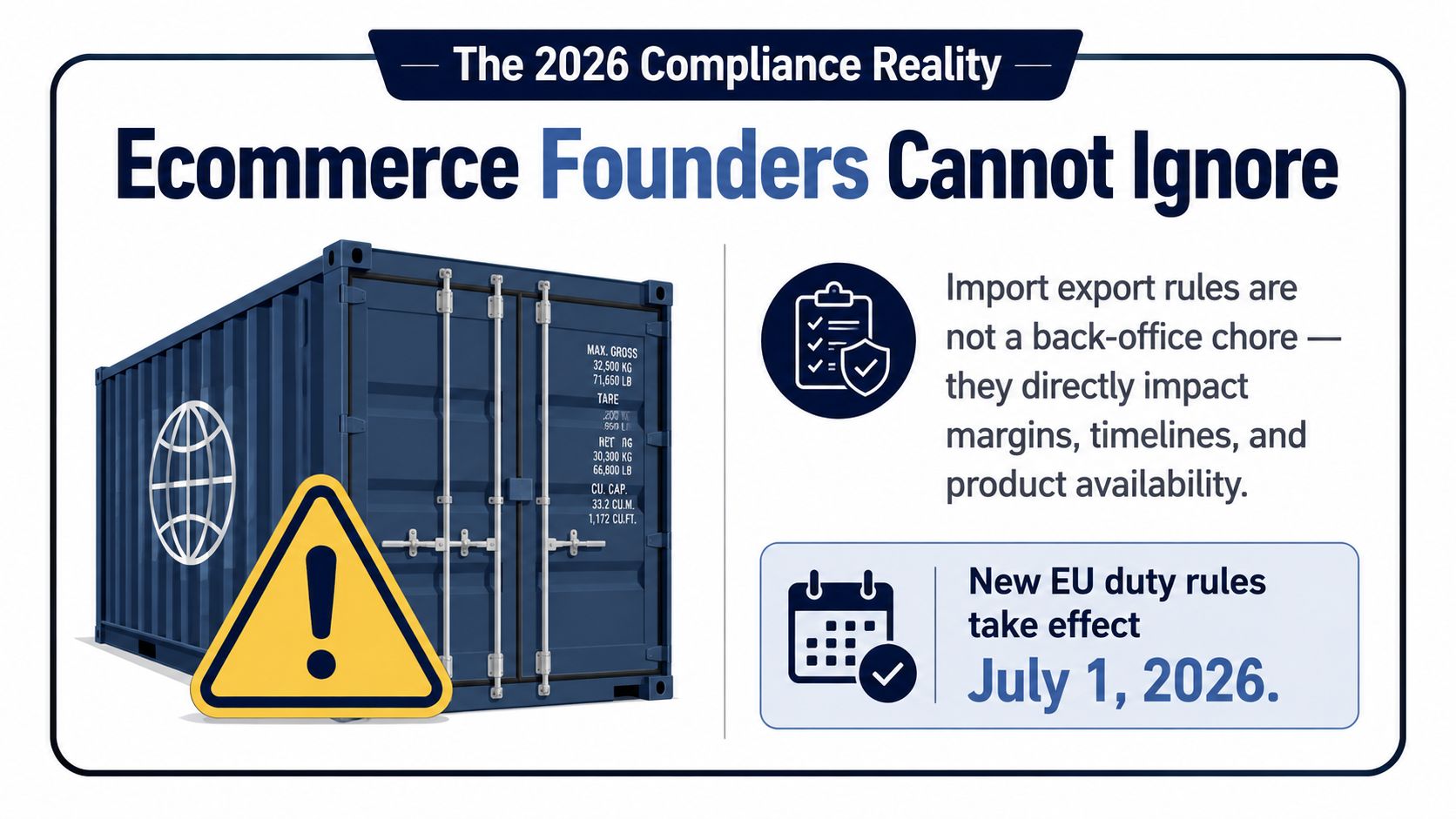
The EU is set to remove its low-value duty exemption on July 1, 2026, with a temporary €3 duty per item for consignments up to €150 planned through July 1, 2028, according to the EU customs reform update. In the US, an interim rule effective June 24, 2026 suspends the $800 de minimis administrative exemption for qualifying shipments arriving through non-postal channels, requiring formal or informal entry procedures. Map exposure by product, route, entry method, and fulfillment model. Then build a SKU-level landed-cost view before you change prices or shipping options.
| Change | Effective date | Who it hits |
|---|---|---|
| EU low-value duty exemption removed, with a temporary €3 duty per item for eligible consignments | July 1, 2026, through July 1, 2028 for the temporary measure | Sellers and platforms facilitating direct-to-consumer imports into the EU |
| US administrative de minimis exemption suspended for qualifying non-postal shipments | June 24, 2026 | Sellers using affected non-postal import channels into the US |
These changes make customs data a commercial capability. Under the new EU framework, platforms and sellers facilitating direct-to-consumer imports are treated as importers, with responsibilities for customs data, charges, and product-law compliance. Own the product and customs master data behind your declarations, and keep it consistent across your systems. Accurate SKU-level inputs let you compare routes, assess regional inventory, and protect margins. That operational control can create an advantage even when your tariff rate is no lower.
UK sellers adjusting to post-Brexit tax and border procedures can use this guide for UK SMEs on Brexit taxes for context. Start with your top-selling SKUs that rely on low-value parcel shipping. Calculate landed costs under the affected routes, compare fulfillment alternatives, and make decisions before changed rules force a rushed response.
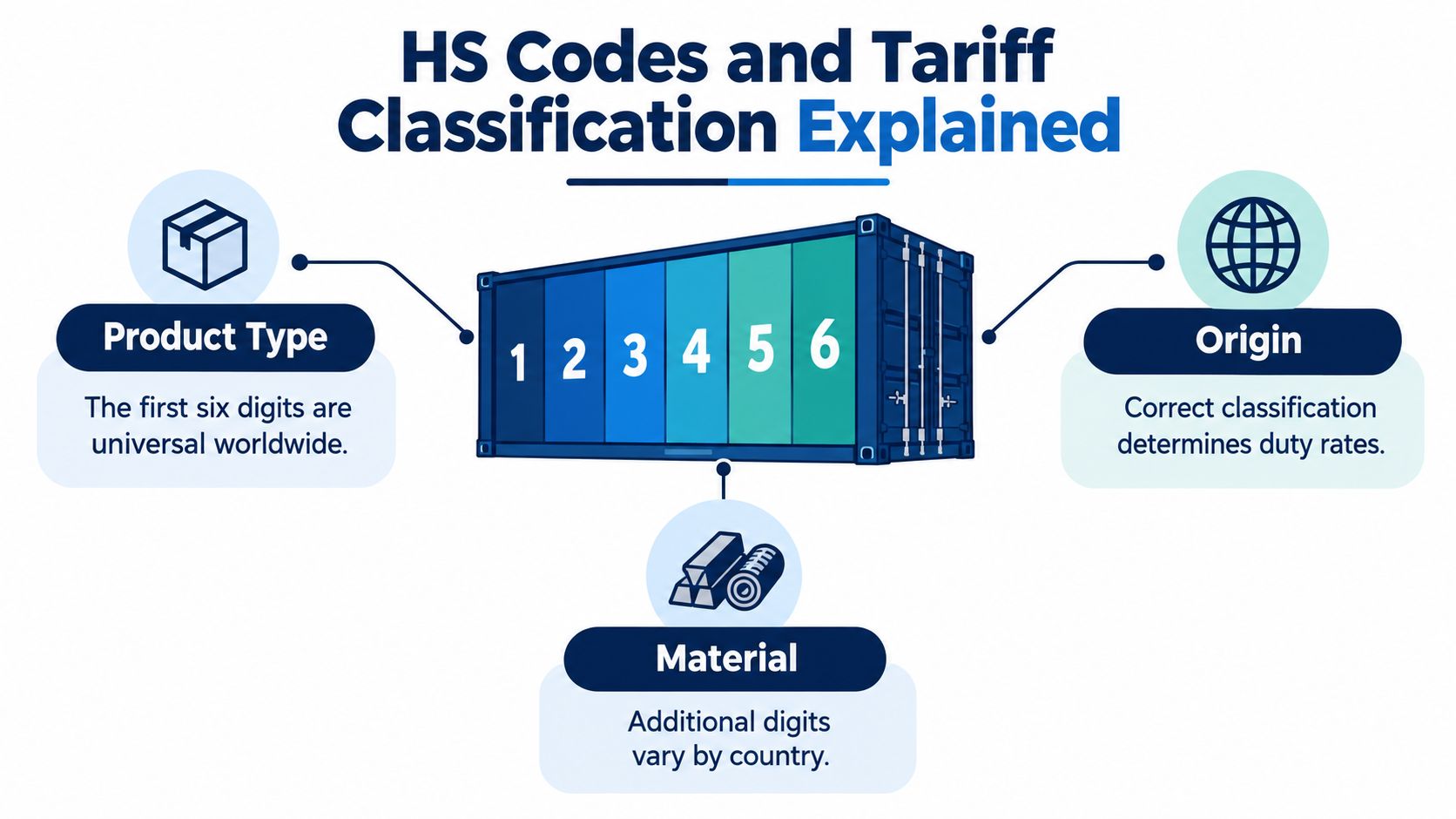
A customs declaration needs a clear answer to a basic question: what is the product? The Harmonized Commodity Description and Coding System, usually called the HS, provides the shared international framework for classifying goods. Think of its six-digit code as the common label on a shipping container. Countries can add their own digits, like local routing instructions, to apply national tariffs and statistical categories.
The World Customs Organization's HS Convention was adopted in June 1983 and entered into force on January 1, 1988. It assigns standardized six-digit codes to approximately 5,000 commodity groups. More than 200 economies, customs administrations, or economic unions use it as the basis for national tariffs and statistical nomenclatures, and it covers approximately 98% of world trade. Those details explain why a classification isn't just a broker's filing choice. It affects duties, customs treatment, and trade statistics across markets.
Don't copy the code from a competitor's listing. Similar-looking products can differ in material, function, or construction, and those details can change the applicable classification.
The WCO periodically updates the HS, generally every four to six years, to reflect new products, technologies, and trade patterns. Revisit classifications when a product changes or the system is revised. A clear overview such as the Smart Classic Business Hub HS guide can help teams understand the terminology, but your actual code must match the product and the destination's tariff schedule.
Tax setup should follow the shape of your orders, not a preference for whichever option sounds easiest. IOSS is available for EU business-to-consumer distance sales of non-excise goods with an intrinsic value of no more than €150 per order. The seller or electronic interface collects VAT at checkout and files a single monthly VAT return through one EU member state, as set out in the EU IOSS guidance.
That approach works only if your checkout, order records, and customs declaration stay in sync. Your system must apply the customer's member-state VAT rate, transmit IOSS identification data with the customs declaration, and reconcile order-level sales with the monthly filing. The €150 threshold is assessed for customs purposes using the exchange rate applicable when the declaration is accepted, so inconsistent invoice valuation or currency movement can push an order over the threshold at import.
| Order profile | Recommended setup | Why it wins |
|---|---|---|
| Eligible, lower-value B2C orders with reliable checkout and tax data | IOSS | VAT is collected at checkout, reducing the risk of a surprise charge at delivery |
| Higher-value or otherwise ineligible parcel orders where the seller wants to control the delivery experience | Delivered duty paid (DDP) | The seller arranges payment of import charges rather than leaving the customer to handle them at delivery |
| Low-volume shipments where the buyer accepts responsibility for import charges | Delivered at place (DAP) | It avoids building a seller-paid import-charge workflow, but shifts delivery friction to the customer |
| Replenishment shipments sent in bulk to a local fulfillment operation | Importer of record structure | It gives the seller a clear party responsible for the import entry before local delivery |
IOSS is not interchangeable with DDP or DAP. DDP and DAP describe delivery terms and who handles import costs and formalities, while IOSS is a VAT collection and reporting scheme for eligible transactions. A bulk importer-of-record setup is a different operating structure again.
If you don't use IOSS, the customer or carrier may need to collect VAT at import. That can create delivery delays, refused parcels, and returns. Keep an auditable record for each order, including ship-from country, destination VAT rate, intrinsic goods value, IOSS eligibility, and customs declaration status. Choose the model based on SKU complexity, returns handling, and your ability to reconcile the data. For broader planning on tax structure, see these tax optimization strategies.
A consumer electronics order moves from Shenzhen to a Rotterdam warehouse. The customer sees a shipping confirmation; customs receives a product description, value, origin, tariff code, consignee details, and declarations that must match. Your team owns the accuracy of those product and transaction records. A carrier or broker can submit them, but cannot fix inaccurate source data.
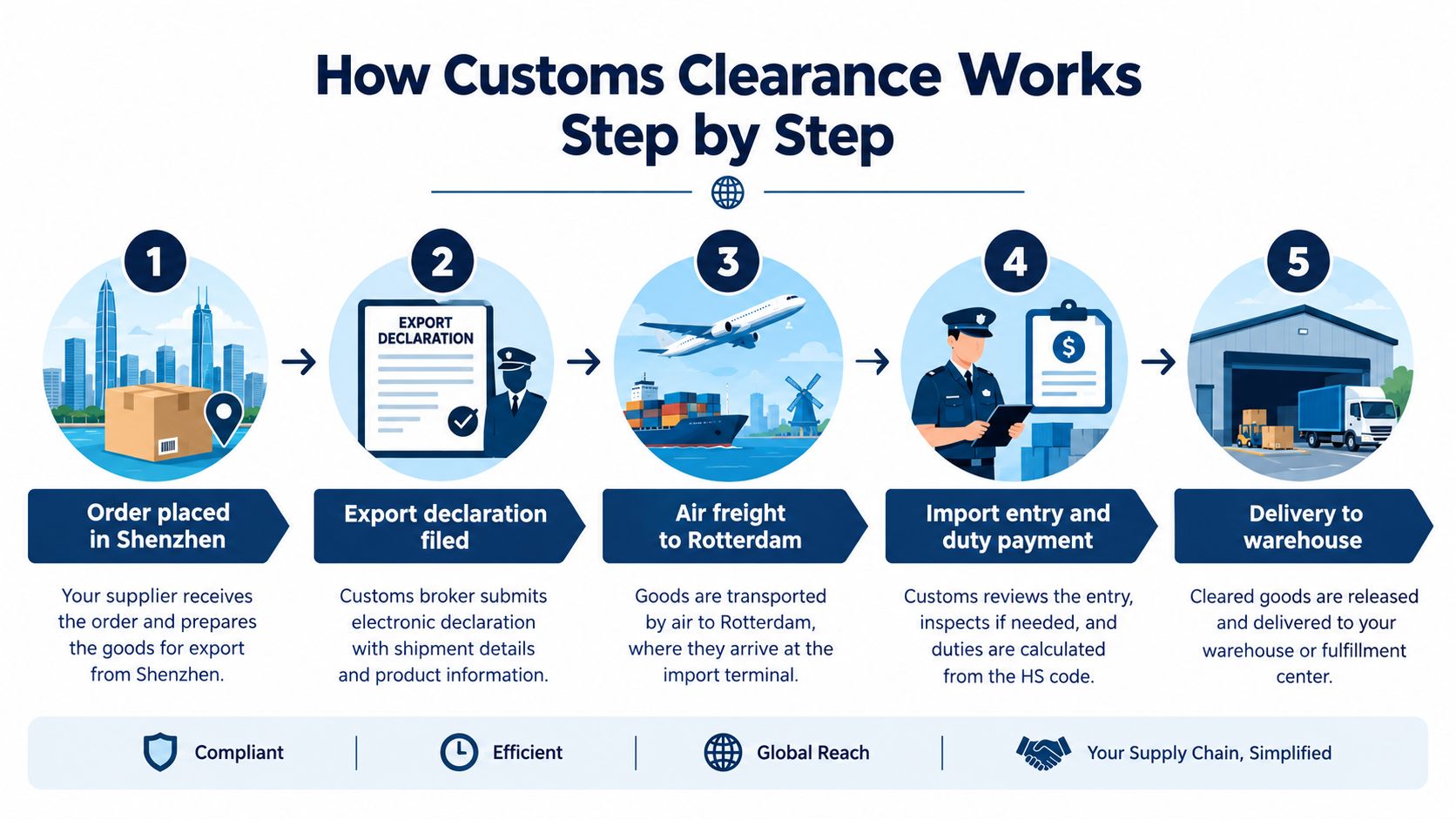
First, the order system creates the shipment record. Give each SKU an accurate product description, supported HS classification, defensible customs value, correct country of origin, and valid consignee details. If the product record conflicts with the invoice, the broker inherits an exception before filing.
Next, export and import declarations move electronically. Your logistics provider or customs broker submits the required filings using your data and route-specific instructions. Customs authorities may conduct risk-based documentary reviews or physical inspections. You cannot control selection, but consistent records reduce avoidable questions and clearance friction.
The WTO Trade Facilitation Agreement tracks members' implementation of measures intended to speed the movement, release, and clearance of goods, including measures completed, ongoing, or pending. Its trade facilitation implementation database shows why a single clearance-time assumption will not work across markets. Map each destination's advance filing, electronic-document, inspection, broker-data, and post-clearance audit requirements. Build those requirements into your SKU-level landed-cost model, and keep customs master data under your control rather than relying on a broker or platform to own it.
Operator's rule: The broker owns the filing. Your team owns the product facts, declared value, origin, and decision about who acts as importer.
If an importer needs an Economic Operators Registration and Identification number for EU customs activity, the EORI number guide explains the identifier. Link broker instructions and company identifiers to the correct legal entity and shipping route.
Watch the process in motion before you redesign it:
Customs clearance doesn't prove that a product is legal to sell. A parcel can move through customs and still face a marketplace removal, product-safety action, or a regulatory hold if the underlying product requirements aren't met. Separate marketplace approval from border compliance, then assign an owner to each.
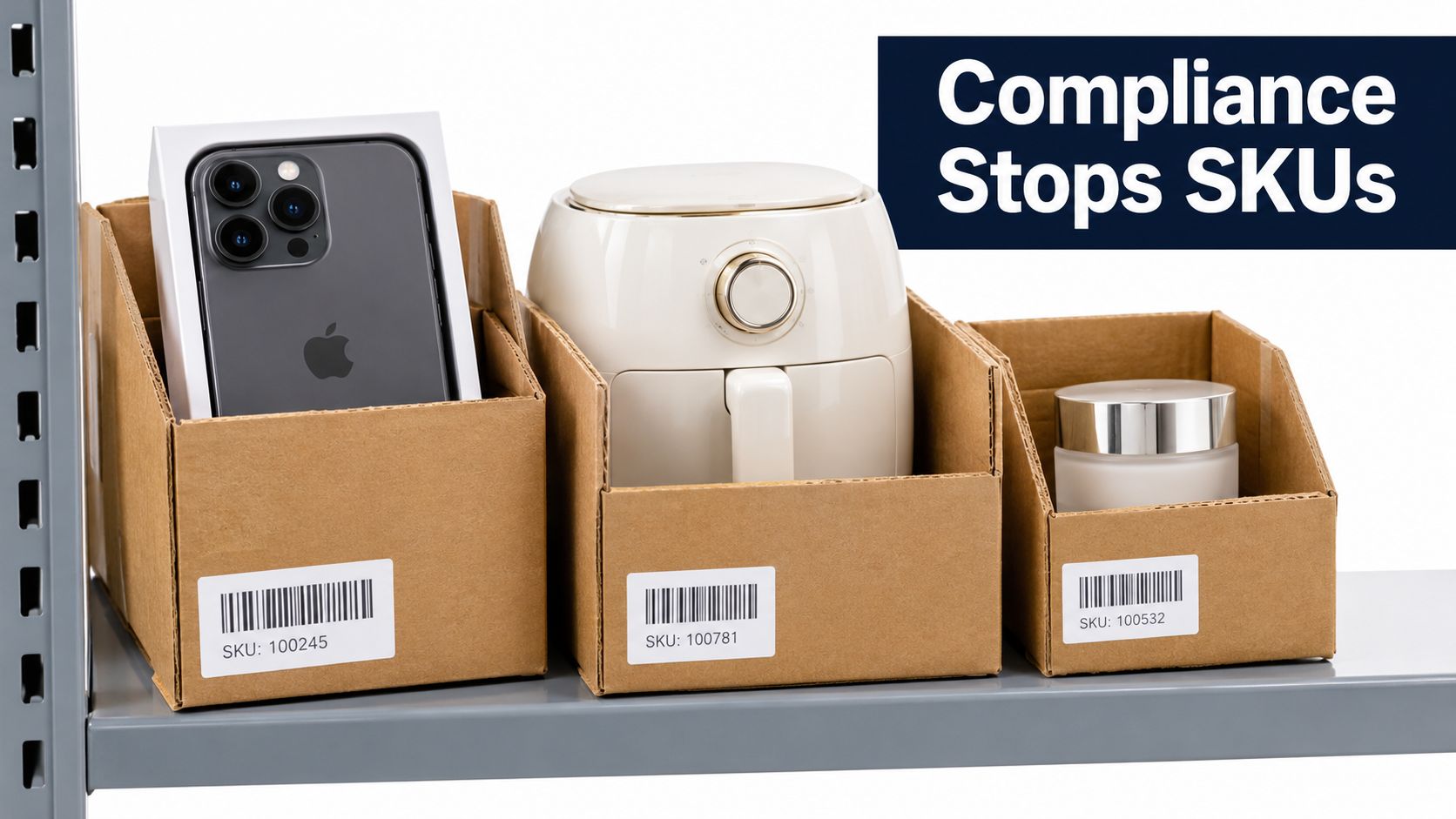
Amazon's restricted-products review and a customs authority's request for product documentation are different control points. Clearing one doesn't clear the other. For each high-revenue SKU, maintain a dossier with product specifications, test reports, declarations, labels, and destination-market approvals. Make the dossier easy for operations and marketplace teams to retrieve before a listing or shipment is blocked.
For a new product, ask one question before placing the purchase order: What evidence must exist before the first unit can be listed, imported, and delivered? If the answer is unclear, the SKU isn't ready to scale.
The 2026 threshold changes turn parcel economics into a per-SKU question. Model the cost of each product by destination and shipping route, then compare it with bulk import and local fulfillment. As noted earlier, EU and US rules differ, so keep their calculations separate.
A threshold alone tells you nothing about margin. Compare parcel fulfillment with bulk import using the same SKU and selling price. Use your actual carrier contracts, duty treatment, and return path rather than an assumed break-even volume. Then test each route against the classification and entry procedures that apply.
| Cost line | Cross-border parcel | Bulk import + 3PL |
|---|---|---|
| Duty and processing | Calculate by SKU, destination, and parcel entry method | Calculate for the bulk entry, classification, and applicable duty treatment |
| Brokerage and entry fees | Record the parcel-level charge from the carrier or broker | Include bulk-entry brokerage and ongoing inventory administration |
| Storage and local delivery | Include destination delivery costs per order | Add local storage, pick, pack, and domestic delivery |
| Returns and recovery | Include return shipping and any available duty recovery | Include local return handling, disposition, and any available duty drawback |
| Data and exception costs | Include manual corrections and repeat parcel exceptions | Include master-data controls and inventory reconciliation |
Build the model from customs value, tariff classification, origin, duties, carrier and broker charges, last-mile delivery, returns, and exception-resolution costs. Compare the result with bulk entry, storage, local fulfillment, and the administrative cost of holding inventory. Use this landed-cost calculation framework to organize the inputs consistently across SKUs.
Keep parcel shipping for SKUs whose total cost stays competitive and whose customs data is reliable. Shift toward bulk import and local inventory when parcel charges, delivery friction, or repeated exceptions outweigh local stocking costs. An importer-of-record arrangement can provide a responsible importing structure while you build internal capability.
The competitive advantage comes from operating with accurate product data and regional stock. That can improve predictability and customer experience even when the tariff rate is unchanged. Calculate costs by SKU and destination, assign ownership of the underlying customs data, and revisit the model when product attributes, routes, or rules change.
A customs record should have an owner, a history, and a test. If your marketplace listing says one country of origin, your ERP says another, and the broker receives a third, the problem isn't solved by adding another spreadsheet. It's a control failure.
The EU Customs Data Hub becomes mandatory for ecommerce on July 1, 2028, with sellers and platforms expected to provide transaction data immediately after sales to EU consumers. Noncompliance can carry penalties of 1% to 6% of the value of goods imported into the EU during the previous 12 months, according to the European Commission's EU customs reform information. Treat that exposure as a reason to assign ownership now, not as a future software project.
For an Amazon, Shopify, and wholesale business, start with a governed product record in the ERP or product-information system. Assign an accountable owner to each critical field: origin, customs value, HS code, product description, restricted-party status, and product-safety evidence. Make changes traceable, and require review before a classification or origin update flows to marketplaces, brokers, and carriers.
Then build a daily exception view that compares the product record with what the marketplace order, broker filing, and carrier declaration contain. Show the SKU, destination, mismatched field, shipment status, and person responsible for resolution. Don't automate the exception away. Automation can move bad attributes faster, so test data changes before they reach live shipments.
Start with integrations that preserve the fields used in customs declarations and provide a clear record of what was sent. Delay decorative dashboards that don't reconcile source data. A customs-data control system should help the operations lead answer a simple question: Which source is authoritative, and who fixes a mismatch before the next shipment?
Treat the next quarter as an implementation project with named owners and deliverables. Start with the products and routes that drive the most revenue, then extend the controls across the catalog. For market-entry planning beyond the current routes, use this guide to expanding internationally to frame the commercial questions alongside compliance work.
Integrate the product master with order, broker, and carrier workflows so the same SKU attributes reach each declaration. Assign owners for classification, origin, customs value, and product-safety evidence. Build an exception dashboard that flags mismatches before they become repeated parcel problems.
Test the flow with real orders and confirm that corrected product data reaches every system that uses it. Don't call the integration done because a file transfers successfully. It's done when the declared fields reconcile with the approved product record and someone owns every exception. Deliverable: a tested data flow, field-owner register, and exception queue with resolution steps.
Run a documented audit against the records created during the earlier weeks. Sample declarations, compare invoices and product attributes, inspect unresolved exceptions, and confirm that the broker's instructions match the actual operating model. Prepare a readiness review for the 2026 changes and a budget that separates system work, product testing, brokerage, and inventory decisions.
Bring the CFO a SKU-level view, not a single compliance line in the budget. Show which routes remain economical, which require a local-stock comparison, and which need product or data work before expansion. Deliverable: a signed-off audit, a ranked remediation list, and a funded plan with accountable owners.
Importing well is a profit center, not paperwork. Make the data dependable, price the route honestly, and give every exception an owner.
Your next three actions are straightforward: audit your priority classifications, model the affected routes by SKU, and assign owners for the customs fields your systems currently share. Serious operators also learn from peers who are solving the same broker, inventory, and marketplace problems. Million Dollar Sellers brings ecommerce entrepreneurs together through curated events, mastermind calls, private forums, and vetted service recommendations; visit Million Dollar Sellers to explore the community.
Join the Ecom Entrepreneur Community for Vetted 7-9 Figure Ecommerce Founders
Learn MoreYou may also like:
Learn more about our special events!
Check Events