Chilat Doina
November 20, 2026
You've just shared your supplier's payment terms, the margin on your best-selling SKU, and why your latest launch failed. Someone on the call takes a screenshot. Nobody objects because nobody has agreed on what can leave the room. The problem isn't that you trusted the wrong people. It's that the group asked for honest disclosure before defining what that trust requires.
A useful peer group should let you discuss a contribution-margin problem without wondering whether the numbers will reach a competitor. It should also let someone challenge your inventory plan without turning disagreement into a personal dispute. Mastermind group rules make both possible.
The format was never meant to be a networking mixer or a coaching hour dominated by an expert. The history of mastermind groups traces the modern concept to Napoleon Hill's The Law of Success, first published in 1925, and its expansion in Think and Grow Rich in 1937, describing at least two people coordinating knowledge and effort in harmony toward a definite purpose.
That definition suggests clear membership obligations:
Hill's emphasis on “perfect harmony” shouldn't become a ban on dissent. For an ecommerce group, respectful disagreement about stockouts, ad-account losses, or marketplace compliance is more useful than polite reassurance.
Practical rule: Protect the person's ability to speak honestly, not their preferred answer.
Strong community-building strategies help people establish relationships. A written charter gives those relationships boundaries when the conversation becomes commercially sensitive.
Operating rules for a founder mastermind
| Rule area | Operating rule | What good looks like | What breaks it |
|---|---|---|---|
| Confidentiality | No recording, forwarding, or identifiable sharing without consent. Cover screenshots, messages, documents, third-party data, pre-join knowledge reused in the group, and post-exit disclosures. | Members can discuss margins, suppliers, and launches within an agreed privacy scope. | Screenshots in other chats or gossip after someone leaves. |
| Participation | Equal airtime, questions before advice, rotating facilitation, and a right to pass. | Every member has space to contribute and dissent is invited. | A high-revenue founder owns the room. |
| Accountability | Every issue ends with an owner, deadline, and metric. Open the next meeting on completion. | Members review commitments before introducing new topics. | Advice produces no follow-up. |
| Trust and candor | Members may disclose failures without humiliation. Performance standards still apply. | Ad losses, stockouts, and failed launches are discussable. | Mockery or concealment of weak results. |
| Attendance and selling | Set a fixed cadence and quorum. Require preparation. Ban pitching and lead generation; admit no unapproved guests. | Members arrive ready, with no unexpected listeners or vendor pitches. | Unexplained absences, surprise guests, or sales pitches. |
| Hot-seat format | Use a timed discussion with a decision statement, baseline metrics, constraints, and a disconfirming question. | The founder leaves with a written action, owner, metric, and review date. | Unbounded advice or premature consensus. |
Read the chart aloud before anyone shares a business problem. A facilitator shouldn't assume that silence means acceptance, especially when members have different expectations about recordings, introductions, or commercial referrals.
A 2026 Executive Support Magazine guide identifies 10 governance topics for mastermind agreements, including confidentiality, attendance, selling, quorum, guests, and enforcement. Those administrative details deserve space beside the more appealing promises of trust and support.
Copy the chart into a shared document, then add named owners and explicit choices:
For confidentiality, the visible test is whether people understand permitted use, not whether they promise discretion. For participation, watch who gets interrupted. For accountability, inspect the completion log rather than the enthusiasm at closing.
Trust and candor need a facilitator willing to stop mockery immediately. Attendance rules need a consequence for repeated unpreparedness. The hot-seat rule needs a timer and a decision owner, not merely an agenda heading.
A charter is an operating agreement among peers. It isn't a substitute for a lawyer-drafted confidentiality agreement when a discussion warrants one, particularly around customer information or a pending transaction.
Don't turn the shared document into a sprawling policy manual. Keep the chart readable, attach the detailed privacy scope, and record amendments where everyone can find them. Members should be able to answer a practical question, such as whether they can forward a spreadsheet to their finance lead, without improvising permission.
“What happens here stays here” doesn't tell a founder whether their launch calendar can appear in someone else's team chat. It says nothing about supplier pricing, margin worksheets, customer records, intellectual property, or pending deals.
The Founder Hub framework notes that the mastermind label has no official operating standard, and a charter isn't a legal confidentiality agreement or a guarantee against disclosure. Write the actual boundaries instead.
What the confidentiality rule covers
| Information | Default rule | Exception | Duration |
|---|---|---|---|
| Screenshots, recordings, and forwards | Prohibited. | Written consent from the speaker and anyone identified. | During membership and after exit. |
| Private messages and shared documents | Same protection as the live room. | Recipients may use them only for the agreed action. | During membership and after exit. |
| Customer, employee, or supplier data | No identifiable third-party details. | That party consents, or members approve a fully anonymized lesson with the affected member's explicit consent. | During membership and after exit. |
| Knowledge from before joining | Protected when repeated from the group. | The original holder may still use independently held prior knowledge outside. | From the group disclosure onward. |
| Accidental disclosure | Stop the spread, notify the affected person, and log a warning. | An isolated accident doesn't automatically require removal. | Retain the incident log for the group's life. |
| Intentional misuse | Removal after documented review. | No exception for deliberate unauthorized forwarding or commercial use. | Immediate and permanent following review. |
Apply these boundaries to the operational details members exchange.
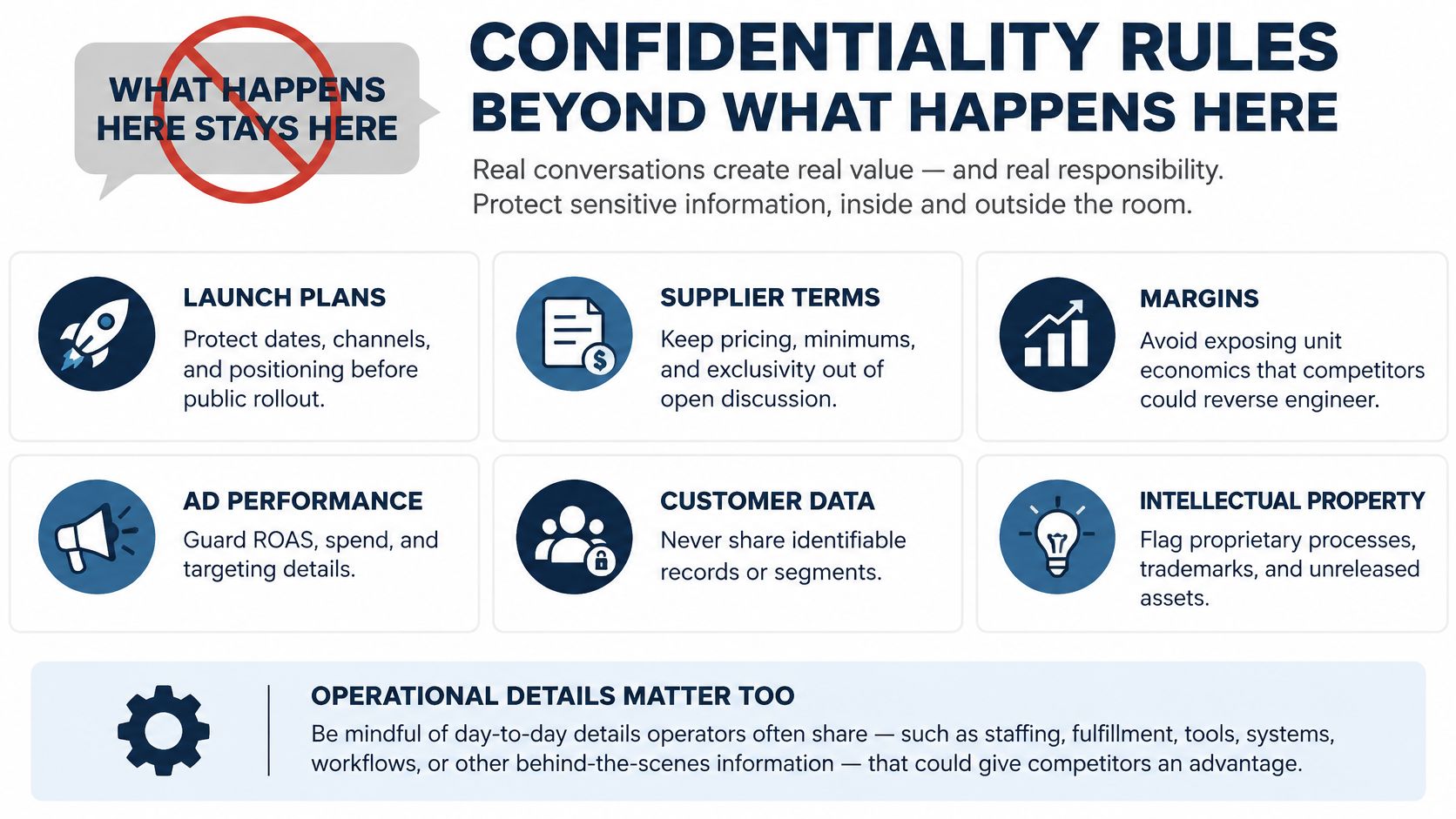
Use a documented response rather than debating intent in the group chat:
For planning restricted communication during that response, Ciphar's resource on secure coordination for incident responders is a useful companion. Keep incident handling separate from ordinary member discussion.
Anonymization isn't automatic permission. A distinctive product, market, or supplier arrangement can identify a business without its name. Require explicit consent before reusing even an anonymized lesson, especially across different data-protection environments.
Paste this scope beneath the charter's confidentiality row. Have counsel address applicable legal obligations and lawful disclosure exceptions rather than implying that peer acceptance overrides them.
Say a prominent operator speaks first about channel expansion. A smaller founder, whose cash position makes that recommendation unsuitable, shelves a better-fit plan. Nobody was rude, but the room still failed to test the decision.
Authority bias means prestige can influence how much weight members give an answer. Relevant experience is valuable. It doesn't make someone else's financing, margin structure, or tolerance for inventory risk appropriate for your business.
Good Growth's discussion of mastermind failures emphasizes that safety requires explicit agreements rather than an assumption that capable founders will naturally share the floor.
Use these prompts to distinguish useful experience from social weight.
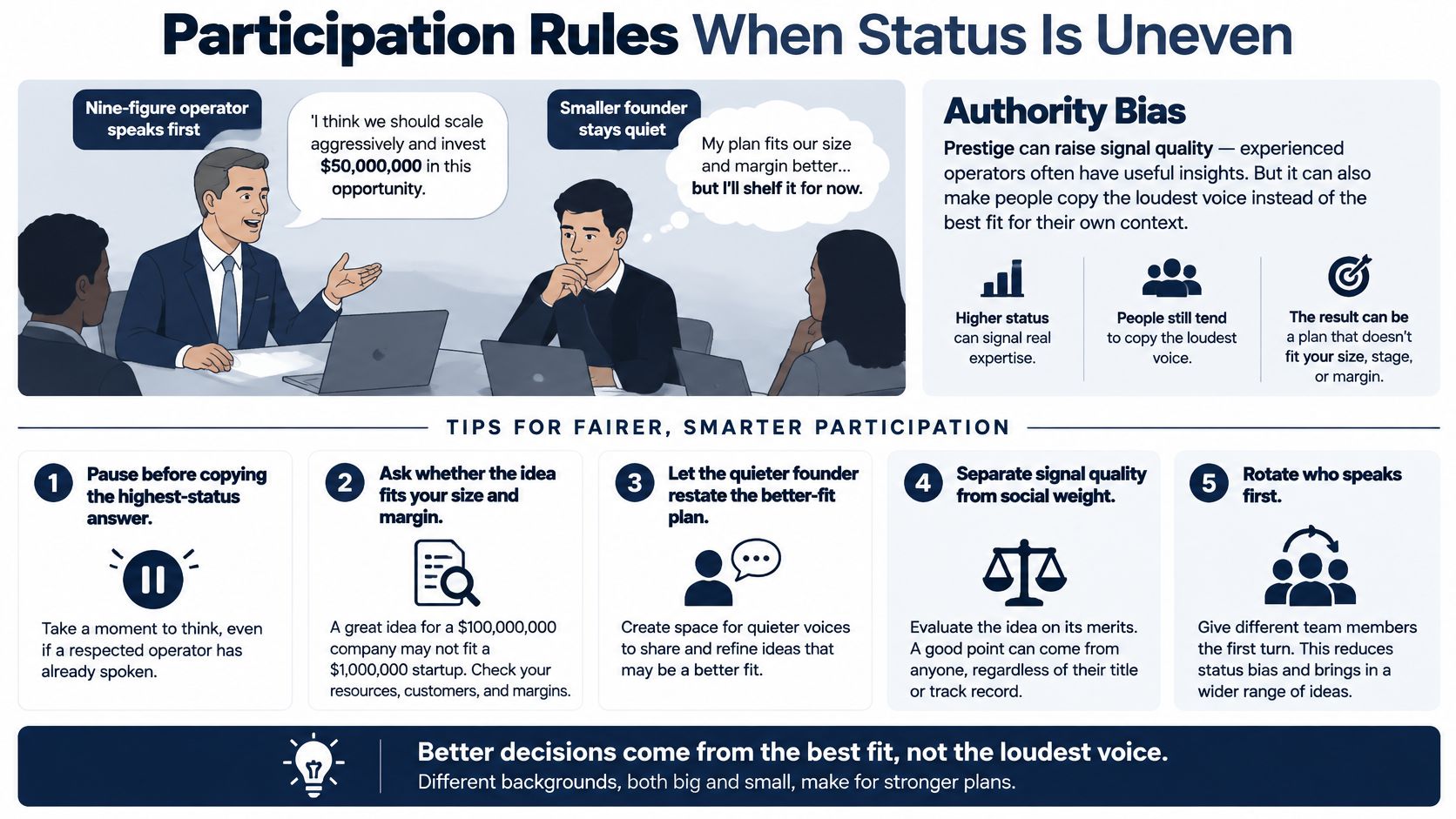
A member must be able to pause or reject advice without losing standing. Practical communication frameworks help members disagree clearly, but the moderator still has to protect that right.
After a redirect fails, stop the speaker's turn and log the interruption. If the same members still take most of the airtime at the next meeting, withhold the dominant member's next hot seat. A further repeat enters the removal process.
A respected member doesn't get an exemption from the rule that makes everyone else willing to speak.
Membership selection also matters. At Million Dollar Sellers, we manually vet and interview everyone who joins, and founders interview founders. Unlike general founder organizations such as YPO or EO, we focus entirely on ecommerce operators, which reduces the mismatch created by unrelated operating contexts.
If the same people dominate consecutive meetings, don't describe the room as collaborative. Apply the rule.
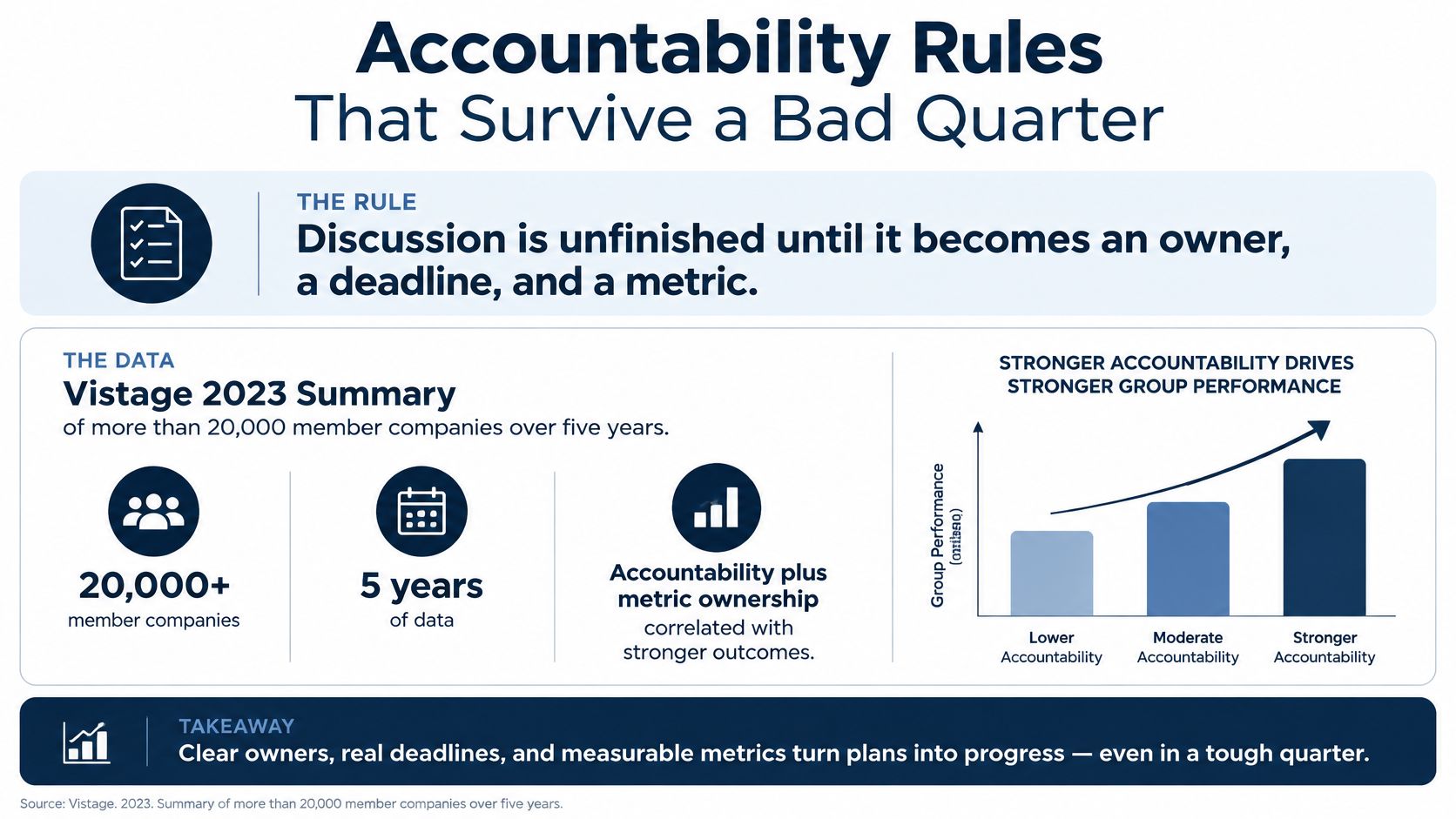
Discussion is unfinished until it becomes an owner, a deadline, and a metric. A difficult quarter makes that rule more important, not less.
Industry research on peer advisory groups links membership to stronger average performance than comparable non-members, though an association reported through industry summaries cannot prove the group caused the difference. The defensible lesson is to replace encouraging conversation with written commitments that members can inspect.
Use this visual as a reminder to assign responsibility before closing a discussion.
Verbal agreement decays between meetings. The charter should require a written record completed before the discussion closes, with the founder confirming the wording out loud so there is no later dispute about what was promised. Use a short record with the following fields:
For contribution margin, specify the target improvement in percentage points and confirm which costs are included. For inventory days, name the report used to calculate the baseline. For an acquisition-channel test, define the spend boundary and stopping condition before launch.
Resolving a marketplace compliance issue needs more precision than sending an appeal. Record the submission owner, required evidence, and what platform response will count as resolution.
A field study of 104 sales and service teams found that psychological safety's effect on effectiveness was mediated by learning behavior and team efficacy, rather than operating directly. Permission to disclose failure still requires action on it.
At the next session, classify each commitment as completed, blocked, or not completed before opening new topics. A blocked owner identifies the dependency and proposes a revised action. A missed commitment requires an explanation and a decision about whether to recommit, change the approach, or stop. Two consecutive misses move the commitment into the escalation path the charter names in advance: a private review with the moderator, then a written consequence such as a probation period or removal.
Accountability standard: Review the commitment without humiliating its owner. Don't lower the standard to avoid an uncomfortable conversation.
For founders who need help turning intentions into routines, Acheloa Wellness coaching on accountability, from Acheloa Wellness, Inc., offers a separate resource to consider. Keep that personal follow-through work distinct from the group's business decision log.
Use accountability systems to keep the action, owner, expected metric, and review date visible to authorized members. Keep member-specific numbers restricted, and obtain consent before sharing any lesson outside the group.
An Amazon-led brand is deciding whether to place a large inventory order for another marketplace. The founder wants expansion, the supplier wants a commitment, and the finance lead is worried about cash tied up in stock.
Good Growth's 2026 guide describes a typical hot seat as 30–45 minutes. The following is a proposed allocation within that window, not a required industry standard.
Use the process diagram to keep advice from overtaking clarification.
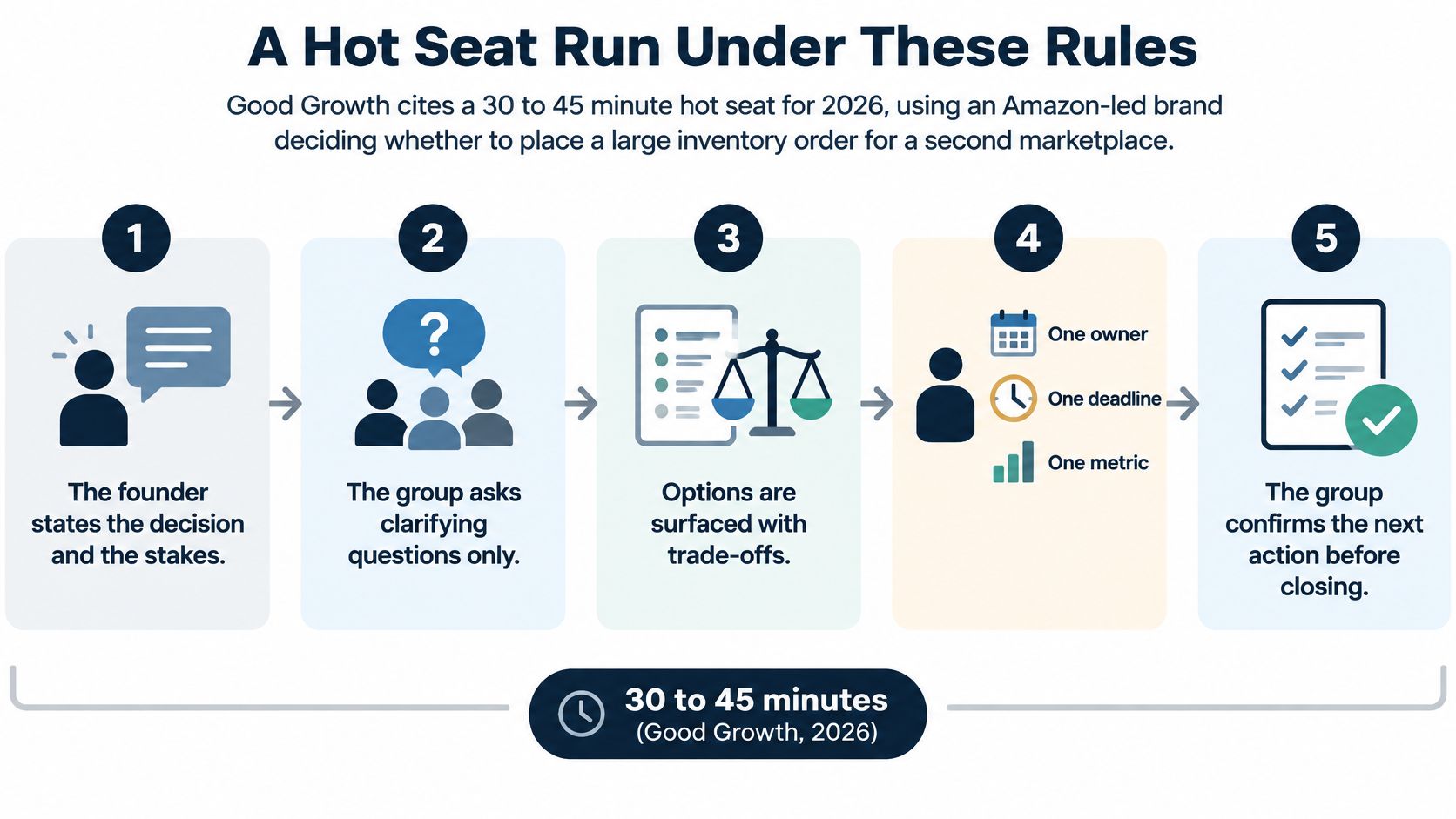
Minutes zero through five, define the decision. The founder states whether to approve the order, reduce it, or defer it. They present current contribution margin, weeks of cover, ad efficiency, and the cash constraint. A compliance hold is a constraint, not a footnote.
Minutes five through twelve, clarify the evidence. Members ask questions only. The facilitator separates confirmed demand from assumptions about transferring rankings, reviews, or customer behavior between marketplaces. Written input goes first so nobody has to contradict a prestigious speaker just to introduce a concern.
Minutes twelve through twenty-two, compare explanations. Marketplace, paid acquisition, supply-chain, finance, and retention perspectives each get a turn. Perhaps demand is genuine, but replenishment timing makes the order unsafe. Perhaps the apparent opportunity rests on economics that exclude launch advertising and returns.
A small-group decision-making study found that groups of at least three participants significantly outperformed dyads in one dataset (p = 0.03). That finding doesn't establish an ideal founder-group size, but it supports testing a decision through multiple perspectives rather than accepting a solo guru's answer.
The accompanying video provides another format for considering the meeting process.
Minutes twenty-two through thirty-two, challenge the preferred option. A member asks what evidence would disprove demand. Run a pre-mortem: assume the order became stranded inventory and identify plausible reasons. Members write rough probability estimates independently before discussing differences.
Minutes thirty-two through forty, let the founder choose. The founder may approve a smaller order, require additional evidence, or reject expansion. Record the action, owner, expected metric, review date, and the assumptions behind the choice. The facilitator reads the commitment back for confirmation.
Use the remaining time to confirm the follow-up. Specify which result will be available at the next meeting and who will prepare it. At that meeting, compare the forecast with what happened before introducing another hot seat.
The founder leaves with autonomy intact. The group has tested the decision without taking ownership of the business, and the commercially sensitive numbers remain inside the agreed boundary.
Decide how the group will operate before anyone shares another supplier agreement or margin worksheet. Rules negotiated after a breach will feel personal, even when the underlying concern is legitimate.
Adopt the charter through concrete actions:
For non-privacy violations, issue a documented warning for an unapproved guest, a sales or hiring pitch, mockery of a disclosed failure, or dominance after a redirect. Record an attendance violation against the member responsible, rather than blaming everyone when the group misses quorum.
A repeat violation triggers removal. Deliberate commercial misuse requires documented review and removal; an accidental slip requires correction and a recorded warning, not automatic expulsion.
The facilitator's log should state the behavior, the rule, the correction requested, and the consequence of recurrence. It shouldn't become a running commentary on someone's character.
If members won't accept confidentiality, equal airtime, or follow-through, change the room rather than hoping etiquette will hold. Bring a live decision, baseline numbers, and a proposed owner and date to the next session so the group can test the charter in practice.
Million Dollar Sellers offers hands-on, 1-day Masterminds covering fundraising through operations, plus monthly Squads of 6–8 members guided by a trained moderator. If you're looking for ecommerce peers to challenge decisions and support follow-through, visit Million Dollar Sellers to explore the community and its formats.
Join the Ecommerce Community for Founders Scaling from 7 to 9 Figures
Learn MoreYou may also like:
Learn more about our events!
Check Events