Chilat Doina
June 25, 2026
Most Miami ecommerce events sell the same dream. More connections, more tactics, more top-line growth.
That's useful, but it's incomplete. A founder can leave Miami with a notebook full of acquisition ideas, a calendar full of follow-ups, and a business that still gets weaker with every sale.
The private conversations are usually better than the stage content. Operators who've built durable brands don't obsess over vanity metrics first. They ask harder questions. Which channel leaves cash behind? Which SKU absorbs too much return risk? Which “winning” campaign only worked because nobody fully loaded the costs?
Miami has become a real hub for high-level ecommerce gatherings. The Miami eCommerce Summit has drawn approximately 500 carefully selected industry leaders and held its 2024 event on Wednesday, November 13th at the Seminole Hard Rock Hotel & Casino in Hollywood, Florida, according to Envive's overview of Florida ecommerce events. EEE Miami 2026 is scheduled for February 4–5, 2026 at The Ritz-Carlton Key Biscayne and is designed for 500 senior leaders, with tickets starting at $950, based on the official EEE Miami event details.
That's the glamorous part. The less glamorous part is what happens after the event. You return with ideas, spend faster, hire faster, test faster, and if your margin discipline is weak, you scale the leak.
Most founders use the phrase “margin” too loosely. They mean profit in general, but there are different layers of profit, and each one answers a different operating question.
If you don't separate those layers, you'll make bad decisions with confidence.
Take a single product sale. A customer buys one unit on your site or through a marketplace. Cash comes in. Then the business starts taking its share back, one layer at a time.
First, you lose the direct product cost. Then you lose the channel cost to make that sale happen. Then you lose the cost of running the company. Then all the leftover non-operating obligations hit the bottom line.
That journey is why a product can look healthy in one report and still leave you with very little money in the bank.
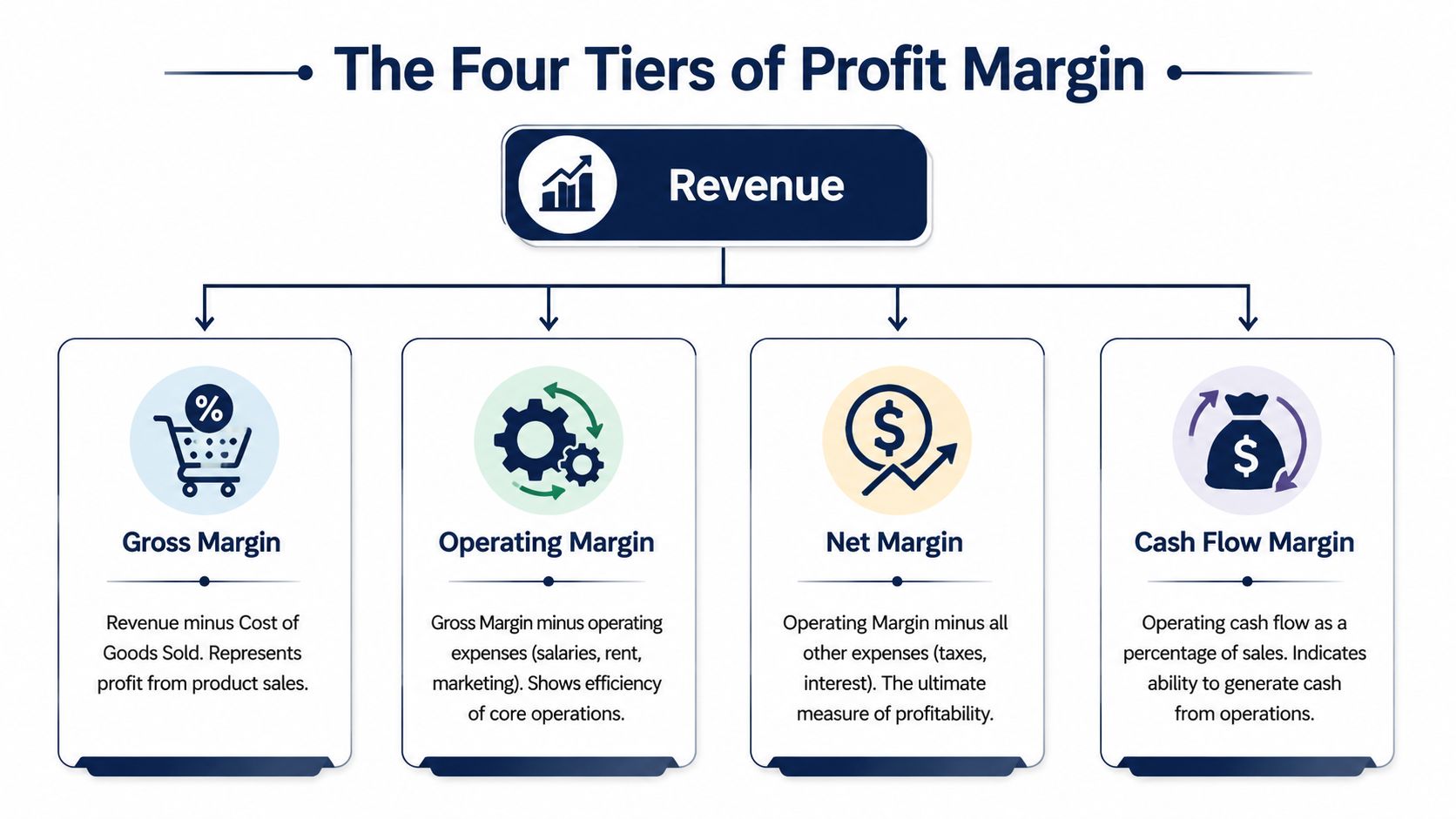
| Margin tier | What it includes | What it tells you |
|---|---|---|
| Gross margin | Revenue minus cost of goods sold | Whether the product itself has room to breathe |
| Contribution margin | Gross margin minus variable selling costs like ads, payment fees, fulfillment, and channel fees | Whether each sale helps fund the business or drains it |
| Operating margin | Contribution profit after fixed operating expenses like payroll, software, and overhead | How efficiently the company runs |
| Net margin | Operating profit after everything else, including taxes and interest | The final health of the business |
Here's the mistake I see most often at Miami ecommerce events. Founders talk about gross margin as if it's the whole story. It isn't.
A product can carry strong gross margin and still be a weak business asset once Amazon fees, Meta spend, agency retainers, discounting, and return handling are loaded in. Gross margin tells you whether the product has promise. Contribution margin tells you whether the sale was worth making.
Practical rule: If you only review gross margin, you're evaluating the product. If you review contribution and operating margin, you're evaluating the business.
Each tier helps you make a different call.
If you need a clean refresher on how to determine profitability, that framework is useful because it forces you to move past the lazy version of “revenue minus costs” and into actual line-item thinking.
The point isn't academic precision. The point is control. Once you label the four tiers correctly, margin stops being a vague finance topic and starts becoming an operating system.
The formulas are simple. The discipline to use them consistently is the hard part.
Most channel arguments come from bad math. A founder says Amazon is more profitable because volume is stronger, or DTC is better because the brand owns the customer. Both claims can be true in a partial sense and false in the P&L.
For channel analysis, keep the formulas standardized.
If your team needs a straightforward finance reference for setup, this guide to the profit margin calculation formula is a useful baseline.
Use one product. Keep the same product cost. Then compare the costs that change by channel.
| Line item | Amazon FBA sale | DTC Shopify sale |
|---|---|---|
| Selling price | Product revenue | Product revenue |
| COGS | Unit cost, packaging, inbound inventory assumptions | Unit cost, packaging |
| Variable channel costs | Referral fees, FBA fees, storage exposure, Amazon ads, promos | Payment processing, pick and pack, shipping subsidy, platform discounts, Meta or Google ads |
| Operating allocation | Team, software, agencies, finance, support | Team, software, agencies, finance, support |
| Other expenses | Interest, taxes, one-off items | Interest, taxes, one-off items |
The logic matters more than a made-up spreadsheet. On Amazon, the fee stack is usually more visible because the marketplace itemizes it. On DTC, founders often underestimate the true variable cost because pieces live in different systems. Shopify shows the order. The ad platform shows acquisition spend. The 3PL shows fulfillment. Finance books software later. Nobody sees the full sale economics in one place.
That's how weak contribution margins survive for months.
Amazon often gives you cleaner conversion demand and stronger purchase intent. It also taxes you in ways founders normalize too quickly. Referral fees, FBA charges, storage exposure, return handling, and ad dependence can make an apparently healthy SKU mediocre.
DTC gives you more control over merchandising, retention, and bundle design. It also exposes you to acquisition volatility, payment processing, shipping pressure, and aggressive discounting habits that subtly damage profitability.
Don't ask which channel is “better.” Ask which channel produces stronger contribution margin after the full cost to win and fulfill the order.
A practical channel review usually surfaces three truths:
Don't average your whole company into one comforting number. Build margin views at three levels:
That structure matters at Miami ecommerce events because omnichannel founders often compare top-line growth stories that aren't actually comparable. One brand's marketplace-heavy revenue can carry a very different margin shape than another brand's repeat-driven DTC revenue, even when both look impressive on the surface.
The fix is simple. Put every channel through the same formula. Then stop rewarding volume that doesn't survive full-cost accounting.
Founders rarely lose margin in one dramatic event. They lose it through tolerated sloppiness.
The dangerous part is that many of these leaks hide inside “normal” ecommerce behavior. Free shipping sounds standard. Small discounts feel harmless. Refunds seem like customer service. A few extra software tools look manageable. Stack enough of them together and the business gets thinner every month.
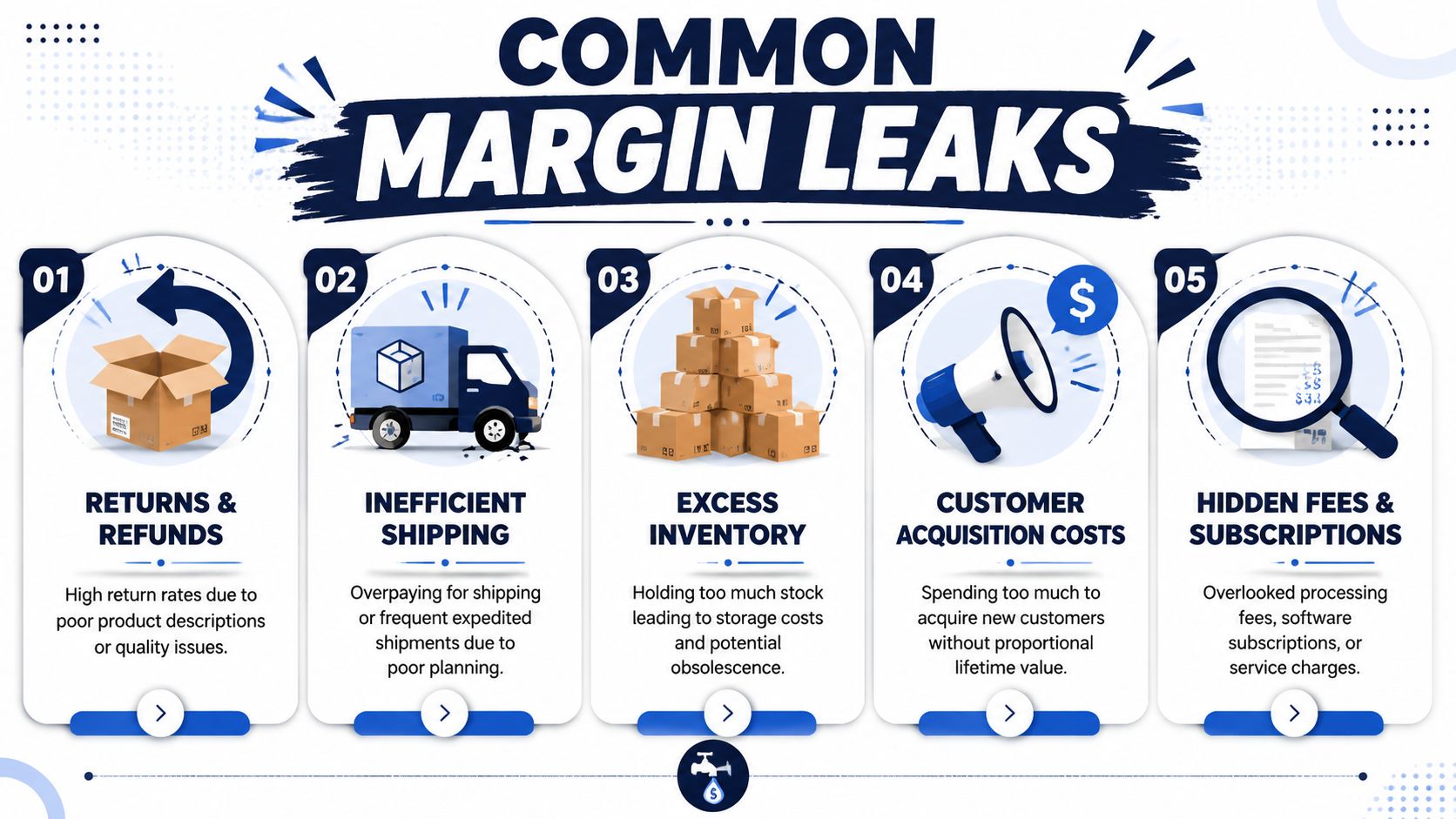
Start with returns and refunds. Not just the obvious ones, but the full cost. You refund the order, lose the outbound shipping cost, absorb return processing, and often write off inventory condition. Then there's the quiet killer: “goodwill” refunds that bypass normal root-cause review.
Next, look at shipping. A lot of brands don't offer free shipping. They subsidize it badly. They underprice thresholds, rely on expensive zones, rush orders that should've been planned better, and treat carrier creep as background noise.
Then inventory. Overstocked items don't just tie up cash. They force markdowns, increase storage costs, and create bad decision-making. Teams start pushing the wrong SKUs because they need to clear inventory, not because demand is strongest.
Ask these in your next weekly review:
A lot of brands know they have a margin problem but still don't know where it lives. That's because they review category totals, not the decisions underneath them.
Most margin leaks don't look serious in isolation. They become serious when they repeat every day across every order.
You don't fix leaks with motivational talk. You fix them with ownership and reporting.
This is the part nobody brags about on stage at Miami ecommerce events. They should. Brands don't become elite by finding one brilliant growth hack. They become elite by refusing to tolerate leaks that weaker operators call “the cost of doing business.”
Once the obvious leaks are closed, the game changes. You stop defending margin and start building it.
That usually comes down to four levers. Pricing, COGS, fulfillment, and paid media discipline. Most brands touch all four. Very few push them in the right order.

Founders love efficiency projects because they feel safe. Pricing feels risky, so they delay it.
That's backwards. A pricing improvement can change every future order. A small operational saving often takes months of negotiation and systems work to realize.
Start with offer architecture, not just sticker price. Test bundles, quantity breaks, channel-specific packs, and threshold logic. On Amazon, a different pack configuration can change fee efficiency. On DTC, a better bundle can lift average order value without leaning on discounts.
Closed-door rule: If your only conversion lever is discounting, you don't have a pricing strategy. You have a margin surrender habit.
Supplier negotiation gets discussed too vaguely. “Ask for better pricing” isn't a strategy.
Go into the conversation with purchase history, forecast confidence, defect concerns, and packaging options. Ask for changes that matter operationally, not just a lower invoice line. Better payment terms, lower MOQs on risky SKUs, improved carton efficiency, and packaging redesign can all improve margin.
A strong first move this week is simple. Take your highest-volume SKU and review every component cost around it, not just the manufacturing quote. Packaging, inserts, labeling, prep, and inbound complexity all belong in the discussion.
A lot of brands overspend because they chase speed where customers don't demand it.
Review your shipping zones, split shipment behavior, packaging dimensions, and exception handling. Audit how often your team expedites orders because inventory was staged poorly or because customer communication came too late. That's not a fulfillment problem. It's an operating discipline problem.
Event operators understand this better than many ecommerce teams. The mechanics behind ticketing, demand timing, and cash planning are often sharper than what many brands apply to product launches. That's one reason a piece on how pre-orders drive event revenue is worth reading. Not for the event niche itself, but for the planning mindset behind demand capture, fulfillment timing, and cash protection.
Here's a useful walkthrough on margin improvement from a different angle:
Teams still celebrate ROAS screenshots that finance would reject in seconds.
A campaign can post strong platform performance and still hurt net profit if it pushes low-margin SKUs, attracts weak customers, or depends on heavy discounting to convert. Look at ad spend through a margin lens. Which campaigns support profitable first orders? Which ones create healthy reorder behavior? Which ones buy revenue at a bad cost?
Your immediate move is to map campaigns to contribution margin by offer, not just by top-line attributed sales.
That's where experienced operators at Miami ecommerce events often separate themselves. They don't ask whether ads are “working.” They ask whether the business keeps enough after the ad, the order, the support burden, and the return behavior.
Most founders review margin too late. They find out there was a problem after the month closes, after cash already tightened, and after teams have repeated the same mistake across hundreds or thousands of orders.
That delay creates both operational burnout and financial burnout. Miami Ecommerce Week notes that 72% of senior ecommerce operators report burnout after high-density events, while 0% of Miami event content addresses this, and the same source ties that mental toll to the financial strain of chasing growth without enough focus on margin health.
A good dashboard reduces that strain because it turns guesswork into an early warning system.

You don't need a bloated BI project to start. You need a disciplined operating view.
Daily
Weekly
Monthly
If you want a practical reference for structuring the reporting layer, this overview of a performance metrics dashboard is a good model for how operators turn raw data into decisions.
You don't need fancy software before you have clean logic. A simple spreadsheet can do the job if the assumptions are solid.
Set up one tab for SKU economics. Include price, COGS, packaging, variable fulfillment cost, payment fees, average discount, ad cost allocation, and returns reserve. Then create a channel tab that applies those assumptions differently for Amazon, DTC, and other channels. Finally, add a scenario tab.
That scenario tab is where real decisions happen.
Your dashboard shouldn't just report history. It should let you test decisions before they hit the P&L.
A margin dashboard fails when it becomes a vanity board.
Don't overload it with every metric your tools can export. Keep the few that change behavior. If a number doesn't trigger a decision, remove it. If a team can't explain what action follows a red flag, refine the metric until they can.
That's the discipline founders should bring back from Miami ecommerce events. Not another pile of ideas. A cleaner operating instrument that tells you where the business is strong, where it's fragile, and what to change next.
The best post-event plan is boring on purpose. You don't need a giant transformation sprint. You need a short list of actions that force truth into the business fast.
Most founders leave Miami energized and then waste the next few weeks reacting. They chase conversations, revisit branding ideas, and test channel tactics before they've audited the engine that funds all of it.
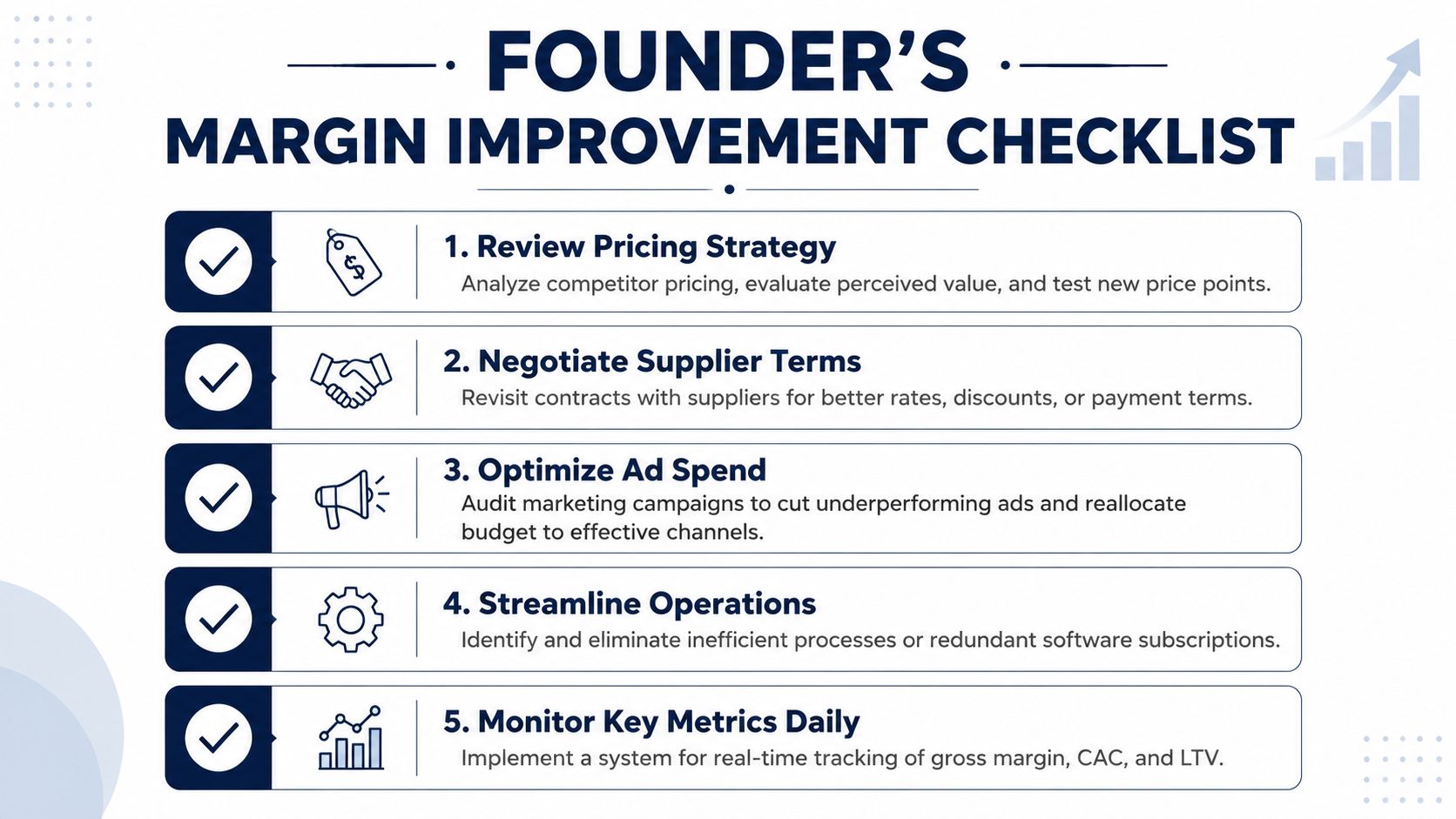
Use this as your immediate operating list after attending Miami ecommerce events or any high-density founder gathering.
Don't ask broad questions like “How do we improve profitability?” Ask sharper ones.
For founders planning their event calendar, this list of ecommerce events in 2026 can help you choose where to spend time. Just don't confuse attendance with execution.
The founders who win after events aren't the ones with the most notes. They're the ones who return and make the business harder to fool.
That's the margin talk most rooms skip. Revenue earns attention. Margin earns survival. And if you get both right, scale stops being a gamble.
If you want more of the unfiltered operator conversations that rarely make it onto conference stages, Million Dollar Sellers is where serious ecommerce founders compare what's working across Amazon, DTC, and omnichannel brands. It's built for entrepreneurs who want trusted peer insight, sharper execution, and a stronger business behind the revenue story.
Join the Ecom Entrepreneur Community for Vetted 7-9 Figure Ecommerce Founders
Learn MoreYou may also like:
Learn more about our special events!
Check Events