Chilat Doina
June 20, 2026
You're probably looking at your 2026 calendar the same way most operators do. Too many events, too many inbound invites, and no clear answer to one question that matters: which trips will yield significant benefit?
That's where most conference plans break. Brands treat events like education or social proof. They fly in, walk the floor, shake hands, collect contacts, sit through panels, and come home calling it productive because the room was busy. Then nothing ships. No partner intro turns into distribution. No tech conversation turns into implementation. No agency meeting turns into a scoped test. No retailer conversation gets to line review.
The useful way to think about ecommerce events in 2026 is simpler. They are a partner acquisition channel. If you run them that way, the ROI logic changes fast. You stop asking, “Who should I meet?” and start asking, “Which relationship types can change revenue, margin, or speed this year?”
Most bad event ROI comes from one problem. You attended without a deal thesis.
You didn't know whether you were there to find a retail buyer, a platform integration partner, a payments lead, a distributor, a co-marketing partner, or a capital relationship. So you defaulted to random networking. Random networking feels productive in the room and useless once you land home.
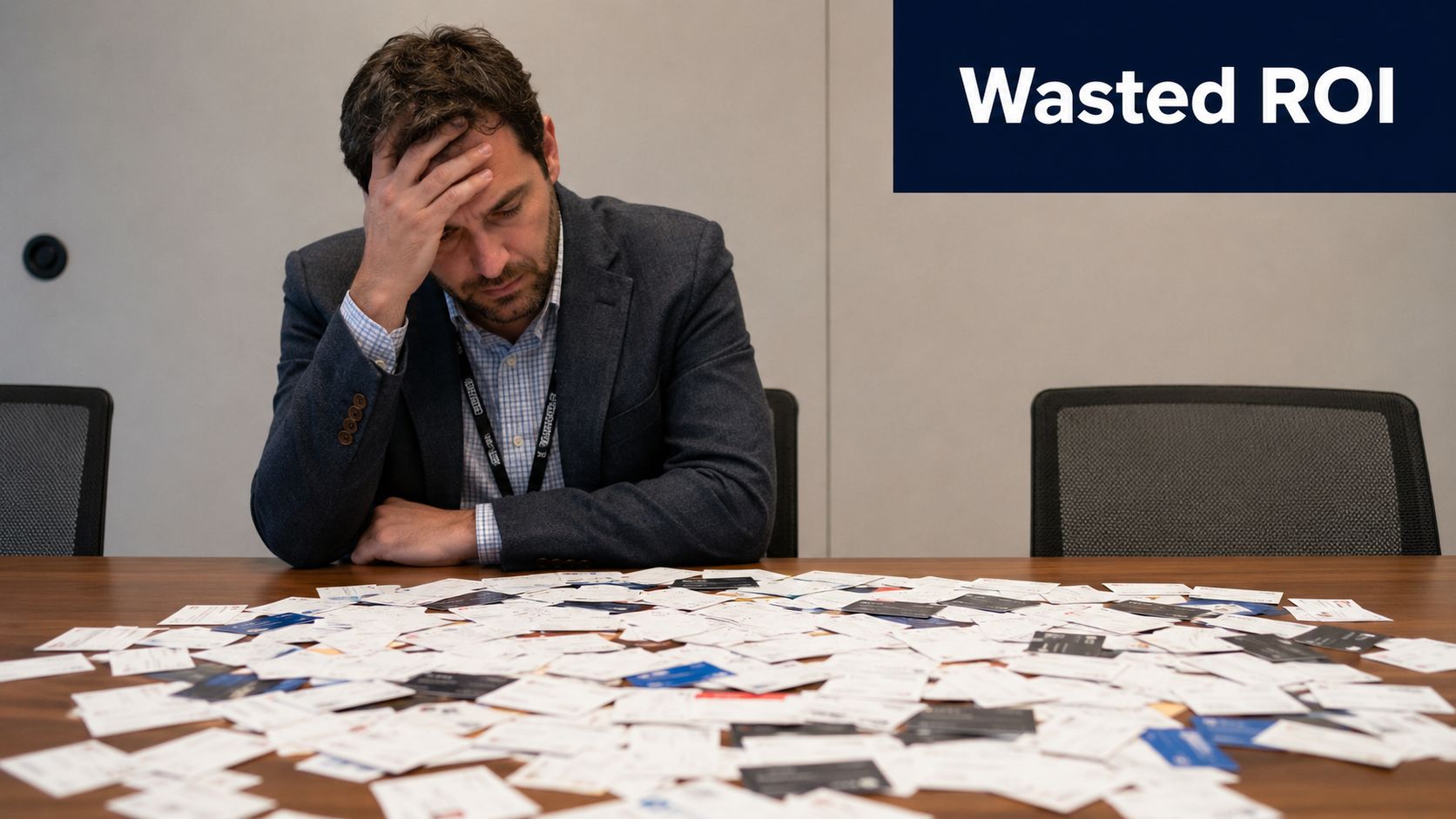
The waste is bigger in 2026 because the market is too large and the calendar is too dense to justify a loose approach. The conference year is anchored by NRF 2026 in New York from January 11 to 13, Shoptalk 2026 in Las Vegas from March 24 to 26, and CommerceNext Growth Show 2026 in New York from June 23 to 24. At the same time, worldwide ecommerce sales have surpassed $6.42 trillion and more than three billion people buy online, which is why these events function as real partnership channels inside a massive market, not side activities for marketers (BigCommerce's 2026 ecommerce conference roundup).
A weak conference trip usually looks like this:
That's why a pile of business cards is usually evidence of bad execution, not good networking.
Practical rule: If you can't name the exact partnership outcomes you want before the flight, you're buying an expensive change of scenery.
Strong operators treat events the way they treat outbound business development. The event is just the venue. The work is account selection, message testing, qualification, and conversion.
That means every trip needs three things locked before departure:
If your team needs better prompts for steering higher-value discussions, these business networking group discussion topics are useful because they force the conversation beyond small talk and into economics, incentives, and fit.
The founders who win at ecommerce events in 2026 won't be the ones who prioritize quantity of connections. They'll be the ones who leave with the most qualified next steps.
At scale, growth rarely comes from doing more of the same. It comes from access. Access to customers, access to channels, access to data, access to better unit economics, or access to infrastructure you don't want to build yourself.
That matters more now because ecommerce isn't an emerging category anymore. It's a mature commercial system with a permanent conference circuit, and the global B2B ecommerce market is expected to surpass $32.11 trillion in 2026 according to Flowlu's 2026 ecommerce statistics roundup. In a market of that size, partnerships stop being “nice to have” and start acting like force multipliers.
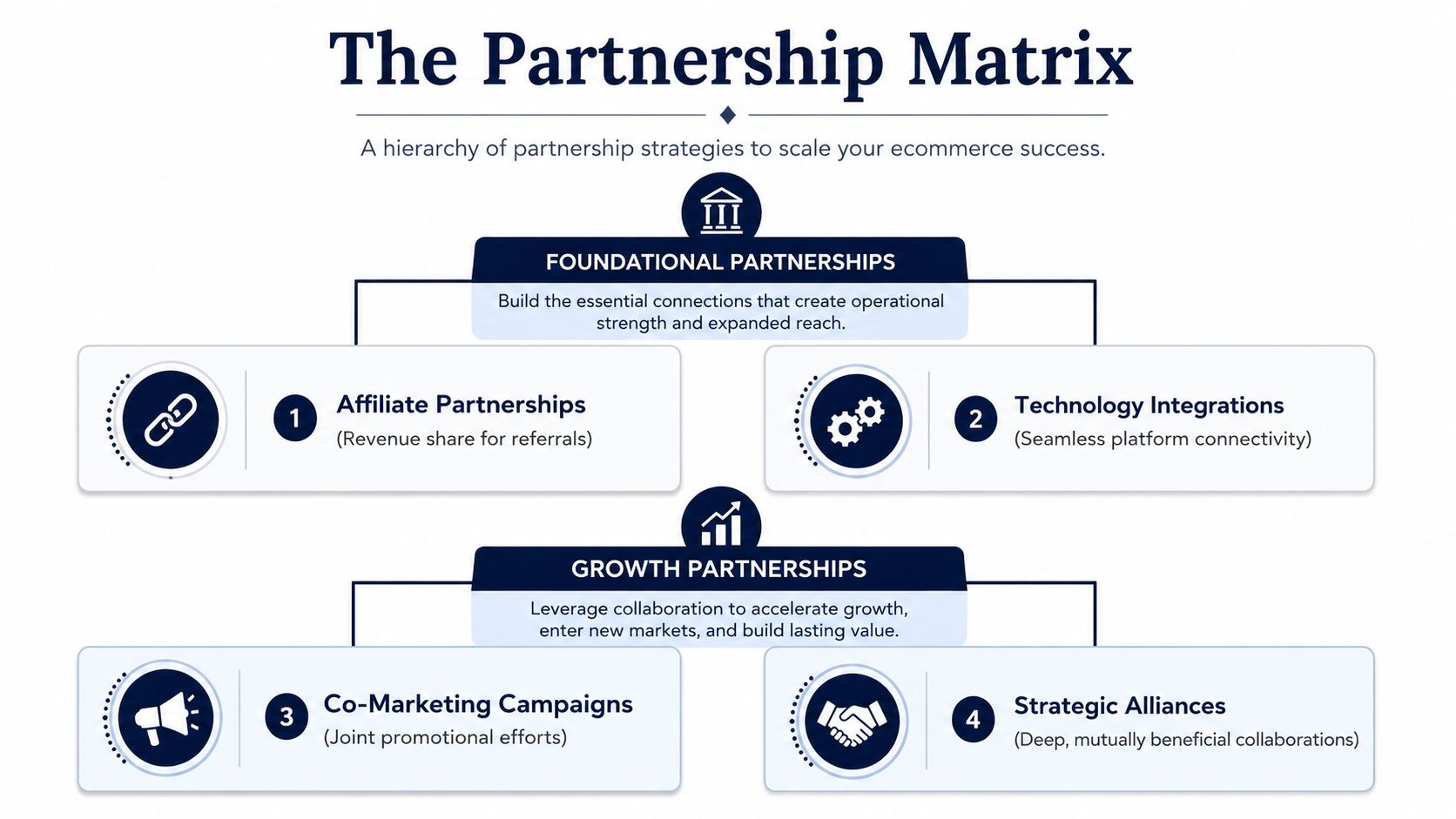
Not every relationship deserves founder time. These do.
Co-marketing partnerships
Two brands or service providers reach the same buyer from different angles and promote together. A practical example is a DTC skincare brand partnering with a beauty device brand on a launch bundle, shared email placement, or joint creator campaign. The point isn't visibility. The point is borrowing trust from an adjacent audience with purchase intent.
Distribution and retail partnerships
Distribution and retail partnerships enable a brand to gain shelf space, marketplace access, wholesale reach, or geographic expansion through another operator. For an Amazon-first seller, this might mean a retail placement conversation. For a DTC brand, it could be a distribution partner with category relationships you don't have.
Tech and platform partnerships
These matter when software directly affects conversion, retention, operations, or reporting. A merchant on Shopify might meet a search, personalization, subscription, or customer support platform and structure a pilot tied to a specific bottleneck. Good platform partnerships don't start with feature tours. They start with one business problem.
The conversations that create the biggest long-term value often aren't flashy.
Strategic partnerships are valuable when both sides bring something the other side would spend real money or real time to build alone.
Walk into any event with one primary partnership category and one secondary category. That's it. If you try to hunt every relationship type in one trip, you'll dilute your meetings and lower your standards.
A simple way to keep your team aligned is to define each target by three questions:
If you need a sharper framework for setting those criteria before outreach starts, this guide to strategic partnership development is a useful reference point.
A key shift is mental. Stop calling everyone a “potential partner.” Many individuals you meet are contacts. A small number are counterparties. Your job is to know the difference quickly.
One reason founders waste event budgets is simple. They pick conferences based on reputation instead of fit.
That's backwards. The right event depends on the partnership you need now, not the one with the loudest brand or biggest afterparty.
The 2026 calendar is clearly segmented. Shoptalk Spring 2026 is positioned as a large-scale strategy event with 10,000+ attendees and 200+ speakers, while CommerceNext Growth Show 2026 has 2,700+ attendees, 150+ speakers, and 60+ sessions with a more execution-oriented focus according to Let's Talk Shop's 2026 conference guide. That split is useful because it lets you match event format to the bottleneck you're trying to solve.
Think of these as market access environments. You go there when you need broad coverage across vendors, retailers, agencies, platforms, and service partners in one trip.
They're useful when:
They're weak when your need is highly technical or highly confidential.
These are where operators speak the same language around one operational domain. Payments, fraud, retention, logistics, subscriptions, and specific marketplace topics fit here.
Use them when:
These are built for trust, not foot traffic. Smaller rooms often produce better partnerships because the social layer is stronger and the attendee quality bar is tighter.
They fit when:
| Partnership Goal | Best Event Type | Example 2026 Event |
|---|---|---|
| Broad platform sourcing | Large-scale expo | Shoptalk Spring 2026 |
| Growth execution partners | Focused execution event | CommerceNext Growth Show 2026 |
| Retail and omnichannel relationship building | Large-scale expo | NRF 2026 |
| Payments or fraud partnerships | Niche vertical conference | ETA Transact 2026 |
| Fraud workflow benchmarking | Niche vertical conference | MRC Vegas 2026 |
| High-trust founder partnerships | Curated mastermind | Private peer event or vetted mastermind gathering |
Start with the bottleneck, not the badge.
If your problem is channel expansion, broad events make sense. If your problem is checkout leakage or fraud friction, broad events create noise. If your problem is strategic alignment with another founder, a massive expo may be the worst environment possible.
Good event selection feels restrictive. If your shortlist includes every major conference, you haven't made a decision.
For most brands, the strongest portfolio is mixed. One broad market event. One specialist event tied to a core operational issue. One smaller room where trust compounds faster than visibility.
That's the practical way to approach ecommerce events in 2026. Not as a bucket list, but as a calendar of different environments, each with a specific job.
Most conference ROI is decided before the badge prints.
Once you accept that, your workflow changes. You stop asking who might be there and start building a target account list the same way a serious partnerships team would build an outbound pipeline.
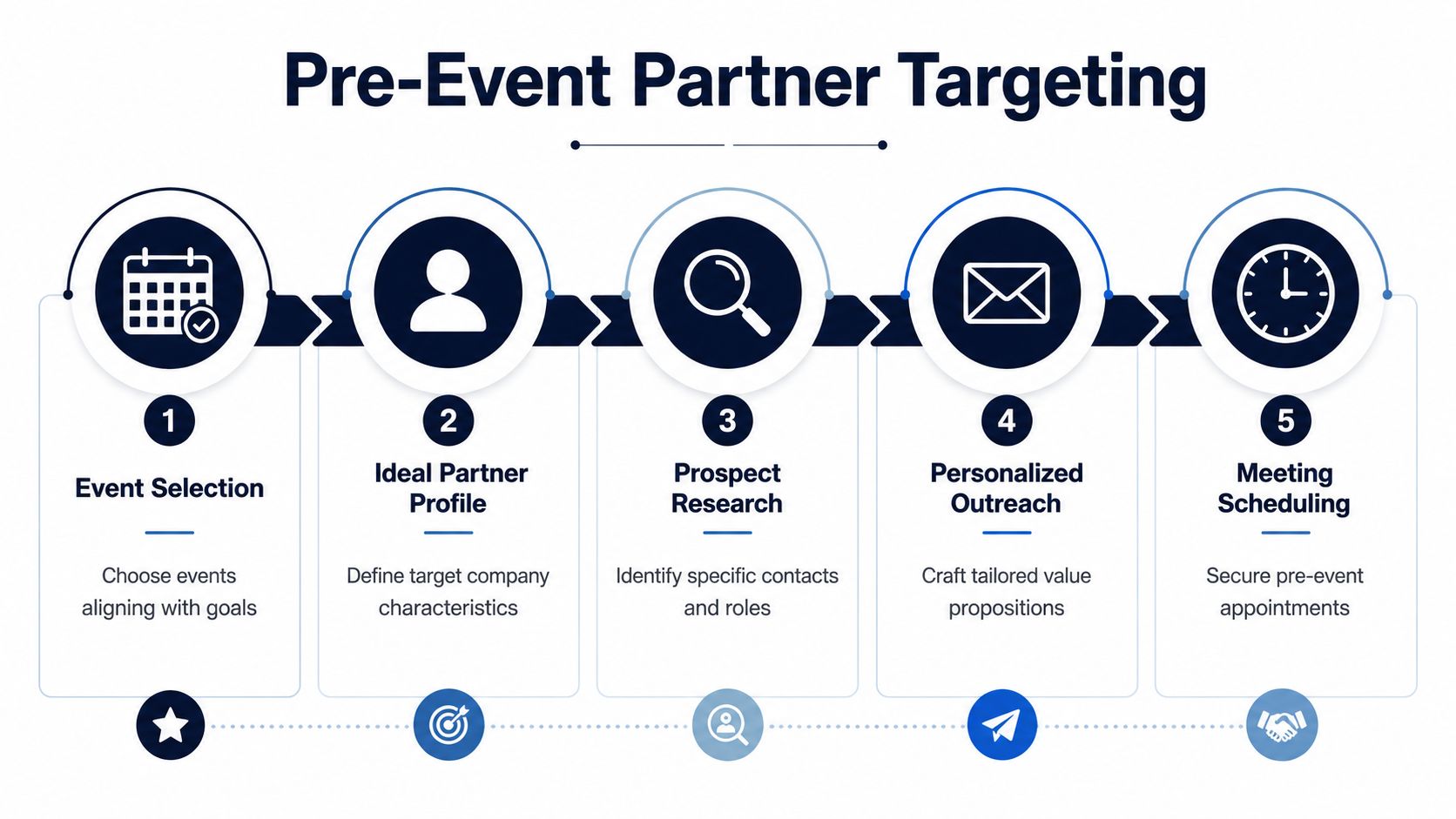
Specialized events make this especially valuable because the attendee base is already filtered. ETA Transact 2026 is listed with 3,000+ attendees and 150+ speakers, while MRC Vegas 2026 focuses on more than 2,000 fraud prevention and payment professionals, which makes those rooms useful for benchmarking workflows like payment orchestration and dispute management against peers operating at scale (Sticky.io's trade show analysis).
Start with the event site and work outward.
Pull the sponsor list
Sponsors tell you who is actively spending to be in the room. That usually means they have budget, sales coverage, and decision-makers on site.
Read speaker bios like a buyer list
Don't focus on fame. Focus on role relevance. The VP who owns retention, partnerships, retail, payments, or technology is often more useful than the keynote name.
Check attendee apps and matchmaking tools
Most founders underuse these because the interfaces are clunky. Ignore the UX. Mine the directory anyway.
Rank companies, then rank people
Company first, contact second. If the account is wrong, the perfect title won't save the meeting.
Your shortlist should be tight. Around a dozen high-probability targets is usually enough to fill the calendar without turning your day into back-to-back low-quality chats.
For each target, document:
If your team uses LinkedIn for this stage, a strong LinkedIn Sales Navigator operator playbook helps narrow by title, company type, and decision-maker relevance instead of blasting generic connection requests.
A short video can also help your team tighten the process before outreach starts:
Pre-event outreach fails when it sounds like event spam. “Would love to connect at the show” is lazy and easy to ignore.
Send a note that proves three things:
Don't ask for coffee. Ask for 15 minutes to discuss one concrete opportunity.
If you need help tightening your target criteria before outreach begins, this guide on how to find a business partner is useful because it pushes you to define fit before contact.
The best event operators don't arrive hoping to meet people. They arrive with half the important meetings already booked.
You walk into a crowded ecommerce event with twelve target accounts on your list, three hours of actual meeting time, and no margin for vague conversations. The operators who leave with revenue-producing partnerships do one thing well. They control the meeting.
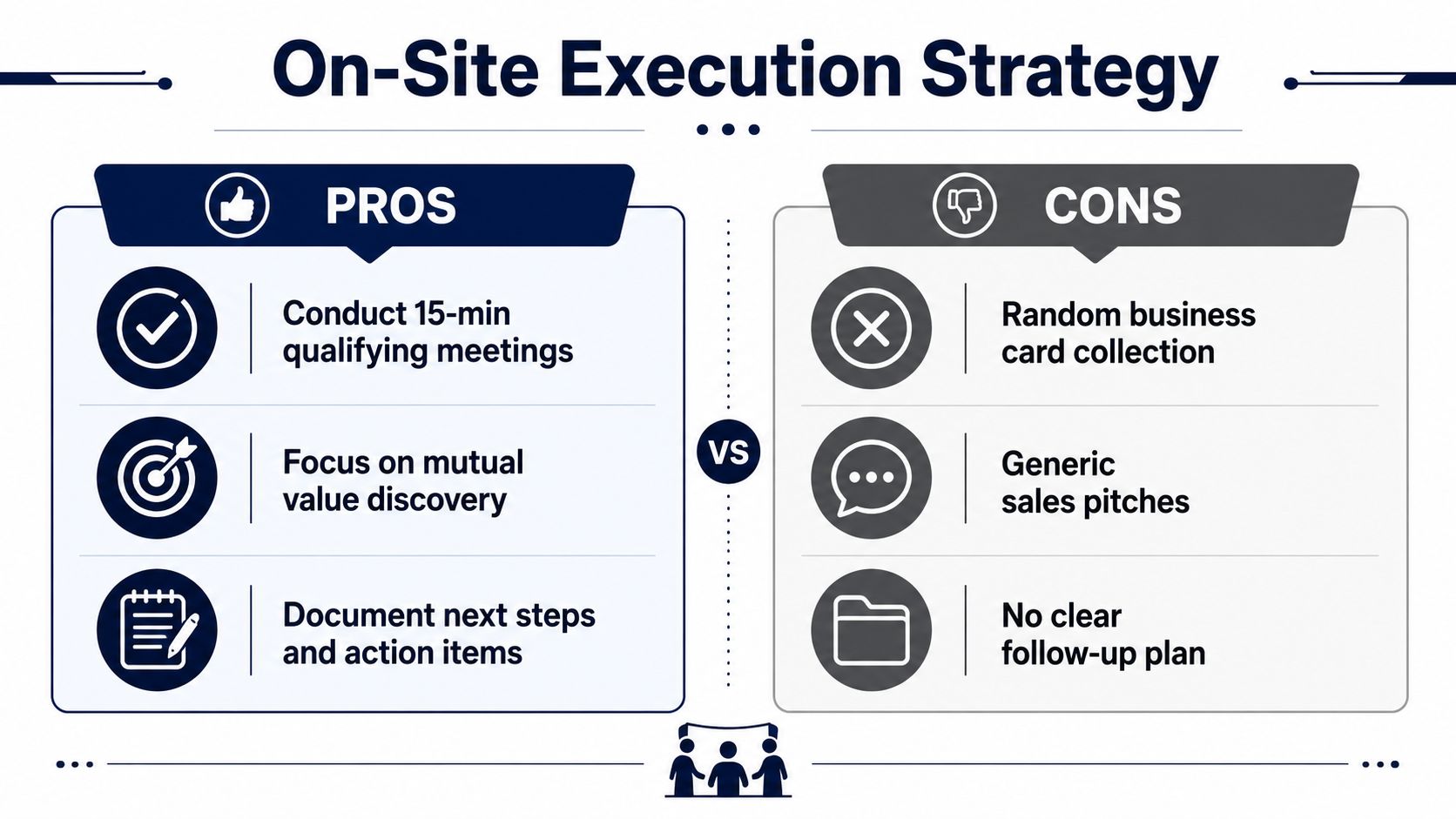
On-site execution is about speed, signal, and next steps. Conference floors reward energy, but partnerships come from clarity. If a conversation does not surface business fit, decision ownership, and a defined follow-up, it was a pleasant chat, not a deal path.
That matters more in 2026 because event formats keep shifting toward workshops, roundtables, and smaller operator rooms. Attendees show up expecting practical conversations around AI, margin pressure, retention, and operational efficiency, not generic brand intros. Envive's review of 2026 programming trends points in the same direction in its analysis of 2026 ecommerce event programming.
Fifteen minutes is enough to know whether a partnership deserves another hour.
Minutes 1 to 3
Set context fast. State your brand, your scale, the channel or capability you care about, and why this meeting made your shortlist.
Minutes 4 to 8
Qualify the business. Ask what they need to get done this year, where current partners fall short, and what would make a new relationship commercially relevant.
Minutes 9 to 12
Pressure-test one opportunity. Keep it narrow. A pilot, a channel test, a bundled offer, a retail introduction, a tech integration. One path.
Minutes 13 to 15
Get commitment. Book the next call, name who needs to join, and define what each side will send before that call.
Founders lose deals here by letting promising conversations end with, "Let's stay in touch." That line kills momentum.
Skip soft openers once the pleasantries are done. Ask the questions that tell you whether this account can move.
Those questions do two jobs at once. They qualify the opportunity and show the other side that you understand how partnerships get approved inside a real business.
Workshops often outperform expo floors for partnership qualification. The value is that operators reveal what they are implementing, not just what they are selling.
A lot of conference ROI is won in the boring parts.
If your team keeps spending on throwaway swag, these actionable tips for event merchandise are a better benchmark than a supplier catalog because they focus on utility and recall.
One tool that fits naturally here for brands that value peer-vetted rooms is Million Dollar Sellers. It runs curated events, masterminds, and private founder discussions, which makes it relevant when the goal is confidential operator-to-operator partnership conversations instead of broad expo networking.
Close every live conversation with a concrete sentence: “Let's get the right people on a 30-minute call next week. We'll review pilot scope, economics, and success criteria.” If they avoid that step, treat it as a weak lead and move on.
A promising conference conversation isn't a partnership. It's a lead.
The actual value shows up when both sides can move from general interest to a simple structure with clear economics, responsibilities, and a test period. If that doesn't happen quickly, the deal usually dies in the follow-up gap.
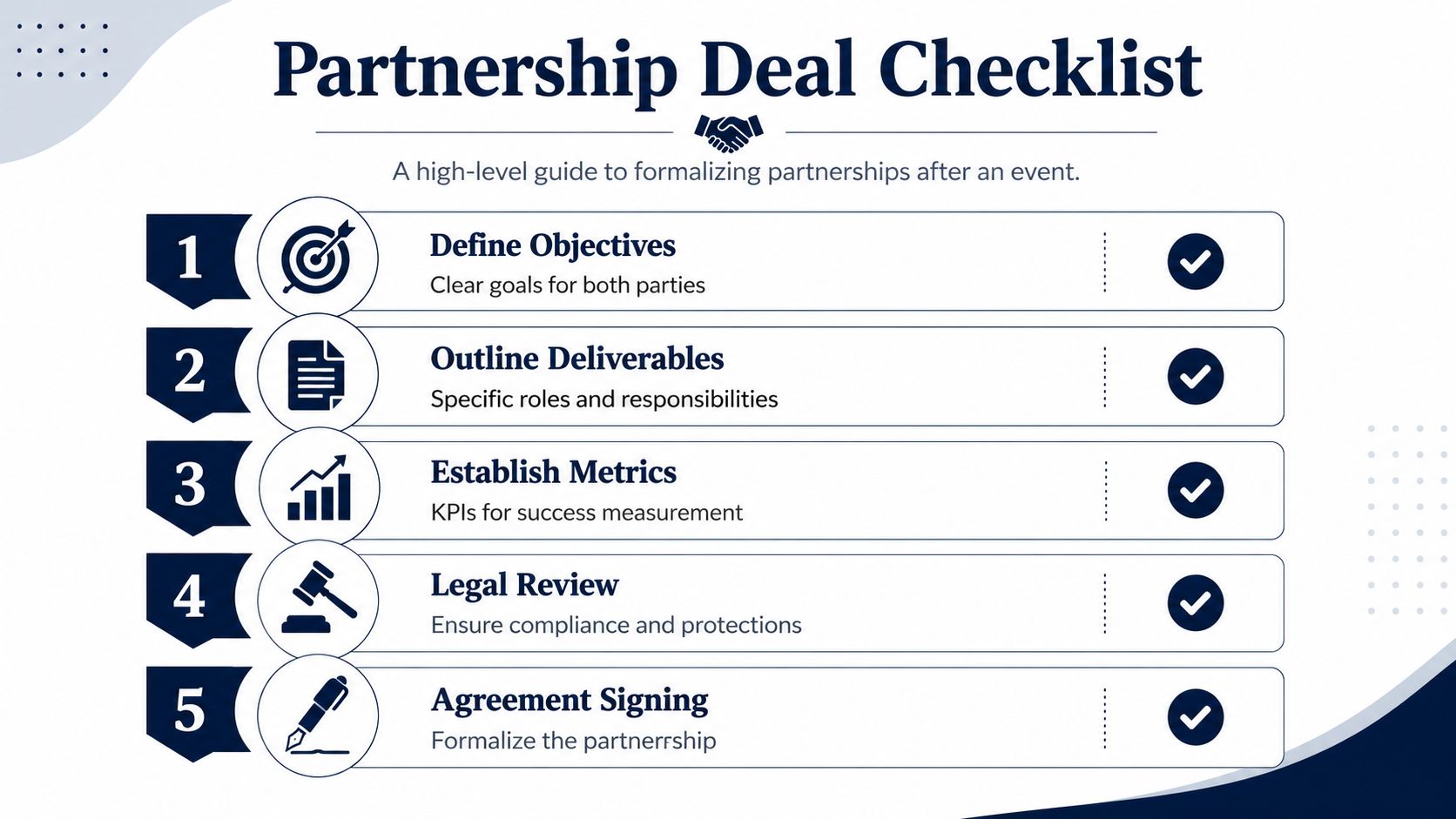
Most ecommerce partnerships fall into a small set of structures:
The mistake is trying to negotiate everything at once. Don't. First agree on the commercial model. Then handle the operating details.
Keep the first document short enough that both sides will review it.
Include:
Objective
What business outcome is this partnership trying to produce?
Scope
Which products, channels, geographies, or audiences are included?
Deliverables
Who does what, by when, and with what approvals?
Economics
Revenue share, fees, budget ownership, payment timing, and any minimum commitments.
Success criteria
What has to happen for the pilot to continue, expand, or stop?
Exit terms
How either side can end the agreement cleanly.
Founders often over-focus on the split and under-focus on execution risk. A worse split with a committed operator is usually better than a flattering split with vague ownership.
Watch for these issues early:
If nobody can explain how the partnership gets implemented in the next few weeks, you don't have a deal. You have enthusiasm.
Legal review matters, but most event-born partnerships fail before legal is the problem. They fail because the structure was soft, the owner was unclear, or the first milestone wasn't concrete enough.
Treat the first deal like a controlled test. Small scope. Clear accountability. Fast feedback.
The smartest way to think about ecommerce events in 2026 is not as isolated trips. It's as a system.
One good partnership should make the next event more valuable. A strong co-marketing partner introduces you to a platform. A platform partner introduces you to a retailer. A retailer relationship gives you credibility in the next room. That's the flywheel.
Measure events the same way. Don't obsess over badge scans or meeting counts. Track the indicators that matter to operators: qualified partner conversations, pilot agreements, active negotiations, channel access gained, and revenue influenced after the event. Some outcomes will be immediate. Others will take quarters. That's normal.
What matters is building a repeatable operating rhythm:
Do that consistently and conferences stop being expensive calendar entries. They become a compounding partnership channel.
If you're an established ecommerce operator who wants higher-trust rooms, sharper peer conversations, and access to other founders who treat partnerships as an execution lever, Million Dollar Sellers is worth a look.
Join the Ecom Entrepreneur Community for Vetted 7-9 Figure Ecommerce Founders
Learn MoreYou may also like:
Learn more about our special events!
Check Events