Chilat Doina
October 18, 2026
Selling everywhere is the laziest advice in ecommerce. It sounds like growth, but usually it's just five dashboards, five fee structures, and one pool of inventory getting promised to everybody at once. A real multi channel ecommerce strategy isn't measured by channel count. It's measured by contribution profit per SKU after you pay for returns, storage, support, fragmented stock, and the ads that supposedly drove the sale.
Open Amazon, launch Shopify, list on Walmart, pitch retail. That's a checklist, not a strategy. You end up with inconsistent pricing, listings nobody owns, and a revenue chart that looks great in a deck while cash gets trapped in the wrong warehouse.
Your customer doesn't think in channels. A 2017 Harvard Business Review study of 46,000 shoppers found that 73% used multiple channels during their shopping journey, shoppers using four or more channels spent 9% more in stores and 10% more online, and they made 23% more repeat shopping trips within six months than single-channel shoppers. Breadth pays, but only when the journey feels coordinated.
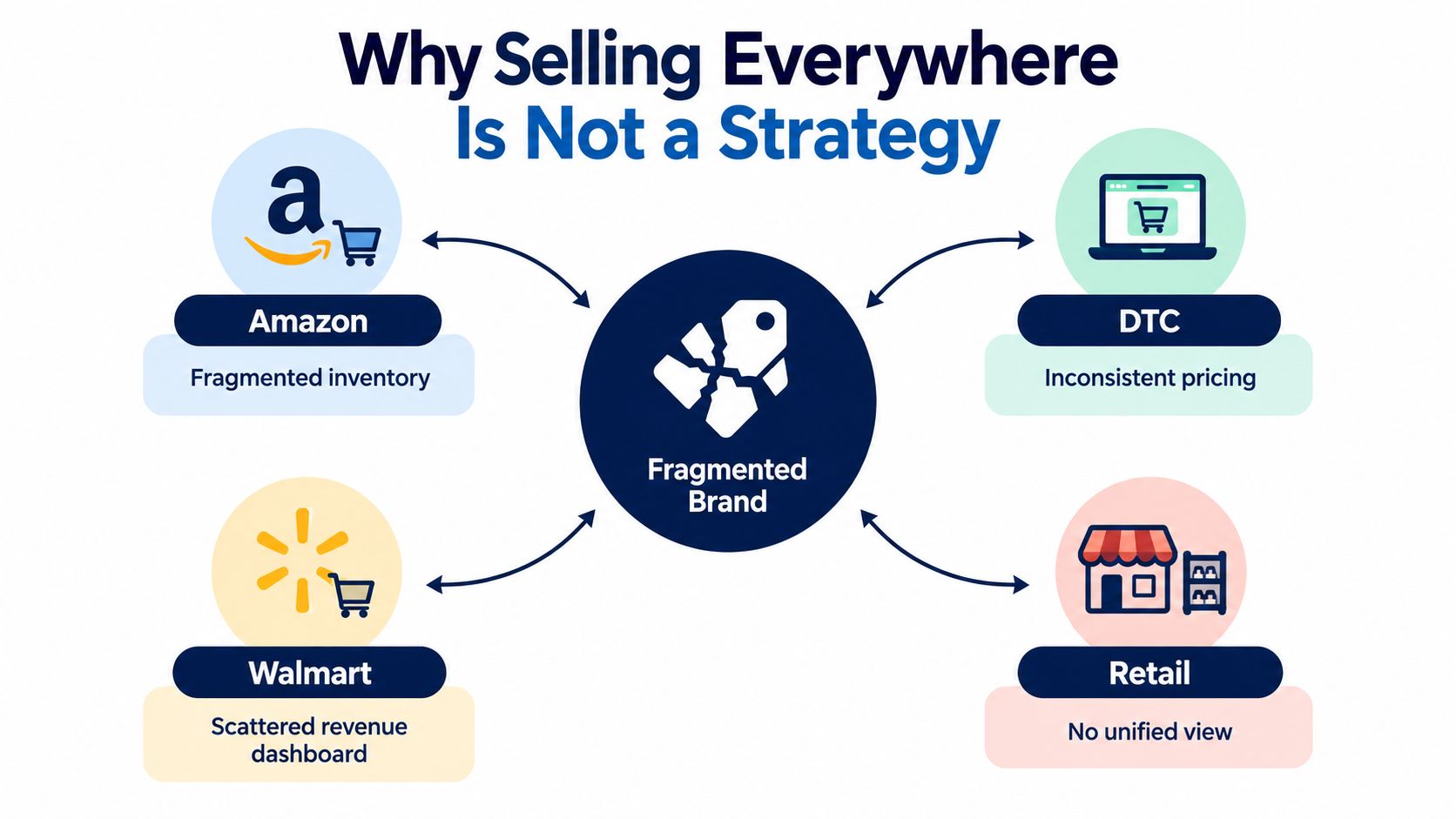
A serious multi channel ecommerce strategy assigns each channel a job. Amazon captures existing search demand. DTC builds margin, bundles, and a customer list you own. Retail creates discovery and trust. Social creates demand you later harvest somewhere else.
If you can't state the job in one sentence, don't launch the channel. You're not building distribution. You're building operational debt.
Practical rule: Every new channel must earn its inventory. If it can't beat the contribution profit of putting that same unit into your best channel, it doesn't get the unit.
Founders scaling past their first marketplace often benefit from a structured guide for enterprise digital teams on how the underlying commerce architecture should connect. Read it as an operations document, not a marketing one. Channel expansion is a margin and operations decision first, and a growth decision second.
The wrong channel doesn't fail fast. It fails slowly, by absorbing your best inventory, your ad budget, and your ops manager's calendar for two years. That's why channel selection deserves more rigor than channel launch.
Score every candidate on contribution margin after fees, customer acquisition cost, lifetime value fit, operational complexity, and strategic optionality. Revenue doesn't make the list. Revenue is what marketplaces report to keep you spending.
Build the math at SKU level. Start with price, then subtract marketplace fees, payment processing, fulfillment, storage, returns, discounts, chargebacks, support, and the cost of splitting stock across locations. The channel with the highest conversion rate often loses once you do this.
Channel Scoring Matrix for Multi Channel Ecommerce
| Channel | Avg Fee Load | Return Rate Sensitivity | Acquisition Cost | Strategic Role |
|---|---|---|---|---|
| Amazon | High | High in fit-sensitive categories | Built into fees and ads | Capture existing demand |
| DTC site | Low to medium | Medium, you control policy | High, you buy every visit | Margin, bundles, retention |
| Walmart Marketplace | Medium | Medium | Lower competition than Amazon | Incremental marketplace reach |
| TikTok Shop | Medium plus creator cost | High for impulse buys | Creative dependent | Discovery and demand creation |
| Wholesale and retail | Margin given to partner | Lower per order, higher per dispute | Relationship and terms driven | Trust, trial, local discovery |
Use the matrix with your own fee statements, not a vendor's estimates. Pull a full quarter of settlements and cost every line. Most founders find at least one beloved channel is break-even at best.
A marketplace listing creates discovery, then the buyer purchases on your DTC site or in a store. Last-click reporting credits the wrong place and starves the channel that created the demand. One 2025 survey on marketplace shopping behavior found shoppers visit an average of two to three marketplaces before buying and 63% prefer completing purchases on marketplaces, which means last-click revenue systematically misreports where demand is created.
So don't kill a channel purely on attributed ROAS, and don't scale one purely on it either. Test it. Pause, geo-split, or stagger launches and watch total contribution across channels. The question isn't which channel sells the most. It's which channel creates the highest incremental, risk-adjusted contribution profit when inventory is constrained.
Most brands don't die from picking a bad channel. They die from picking a good channel at the wrong time. Retail exposes weak packaging. Wholesale exposes weak cash flow. A second marketplace exposes weak inventory discipline.
Sequence by readiness, not by opportunity. A buyer from a big retailer saying yes is not a readiness signal. It's a purchase order with chargebacks attached.
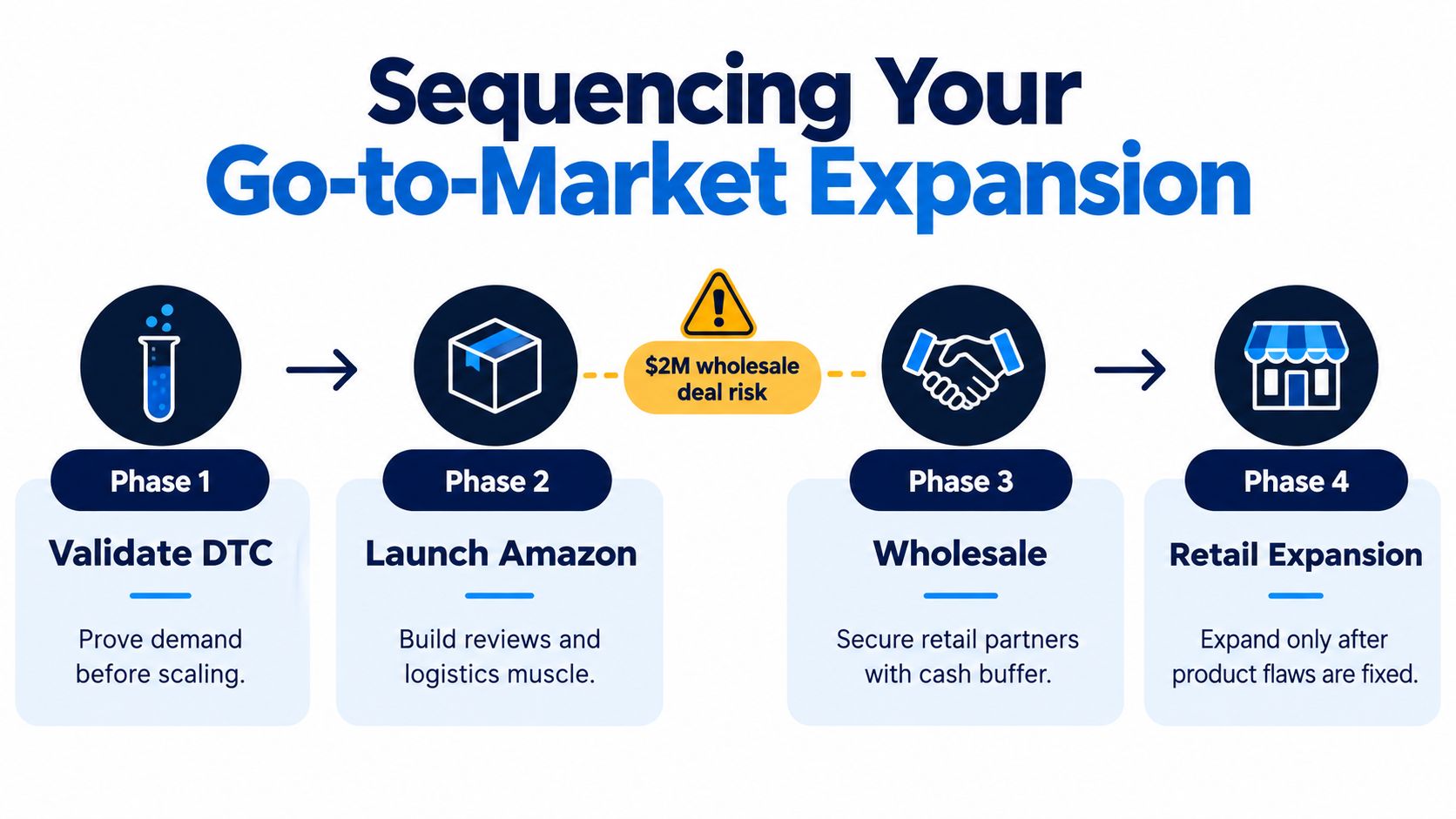
Some brands start DTC first, others Amazon first. Either works. What doesn't work is launching three channels in one quarter with one ops hire and no cash buffer.
Check three things before moving. Cash, can you fund inventory for the new channel without starving the current one? Awareness, does anyone search for you by name yet? Operations, can you hit the new channel's shipping and content standards on your worst week, not your best?
Plan against how people shop. McKinsey's consumer research across 18 countries reports 80% of consumers shopped online in the prior month, while the majority of shopping remains omnichannel. Your forecast should assume buyers move between online and physical environments from day one.
Early failure signals show up before the P&L does. Rising cancellations, slipping review ratings, and support tickets about price mismatches mean you're expanding faster than your systems. Slow down. A delayed launch costs weeks. A botched retail launch costs the relationship.
Overselling on Walmart while units sit in a DTC warehouse isn't a sync problem. It's a control problem. A plug-in that pushes quantities between marketplaces doesn't know about your open wholesale order, your bundle commitments, or the pallet stuck in inspection.
Treat inventory as a ledger, not a feed. Every SKU, location, and condition gets one record, and every channel publishes from it.
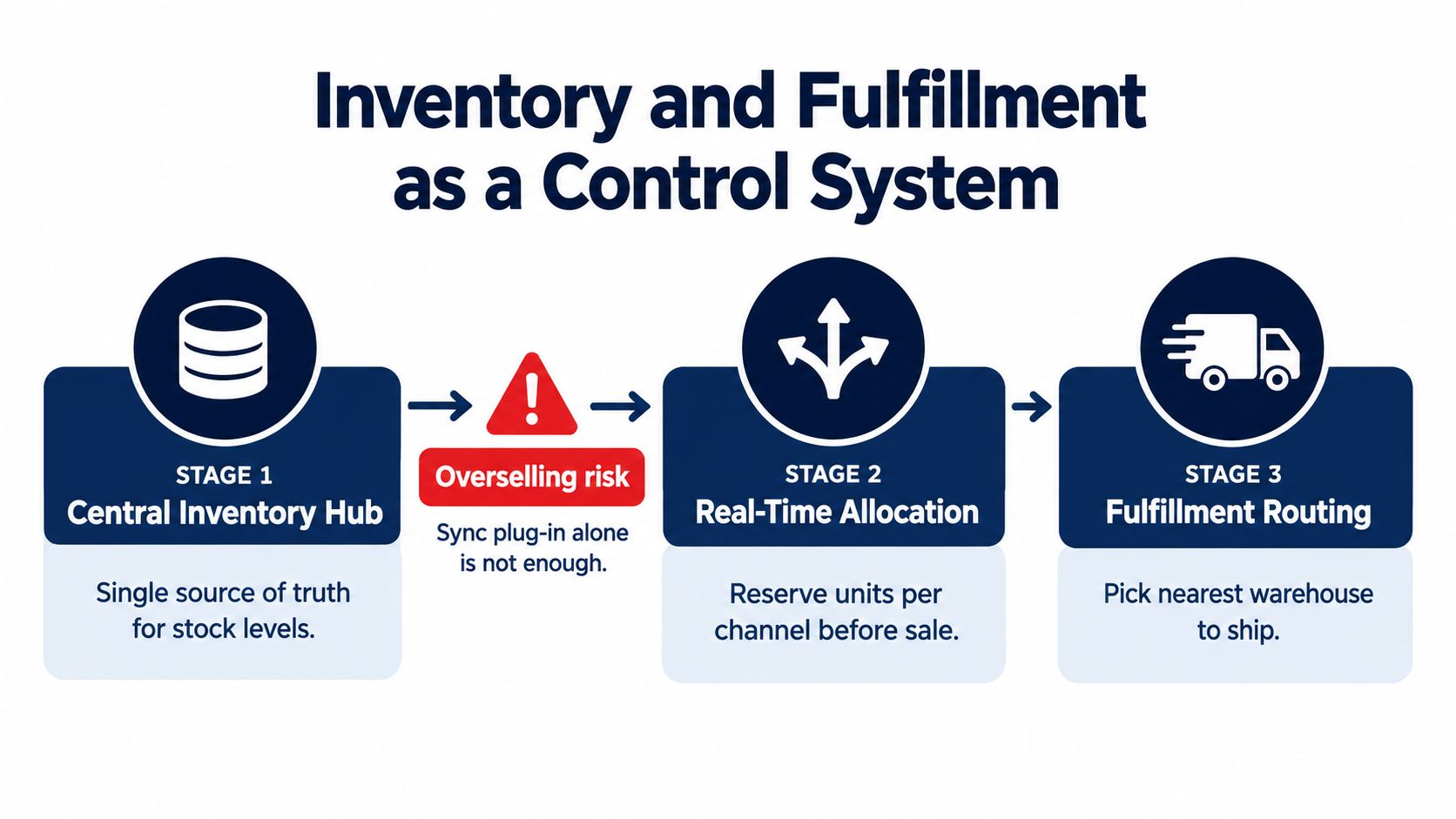
Sellable stock equals physical on-hand minus open reservations, damaged or inspection units, transfer-locked units, bundle-component commitments, safety buffers, and channel-specific caps. Anything else is a promise you may not keep. That math has to run per SKU and per channel, because Amazon, your site, and a wholesale account will happily sell the same unit three times.
Roll it out in order. Build one inventory ledger, map every reservation, return, bundle, and transfer event, then publish available-to-promise quantities per channel. Reconcile against cycle counts and alert on variance before you approve promotions or reorders. Teams working through this build can learn a lot from a practical walkthrough on how to sync stock across sales channels without letting each marketplace become its own source of truth.
The CAPS Research benchmark on inventory accuracy puts average inventory-record accuracy at roughly 83% versus about 95% for world-class operations, an apparent 17% record discrepancy that drives overselling, cancellations, emergency transfers, and distorted reorder points. That gap is not an accounting detail. It's cancelled orders during your biggest promo week.
If your team can't trust the count, they'll hoard safety stock in every channel, and your cash conversion cycle will quietly fall apart.
Track inventory-record accuracy, oversell rate, stockout rate, cancellation rate, and available-to-promise variance separately by channel. Aggregate numbers hide the channel that's bleeding. Our deeper breakdown of multi-channel inventory management systems and workflows covers how to structure the ledger before you buy more software.
Your stack doesn't fail because you picked the wrong logo. It fails because Shopify, Amazon, your 3PL, and your ERP each keep a slightly different version of the same product and customer. Integrations then faithfully sync bad data at high speed.
Fix the data model first. Software second.

The payoff is visible on the shop floor. Google's 2024 Omnichannel Index of 368 retailers found 84% of omnichannel retailers gave store assistants access to stock data from other stores and online, with one cited retailer generating 9% of total store revenue from clienteling within six months of launch. That only works when staff trust the inventory and customer data in front of them.
Buy commodity plumbing like channel listing, order routing, and standard ERP connectors. Delay anything that needs six months of implementation before it touches an order. Build only the thin layer that is specific to your business, usually allocation rules, bundle logic, or reporting.
Before signing, demand a data contract from every vendor. Which fields do they own, which do they overwrite, how do they handle deletions and returns, and how do you export everything when you leave? Listing tools overwriting each other is the most common integration failure we see, and it's preventable in the contract. Our notes on ecommerce platform integration architecture go deeper on sequencing these decisions without locking yourself into the wrong core system.
Identical pricing and creative everywhere is not consistency. It's laziness that leaves money on every shelf. Consistency means one brand, one customer view, and one set of service rules, with offers deliberately differentiated by channel role.
Amazon wins the comparison shopper. DTC wins the bundle, the subscription, and the repeat buyer. Retail wins trial. Price and assortment should reflect those jobs instead of flattening them.
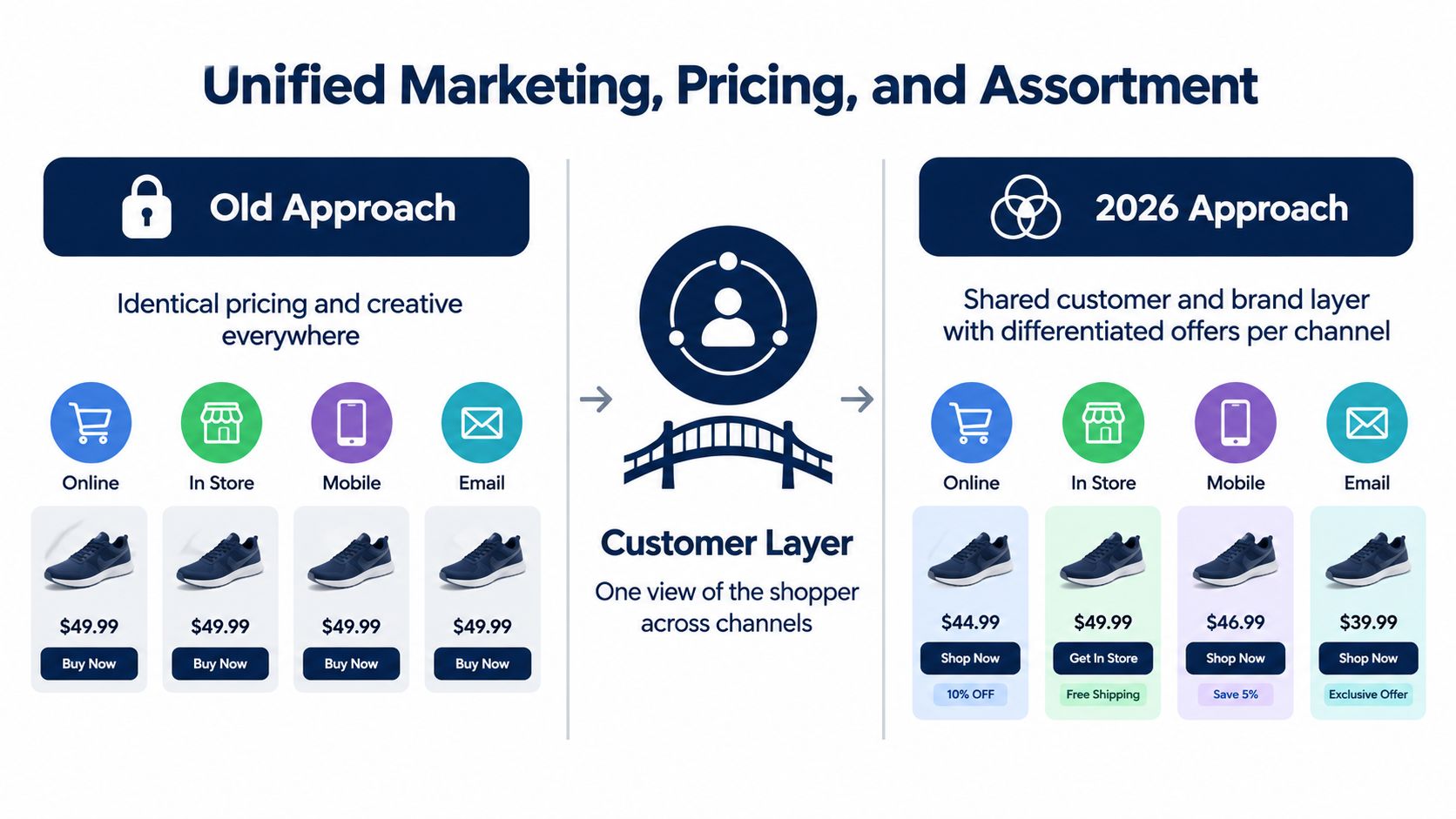
Give DTC the exclusive bundles, refills, and higher-margin configurations marketplaces can't easily replicate. Give marketplaces the hero SKU at a defensible price that protects your MAP policy. Give retail the assortment that turns fast on a shelf, not your full catalog.
Watch the cannibalization line carefully. A marketplace discount that undercuts DTC trains your best customers to stop buying where your margin lives. Coordinate promo calendars across channels in one document owned by one person, and read a solid multichannel campaign management guide before your next big push if campaign ownership is currently split across three teams.
Discovery and checkout now happen on a phone, in a feed, between other things. Data on global retail and mobile commerce trends shows mobile commerce represented 65.7% of global ecommerce retail sales in 2022 and 64% of internet users reportedly discovered brands through social media. Creative must land in seconds, product pages must load fast, and checkout must work one-handed.
That changes attribution too. A TikTok view drives an Amazon search, which drives a DTC visit, which ends in a store purchase. Last-click calls that a store sale and kills the TikTok budget.
Run holdouts and geo-lifts. Pause a campaign in matched regions, stagger a channel launch, or compare pre and post windows with a control group. Watch total contribution profit across all channels, not just the platform's reported conversions.
It's slower than reading a dashboard. It's also the only way to separate halo from cannibalization before you scale the wrong thing.
If your weekly meeting opens with revenue by channel, you're steering by the most misleading number in the building. Revenue doesn't know about returns that land next month, storage bills, or the inventory you fragmented to chase it. Replace it with contribution margin per channel and watch how fast the conversation changes.
You don't need forty metrics. You need a short list, reviewed on a rhythm, with one owner who is accountable for the total rather than for a single storefront.
KPI Reference Bands for Multi Channel Brands
| KPI | 7-Figure Target | 8-Figure Target | Why It Matters |
|---|---|---|---|
| Contribution margin by channel | Positive on core SKUs | Positive across the catalog | Stops scaling unprofitable revenue |
| Inventory accuracy | Cycle counts on top SKUs | Systematic counts everywhere | Prevents overselling and cancellations |
| Oversell and stockout rate | Tracked weekly by channel | Alerted daily with owners | Protects marketplace account health |
| Repeat purchase by source | Measured by first channel | Modeled into media budgets | Shows which acquisition is worth funding |
| Fulfillment cost per order | Reviewed monthly | Reviewed weekly by node | Catches margin leaks early |
| Incrementality testing | One test per quarter | Rolling test calendar | Separates halo from cannibalization |
Use directional bands, not borrowed benchmarks. Your category, return profile, and price point set what's realistic. Trend and variance matter more than hitting someone else's number. Our guide to analytics for ecommerce decision making shows how to build this scorecard without hiring a data team first.
Keep the agenda fixed. Start with inventory risk, stockouts, oversells, and units trapped in the wrong node. Move to contribution by channel, then to one incrementality result or test in flight. End with decisions, inventory reallocations, budget shifts, and promo changes, each with a name and a date.
Daily checks cover inventory exceptions. Weekly reviews cover the scorecard. Monthly reviews cover incrementality and channel economics. Quarterly, reassign channel roles entirely, because the channel that was your acquisition engine last year may now be your margin leak.
Operating principle: One channel-agnostic P&L owner beats five channel managers defending five budgets. Somebody has to be rewarded for total profit, or nobody will protect it.
Start with inventory and data integrity, because every later decision depends on counts you can trust. Then build SKU-level contribution reporting, even if the first version lives in a spreadsheet your finance lead updates weekly. Only then change channel sequencing, pricing roles, or tech, because now you can tell whether the change made money.
Staff for it. Once you run DTC plus two marketplaces, inventory operations is a real role, not a side task for whoever answers tickets slowest. Marketing, finance, and support need the same scorecard, or each team will optimize its own metric at the expense of the others.
Watch for the classic derailments. An Amazon stockout during a DTC push, a rogue reseller breaking MAP, an OMS rollout that breaks attribution, a wholesale deal that grows revenue while tanking margin, and a retail pilot eating cash with no reorder path. Every one of these is visible in the weekly review weeks before it hits the bank account.
This week, do three things. Pull true contribution margin for your top SKUs on every channel. Freeze new channel launches until that math exists. Then assign one owner for total cross-channel profit and put the thirty minute review on the calendar. That's how a multi channel ecommerce strategy starts scaling instead of sprawling.
If you're making these channel, inventory, and margin calls alone, you're paying tuition other founders already paid. Million Dollar Sellers is an invite-only community of 7, 8, and 9-figure operators sharing real P&Ls, vetted partners, and what works across Amazon, DTC, and retail. Apply to join and bring your hardest multichannel decision to people who've already survived it.
Join the Ecom Entrepreneur Community for Vetted 7-9 Figure Ecommerce Founders
Learn MoreYou may also like:
Learn more about our special events!
Check Events