Chilat Doina
November 29, 2026
Your store price and your marketplace price don't match. A shopper noticed, and now you're on a support call explaining why the jacket she reserved online costs $14 more in the store she's standing in. That gap isn't a pricing problem. It's a framework problem.
Most brands hit this moment after they've added channels faster than they've added rules. They open a TikTok Shop, list on a second marketplace, launch a retail partnership, and each new door brings revenue and a fresh set of contradictions. The omnichannel strategy framework is the set of decisions that stops those contradictions before a customer finds them.
Here's the uncomfortable part: adding a channel is easy, and it feels like progress. Coordinating one takes real design work. The brands that get this right don't have more channels than you. They have clearer rules about how those channels share customer identity, stock, prices, service and credit for the sale.
Over the next few sections you'll get the components of the framework, a walk through a real shopper path and the handoffs where it breaks, and a way to judge each channel not by the revenue it reports but by the profit its journeys earn.
A shopper sees a jacket in a social feed. She taps through to your site to check whether her size is in stock. She has a question about the lining, so she messages you on the marketplace listing where she first found the brand. Then she drives to the store to try it on and collect it, and the tag on the rail reads a different price than the site did.
Nothing in that story is unusual. What's unusual is a brand that handles all four touchpoints without the customer repeating herself.
Multichannel is a row of shops that never share a notebook. Each one keeps its own customer list, its own price sheet, its own stock count, and its own idea of what happened. Omnichannel is one conversation that continues whether the customer is on a phone, in a store or on a marketplace. The product doesn't change. The notebook does.
That distinction is the whole framework in miniature. Your omnichannel strategy framework is the written set of rules deciding how channels share five things: customer identity, inventory, pricing, service and measurement. Every rule you write belongs to one of those five, and every gap between them is a place a customer gets dropped.
The common mistake is sequence. Brands add the channel first and define the handoffs later, usually after the complaints arrive. That order guarantees two outcomes. Customers repeat themselves to whoever answers next, and your team can't tell which channel earned a sale because three of them touched it.
The sequencing rule: no channel goes live until you can name what job it does, who owns it at each stage of the journey, and how it reports the profit it generates.
The rest of this guide answers three questions in order. What are the components of a working framework? How do shoppers move between channels, and where do handoffs break? And how do you judge each channel by the profit of the journey rather than the revenue of the sale?
Think of the framework as six layers stacked on each other. Each layer answers a different question, and each has a person who owns it. When a customer experience fails, the failure traces back to one of these layers, and knowing which one saves you from rewriting everything.
| Component | Core question it answers | Usual owner |
|---|---|---|
| Customer journey map | Where do shoppers discover, buy, receive and return? | Marketing lead |
| Channel roles | What job does each channel do at each stage? | Channel managers |
| Unified customer data | Can a shopper be recognized across touchpoints? | Data or CRM team |
| Inventory and fulfillment | Which node ships each order, and from what stock? | Operations lead |
| Experience standards | Do pricing, promotions and service match on every channel? | Customer experience team |
| Measurement | Which channel earned the profit, not just the sale? | Finance and marketing |
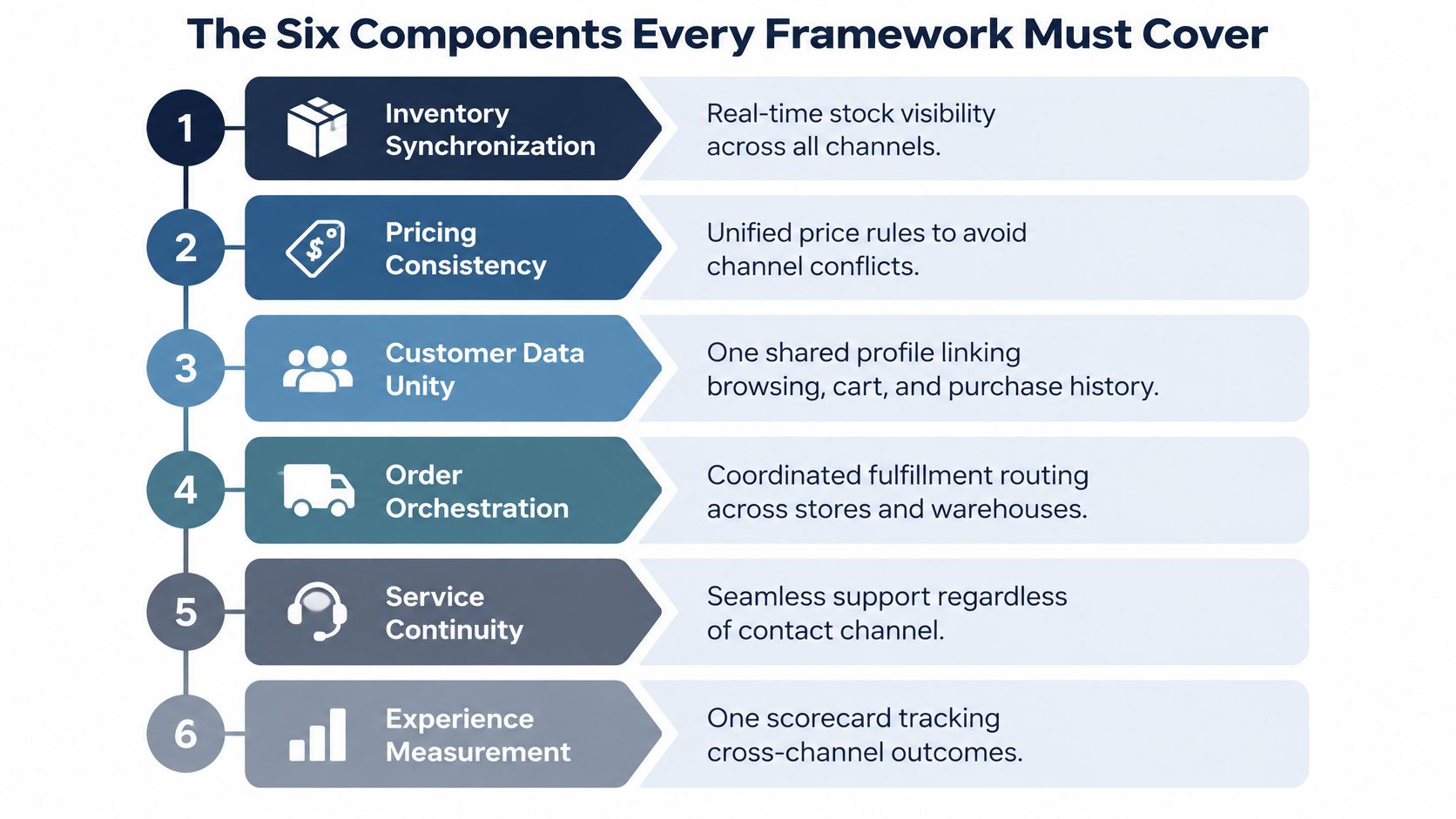
The journey map sits at the base because everything else is defined against it. You can't assign channel roles until you know the stages, and you can't decide what data to unify until you know where recognition needs to happen.
Above the journey sit channel roles and customer data, which work as a pair. A channel role tells you what a channel is for. Unified data tells you whether the channel can see who it's serving. Give a marketplace a role in discovery but no access to customer identity, and you've designed a blind spot.
Fulfillment and experience standards come next. These are where customers feel the framework, because a promise about delivery or price is the visible edge of a set of internal rules. Measurement sits on top and checks the whole stack, which is why it's last and why it's the layer most brands skip.
Pick one journey, say a return, and walk it through all six rows. Can you name the owner for each? Is there a written rule, or does it live in someone's head?
If two rows have no named owner, you don't have a framework yet. You have a set of channels and a team improvising between them. That's worth knowing before your next channel launch, not after.

A kitchen appliance, four channels, one shopper. Follow the purchase from start to finish, because the abstract version of this hides all the interesting parts.
Step one, the ad click. A shopper searching for a stand mixer taps a paid search result and lands on your product page. She sees a price and a stock status. Both are promises, and she'll hold you to them later.
Step two, the marketplace. Before buying, she looks up the same model on a marketplace to read reviews. The listing shows a price. If that number doesn't match the site she just left, she now has a reason to keep shopping, and you've funded a competitor's sale with your own ad spend.
Step three, the store. She visits a retailer to handle the machine, check the weight, and ask about delivery. The store assistant pulls up availability. If the assistant can't see the online bundle she was offered, the visit ends with a shrug.
Step four, the purchase. She buys on your website, because the site offers a bundle with the attachment set. The bundle won because the site recognized her, remembered her research, and made the next step obvious.
Notice what just happened to your margin. You paid for the click, paid the marketplace in comparison traffic, paid for the store visit in staff time, and collected revenue on exactly one of those four touchpoints. The journey made the profit, or lost it. No single channel did either.
That crossing behavior is how most buyers shop. A study of roughly 43,000 shoppers at one multichannel retailer found that 73% were omnichannel customers who used multiple channels before completing a purchase. Only 7% used online channels exclusively, and 20% relied exclusively on physical stores.
Read those three numbers together and the design implication is hard to miss. Most of your buyers cross channel boundaries mid-journey, and every crossing is a place where price, stock, promise or identity can break. Each break costs margin twice: once in the sale you lose, and once in the acquisition spend you already burned getting her that far.
Where the money leaks: each handoff is a small test of your framework. Most brands pass the first one and fail the third, because the store system and the website system were bought by different people in different years.
Price parity. Is the number identical on the ad landing page, the marketplace listing, the store tag and the checkout? A deliberate channel-specific promotion is fine. An accidental gap is not, because it teaches the shopper that your prices are negotiable if she just keeps looking.
Shared stock visibility. Can the store see what the website can promise, and can the website see what's on the store floor? If either answer is no, you'll take orders you can't fill or turn away stock you have. Both outcomes hit the same line item: you paid to acquire a customer and then refused her money.
Continuity of history. When a shopper asks a question or starts a return, does the person answering see what she already bought and where? How channels share one customer record determines whether she gets a short answer or has to re-explain herself from the beginning. Re-explanation is friction, and friction at the service stage is what turns a profitable repeat buyer into a one-time transaction.
Working through real omnichannel examples from brands that run these handoffs well makes the checks concrete, because you can see which rule each brand chose to enforce first and what it cost them to get there.
One thing worth sitting with before moving on. None of the steps above is about which channel closed the sale. The shopper used four, the profit lives in the whole path, and the question of who gets credit is a measurement problem that deserves its own treatment.
A relay race is the right picture for this. The baton has to keep moving, and a clean handoff matters more than any single runner's speed. Two different handoffs happen in a relay, and the same is true in your framework.
Vertical integration links channels across sequential journey stages: discovery, purchase, delivery, returns and after-sales. The handoff from discovery to purchase is a vertical link. So is the one from purchase to delivery.
Research on omnichannel integration across the customer journey describes exactly this structure, treating the journey as a sequence and asking how channels connect across it. When a vertical link fails, the customer notices immediately. She's told the item ships in two days, then gets a message saying five.
Vertical breaks are expensive in a way revenue reports hide. A shopper who abandons at the delivery promise stage was already paid for twice: once in ad spend to reach her, once in margin you never collect. Each vertical handoff is therefore a margin checkpoint, not just a customer-experience nicety.
Horizontal integration aligns channels that operate in the same stage. Your Amazon listing, your direct-to-consumer product page and a marketplace's fulfillment promise all describe the same product to the same shopper at roughly the same moment. If the title, image, dimensions and warranty differ between them, the shopper has to decide which version to believe, and hesitation at the decision point costs you conversion you already paid to earn.
The same research sets out stage-level measures that expose horizontal breaks: assisted conversion rate, cross-channel customer identification rate, channel-switch completion rate, return resolution time and repeat-purchase rate. Pick two of those and you'll know within a quarter whether your channels are aligned or merely coexisting.

For each journey stage, name three things. The primary channel does the work. The supporting channel backs it up. The rule moves the customer between them.
Example for discovery: paid search is primary, the marketplace listing supports, and the rule is that both show the same title, hero image and price on the same day.
The value of writing it down is that disagreements get settled once instead of every week. When a channel manager wants to run a different price, the rule already answers.
Integration sits on a continuum, and where a brand belongs on it depends on its customers, its categories and its economics. The point of a continuum is that your position is a choice, not a finish line.
Two considerations decide it. Does the integration reduce customer friction, or does it only add systems complexity? And does it improve completion, retention or service economics? Both questions are really one question viewed from two angles: does this link raise the profit of the journey it belongs to, measured end to end, after the cost of building and running the connection?
Keep an integration when it does. Isolate a channel when shared processes create conflicts in pricing, attribution or inventory ownership, such as a clearance marketplace that would undercut your own site's margins. Isolating a channel deliberately is a strategy. Isolating it because nobody wrote the rule is an accident. When you're working out how to credit the channels that touch a sale, Chartsy on multi touch attribution is worth reading before you pick a method.
Every channel you add makes your product easier to reach and your warehouse harder to run. That trade-off is measurable, and it doesn't resolve itself.
A multi-year study of a major global grocery retailer found that increasing omnichannel activity was significantly associated with lower cases picked per labor hour (β = −52.89, p < 0.001), which the researchers characterize as evidence that omnichannel activity can reduce fulfillment productivity. Read that plainly: the same team, in the same building, picked fewer cases per hour as channel activity rose. Revenue grew and labor efficiency fell.
That's not a reason to avoid channels. It's a reason to redesign inventory, allocation and replenishment before you add the next one.
Four mechanisms do most of the work.
Channel-level safety stocks. Without them, your fastest-growing marketplace drains the inventory your own site promised, and your best customers see out-of-stock on the channel you control.
Real-time available-to-promise quantities. Every channel should see the same true number, updated as orders land, not a nightly snapshot. Stale numbers are how you sell the same unit three times.
Order-routing rules. Decide which node fulfills which order before the order arrives: nearest node, cheapest node, or the node with the stock. Write the tiebreaker too.
Written economics for split shipments and returns. Know what a two-node shipment costs you and what a return from a marketplace costs you. Then set the threshold that triggers rerouting.
Store inventory can be a real asset. In a global logistics study, 76% of retailers reported using store inventory to fill online orders, a figure cited in the same study of omnichannel fulfillment performance. It shortens delivery times and moves aged stock.
It also raises the bar. A store's inventory record is only as good as the last time someone counted the shelf. Ship from a store that hasn't been counted in three weeks and you'll promise product that isn't there.
Say a customer buys a two-item order: a main item and an accessory, both carrying a normal product margin.
The main item ships from the warehouse on standard free shipping at a modest fulfillment cost. The accessory isn't at the warehouse, so it ships from a store: pick and pack at the store, plus a second shipping label. The two fulfillment costs together now eat a visible chunk of the order's gross margin, and the order still makes money.
Then the customer returns the store-shipped item. Reverse logistics, inspection and restocking add another cost, and payment fees on the original order took their slice. That one node decision turned a profitable order into a break-even one. Multiply it across a few hundred split orders a month and it's a real number on your P&L.
Practical rule: decide the routing logic before opening a new channel, not after the first complaints. And track fill rate, inventory accuracy, stockout rate, order-cycle time, split-order percentage, fulfillment cost per order and return-adjusted contribution margin by node.
The same discipline applies to automation. Where demand forecasting or allocation tools route stock across nodes, set a human sign-off threshold. Automated routing can favor speed over margin, so a planner should review allocation conflicts and inaccurate inventory data before the system is allowed to reroute orders. For more on structuring these rules across warehouses and stores, this guide to building an omnichannel fulfillment strategy goes deeper on node selection.
A framework can describe integration, journeys, unified data and fulfillment options in detail, yet the question a founder has to answer is simpler: does this channel make money? Most measurement setups dodge that question.
Revenue by channel is a flattering number. It counts every sale once and hides the advertising, returns, payment fees, carrying costs and split shipments behind it. Revenue works like the top of an iceberg: easy to see from a distance, and misleading about the mass underneath. An experience can look polished and still be shifting demand from one channel to another while total profit falls.
Deloitte's 2025 retail industry outlook names customer-acquisition costs as a major obstacle to omnichannel profitability. That is the tension at the center of every measurement decision: spending on channels keeps rising, and measurement is the only part that tells you whether it paid off.
| Metric | What it reveals | How to calculate |
|---|---|---|
| Contribution margin by journey | Profit each purchase path earns after its costs | Revenue minus product cost, advertising, returns, payment fees and shipping for each journey |
| Blended customer acquisition cost | Total acquisition spend per new customer across all channels | Total acquisition spend divided by all new customers in the period |
| Return-adjusted margin | Profit left after refunds and return handling | Margin after refunds, reverse logistics and restocking for each channel |
| Assisted versus incremental conversions | Sales a channel influenced versus sales it actually caused | Holdout or geographic tests comparing exposed and unexposed groups |
| Channel cannibalization rate | Share of a channel's gain that comes from another channel | Sales lift in the test group minus the drop in the channel it displaces |
Contribution margin by journey is your primary decision metric, and it's the one that replaces revenue by channel. It answers the question that matters: does this path to purchase earn money after everything it costs to serve?
Blended acquisition cost keeps you honest about growth. A marketplace might report a low cost per acquisition while your own site's spend carries the brand-building cost that made the marketplace sale possible. Add both costs together and the cheap channel often stops looking cheap.
Return-adjusted margin is where category differences show up. High-return categories can post attractive gross margins and lose money after reverse logistics, because a returned order costs you outbound shipping, reverse shipping and restocking while earning nothing.
Assisted versus incremental conversions separates influence from cause. A channel that appears in every journey is not necessarily creating any of them. A holdout or geographic test tells you what would have happened without it: the exposed group gets the channel, the unexposed group doesn't, and the gap between them is what the channel caused rather than merely touched.
Cannibalization rate exposes a channel that looks like growth and is really a transfer. If a new marketplace's sales match the drop on your site, you bought complexity and paid fees for the privilege.
The test for any option: will buy-online-pickup-in-store, marketplace expansion or same-day delivery add enough lifetime value to cover its operating cost? If the answer is unclear, you don't have a framework yet. You have an assumption.
Pick the channel or promise you're least sure about and run a holdout or geographic test. Keep everything else steady so the result is readable. Compare the outcome against your blended figures and note the difference between what the channel reported and what it caused.
If incremental contribution stays negative after returns and fees, retire the channel or narrow its role. If it's positive, you've earned the right to scale it. One clean test per quarter beats a dashboard nobody trusts, and if you're rebuilding reporting from scratch, this list of KPIs for ecommerce businesses helps you choose which numbers belong on it.
The temptation is to fix everything at once. Resist it. A single journey gives you clean data and one owner, while a full rollout multiplies the cost of every error and makes it impossible to tell which change moved profit.
Here's the sequence for the next quarter.
Every rule you write for one journey teaches you something about the others. You'll learn where your stock data is stale, which system can't see customer history, and where the margin disappears. Those findings transfer. A broad rollout teaches you the same lessons, but you learn them from a dozen complaints at once and can't attribute any of them to a specific change.
Narrow scope is not caution. It's how you keep the ability to tell what worked.
The decision test stays the same at every scale. If a new channel can't show positive incremental contribution after returns and fees, it isn't part of the framework yet, no matter how good the launch numbers look.
Million Dollar Sellers is an invite-only community for founders running ecommerce brands across Amazon, DTC, TikTok Shop and retail, and the framework in this guide is the kind of thing members compare notes on constantly, with over 500 member SOPs and templates covering channel roles, routing rules and margin reporting. Membership is built for founders doing at least $1M in trailing twelve-month revenue, with P&L ownership and a seat at the table where these decisions get made. If you're ready to build your omnichannel strategy framework alongside operators who've already made the mistakes, visit Million Dollar Sellers to learn how to apply.
Join the Ecommerce Community for Founders Scaling from 7 to 9 Figures
Learn MoreYou may also like:
Learn more about our events!
Check Events