
Chilat Doina
October 5, 2026
Most channel expansion advice starts with the wrong question: “Where else can we sell?” The better question is, “Can our inventory, fulfillment, finance, and customer-service systems absorb another channel without damaging the channels we already operate?”
More storefronts can increase reach, but they can also create duplicate demand, fragmented data, slower service, avoidable returns, and margins that look healthy only because nobody has assigned the full cost of serving each order. A durable channel expansion strategy treats every new marketplace, retail account, or direct-to-consumer storefront as an operational stress test. Growth comes after stability, not instead of it.
The “be everywhere” mindset sounds ambitious, but it often hides a weak operating model. A new channel doesn't automatically create new demand. It may attract the same customers who already buy from your website, compete for the same inventory, and add another set of fees and service expectations without adding enough profitable volume.
The market is already crowded with multichannel sellers. DHL's 2025 global business report says 63% of retailers sell on three or more platforms, 68% sell on Amazon, and 87% are active on social media (DHL's 2025 e-commerce trends report). Those figures make one point clear: merely opening another account is no longer a meaningful differentiator.
Channel overlap creates problems that don't appear in a top-line sales report. A customer may discover a product through social media, compare it on Amazon, and purchase through a branded website. If the business treats each interaction as independent, its acquisition reporting becomes distorted and its inventory planning becomes less reliable.
Cannibalization isn't always bad. A marketplace may introduce the brand to buyers who would never visit the DTC site, while a retail account may provide physical discovery that supports later online purchases. The issue is whether the channel produces synergy with the existing portfolio. If it only relocates an existing order while adding platform fees, operational work, and customer-service obligations, total contribution can decline.
Practical rule: A channel earns its place when it adds profitable demand, strategic reach, or useful customer insight. “We can list there” isn't a business case.
Founders should model the expansion before approving the launch. Include platform commissions, payment costs, promotional allowances, pick-and-pack labor, storage, returns, customer support, software, chargebacks, and the management time required to keep listings and reporting accurate. If the forecast doesn't show how the channel will pay for its own complexity, the launch is premature.
The relevance of why financial forecasting matters for scaling emerges here. A forecast should show not only expected revenue, but also the timing of cash outflows, inventory commitments, payment delays, and downside scenarios. A channel can be profitable on paper and still strain working capital during its launch.
The mature objective isn't maximum channel count. It's consistent orchestration. Product data, pricing rules, inventory availability, order routing, customer identity, returns handling, and financial reporting should work from a shared operating logic.
A marketplace may require different packaging or dispatch rules from a wholesale account. A DTC order may allow a promotional bundle that can't be offered through a retail partner. Those differences are manageable when they're documented and automated. They become expensive when employees resolve them manually in spreadsheets, inboxes, and disconnected dashboards.
The practical test is simple. If adding a channel creates uncertainty about which inventory is available, who owns an unhappy customer, or how much an order contributes, don't add the channel yet. Fix the operating model first.
Before launch, audit the business as if the new channel has already gone live. Follow a sample order from listing to payment, fulfillment, delivery, return, refund, and accounting entry. At each point, identify the system, person, rule, and fallback responsible for the work.
MIT's 2026 survey captures the tension clearly. 81% of supply chain leaders saw ongoing eCommerce growth, while 51% named channel integration as their top strategic challenge and 50% cited fulfillment decisions (MIT's State of Supply Chain and Omnichannel report findings). Demand isn't necessarily the hard part. Connecting the demand to accurate inventory and reliable fulfillment is.
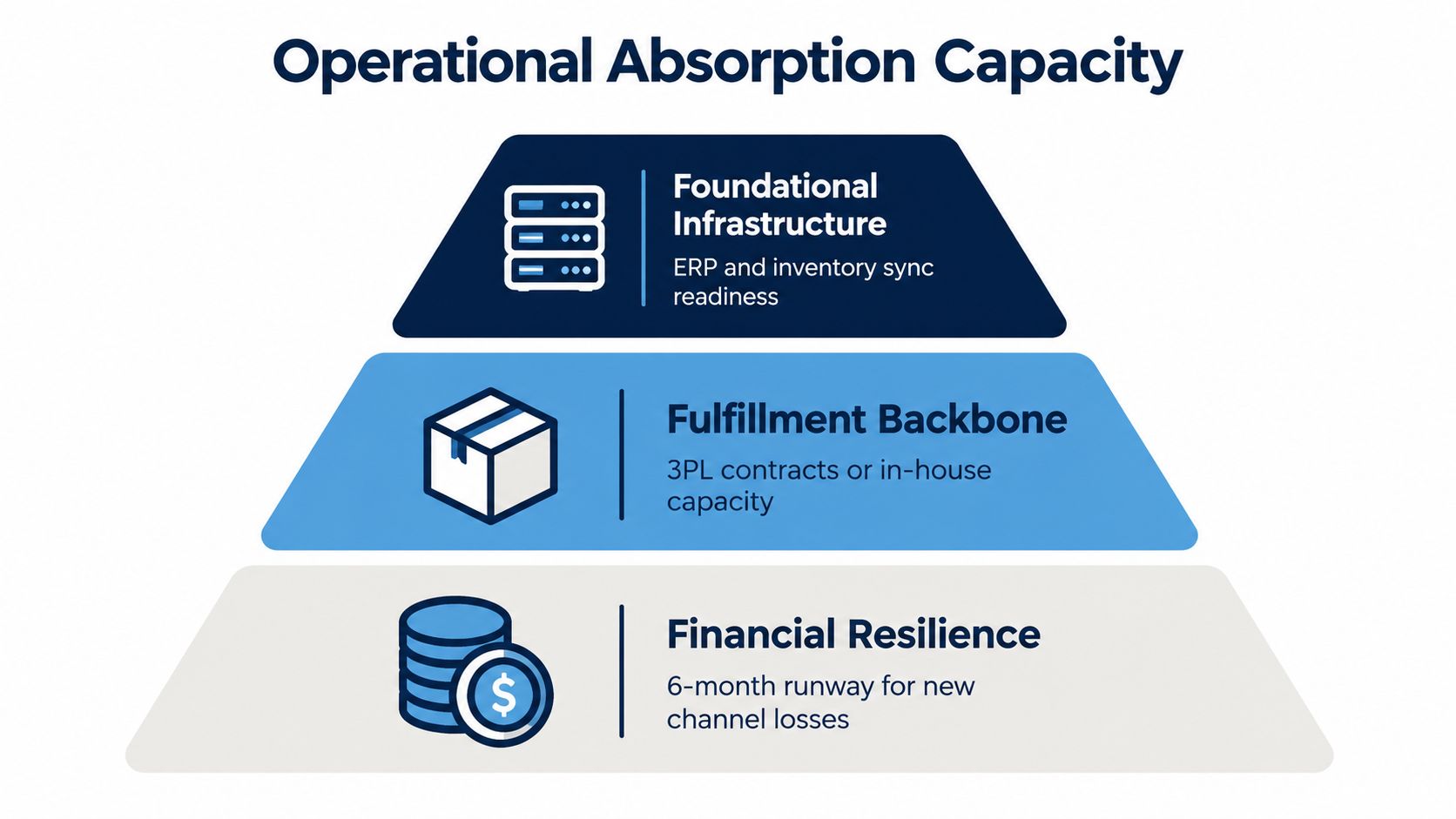
Inventory synchronization is the first control point. Your ERP, ecommerce platform, warehouse system, and marketplaces need a defined source of truth for available-to-sell inventory. Don't assume that a connector has solved the problem. Test overselling, partial shipments, cancelled orders, stock adjustments, bundles, preorders, and returns.
Product information creates a similar risk. Each channel may use different attributes, images, titles, compliance fields, pack sizes, and variation structures. Assign ownership for the master product record, then document which fields can be adapted locally and which must remain consistent.
Pricing needs its own rules. A marketplace promotion, wholesale discount, or shipping subsidy can alter contribution margin even when the product's list price stays unchanged. The system should make those changes visible rather than leaving operators to discover them during month-end reconciliation.
Fulfillment rules should answer four questions before launch:
Expanded channels increase complexity through fees, fulfillment, returns, customer-service load, and reporting overhead. Those costs can erode margins when the business doesn't model them explicitly, as explained in this multichannel ecommerce growth strategy analysis.
Review order accuracy, inventory accuracy, response times, return processing, refund timing, and backlog by channel. A dashboard built around KPIs for operations can help separate a demand problem from a process problem.
Financial resilience belongs in the same audit. Estimate launch losses, additional inventory requirements, software costs, contractor support, and the cash tied up by slower-paying customers. If the business can only fund expansion by starving the core channel of inventory or delaying essential supplier payments, the channel isn't ready.
A channel decision should survive a skeptical review from operations, finance, and customer service, not just a growth meeting. Build a candidate sheet and score each option against the constraints that determine whether the business can serve it profitably.
Start by defining the job the channel must perform. Is it meant to acquire new customers, increase order frequency, move a specific product range, improve brand discovery, support wholesale volume, or diversify dependence on one platform? A channel with no clear job becomes a collection of activity with no useful success criteria.
Use a consistent scoring scale for every candidate. The exact weighting depends on the business, but the categories should force a balanced decision:
Score the candidates independently before discussing them as a group. That prevents the loudest revenue forecast from dominating the decision.
| Channel Type | Margin Profile | Operational Complexity | Customer Acquisition |
|---|---|---|---|
| Amazon marketplace | Can be attractive at scale, but fees, fulfillment choices, promotions, and returns require close control | High catalog, compliance, inventory, and service discipline | Strong reach, with meaningful platform dependence |
| Shopify DTC | Greater control over pricing, merchandising, and customer data, but acquisition and fulfillment costs must be tracked carefully | Medium to high, depending on the existing stack and service model | Brand-owned acquisition, retention, referrals, and paid traffic |
| B2B wholesale | Lower realized price can be offset by larger orders and predictable account relationships | High because of terms, case packs, routing, documentation, and payment collection | Partner-led acquisition, with slower relationship development |
| Brick-and-mortar retail | Margin depends on wholesale terms, deductions, promotions, replenishment, and compliance | High due to packaging, routing, purchase orders, and retail requirements | Retailer traffic and physical discovery, with less direct customer ownership |
A high-revenue channel shouldn't automatically win. A modest channel that fits your warehouse, product assortment, and customer-support capacity may create more useful profit than a larger opportunity that forces expensive process changes.
Choose the channel with the strongest combination of incremental demand and absorbable complexity. If two options score similarly, choose the one that teaches your team more without committing the most capital. A pilot should expose process weaknesses while they're still affordable to fix.
Reject any candidate that depends on undocumented founder intervention. If the founder must approve inventory allocations, answer routine service questions, repair listings, and reconcile every payout, the business hasn't designed a channel. It has created another job.
Each channel changes the economics of the same product. The product cost doesn't change, but the costs around it do. Packaging, pick paths, payment timing, returns, promotional rules, customer ownership, and compliance requirements all shape the final contribution.
A useful channel expansion strategy calculates net contribution per order, not just revenue per order. For every channel, trace the money from the customer payment to the amount left after variable costs and the operational burden required to deliver the promise.
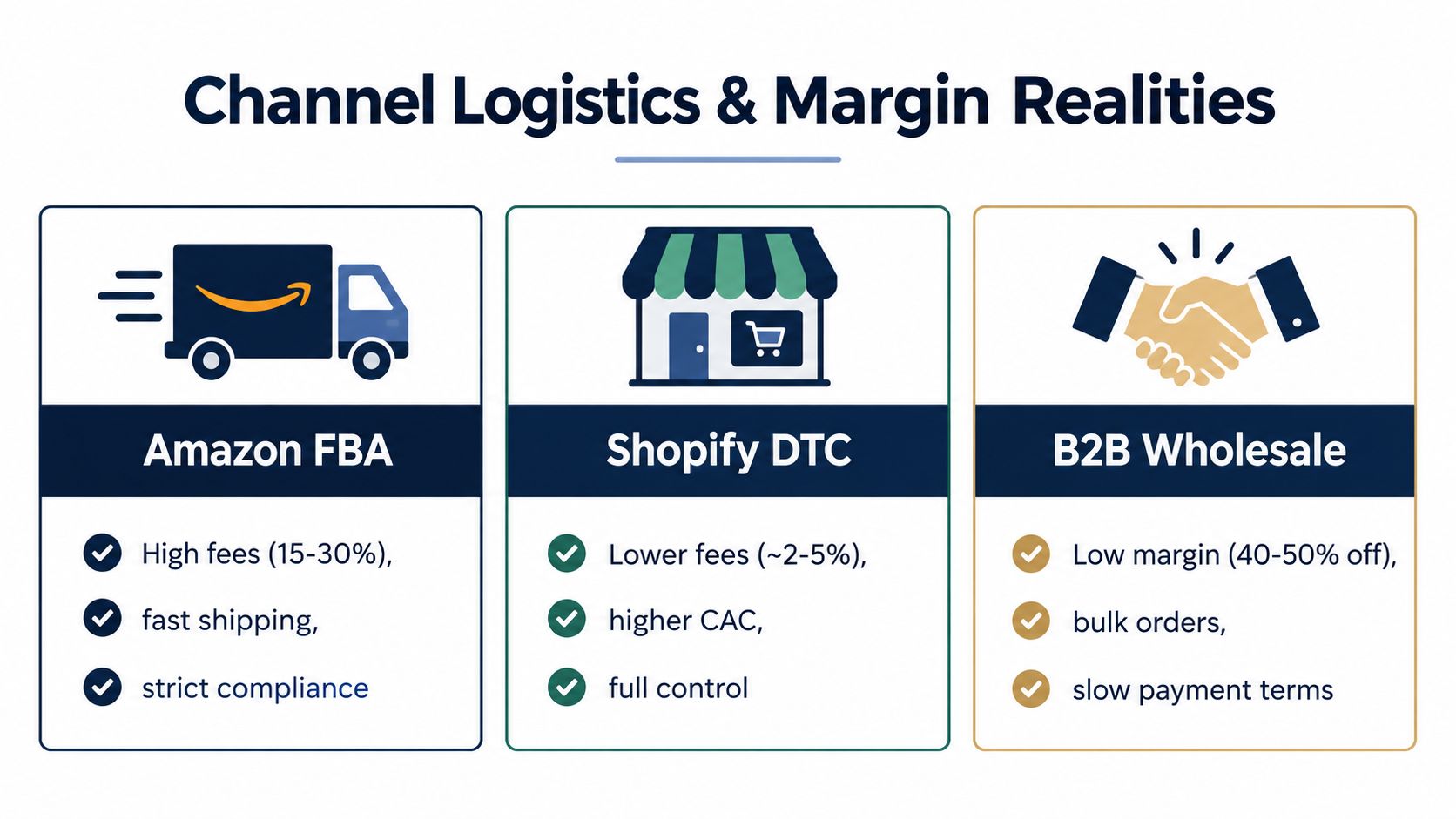
Amazon offers demand access and a mature fulfillment environment, but the seller gives up control over important parts of the customer experience. FBA can simplify delivery and outsource warehouse execution, while FBM can provide more control over inventory routing and product handling. Neither option is automatically more profitable.
For FBA, model storage, fulfillment, referral costs, aged inventory exposure, prep requirements, removals, returns, and the cash tied up in stock. For FBM, model pick-and-pack labor, packaging, carrier rates, service-level commitments, late-shipment risk, and the systems needed to keep inventory accurate.
Amazon also requires disciplined catalog governance. Variation errors, suppressed listings, compliance gaps, and poor replenishment decisions can turn a high-demand product into an operational exception. Keep channel-specific inventory and profitability reporting separate from blended brand reporting.
DTC provides control over merchandising, customer communication, bundles, pricing, and retention. It also makes the brand responsible for traffic generation, conversion, payment processing, fulfillment, customer service, and returns.
The most common mistake is to treat DTC as a low-cost channel because platform fees look visible and manageable. Acquisition costs, creative production, discounts, shipping subsidies, support labor, and failed delivery attempts often sit outside the basic store report. Build contribution reporting that includes those costs before increasing paid spend.
DTC can be strategically valuable even when its first-order economics are modest, but that case depends on repeat purchasing, retention, and customer value. Track those outcomes by cohort instead of using blended averages that hide weak acquisition sources.
Wholesale changes the operating rhythm. Orders may be larger, but they can require case-pack rules, purchase orders, routing guides, compliance documents, negotiated terms, and longer payment cycles. A wholesale account can create useful demand stability, but the business needs enough cash and administrative discipline to carry the relationship.
Brick-and-mortar retail adds another layer of execution. Packaging may need to meet shelf requirements, deliveries may need to follow retailer windows, and deductions can appear after the shipment has left the warehouse. Forecast sell-through and replenishment separately from initial sell-in. Inventory shipped to a retailer isn't the same as inventory sold to a consumer.
Before comparing channels, calculate product cost consistently with the method described in how to calculate landed cost. Then make sure finance can reconcile payouts, deductions, refunds, and inventory movements by channel. If the books are difficult to close, resources that help clean up messy ecommerce books can be useful before expansion, not after the reporting has become unreliable.
The operating principle is straightforward: don't choose a channel because its gross margin looks attractive. Choose it because the fully loaded contribution remains healthy after the channel's actual logistics and service requirements.
Launch one channel at a time. A simultaneous rollout across marketplaces, retail, and DTC creates too many variables to diagnose. When performance drops, the team won't know whether the cause is demand, pricing, inventory, integration, fulfillment, content, or customer service.
Implementation guidance recommends a scoring sheet for three or four candidate channels, 30/60/90-day revenue and order targets, and operating gates such as inventory accuracy of at least 98% before proceeding to another channel (Shopify's ecommerce growth guidance).
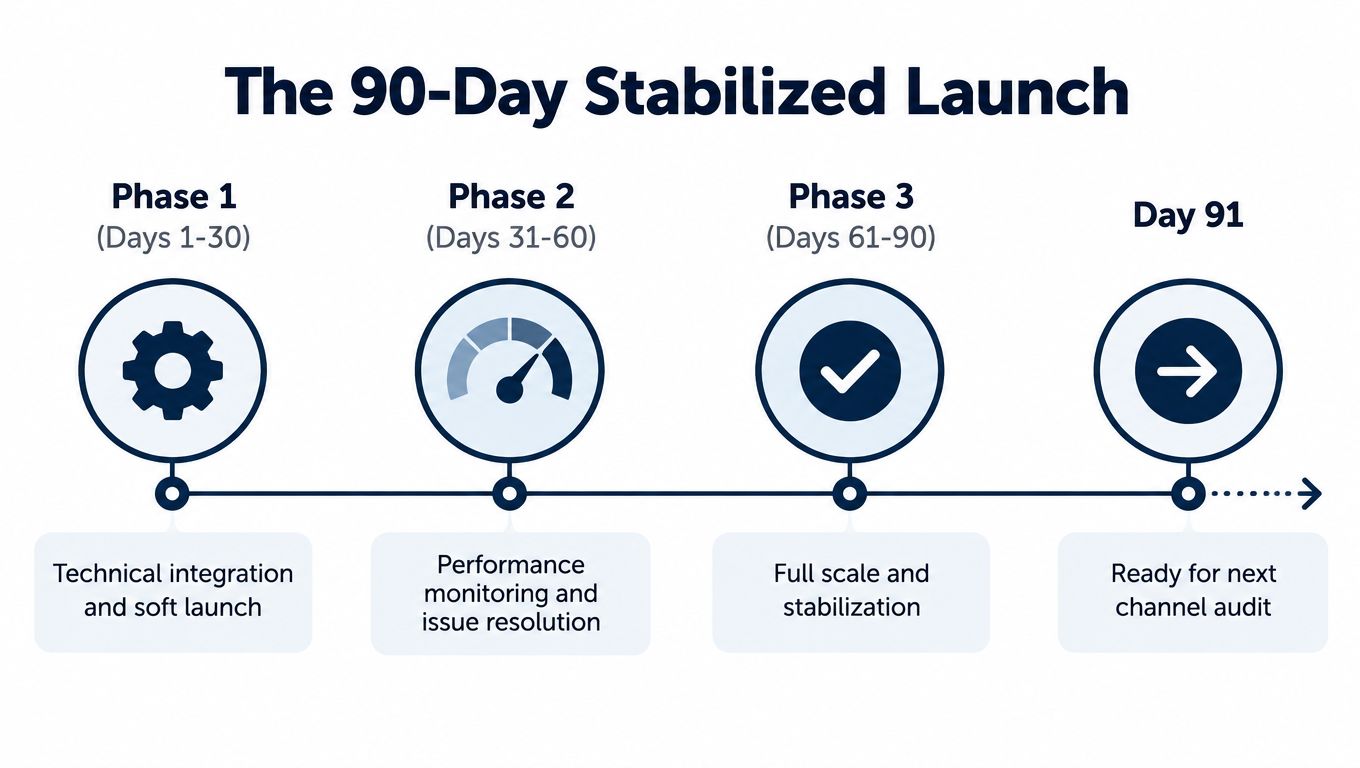
The first phase is about readiness, not scale. Finalize the assortment, pricing rules, content, channel policies, inventory allocation, shipping promises, return workflow, and reporting definitions.
Run test orders through every important path. Test cancellations, address changes, partial fulfillment, refunds, returns, out-of-stock conditions, promotion codes, and customer-service escalations. Reconcile the test transactions from the channel payout through the order system and into accounting.
Launch softly. Keep the assortment narrow enough that the team can inspect the details. Assign one accountable owner for the channel, with named support from operations, finance, customer service, and marketing. The owner should publish a regular scorecard, not just report sales.
Launch gate: Don't increase inventory or paid traffic until the team can explain every order state and every material cost.
The second phase is where the operating model meets real customer behavior. Review late shipments, cancellations, stock discrepancies, listing questions, return reasons, refund delays, support volume, and carrier exceptions.
Compare actual contribution with the original model. Separate one-time launch costs from recurring costs, but don't exclude recurring labor just because the team is currently absorbing it informally. If an employee spends hours correcting channel errors, that time belongs in the channel economics.
Use the data to narrow the work. Fix the recurring exception first, whether it's an inventory sync problem, a packaging failure, a listing mismatch, or a handoff between customer service and the warehouse. Avoid adding more products while basic execution remains unstable.
The final phase should expand volume carefully, not just switch every growth lever to maximum. Increase assortment, inventory, or advertising only when service levels, inventory accuracy, contribution margin, and reporting remain within the agreed guardrails.
Set explicit stop conditions. Pause expansion if the channel requires repeated manual corrections, creates stockouts in the core business, produces unprofitable returns, or consumes more support capacity than planned. A pause is a management decision, not a failure.
At the end of the period, conduct a formal review. Decide whether to scale the channel, hold it at its current level, redesign the operating model, or exit. Only after the channel is stable should the team audit the next candidate.
Revenue is useful for measuring demand, but it isn't enough to decide whether a channel deserves more inventory or budget. A channel can grow while weakening the business if it consumes working capital, creates expensive returns, or borrows operational capacity from a more profitable channel.
The market opportunity is substantial. One 2025 market estimate valued the global multi-channel retail market at $1,562.7 billion and projected growth to $2,500 billion by 2035, implying a 4.4% CAGR over the forecast period (the global multi-channel retail market estimate). The scale of the category makes disciplined measurement more important, not less.
Track each channel through a consistent waterfall:
The objective isn't perfect accounting precision. It's decision-grade visibility. If one channel appears profitable only because fulfillment labor and returns are excluded, the dashboard should make that weakness visible.
A useful analytics framework for ecommerce should connect money to execution. Monitor contribution margin, order accuracy, inventory accuracy, stockouts, fulfillment time, return rate, refund time, support response, cancellation rate, and inventory aging by channel.
Review the relationship between channels as well. Watch for one channel taking the best inventory, forcing another into stockouts, or creating customer-service volume that affects the entire brand. Measure whether a channel adds customers, repeat purchases, useful data, or only additional orders from existing demand.
The decision rule should be clear. Stabilize the current channel, prove its economics, document the operating playbook, and then evaluate the next channel. If the business can't explain where margin is created or lost, expansion should wait.
Million Dollar Sellers gives serious ecommerce operators access to peer discussions, curated events, private forums, and vetted service recommendations that can sharpen channel planning and partner discovery. Visit Million Dollar Sellers to explore a community built around practical strategy sharing and execution across Amazon, DTC, and omnichannel brands.
Join the Ecom Entrepreneur Community for Vetted 7-9 Figure Ecommerce Founders
Learn MoreYou may also like:
Learn more about our special events!
Check Events