Chilat Doina
January 4, 2026
Let's be clear: a "pivot" isn't just a buzzword for a random change of plans. It’s a calculated course correction you make when the data—and your market—tell you that a core belief about your business is flat-out wrong. It's about deliberately shifting your product, your market, or your entire model to find a path that actually works.
This is easily one of the toughest decisions a founder can make. But more often than not, it's the very thing that separates the brands that fizzle out from the ones that achieve breakthrough growth.
The thought of a pivot can feel like a high-stakes gamble, but it should never be based on gut instinct alone. For successful e-commerce and Amazon sellers, the writing is usually on the wall long before a full-blown crisis hits. You just have to know where to look. It all comes down to ditching intuition and committing to the hard data that signals when your current strategy is losing steam.
Before you even think about changing direction, it's crucial to have a solid grasp of what a business strategy entails. After all, you need to understand the foundation you're about to rebuild.
So many founders ignore these signals. A study from CB Insights dropped a bombshell of a statistic: 35% of startups fail for one simple reason—no market need. This isn't a sudden implosion; it's a slow burn that shows up in your metrics, month after month. Catching these warning signs early is what separates thriving 8-figure brands from those that quietly disappear.
The most obvious red flag? Stalled growth.
You launched, maybe got some early wins, but now everything has flatlined. User acquisition, engagement, revenue—it’s all stuck in neutral. You’re pouring more cash into marketing and obsessively tweaking your Amazon listings, but the needle just won't budge. This kind of plateau is a classic sign that your current approach has hit its ceiling.
Here are the specific metrics you should be watching like a hawk:
You can have revenue coming in the door and still be running a fundamentally broken business. The relationship between what it costs to land a customer and the value they bring over time is the lifeblood of e-commerce. When those numbers are upside down, a pivot is often the only way out.
The most critical indicator here is the relationship between Customer Acquisition Cost (CAC) and Lifetime Value (LTV). If your CAC consistently outweighs your LTV, and optimization efforts can't close the gap, your business model is on an unsustainable path.
Let's say you sell a supplement on Amazon. A year ago, your ACoS (Advertising Cost of Sale) was a healthy 25%, and your CAC was $15. Fast forward to today. Competition has intensified, ad costs have skyrocketed, and now your ACoS is 50% and your CAC has ballooned to $40—all while your product price is the same.
This isn't just a marketing problem. It’s a glaring signal that your business model is no longer viable in the current market, and it’s time for a major strategic shift. Taking a deeper look into strategic planning for small business can give you a solid framework for re-evaluating these core numbers.
Your quantitative data tells you what is happening, but it’s the qualitative feedback that tells you why.
Are you constantly hearing that your product is a "nice-to-have" but not a "must-have"? Are your support tickets flooded with complaints about the same missing feature? This direct feedback is absolute gold. It’s the market telling you, point-blank, that you haven't solved a big enough problem.
When customers aren't willing to pay what you're asking, or your churn rate is through the roof because the value just isn't there, it’s time to stop talking and start listening. A pivot might mean zooming in on that one single feature customers do love and rebuilding the entire business around it.
So, you’ve run the numbers, and it’s clear something needs to change. Now for the hard part: deciding what to change. A pivoting business strategy isn't about throwing spaghetti at the wall to see what sticks. It's a calculated shift toward a more profitable, sustainable path.
For e-commerce brands, pivots almost always fall into one of four buckets. Each one addresses a different core problem and comes with its own set of opportunities and risks. Getting this choice right is everything. You need to match the pivot strategy to the specific cracks you've found in your business foundation.
This decision tree gives you a simple way to visualize the starting point. When your key metrics are in a nosedive, it’s a clear signal to think bigger than just minor tweaks and optimizations.
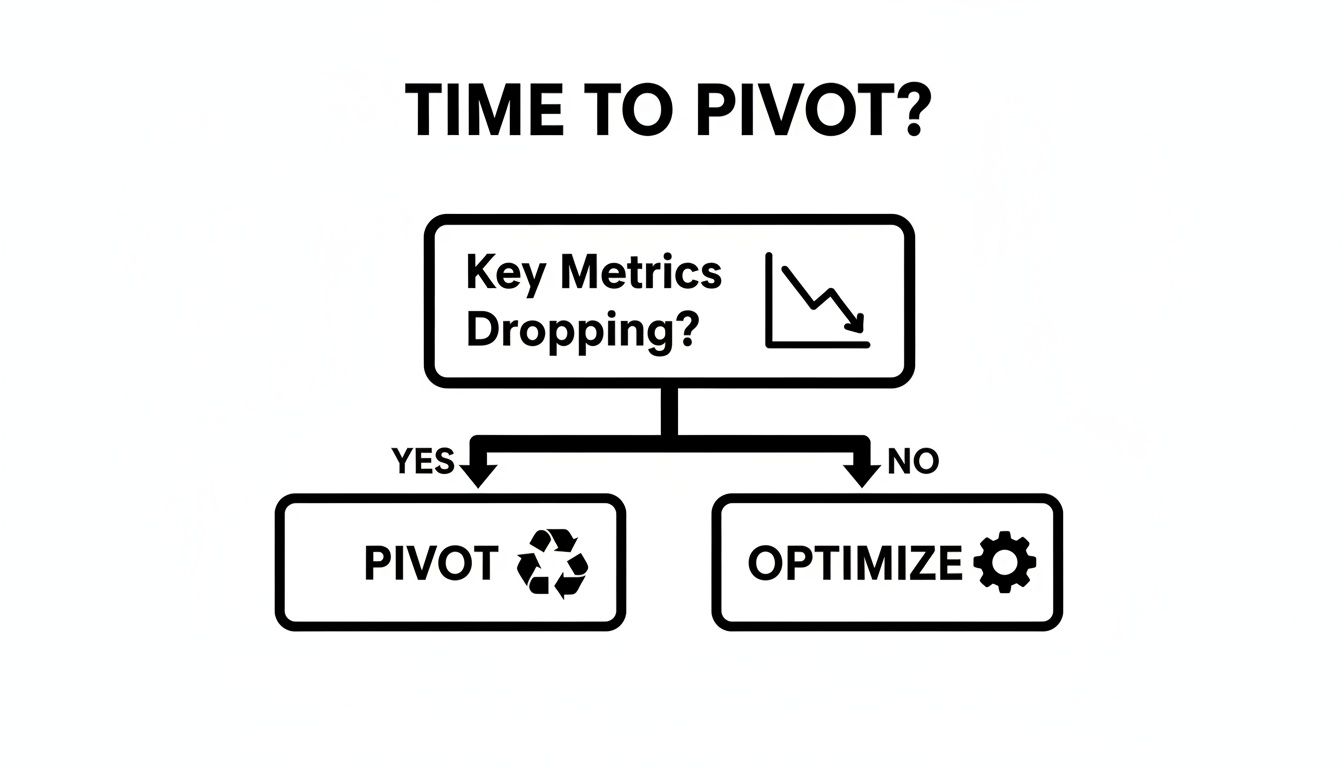
As the flowchart shows, a pivot only hits the table when the data confirms your current model isn’t just having a bad month—it’s fundamentally struggling.
This is the one most people think of first. A product pivot means making a major change to what you sell. We’re not talking about a new colorway or a minor feature upgrade. This is a fundamental reimagining of your core offer.
It could be a "zoom-in" pivot, where you take one hyper-popular feature of a larger product and build the entire business around it. Imagine a brand selling a complex, multi-piece home gym system, but customer reviews only ever rave about the unique resistance bands. Pivoting to focus exclusively on creating a premium line of those bands could unlock massive growth.
Or, you could do a "zoom-out" pivot. This is where a single successful product becomes the foundation for a much broader platform. A company that got its start with a smart water bottle might expand into a whole ecosystem of connected wellness tech, like smart scales and sleep trackers.
A product pivot is your response when the market is screaming, "We love the problem you're solving, but your solution isn't quite right." You've found a real need, but your first attempt at meeting it missed the mark.
For any online brand, where you sell is just as critical as what you sell. A channel pivot means fundamentally changing how you get your product into customers' hands. The classic example we see all the time is the Amazon-only FBA seller who decides to launch their own direct-to-consumer (DTC) store on Shopify.
This move is a major trade-off. You give up the firehose of built-in traffic from the Amazon marketplace, but you gain something far more valuable for long-term growth: customer data and brand control. Owning that customer relationship is a game-changer. It lets you build a real community, retarget customers, and capture much healthier profit margins.
Other common channel pivots include:
Sometimes your product is fantastic, but you're just talking to the wrong people. A customer pivot (or customer segment pivot) means you reposition your existing product to serve a totally different audience. The product itself might not change at all, but the marketing, branding, and messaging get a complete overhaul.
Think about a brand selling premium, ultra-durable backpacks originally marketed to broke college students. Sales are flat because, surprise, the price point is way too high. But they notice their small base of loyal customers are actually young professionals using the bags for their daily commute and weekend trips.
The pivot? They’d swap out all the campus lifestyle photos for slick, urban commuting shots. Ad copy would change from "survives all-nighters" to "protects your tech in style." Ad spend would shift from TikTok to LinkedIn. The product is the same, but the new target market is a perfect—and much more profitable—fit.
This type of pivot changes the very mechanics of how you make money. It's a strategic shift in your revenue model, designed to better align with how customers get value and, ideally, to create more predictable income.
The most powerful model pivot for e-commerce brands today is moving from one-off sales to a subscription-based model.
For instance, a company selling high-end coffee beans could shift from selling individual bags to offering a curated monthly subscription box. This one change can dramatically boost Customer Lifetime Value (LTV) and create a stable, recurring revenue stream. That kind of predictable income is gold—not just for your cash flow, but for attracting investors, too.
To help you weigh these options, the table below breaks down what you can expect from each approach.
This table outlines the four primary pivot types, giving you a realistic look at their complexity, potential payoff, and the key risks you'll face as an e-commerce brand.
Pivot TypeComplexity & ResourcesPotential ImpactPrimary RiskProduct PivotHigh - Requires R&D, new manufacturing, and marketing relaunch.High - Can unlock a much larger market or achieve true product-market fit.Market rejection of the new product, sunk development costs.Channel PivotMedium - Needs new operational processes, marketing skills, and platform investment.High - Diversifies revenue, builds brand equity, and improves margins.Channel conflict, underestimating the resources needed for the new channel.Customer PivotMedium - Primarily a marketing and branding effort; minimal product change.Medium to High - Can unlock a more profitable or larger customer segment.Misreading the new audience and failing to gain traction, alienating existing customers.Model PivotHigh - Involves changing financial models, operations, and customer expectations.High - Can dramatically improve LTV and create predictable, recurring revenue.Customer resistance to the new model, operational complexity.
Each path demands a different level of investment and carries unique challenges. Choosing the right one is about honestly assessing your resources, your market, and which of your core assumptions about the business has proven to be wrong.
Picking a new direction is one thing, but a pivot without validation is just an expensive guess. Before you tie up serious capital and shuffle your team around, you have to de-risk the new strategy by getting some real-world evidence.
This whole process is about swapping founder intuition for hard market proof. You're making sure your next move is guided by data, not just a gut feeling.
The idea is to test your biggest assumptions with small, cheap experiments. You’ve probably heard that "no market need" is a top reason startups go under. This is exactly what disciplined validation helps you avoid. For an e-commerce brand, this means getting real signals from actual customers before you flip your entire operation on its head.
You don't need a massive budget to figure out if an idea has legs. Lean validation techniques are all about speed and efficiency, helping you get clear answers without breaking the bank.
A "smoke test" is a classic for a reason. Let's imagine you're thinking about a product pivot. You currently sell one popular kitchen gadget but want to launch a full line of premium cookware. Instead of placing a huge factory order, you can build a slick landing page for the new product concept first.
This approach gives you a direct pulse on demand from your target audience. To really make sense of this kind of feedback, you need a solid framework for data-driven decision making. It's what turns raw numbers into a confident plan of action.
When you're looking at pivots around pricing or customer segments, small-scale A/B tests are your best friend. Maybe you think you can target a more premium customer by bumping your prices by 20%. Just rolling that out to everyone at once is a huge risk.
Instead, run a controlled experiment. Using tools built into Shopify or from third-party apps, you can show the new, higher price to just 10% of your website visitors. A week later, you compare the conversion rate and average order value of that test group against the 90% who saw the old price. Now you have concrete data on how the price change actually affects buying behavior.
Validation isn't about looking for proof that your idea is brilliant. It's about rigorously stress-testing your assumptions to find the fatal flaws before they can sink your business.
Simple survey tools can be just as powerful for validating a new customer focus. If you want to reposition your brand for a completely new demographic, send a targeted survey to your email list to see if you're on the right track. Ask pointed questions about their needs, their pain points, and what they really value in a product like yours.
The final piece of the validation puzzle is pulling all your test results together into a solid business case. This is where your existing analytics platforms become absolutely critical. For a deep dive, check out how leveraging data analytics for small businesses can give you actionable insights from market trends and customer feedback.
You need to pull data from every source you have to paint a complete picture:
When you combine the results of your lean experiments with insights from your core analytics, you build a powerful, evidence-based argument for the pivot. This data-first approach doesn't just increase your odds of success—it's also the key to getting your team and stakeholders fully behind the new direction.
You've done the hard work, validated your new direction, and now you've got a solid strategy. That's the starting point. But a strategy gathering dust on a shelf is worthless without a clear path to make it happen. This is the moment your pivoting business strategy morphs from a well-researched hypothesis into a tangible reality. A killer implementation plan is what turns a high-stakes bet into a controlled, measurable process, making sure everyone on your team is marching in the same direction.

This whole phase is about translating the "why" into a very detailed "how." We're talking about breaking the pivot down into manageable chunks, defining who owns what, and setting up the right scoreboard to track your progress. The goal here isn't chaos; it's a playbook designed to maximize your shot at a successful transition.
Trying to flip a switch and change everything overnight? That’s a classic recipe for disaster. A phased rollout is your best friend here. It lets you manage risk, learn on the fly, and build up some real momentum. Think of it less like a hard cutover and more like a controlled transition with clear, defined milestones.
For an e-commerce brand, a phased plan could look something like this:
This step-by-step approach keeps things from getting overwhelming and lets you course-correct before you've gone all in.
A plan is just a document without a team to bring it to life. Every single part of this pivot—from the big initiatives down to the small tasks—needs one person who is ultimately accountable. Ambiguity is the enemy of action, so clarity is non-negotiable. Who’s in charge of updating the Shopify theme? Who owns the new Amazon A+ Content? Who is reallocating the ad spend? Get specific.
A pivot isn’t just a change in strategy; it’s a change in focus. Every resource—from your team’s time to your marketing budget—must be deliberately reallocated to support the new direction.
This forces some tough but necessary conversations about resources. Take your marketing budget, for instance. A gradual shift is often the smartest play. You might start with a 70/30 split (70% on the old model, 30% on the new) in Phase 1. By launch, you could be at 50/50, and as the new model proves itself, you might transition to a 20/80 split.
Inventory management is another massive headache, especially if you're pivoting your product line. You absolutely need a plan to liquidate old stock. Think flash sales, bundling it with new hot-sellers, or pushing it through an outlet channel. The goal is to free up cash and warehouse space for what's next.
You can't know if you're winning if you never defined the score. Before you launch a single thing, the entire team needs to agree on the Key Performance Indicators (KPIs) that will tell you if this pivot is actually working. These metrics have to be directly tied to the goals of your new strategy.
Here are a few examples to get you thinking:
These KPIs give you an unbiased look at your progress and are critical for making smart, data-backed decisions as you roll things out.
Sometimes, the need to pivot comes from massive market shifts you just can't ignore. We saw this play out in real-time during the 2020 pandemic when giants like Walmart had to aggressively lean into omnichannel strategies. Back then, Amazon was king, owning 38.1% of U.S. e-commerce, while Walmart sat at just 5.3%. Walmart poured billions into its online infrastructure and curbside pickup, and its online sales exploded, surging over 70% year-over-year. With global e-commerce projected to hit $6.86 trillion by 2025, it’s clear that a well-executed pivot isn't just a growth hack—it's a survival tactic. You can discover insights on b2b e-commerce statistics at Shopify to explore these trends further.
Flawless execution is what turns a bold vision into a market-winning reality. By creating a phased plan, assigning clear owners, and defining success with the right KPIs, you're building a solid foundation for your brand's next chapter.
Pushing your pivot live is a huge milestone, but it's the starting line, not the finish. The real work starts now. A pivoting business strategy is never perfect on day one, and its long-term success comes down to how well you can monitor, measure, and adapt based on what the market is telling you.
You're shifting from a launch mentality to one of constant, data-driven refinement. Time to close the loop.

Let's be real: your old key performance indicators (KPIs) are probably useless now. To get an honest read on success, you need a brand-new scoreboard with metrics that directly track the goals of your new direction. Vague goals just lead to vague results, so you have to get specific.
The numbers you obsess over will depend entirely on the kind of pivot you just pulled off:
The best way to keep these numbers from becoming a chaotic mess is to get them organized. Setting up a dedicated performance metrics dashboard is the only way to keep these vital signs front and center for you and your team.
The quantitative data—the numbers on your dashboard—tells you what is happening. But it’s the qualitative feedback from your first wave of new customers that tells you why. You need to build a system to capture these gold nuggets quickly and consistently.
A successful pivot isn't just about launching a new idea. It's about launching a new learning process. Your ability to listen and react faster than the competition is your single greatest advantage.
Don't just sit back and wait for feedback to trickle in. You have to go get it. Send dead-simple, one-question surveys to new customers about a week after their purchase. Run quick polls on social media aimed squarely at your new target audience.
Most importantly, give your customer service team a process to tag and categorize every single piece of feedback they get. This is raw, unfiltered intelligence coming straight from the front lines.
A pivot is rarely a single, dramatic moment. It’s almost always a series of calculated adjustments guided by data. The initial launch just gets you in the game; the tweaks you make afterward are what lead to the massive wins.
Take a look at the textbook case of Starbucks. Back in 2014, with 80% of their sales happening in-store, they launched their mobile order & pay feature. This digital pivot completely rewired their business. Fast forward to 2023, and digital transactions make up 25% of all U.S. sales, fueling over $32 billion in global revenue from an app with 30 million+ active users. This just mirrors the bigger picture, with mobile e-commerce on track to hit $2.51 trillion by 2025.
For any Amazon seller in the MDS community, this story should be a massive wake-up call about having a mobile-first mindset. The result for Starbucks? Their stock shot up over 500% since that 2014 pivot, turning a strategic shift into a billion-dollar growth engine.
Starbucks didn't just launch the app and call it a day. They obsessively refined it based on user data, adding loyalty programs, personalized offers, and a smoother checkout. That's what continuous adaptation looks like. Your pivot is no different. Use your data and customer feedback to constantly refine your product, your messaging, and your entire strategy. This iterative process is what turns a good pivot into a great one.
Making a major strategic shift is easily one of the toughest calls an e-commerce founder will ever have to make. Let's tackle some of the most common questions that pop up when you're staring down a potential pivot.
It’s a fine line, isn’t it? Knowing whether you need a small course correction or a complete change of direction can feel murky.
An adjustment (or iteration) is what you do when the business model is fundamentally sound, but you need to dial things in. Think of things like tweaking your ad copy, A/B testing a checkout flow, or refining your email sequences. These are optimizations.
A pivot is for when a core belief about your business gets shattered by reality. You need a full-on pivoting business strategy when the data tells you the foundation itself is cracked.
Keep an eye out for these signals:
If you realize you're solving the wrong problem for the wrong people, it’s pivot time. No amount of fine-tuning will fix that.
The single most common—and expensive—mistake is pivoting based on a gut feeling or a few conversations instead of hard data. It's so easy for founders to get excited about a new idea and go all-in, throwing resources at it before they've actually proven anyone wants it.
A successful pivot is a calculated, evidence-based process, not a panicked reaction. The worst time to abandon a data-driven approach is during a high-stakes transition; it’s your only real defense against a catastrophic failure.
The fix? Run small, cheap tests. Get that data and validate your new direction before you bet the farm on it. A simple landing page to gauge interest or a targeted survey to your ideal customer can save you from a world of pain.
You need to be transparent and tell a clear story.
For your team, this isn't about failure. Frame it as a strategic evolution—a smart move based on what you've all learned from the market. Show them the data that led to the decision and paint a clear picture of the new vision. Most importantly, connect the dots for them. Explain exactly how their role fits into the new plan to keep everyone focused and on board.
For your investors, you need a tight business case. Lay out the new opportunity, the validation data you've gathered, your implementation plan, and what the financial upside looks like. Confidence is key, but it has to be backed by evidence. That’s how you maintain their trust and get their buy-in. When done right, clear communication turns that scary uncertainty into a shared sense of purpose.
At Million Dollar Sellers, our members navigate these high-stakes decisions with the support of the world's most successful e-commerce entrepreneurs. Learn how our exclusive community helps top sellers scale smarter and stay ahead of the curve. https://milliondollarsellers.com
Join the Ecom Entrepreneur Community for Vetted 7-9 Figure Ecommerce Founders
Learn MoreYou may also like:
Learn more about our special events!
Check Events