Chilat Doina
January 25, 2026
Figuring out what the best-selling products on Amazon are isn’t about finding some secret, static list. It's about learning to read a living, breathing system. Sure, the top sellers almost always come from high-demand categories like Electronics, Home & Kitchen, and Beauty & Personal Care. But the real magic is in understanding the market's pulse, not just memorizing what's hot today.
If you want to find a winning product, you have to understand the game. So many new sellers look at the Amazon Best Sellers list and think it’s a historical record—a hall of fame for the most popular items ever. It's not. The reality is much more immediate and, frankly, more useful.
Think of a product's Best Sellers Rank (BSR) less like a trophy and more like a real-time stock ticker. It tells you how well a product is selling right now compared to everything else in its category.

This rank isn't some weekly or monthly report. Amazon crunches the numbers and recalculates the BSR for millions of products every single hour. A sudden sales spike from a TikTok video or a flash deal can send a product soaring up the charts, only for it to disappear a day later. On the flip side, a product with slow, steady sales can hold a solid BSR for months without those wild swings.
Getting a feel for this constant flux is the key. It’s how you learn to spot a product with real, sustained momentum versus one that’s just having a fleeting moment in the sun.
A low BSR (closer to #1) is a great sign of strong recent sales, but its stability over time is what truly signals genuine market demand. A product that hangs out in the top BSR ranks consistently is a far safer bet than a one-hit wonder.
A seasoned seller doesn't just look at the BSR number; they use it as a diagnostic tool. They’re analyzing the trend. Is the rank consistently good? Is it all over the place? Or is it steadily climbing, hinting at a growing wave of interest? Answering these questions is how you find genuinely viable opportunities instead of chasing fads that will leave you with a garage full of unsold inventory.
By learning to read these signals, you stop asking what the best-selling products are and start understanding why they're selling. This is where using the best Amazon seller tools becomes essential. They let you track BSR trends over time, giving you a much clearer picture of a product's long-term potential. That’s the first real step toward making smart, data-driven decisions for your business.
Picking the right product category on Amazon is a bit like choosing where to go fishing. Some oceans are teeming with hungry fish, while others are crowded with other boats, all fighting over the same small catch. To really get a handle on what sells best on Amazon, you first have to understand the larger categories where these top products live. It's no accident that certain verticals consistently crush it—it all comes down to fundamental consumer behaviors that create reliable, year-round demand.
When we break down these high-demand categories, we're doing more than just spotting a few hot products. We're getting a look under the hood at the mechanics of what makes a product type a runaway success on Amazon. This kind of strategic view is what separates a one-hit-wonder from a truly scalable business.
Two of the most dominant and consistently profitable categories on Amazon are Home & Kitchen and Beauty & Personal Care. Their immense power comes from a single, simple concept: necessity. These aren't just one-off, "nice-to-have" purchases; they're built around items that people need, use up, and buy again. And again.
It’s almost like a subscription model baked into everyday life. People will always need new kitchen gadgets, cleaning supplies, skincare products, and vitamins. For sellers who can tap into this, it creates an incredibly predictable and recurring revenue stream. This constant, baseline demand provides a stable foundation, making these categories far less vulnerable to the whims of fast-moving trends.
Just look at CeraVe Daily Moisturizing Lotion, which moves an incredible 22,100 units every single day. That's not a fluke. It's proof of the power behind a trusted, consumable product that becomes part of someone's daily routine.
So, let's look at the core drivers behind Amazon's top-performing product categories. Each one taps into a slightly different psychological trigger, opening up unique opportunities for sellers who know what to look for.
Getting a grip on these drivers is the first real step in aligning your product strategy with how people actually behave. You’re not just selling a widget; you’re selling a solution to a recurring need or an upgrade to a lifestyle they already have.
While flashy, trend-driven products can deliver a quick sugar rush of sales, the most durable and profitable Amazon businesses are almost always built on the bedrock of everyday essentials. These categories might seem less glamorous, but their steady, predictable demand offers a kind of stability and long-term potential that's tough to beat.
A quick look into Amazon's "boring" essentials reveals some truly staggering numbers. Recent data showed Amazon Basics Printer Paper as the #1 bestseller, while Mama Bear Baby Wipes pulled in an incredible $61.7 million in monthly sales. These products aren't exciting, but they are undeniably reliable. Even though about 35% of sellers are competing in Home & Kitchen, it remains highly profitable precisely because of this unwavering consumer demand. You can dig deeper into these top-selling product trends to get a better feel for the market.
To really see the big picture, it helps to compare these powerhouse categories side-by-side. Each one presents a different kind of opportunity, with its own unique consumer mindset.
CategoryPrimary Sales DriverKey Consumer BehaviorStrategic Opportunity for SellersHome & KitchenNecessity & ConvenienceProblem-solving; seeking efficiency and organization in daily life.Offer practical solutions to common household problems; build a brand around a specific home task (e.g., cooking, cleaning).Beauty & Personal CareRoutine & TrustHigh brand loyalty; repeat purchases are common once a preferred product is found.Create high-quality, consumable products that can become part of a daily ritual; focus on building community and trust.ElectronicsInnovation & UpgradesDesire for the "latest and greatest"; frequent replacement of older tech.Focus on accessories for popular devices or find a niche with innovative features that improve on existing tech.Health & HouseholdWellness & NecessitySubscription-like behavior for consumables like supplements and cleaning supplies.Tap into recurring revenue with "Subscribe & Save"; build a brand around health-conscious or eco-friendly values.
This table isn't just a list; it's a strategic map. It shows you the why behind the sales, helping you match your business goals to the category that makes the most sense for you.
By understanding these core dynamics, you move beyond just hunting for "best-selling products" and start a more strategic evaluation of market opportunities. You're looking for a niche that not only has high demand but also aligns perfectly with your resources and vision. That's the difference between just finding a product and truly building an empire.
Anyone can get lucky and stumble upon a winning product once. But building a real, sustainable Amazon business isn't about luck. It's about having a repeatable system—a framework that helps you consistently spot high-potential products before they blow up.
This is how you get ahead. It means moving beyond just poking around on keyword tools and adopting the kind of deep-dive research methods that elite sellers use to find those hidden gems. The goal is to stop chasing trends and start setting them, building a whole portfolio of winners that keeps your business growing year after year.
One of the most powerful, yet overlooked, strategies is to find products that are already in high demand but are... well, just okay. I'm talking about items with a ton of sales velocity but a swamp of mediocre reviews, usually hovering between 3.5 and 4.2 stars.
This is a massive green light. That review range tells you that customers are desperately buying the product, but the current options are consistently letting them down. It’s a market literally begging for a better alternative.
Think of it like a popular restaurant that serves bland food. People are already lining up out the door. You don't need to convince them to come inside; you just need to give them a better meal. For an Amazon product, that could mean:
The negative reviews from your competitors are a goldmine. They are a free, brutally honest roadmap telling you exactly what customers hate and what they wish the product did. All you have to do is listen and build what they're asking for. You can dive deeper into different validation methods by reading up on how to choose products to sell on Amazon.
Guesswork is the enemy of a profitable FBA business. The fastest way to fill a warehouse with inventory you can't sell is to rely on a gut feeling. Top sellers treat product research like a science, using hard data to forecast demand, understand seasonality, and get a clear picture of the competitive landscape.
And don't just limit yourself to Amazon's data. Look at the bigger picture. Understanding how phenomena like TikTok Shop's $500M sales in Black Friday week happen gives you incredible insight into what makes a product category explode. These massive external trends always spill over onto Amazon.
Don't just analyze a product's past performance; project its future. A product might look great in October, but if its demand plummets after the holidays, you could be left with dead stock by February.
Use free tools like Google Trends to see if interest in a niche is growing, shrinking, or just a seasonal flash in the pan. This helps you plan your inventory buys and marketing, so you can ride the wave of peak demand without getting crushed by the crash. A product with steady, year-round demand is almost always a safer and more profitable bet than one with crazy seasonal spikes.
It's easy to get analysis paralysis when you're juggling a dozen different data points. That's where a "Product Opportunity Scorecard" comes in. It's a simple but powerful tool that forces you to be objective and removes emotion from your decision-making.
The idea is to give a weighted score to the factors that matter most to your business and risk tolerance. It turns a messy, complex decision into a single, data-backed number, making it dead simple to compare different product ideas side-by-side.
Here’s a simplified version of what that might look like:
FactorDescriptionWeight (1-5)Score (1-10)TotalProfit MarginPotential net profit after all costs and fees.5840Market DemandEstimated monthly sales and search volume.5945Competition LevelNumber and quality of existing competitors.4624Improvement AngleClear opportunity to create a superior product.4936Sourcing EaseComplexity and reliability of the supply chain.3721SeasonalityConsistency of demand throughout the year.3824Overall Score---190
This kind of structured approach makes sure you don't miss anything, from the money side of things to the nitty-gritty of logistics. It's a disciplined framework that turns product research from a gamble into a calculated strategy for success.
Pinpointing a product with sky-high demand is an incredible rush, but it's only half the battle. A product that flies off the virtual shelves can still bleed you dry if you haven't mastered your numbers. The real secret? A best-seller is only a winner if it’s genuinely profitable after every single cost gets taken out.
This means you have to go way beyond a simple "sale price minus cost" formula. The Amazon ecosystem is layered with fees and expenses that will absolutely chew through your margins if you aren’t tracking them with a microscope. Profitability isn't just a goal; it's the fuel that keeps your business running, and it demands a laser focus on the financial nitty-gritty.
Think of it as a simple three-step process: research, analyze, and then score.
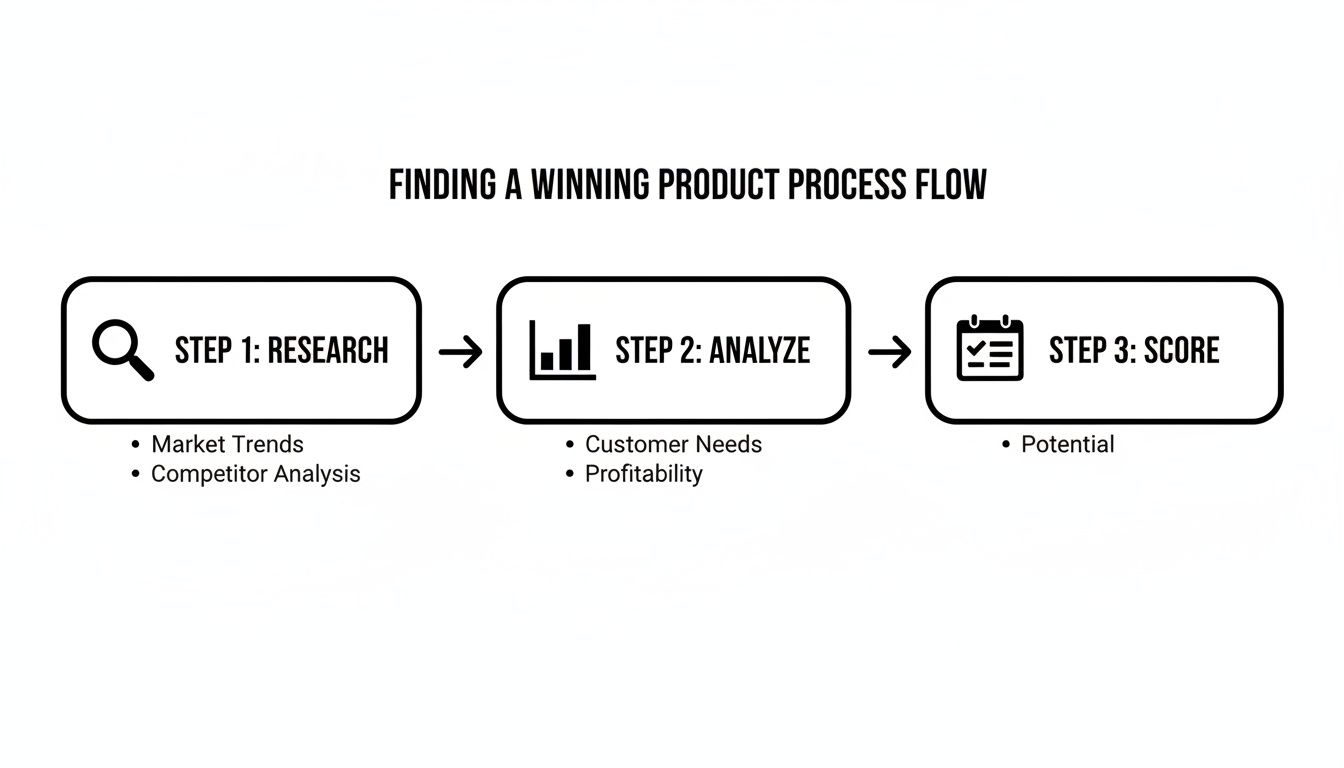
Each of these stages acts as a critical filter. You’re not just looking for something popular—you’re hunting for a product that is financially viable and makes strategic sense for your brand.
Figuring out your actual profit margin requires an almost forensic level of detail. Seriously, think like a detective. Every small clue adds up to the final picture, and a product that looks great on the surface can quickly turn into a money pit once all the hidden costs come to light.
To get the real story, you have to account for every single variable. I’m not just talking about the big, obvious expenses. It's the small, recurring costs that sneak up on you and quietly drain your bank account.
A proper profit calculation has to include:
Only after you subtract all of this from your revenue will you see your true net profit. That's the number that lets you make smart decisions about pricing, inventory, and your next move.
Once you have a rock-solid handle on your numbers, the next piece of the puzzle is sourcing. Where you get your products and the kind of relationship you build with suppliers can literally make or break your entire business. The two main paths are sourcing domestically or manufacturing overseas, and each comes with its own set of pros and cons.
Domestic sourcing usually means faster shipping times, much easier communication (no late-night calls to different time zones), and often a higher perceived quality. The catch? It almost always comes with a higher unit cost, which can put a serious squeeze on your profit margins.
Overseas sourcing, especially from platforms like Alibaba, offers dramatically lower manufacturing costs. This is where you find those healthier profit margins. But the trade-offs are real: longer lead times, potential language barriers, and an absolute non-negotiable need for strict quality control to make sure your products are up to snuff.
The most successful sellers don't just find a supplier; they build a partnership. This means crystal-clear communication, painfully detailed product specs, and an unwavering commitment to quality from day one. Your supplier relationship is one of your most valuable assets.
Whichever path you choose, negotiation and quality control are everything. Don't ever be afraid to negotiate on price, especially if you're placing a larger order. And please, always order samples first. Better yet, use a third-party inspection service to check your products before the full shipment leaves the factory. That small upfront investment can save you from a catastrophic quality issue and a tidal wave of one-star reviews later.
Sourcing smart is also about playing defense and mitigating risk. For example, relying on just one supplier makes your business incredibly vulnerable. If they have a production delay or suddenly jack up their prices, you're stuck. Diversifying your supply chain with backup suppliers is a key strategy for long-term stability.
Speaking of risk, you also have to factor in your marketing costs. Launching a product is one thing, but keeping the sales momentum going requires a savvy approach to your ad spend. Understanding how to measure marketing ROI ensures your advertising dollars are actually driving profit, not just vanity sales numbers.
Ultimately, your goal is to build a reliable, high-quality supply chain that protects your brand's reputation. Meticulous quality control isn’t just about avoiding returns; it’s about earning those five-star reviews that feed the Amazon algorithm and create sustainable, long-term growth. This holistic view of your finances is what separates the amateurs from the pros who build lasting brands.
The most successful sellers on Amazon all have one thing in common: they’re masters of anticipation. They don't just react to what’s selling today; they're already setting themselves up for what will be flying off the shelves tomorrow. This means learning to read the subtle shifts in what customers want and spotting new opportunities before everyone else does.
Think of it like surfing. You can't just paddle out into the ocean and hope a great wave finds you. The best surfers study the water, feel the currents, and get into the perfect position to catch a monster swell right as it starts to form. For e-commerce sellers, this means using tools and looking at data from outside of Amazon to get a read on what's coming.

The real trick is to spot rising demand while the competition is still asleep at the wheel. By the time a product category blows up and hits the Amazon Best Sellers list, you can bet thousands of other sellers have already jumped in. The true advantage comes from catching a trend in its infancy. This gives you precious time to source a great product, build out a killer listing, and start ranking before the market gets flooded.
To pull this off, you need to become a sort of digital anthropologist, observing what people are buzzing about in their natural online habitats.
This proactive approach flips the script. You're no longer just a trend follower; you're becoming a trendsetter. You’re not just reacting to Amazon’s data—you’re getting ahead of the demand that will eventually shape it.
Once you've zeroed in on a promising trend, timing your launch and managing your inventory is everything. A fantastic product can fall flat if it shows up to the party too late—or worse, way too early. This is where a strategic sales calendar becomes one of your most valuable tools, helping you line up your inventory and marketing with peaks in customer demand.
A proactive inventory strategy isn't just about avoiding stockouts during Q4; it's about dodging the financial bullet of being overstocked on a seasonal product the day after the holiday ends.
When you plan your year around key sales periods, you capitalize on the natural buying frenzy while protecting your cash flow.
By mapping out these key dates, you create a predictable rhythm for your business. It allows you to place larger inventory orders with confidence, plan ad campaigns for maximum impact, and ultimately ride the waves of peak demand instead of getting caught in the undertow. This kind of foresight is what separates the amateurs from the pros who consistently find and profit from the best selling products on Amazon.
Landing a single hit product is a rush, no doubt. But long-term success on Amazon isn’t built on one-off victories. It's about building a scalable, repeatable system that consistently surfaces winning products. That’s the real difference between a temporary side hustle and a durable e-commerce brand.
This "engine" isn't powered by guesswork or chasing shiny objects. It runs on a strategic, data-driven process that methodically uncovers opportunity. It’s how you turn the hunt for a best-seller from a high-stakes gamble into a calculated business strategy.
To get this system humming, you need to pull together all the core strategies we've talked about into a single, cohesive action plan. Each piece plays a critical part in building a resilient and profitable business that can roll with the punches of a fast-changing market.
Ultimately, the whole point of this engine is to manage your risk while maximizing your opportunities. That means knowing your numbers inside and out, from calculating your true landed costs to diversifying your supply chain so you're not left scrambling. It also means keeping an eye on the horizon, using external data to get a sense of where demand is headed before it peaks.
Success isn't a single event. It’s the outcome of a well-oiled machine. By building a systematic engine for product research, validation, and management, you create a business that doesn't just find one best-seller—it learns how to manufacture them.
When you're trying to make sense of the Amazon marketplace, a few questions always seem to pop up. Let's tackle some of the most common ones sellers have when they're hunting for that next big product.
Amazon's Best Sellers list updates hourly. This is a double-edged sword. On one hand, it gives you a real-time pulse on what's hot right now. A product can rocket up the charts thanks to a flash sale or a shoutout on social media.
But for sellers, that high frequency means you can't just look at a snapshot in time. A consistent ranking over several weeks is what really signals a true winner, not a temporary spike that vanishes by morning. Always look at the trend, not just today's number.
This really boils down to your budget and how much risk you're willing to take on.
Jumping into a massive category like Home & Kitchen feels exciting because the sales potential is huge. But you're also stepping into the ring with heavyweights. You'll need deep pockets for advertising and a product that truly stands out to even get noticed.
On the flip side, a niche product has far less competition. You can become the big fish in a small pond. The trade-off? Your total potential sales will naturally be smaller.
A killer strategy many successful sellers use is to find a niche inside a popular category. Think "ergonomic travel pillows for side-sleepers" instead of just "travel pillows." You get the targeted traffic from the big category but with way less direct competition. It's the best of both worlds.
The most common—and most expensive—mistake is getting star-struck by revenue potential while completely ignoring profit margins. A product that brings in six figures a month can still lose you money if you haven't factored in every single fee, ad dollar, and shipping cost.
Another classic error is picking a product you're personally passionate about without checking if anyone else actually wants to buy it. Always validate your gut feelings with hard data.
Finally, too many new sellers just don't do their homework on the competition. Launching into a category dominated by established brands without a unique angle and a serious launch budget is a recipe for failure. Do your due diligence, always.
At Million Dollar Sellers, we know that building a real brand on Amazon is about more than just one winning product—it's about having a network of proven experts in your corner. Join our exclusive community of 7, 8, and 9-figure founders to get the strategies and peer support you need to build a lasting e-commerce empire. Learn more and see if you qualify at https://milliondollarsellers.com.
Join the Ecom Entrepreneur Community for Vetted 7-9 Figure Ecommerce Founders
Learn MoreYou may also like:
Learn more about our special events!
Check Events