Chilat Doina
November 10, 2026
65% of consumers reported buying private-label or low-cost brands in 2025, up from 63% the previous year, according to Capgemini's global consumer research across twelve countries. That reframes the search for products in demand: buyers don't just need a reason to purchase. They need a reason to choose your offer over an acceptable, cheaper alternative.
For ecommerce founders, the useful question isn't what people want. It's where a recurring need, a buyer's readiness to purchase, and workable delivered economics overlap. A popular category can fail that test. A less fashionable product can pass it.
In 2024, housing, transportation, food, healthcare, and personal insurance and pensions accounted for 83.7% of US consumer spending, according to the Bureau of Labor Statistics consumer expenditure report. These are household expenditure groups, not ecommerce product categories. Rent, medical services, and pension contributions aren't merchandise revenue available to an online seller.
The strategic use of that concentration is to identify the needs surrounding major spending commitments: maintaining a home, preparing food, caring for health, and keeping everyday equipment usable.
| Category | Demand evidence | Readiness signal | Main barrier |
|---|---|---|---|
| Essential recurring needs | Household expenditure is concentrated in essential categories | Habitual replacement or replenishment can indicate readiness | Competition and thin margins |
| Health and wellness | Euromonitor projected global vitamin and supplement retail sales to reach USD 139.9 billion in 2025 | NielsenIQ found 55% of global consumers willing to spend more than $100 per month on better nutrition, self-care, and physical or mental health in 2025 | Claims, labeling, and evidence burden |
| Value and private label | Reported purchasing supports screening lower-cost alternatives | Price-led comparison is a useful hypothesis to test | Retailer private-label competition |
| Convenience and replenishment | Reduced purchasing effort is a proposition to validate | Existing repeat orders can support a subscription test | Delivery cost and stockouts |
The table identifies demand pools, not available profit. Its readiness signals are screening questions, not proof that customers will buy a particular SKU.
Essential products deserve attention because founders can investigate an established task rather than invent a new habit. But a familiar household refill also invites direct price comparison. You'll need a reason buyers should switch that survives the cost of shipping.
Health and wellness presents a different challenge. Willingness to spend across nutrition and self-care doesn't establish willingness to buy your supplement. Ingredient documentation, appropriate testing, and supportable benefit language belong in the product specification, not the launch cleanup.
For household products, narrow the task before selecting merchandise. A host furnishing a short-term rental needs different attributes from a homeowner furnishing a rarely used guest room. Meliusly's guide to renter-friendly furnishings that withstand guest use provides a useful starting point for examining that use case, without proving demand for any particular furnishing.
Use top Amazon searches to discover how shoppers describe needs, then investigate the products behind those searches. Shortlist categories that fit your sourcing capabilities, margin requirements, and compliance capacity. A large category outside those limits isn't a practical opportunity.
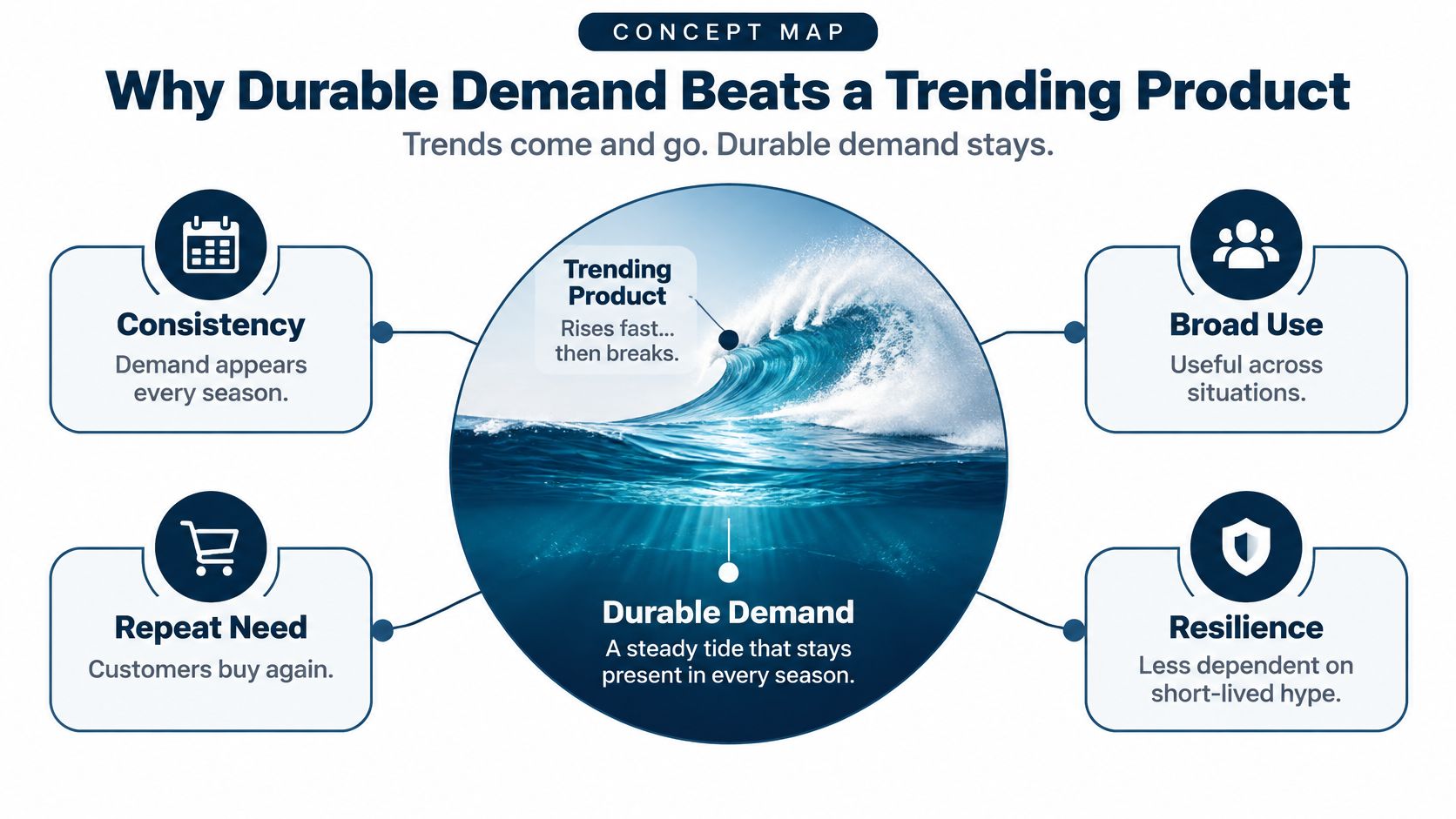
A trend is a wave: it rises quickly and breaks. Durable demand is the tide underneath, less dramatic but present beyond a single launch or viral moment.
For product screening, define durable demand through connected conditions: a recurring need, observable spending, search and sales activity that persists across seasons, and customers able to pay the delivered price. Treat those as requirements to investigate, not characteristics you can infer from a bestseller badge.
Consider a hypothetical phone accessory whose appeal depends on a new device launch. Its initial sales might reflect launch attention rather than an enduring replacement need. A household refill serves a different purchasing trigger: the customer uses the product up.
Neither automatically makes a better business. The accessory could support an attractive contribution margin, while the refill could be too expensive to ship. The distinction tells you what to validate: continued relevance for the accessory, and economical repeat purchasing for the refill.
Replacement accessories also sit between novelty and necessity. Browse Nothing But Bands' Apple Watch replacement bands as an example of a category where buyers might shop for wear replacement, activity-specific use, or appearance. Those are separate hypotheses, and each calls for different messaging and evidence.
Category size isn't a business model. Competition, margins, compliance, logistics, and acquisition costs determine whether a founder can turn demand into profitable orders.
Ask what makes the customer need the product again without another promotional event. A worn component, exhausted supply, or recurring task gives you a trigger you can investigate in reviews and order histories.
Don't confuse repeat visits with repeat need. Customers returning to compare colors aren't demonstrating replenishment behavior. Identify the event that prompts another purchase, then check whether customers describe that event themselves.
The same product category can contain buyers with very different spending capacity. In Federal Reserve household-level analysis, real average retail spending as of August 2024 was 7.9% higher for low-income households, 13.3% higher for middle-income households, and 16.7% higher for high-income households than in January 2018.
Those are inflation-adjusted changes against a pre-pandemic baseline, not nominal revenue growth or predictions for your store. Higher-income households experienced the strongest percentage increase. The low-income result was also positive, so it doesn't support a claim that their spending fell below the baseline.
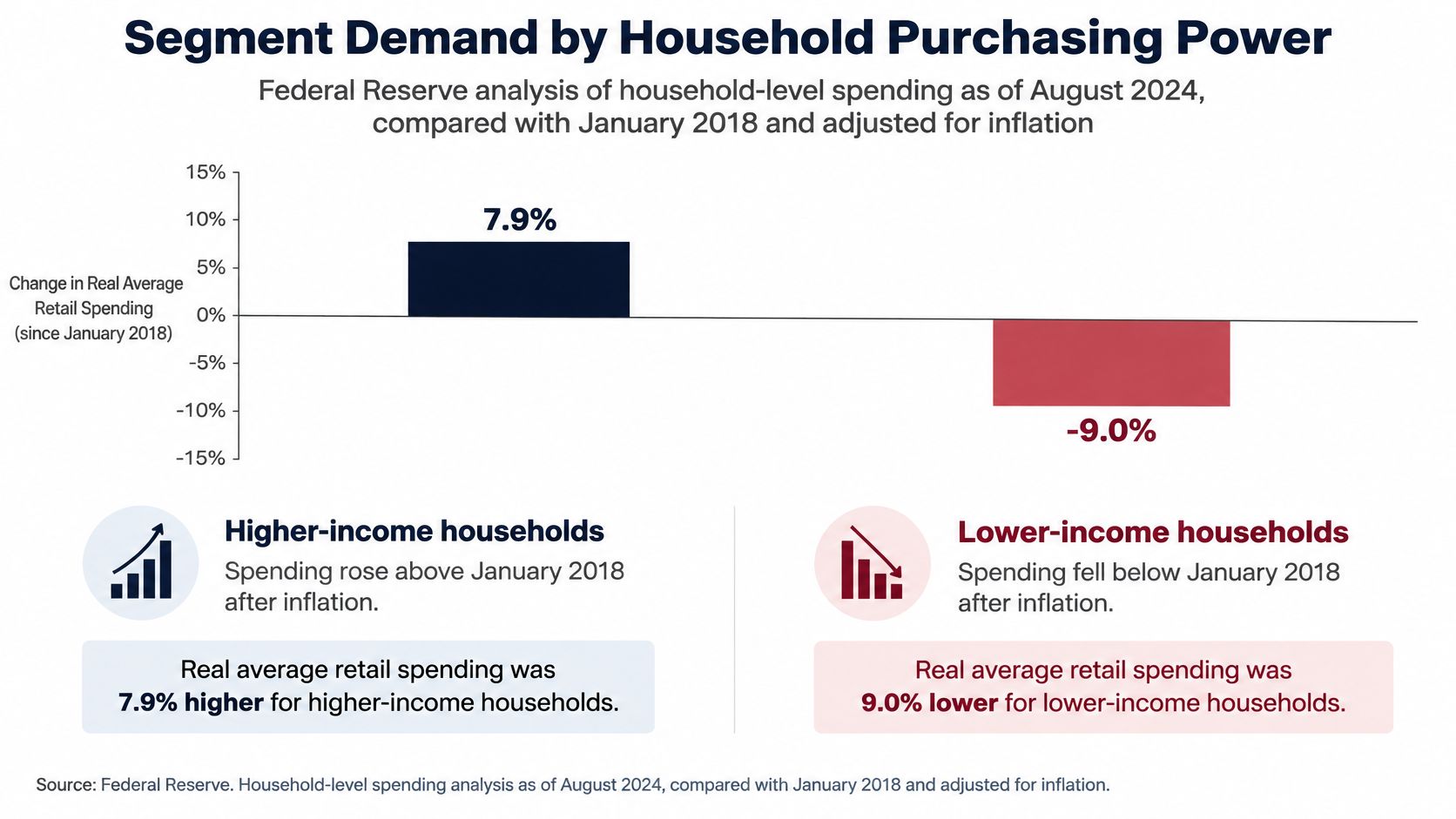
Use the source figures stated above when making decisions: the comparison is positive across all income groups, with the largest increase among high-income households.
Say you're evaluating kitchen storage containers. Don't assume the same bundle and product page should serve every buyer.
| Target segment | Offer to test | Evidence the listing should provide |
|---|---|---|
| Budget-constrained households | A practical starter pack with a manageable checkout total | Clear unit pricing, dimensions, and included components |
| Middle-income households | A coordinated set for a defined storage task | Fit, replacement options, and useful bundle contents |
| Higher-income households | A premium set emphasizing design and durability | Material specifications, care instructions, and substantiated performance claims |
These are positioning hypotheses, not findings about how every household shops. A high-income buyer may prefer the cheapest adequate solution; a budget-constrained buyer may save for something durable.
The useful distinction is which trade-off your customer is willing to make. Swift Running's discussion of running shoe durability versus price offers a concrete category for examining whether premium pricing connects to a benefit a buyer values.
The Federal Reserve analysis also describes the Census Bureau's retail-sales survey, which collects sales directly from retailers to estimate category totals. Those totals provide context, but they don't establish that demand is strengthening at your proposed price.
Choose a primary segment using a clear market segmentation approach. Then compare products within that segment's realistic spending range. Set your price after examining the alternatives that customer can afford, not after averaging an entire category.
Use a scorecard to expose weak assumptions before supplier negotiations make a candidate feel inevitable. Assess demand breadth, customer readiness, evidence burden, compliance complexity, repeat-purchase potential, and competitive intensity separately.
| Criterion | Question to ask | Where to check | Red flag |
|---|---|---|---|
| Demand breadth | Do buyers search for and purchase the underlying need beyond a single trend? | Search trends and marketplace category sales | Demand spikes once, then drops |
| Customer readiness | Do buyers understand the product and whether it fits them? | Reviews, product questions, and forum threads | Persistent confusion without demonstrated purchasing |
| Evidence burden | What proof must support the promised benefit? | Competitor claims and published testing | Essential claims require testing you can't fund |
| Compliance complexity | Which labeling, safety, or import requirements apply? | Relevant regulator guidance and marketplace category rules | Restricted ingredients or missing certifications |
| Repeat-purchase potential | Does use create a credible replacement or replenishment event? | Reorder mentions and actual subscription records | No clear reason for a customer to return |
| Competitive intensity | Which sellers dominate relevant listings, and at what prices? | Marketplace listings and advertising tools | Established competitors control visibility at an unworkable price |
A red flag isn't always a rejection. It tells you which uncertainty must be resolved before the candidate advances.
In PwC's 2026 survey of 21,808 consumers across 27 countries, 57% were qualified buyers for nutrition, supplements, and personal-care products, while another 26% needed more information or weren't yet ready to purchase. These groups shouldn't be treated as equally accessible demand.
A ready buyer may need a credible comparison and a suitable offer. An interested buyer may still need to understand intended use, limitations, suitability, or the evidence supporting a benefit.
That distinction creates an opportunity, but also a cost. You may need clearer instructions, better product documentation, or customer support before your acquisition campaign can work. Some uncertainty can't be solved with copywriting because the product itself lacks adequate substantiation.
Readiness test: Identify the unanswered question that prevents purchase, then establish whether you can answer it truthfully and economically.
Use a simple scale running from weak to strong, and make the direction consistent. A high compliance score should mean manageable requirements supported by documentation, not greater complexity.
Record the evidence beside each judgment. “Strong repeat potential” is less useful than a note identifying reorder records or customers describing a replacement trigger. When evidence is missing, mark the assessment as unverified rather than awarding an optimistic score.
Don't let a combined score hide a critical failure. A candidate with broad interest and attractive pricing still needs a hold if its essential claim can't be substantiated or its required certification is missing. Rank candidates using both their overall attractiveness and their unresolved red flags.
A technically better product doesn't necessarily produce a better customer offer. McKinsey's State of the Consumer analysis describes a bring-it-to-me mindset, with declining tolerance for inconvenience and rising expectations for service and speed.
That makes fulfillment part of product selection. Evaluate what the customer receives, when they receive it, and what the complete order costs, not just the item's specification.
Say a founder develops a superior liquid cleaning product. The formula performs well, but the packed shipment is heavy and expensive to deliver. A competing concentrate may offer customers a lower delivered cost even if they prefer the original formula.
The right response isn't automatically more persuasive advertising. Test whether concentration, packaging, pack size, or fulfillment location can change the economics without weakening the product.
A delivery promise is part of the offer. Don't advertise a service level your replenishment plan can't support.
Localized fulfillment can reduce delivery distance and cross-border friction, but it also introduces inventory allocation decisions. Region-specific assortments may be more practical than stocking every variant everywhere.
Use ecommerce demand forecasting to connect purchasing decisions with expected sales, supplier lead times, and replenishment triggers. A subscription option is only useful when you can supply the promised shipment and the customer needs it.
Validation should produce a decision, not a folder full of encouraging screenshots. Give every candidate a written hypothesis, a named owner, and a record of what would make you proceed, revise the offer, or stop.
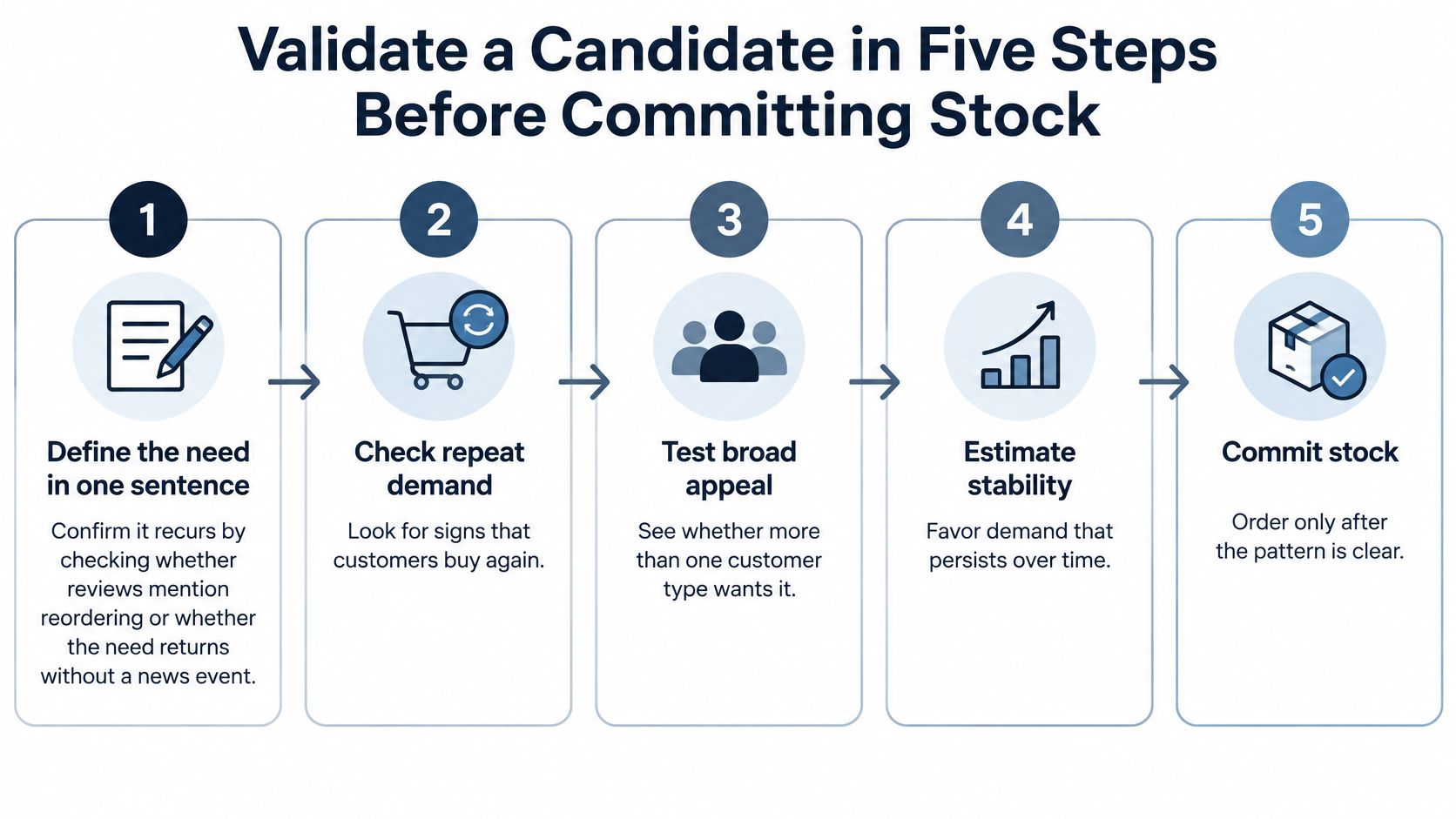
Use the following checks as decision gates. Evidence of persistent demand is necessary, but it doesn't replace claim review or a landed-cost calculation.
Write the customer, task, and purchase trigger together. For example: “Apartment residents need a replacement filter when their existing compatible filter reaches the end of its useful life.”
That statement gives you something specific to investigate. “Consumers want healthier homes” doesn't identify a product requirement or a buying event.
Read reviews for language about replacement, running out, repeated use, and compatibility. Separate actual purchasing behavior from wishes. A customer saying they would like a refill is weaker evidence than a customer describing previous refill orders.
Proceed when buyers describe an identifiable recurring task. Adjust when the need is real but your proposed format doesn't fit it. Stop when the supposed need exists only in launch commentary or your own marketing language.
Compare search behavior with category purchasing activity. Google Trends can help distinguish a persistent query from event-driven attention; marketplace keyword and category tools can help you investigate commercial relevance.
Keep the terms comparable. A broad query such as storage may include informational searches, while a specific container-size query may indicate a more defined shopping task. Don't treat both as equivalent demand.
Create a working evidence sheet with:
National totals are a plausibility check, not a forecast for your SKU. You're looking for agreement between independent signals, while documenting where estimates or incomplete coverage limit confidence.
Group customer questions by what prevents a decision: compatibility, effectiveness, safety, setup, dosage, maintenance, or price. Keep the customer's wording so you don't turn a practical concern into an abstract marketing theme.
On your own test pages, track questions alongside purchases using a consistent observation window. On competitor listings, don't calculate a question-to-purchase rate unless you have a credible purchase denominator. Public questions alone won't supply one.
Consider a hypothetical supplement candidate with broad category interest and buyers who understand the intended use. It can still stall here if the proposed benefit language requires substantiation the founder hasn't obtained.
The decision is hold for review, not launch with softer-looking copy. List every proposed claim across the label, listing, ads, and supporting content. Have a qualified reviewer assess those claims and the applicable market requirements before ordering branded inventory.
A candidate can pass the readiness check and fail the promise check. Keeping those judgments separate prevents customer enthusiasm from being mistaken for permission to make a claim.
Request a written supplier quote and calculate contribution at the price your chosen customer segment will consider. Use the packed product, planned fulfillment route, and actual fee categories rather than a factory-unit-cost shortcut.
Include:
Keep landed inventory cost separate from order-level contribution so you can see which assumption makes the offer fail. Test a less favorable freight quote, a weaker conversion outcome, and a higher return allowance rather than relying only on the preferred scenario.
Say a household refill candidate shows recurring need and encouraging repeat intent. At the realistic selling price, however, competing private-label offers leave no room for outbound freight. Adjust the format or stop the candidate; don't assume customers will accept a higher price because the need is durable.
Use a limited first order or a clearly disclosed preorder where appropriate. The offer should represent the price, product, and delivery conditions you intend to sustain, not an uneconomic promotion designed to manufacture encouraging results.
Measure completed purchases, acquisition cost, contribution, cancellations, returns, and the reasons customers hesitate. Record repeat intent separately from actual repeat purchasing. Don't scale replenishment assumptions before customers have had a realistic opportunity to use the product.
Write the decision rules before launch:
This week, choose the first candidate to test and write its go, adjust, or stop rule before spending on stock. Pressure-test that rule with founders who have already scaled, asking them to challenge the assumption most likely to make your result misleading.
At Million Dollar Sellers, we offer a peer community whose members have collective TTM revenue of $15B+, providing a place to pressure-test product decisions with experienced ecommerce founders. Members also get access to 190+ vetted partner offers worth over $20k in value. Visit us to explore the community and bring a specific demand hypothesis, landed-cost model, and test decision for discussion.
Join the Ecommerce Community for Founders Scaling from 7 to 9 Figures
Learn MoreYou may also like:
Learn more about our events!
Check Events