Chilat Doina
November 13, 2026
Three weeks ago a retail buyer asked your national account manager a simple question: why should we give you a second facing in the salty snack set? Your account manager answered with a brand story. Two days later a distributor asked the same question and got a different answer. Meanwhile the wholesale inbox fills with requests from regional chains, and every reply is written from scratch by whoever gets to it first.
That isn't a lead problem. It's a consistency problem, and it's the reason a sales playbook belongs in your operating plan before another hire or another ad budget. A playbook is not a binder of scripts. It's a system that defines who you sell to, what qualifies an account, what you ask in discovery, what evidence you show, and what has to be true before you send a proposal. Frameworks covered in this Salesmotion breakdown of MEDDIC frameworks give you the vocabulary for that system.
Eight playbooks follow. Each one covers a different part of the same problem: qualifying, discovering, opening doors, and giving a retail or wholesale buyer a reason to move now. For each, you'll get the part worth copying this week and the part that fails when your buyer is a category manager, a distributor, or a marketplace partner rather than a software CTO.
Challenger selling came out of research by the Corporate Executive Board, now Gartner, into what separated top performers in complex B2B sales. The answer wasn't relationship depth. It was that the strongest reps teach the buyer something new about the buyer's own business, tailor the message to each stakeholder, and keep control of the conversation. Applied to retail and wholesale, that changes the job of the first meeting. You're not there to describe the product. You're there to change how the buyer sees their category.
Buyers arrive at the meeting having done their homework, and increasingly they do it with AI. In 2025, 74% of sales professionals said AI makes buyer research easier, while market research and product demos were identified as more effective deal-moving content than generic collateral, according to HubSpot's sales strategy report. The same report cites Gartner's projection that 95% of seller research workflows will begin with AI by 2027, up from less than 20% in 2024.
That changes what a challenge is worth. A category overview a buyer can get from a chatbot in ninety seconds isn't an insight. What still lands is evidence the buyer can't generate alone: your repeat-purchase curve by SKU across twelve months of DTC orders, the review theme that predicts returns, the search terms where you beat the shelf leader.
Challenger fails when the insight is borrowed or condescending. A $4M brand lecturing a national retailer's category team with data that team produced gets a polite nod and no purchase order. It fails again when the seller has no standing on the topic.
Practical rule: If the buyer can pull your insight off their own dashboard, it's a summary, not a challenge.
Say a snack brand pitching twelve SKUs to a regional grocery chain opens with the repeat-purchase rate on its top two items against the buyer's own category benchmarks. Same facts, different frame, and the conversation moves from price to shelf allocation.
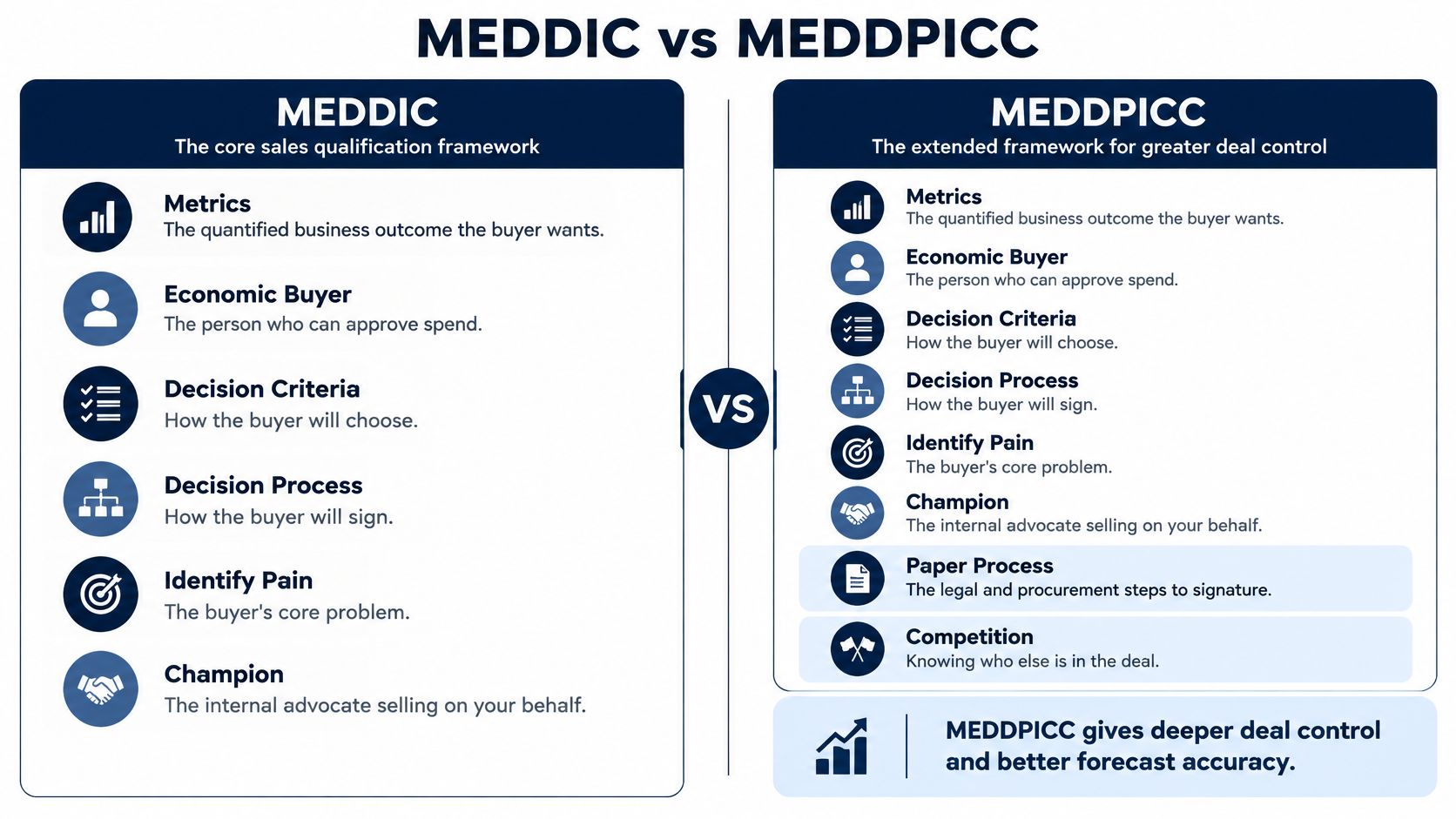
MEDDIC scores every opportunity against six questions: Metrics, Economic buyer, Decision criteria, Decision process, Identify pain, and Champion. MEDDPICC adds Paper process and Competition. The discipline is less about the acronym than about forcing a yes or no on whether a deal deserves another week of samples, spec sheets and freight quotes.
The extended version exists because procurement kills more deals than competitors do.
Aberdeen research cited in a Highspot guide to building a sales playbook found that organizations using playbooks had sales cycles 10% shorter, 12% more representatives reaching quota, and 7% greater revenue growth than peers without comparable playbook use. The same guide cites more than 20 years of CSO Insights research showing that approximately 85% of sales organizations reported doing a poor job documenting and implementing their sales process.
That gap gets expensive in ecommerce, where the people who know how to open a retailer are usually the founders, and the knowledge walks out of the room with them.
Three predictable failures. The economic buyer is often a category manager with a shared budget and no signature authority, so a scorecard that demands one name stalls the deal. The paper process (vendor setup, EDI, insurance certificates, co-op, chargebacks) is where wholesale deals die, and most rep scorecards skip it. And in marketplace negotiations there's usually no champion to map, only a system.
Score anyway. A pipeline full of blanks tells you more than a pipeline of green checkmarks.
If scoring is new to your team, Lead Printer's lead qualification guide covers how to write criteria you can test. Say a 30-store regional chain asks for a proposal. MEDDIC says you can't call it late-stage until you know who signs the vendor setup form and who approves the planogram.
SPIN comes from Neil Rackham's analysis of roughly 35,000 sales calls, and its finding was uncomfortable for the scripted-sales industry. Closing techniques correlated with worse outcomes in larger deals. Question quality correlated with better ones. The playbook runs four question types. Situation questions establish facts. Problem questions surface dissatisfaction. Implication questions cost out the problem. Need-payoff questions let the buyer describe the value of solving it themselves.
The last two are the ones sellers skip, and the ones that move a deal.
This walkthrough is a reasonable use of twenty minutes if you want the question types demonstrated rather than described.
Sales Enablement PRO's episode on optimizing your sales process reports that organizations with structured sales processes and plays had win rates 19 percentage points higher than organizations without that structure. The same source states that 70% of businesses with a standardized sales process were high performers, with a 28% revenue increase compared with businesses lacking one. Adoption widens the range further: independent summaries of CSO Insights research cited there show organizations above 90% process adoption at a 57.8% win rate and 72.4% quota attainment, against 40.4% and 49.4% for organizations below 25% adoption.
Translated for a small team: the framework is worth less than the habit of using it every call.
Two failures, both common in ecommerce. SPIN assumes the buyer will invest time in discovery, and a retail buyer reordering a proven SKU doesn't want implication questions, they want a ship date and case pack confirmation. Implication questions also patronize a buyer who knows their margin better than you do. Cost out their problem with wrong assumptions and you've spent credibility for nothing.
Use SPIN where the purchase is considered: a category launch, a private-label program, a distributor expansion, a vendor negotiation with real money on the line.
A brand pitching a private-label program uses implication questions to let the buyer calculate what a slow first quarter does to next year's planogram review. The buyer makes the case. You don't have to.
Sandler reframes the sale as a mutual evaluation. The rep qualifies the buyer as firmly as the buyer qualifies the rep, opens every call with an upfront contract covering purpose, time and outcome, and digs into the emotional reason behind the business problem. The most useful technique is the negative reverse: asking what would have to be true for the buyer to say no, which surfaces the main obstacle while it's still cheap to fix.

A brand using this with a distributor might open with: "You've got twenty minutes. I want to understand whether this line fits your Q3 plan, and if it doesn't, I'd rather know today than after three sample shipments."
McKinsey's account of a national sales-force transformation describes a company that standardized its sales processes, added performance metrics and diagnostic reports, built manager-led training academies, and put a tool in place to track every lead. The rollout reached the full sales force within six months. After 12 months, lead-conversion rates were up 20% and self-generated leads had risen 25%.
The methodology was the cheap part. The academies, the reporting and the accountability were the work.
Upfront contracts land badly with a retail buyer who took the meeting as a favor, and the "no proposal without confirmed budget and timeline" rule collides with retail RFP cycles where vendors submit blind to hit a deadline. Sandler also assumes the seller can afford to walk away. A brand chasing its first national account usually can't.
Practical rule: The contract is a courtesy, not a trap. Say what you'll ask, how long it takes, and what happens if it's not a fit.
Keenan's framework rests on one idea. Buyers don't buy products, they buy the distance between their current state and their desired future state. The rep's job is to diagnose that gap in specifics, quantify what it costs, and position the product as the bridge. It suits buyers who research before they talk to sales, because the conversation starts with their situation instead of your catalog.

McKinsey's account of a data-driven commercial playbook describes a program that used advanced analytics to identify customer white spaces, then converted them into repeatable campaign playbooks with a centralized message-development process. It recovered 90% of revenue lost during the COVID-19 crisis in seven weeks, and conversion rates improved fivefold. The same program later generated more than $1 billion in revenue through a digital platform and reduced churn three times among digitally engaged customers compared with non-engaged ones.
The transferable part isn't the scale. It's the sequence: find the gap in data, then build the play around it.
A gap only motivates a buyer if they can close it. "You're underperforming the category leader on Amazon" is a gap your contact can't fix and your champion can't either. It produces defensiveness, not a purchase order. Gaps also require the buyer to hand over current-state numbers, and plenty of retail buyers won't share sell-through with a vendor they haven't approved yet.
Pick gaps where your product is a plausible bridge and the buyer controls the lever: shelf productivity, returns rate, replenishment frequency, margin per square foot.
Say a brand pitching a distributor finds that out-of-stocks in two regions cost that distributor an estimated six figures in annualized sales. Now the product discussion starts from a number the buyer already believes.
Michael Bosworth's framework was among the first to move selling away from features and toward diagnosis. The rep identifies a business problem, builds a solution aligned to a measurable outcome, and sells that outcome to the people who own it. The structure runs pain, impact, vision of a solution, and proof. For a retail or wholesale audience it reads as competence, because you understand their operation before you talk about your product.
Adobe's 2025 retail digital trends report found that 42% of retailers prioritize unifying customer data across channels, while 43% prioritize advanced real-time data processing, with disconnected systems and organizational silos still standing in the way of personalized action. That's the environment your business case lands in. A solution story that depends on the retailer joining online and in-store data may be correct and still unactionable this quarter.
Build the case so it works with the data the buyer can reach.
Custom solutions are where margin goes to die. A brand that lets a retailer define a bespoke bundle, a new packaging format and an exclusivity window ends up with an operations problem dressed as a win, plus a production run that will never repeat. Solution selling also misfires on reorders and proven SKUs, where the buyer wants execution, not diagnosis.
There's a governance question underneath. When two channels want the same account, "solution" means deciding who owns the buyer before you design anything.
Say a retailer asks for an exclusive Q4 bundle. The solution isn't the bundle, it's a plan for shelf productivity with a defined exit date, a case pack your plant can run, and a margin floor you won't cross in January.
Aaron Ross built the outbound model at Salesforce by splitting prospecting from closing. Dedicated sales development reps worked narrow lists with tight email and phone sequences, handed qualified meetings to account executives, and pipeline became forecastable instead of heroic. The key innovation was specialization. Reps do one thing well instead of everything badly.

In ecommerce terms, one person or one block of time owns opening distributor and retail conversations, and a different person owns the account once it's live.
In 2024, 75% of B2B sellers who exceeded quota reported using artificial intelligence, according to LinkedIn Sales Solutions' Deep Sales study with Ipsos. The practical read for a small team is that list building and first-draft personalization now take minutes, which moves the constraint to judgment: knowing which accounts to exclude before you spend a week on them.
Volume sequences aimed at retail buyers during line review season get deleted, and a generic "partnership opportunity" email to a category manager is a wasted send. Deliverability is the other failure mode. One shared domain blasting 400 cold emails a week will land in spam and drag your transactional mail down with it.
The model breaks again when there's nobody to hand the meeting to. A founder doing outbound alone can book more meetings than they can run, which is worse than booking fewer.
Practical rule: Track reply rate and meetings booked per 100 prospects, not emails sent. Volume without a reply rate is a habit, not a metric.
HubSpot popularized inbound selling: publish useful content, let prospects find you, and qualify them through behavior rather than cold outreach. Product-led growth extends that by making the product itself the qualifier. Trial usage, sample reorders, portal activity and repeat purchases become the signal that routes an account to a human.
For ecommerce brands, the closest analogue is the sample or starter program. A retail buyer who reorders a sample case twice in six weeks is telling you something a discovery call can't.
The spread between the best sellers and everyone else keeps widening. In 2024, top-performing sales professionals were twice as likely to hit quota as their peers, according to LinkedIn Sales Solutions' B2B sales research. One reasonable explanation is timing. Top performers call the account that just reordered, not the account that looks biggest on paper.
Retail buyers don't self-serve a wholesale contract, and a sample program that isn't gated attracts hobbyists who will never place a case order. Content-led inbound also assumes you can out-publish competitors in a category where the buyer searches for a supplier twice a year.
The plumbing matters just as much. Signals only route accounts if your storefront, wholesale portal and CRM share one customer record. If they don't, you're doing product-led growth with three versions of the same buyer.
| Item | Best For | Core Motions | Sales Cycle Fit | Ecommerce Use Case |
|---|---|---|---|---|
| The Challenger Sale | Complex, multi-stakeholder B2B deals | Teach with commercial insight, tailor by stakeholder, take control | Long, considered sales cycles | Reframe retail buyers' shelf-space decisions with category data |
| MEDDIC / MEDDPICC | Qualifying and forecasting complex opportunities | Verify metrics, buyer, criteria, process, pain, champion, paperwork, and competition | Long, committee-led deals | Qualify wholesale or retail programs with multiple decision-makers |
| SPIN Selling | High-consideration purchases requiring discovery | Ask Situation, Problem, Implication, and Need-payoff questions | Longer deals where buyers must assess the cost of inaction | Explore retailer concerns about margin or inventory risk |
| Sandler Selling System | Qualification-focused inbound and outbound teams | Set upfront contracts, uncover pain, qualify budget and timing, agree on next steps | Structured cycles where stalled deals need early qualification | Set call expectations and qualify agency or wholesale prospects |
| Gap Selling | Consultative sales tied to measurable outcomes | Map current and future states, quantify the gap, diagnose root causes | Considered and enterprise sales | Compare marketplace performance with target margins or share |
| Solution Selling | Complex deals centered on business problems | Diagnose needs, build a business case, tailor proof to stakeholders | Longer cycles involving several buyer roles | Align a solution with measurable outcomes for retail or B2B buyers |
| Predictable Revenue Outbound Playbook | Teams building repeatable outbound pipeline | Segment prospect lists, run outreach sequences, measure and refine results | Ongoing prospecting that feeds a sales pipeline | Reach distributors, retailers, and agencies with targeted campaigns |
| Product-Led Growth and Inbound Sales Playbook | Products that demonstrate value through use or trial | Attract inbound interest, offer trials or samples, route accounts using usage signals | Self-serve entry with sales support for qualified or expanding accounts | Use samples, starter kits, or repeat-purchase signals to qualify buyers |
When a retailer asks for a margin concession while marketplace costs are rising, a generic sales script will not help your team decide what to protect. Eight frameworks are too many to run at once. Choose one qualification framework, such as MEDDIC; one discovery method, such as SPIN for considered purchases or Gap Selling for measurable outcomes; and one sales motion, such as outbound prospecting or product-led inbound. Write down how each applies to your buyers and channels.
Put the chosen methods in one playbook where the team works, not in a PDF. Include six practical components:
Use a 30-minute weekly review to examine live deals. Ask which play the team applied and whether the documented exit criteria were met. If the same exception keeps recurring, update the playbook rather than asking reps to improvise.
Automate only after the manual process works. Run the play by hand, identify where it breaks, then use this guide to automating online store sales to consider what to automate. Automating unclear rules makes inconsistent decisions faster.
Million Dollar Sellers members get 500+ SOPs and templates, along with recorded weekly tactics calls, to adapt for their own Amazon, DTC, and omnichannel brands. Use those resources as starting points, then rewrite the language and decision rules for your category.
Million Dollar Sellers is an invite-only community for ecommerce founders. Its members collectively generate $15B+ in TTM revenue. For founders building qualification criteria, channel ownership rules, and discovery scripts, the community offers access to peers focused entirely on ecommerce operators. Applicants interview with a current member and the MDS team, and founders interview founders. Learn more about Million Dollar Sellers.
Join the Ecommerce Community for Founders Scaling from 7 to 9 Figures
Learn MoreYou may also like:
Learn more about our events!
Check Events