Chilat Doina
July 20, 2026
Most advice on managing the sales pipeline starts in the wrong place. It tells you to map seller steps, clean up the CRM, and push reps to log activity. That sounds organized. It also creates a pipeline full of motion without much truth.
That's why founders end up staring at a dashboard packed with “active” deals that aren't moving. Proposal sent. Follow-up scheduled. Demo completed. None of that means the buyer is committed. It only means your team did something.
For omnichannel brands, that gap is expensive. A wholesale conversation with a retail buyer, a marketplace partnership discussion, and a large DTC B2B opportunity all move at different speeds. If your pipeline tracks rep effort instead of buyer progress, your forecast turns into a confidence game. You can't plan inventory, cash, hiring, or ad spend off that.
The fix is simple to understand and harder to enforce. Build the pipeline around proof of buyer intent. Then manage it with discipline. If you already have a lot of activity data, use it to spot where your forecast keeps breaking. This is the same reason teams that get serious about analyzing sales data usually discover that their stage definitions, not their reps, are the actual problem.
The most common pipeline stages are built around seller actions. Contacted. Demo booked. Proposal sent. Negotiation. Those stages are easy to log because they depend on your team, not the buyer.
That's also why they fail.
A rep can send a proposal to an unqualified account. A founder can take a great call with a retailer that has no open budget. An account manager can label a deal “late stage” because the conversation feels warm. None of those things tell you whether the buyer has advanced.
A lying pipeline usually has three symptoms:
This gets worse as you scale across channels. In DTC partnerships, the buyer path may hinge on approved test scope, margin fit, or internal signoff. In wholesale, it may hinge on line review timing, category approval, or executive sponsor buy-in. “Proposal sent” tells you almost nothing in either case.
Practical rule: If a stage can be advanced without the buyer confirming something, it's not a real stage. It's a rep task.
A lot of teams blame CRM adoption. Sometimes that's fair. More often, the tool is carrying a broken model. If the underlying structure is seller-centric, clean data still produces bad forecasts.
The strongest shift I've seen is moving from internal activity labels to buyer-verifiable checkpoints. That means asking a harder question at every stage: what did the buyer do, approve, share, or commit to that proves this deal is real?
That change sounds small. It isn't. It's the difference between a pipe full of “work performed” and a pipe full of “revenue likely.”
A buyer-centric pipeline usually needs 6 to 8 rigorously defined stages that mirror the buyer's decision process, with qualification frameworks like MEDDIC or BANT embedded across multiple stages, not just discovery, according to Elephant RevOps on high-velocity pipeline design.
The biggest upgrade is straightforward. Replace generic seller-activity stages with buyer-behavior stages such as Budget Confirmed or Executive Sponsor Engaged. Prospeo's pipeline challenges analysis argues that this is the single most impactful fix for forecast accuracy, and that phantom deals without buyer activity in the last 30 days should be purged immediately for better predictability, as noted in its breakdown of sales pipeline challenges.
Every stage needs two things:
That means “Discovery complete” isn't enough. A real stage change might require confirmed pain, identified stakeholders, and agreement on the next evaluation step. If the buyer won't confirm those things, the deal hasn't moved.
Here's the transformation.
| Stage Number | Traditional Stage (Seller Activity) | Buyer-Centric Stage (Buyer Commitment) | Exit Criteria (Example) |
|---|---|---|---|
| 1 | Lead Contacted | Problem Acknowledged | Buyer confirms a relevant business problem worth solving |
| 2 | Discovery Call Held | Stakeholders Identified | Buyer names decision-makers and process participants |
| 3 | Demo Completed | Solution Validated | Buyer confirms the solution fits core use case |
| 4 | Proposal Sent | Budget Confirmed | Buyer confirms funding path or approved spend range |
| 5 | Follow-Up / Negotiation | Decision Process Confirmed | Buyer shares timeline, approval path, and next meeting |
| 6 | Verbal Commit | Executive Sponsor Engaged | Senior decision-maker is involved and aligned |
| 7 | Contract Sent | Final Approval in Motion | Buyer has initiated procurement or internal approval |
| 8 | Closed Won | Live Commercial Agreement | Agreement is executed |
For a DTC brand partnership, a stage shouldn't move because your rep sent a sample deck. It should move when the buyer confirms the test criteria, margin fit, and who owns approval on their side.
For an Amazon wholesale account, the deal isn't “late stage” because terms were discussed. It's late stage when the buyer has confirmed assortment interest, ordering path, and internal sponsor support.
That's why I prefer stage names like these:
Those names force clarity.
A quick visual helps operationalize the structure:
If your stage definitions are soft, reps will interpret them loosely. That's not a character issue. It's normal behavior in any revenue team under pressure.
Use mandatory fields tied to each stage:
A stage should be hard enough that two different managers reviewing the same deal would place it in the same spot.
That consistency is what makes managing the sales pipeline useful. Without it, the CRM is just a more expensive spreadsheet.
A buyer-centric pipeline still fails if qualification happens once and then disappears. That's the trap with BANT, MEDDIC, or any other framework. Teams treat it like a discovery checklist, then let deals drift for weeks with no revalidation.
Qualification has to stay live through the entire deal.
When a deal moves, ask different questions than you asked at the start.
At the front of the pipeline, you're testing fit. Later, you're testing commitment. Near the end, you're testing execution risk.
A practical operating standard looks like this:
Many brands get sloppy managing their sales pipeline. Reps keep old assumptions in the CRM long after the buying situation has changed. Budget moved. The champion lost influence. Another stakeholder appeared. The deal still looks clean on the board because nobody forced a re-check.
High-performing sales teams review pipelines at least weekly, and deals that stagnate for more than 14 days without a documented next step are significantly more likely to be lost, according to Salesforce's guidance on pipeline management.
That one rule alone changes behavior. If a deal sits without contact or a next step, it shouldn't remain comfortably “active.”
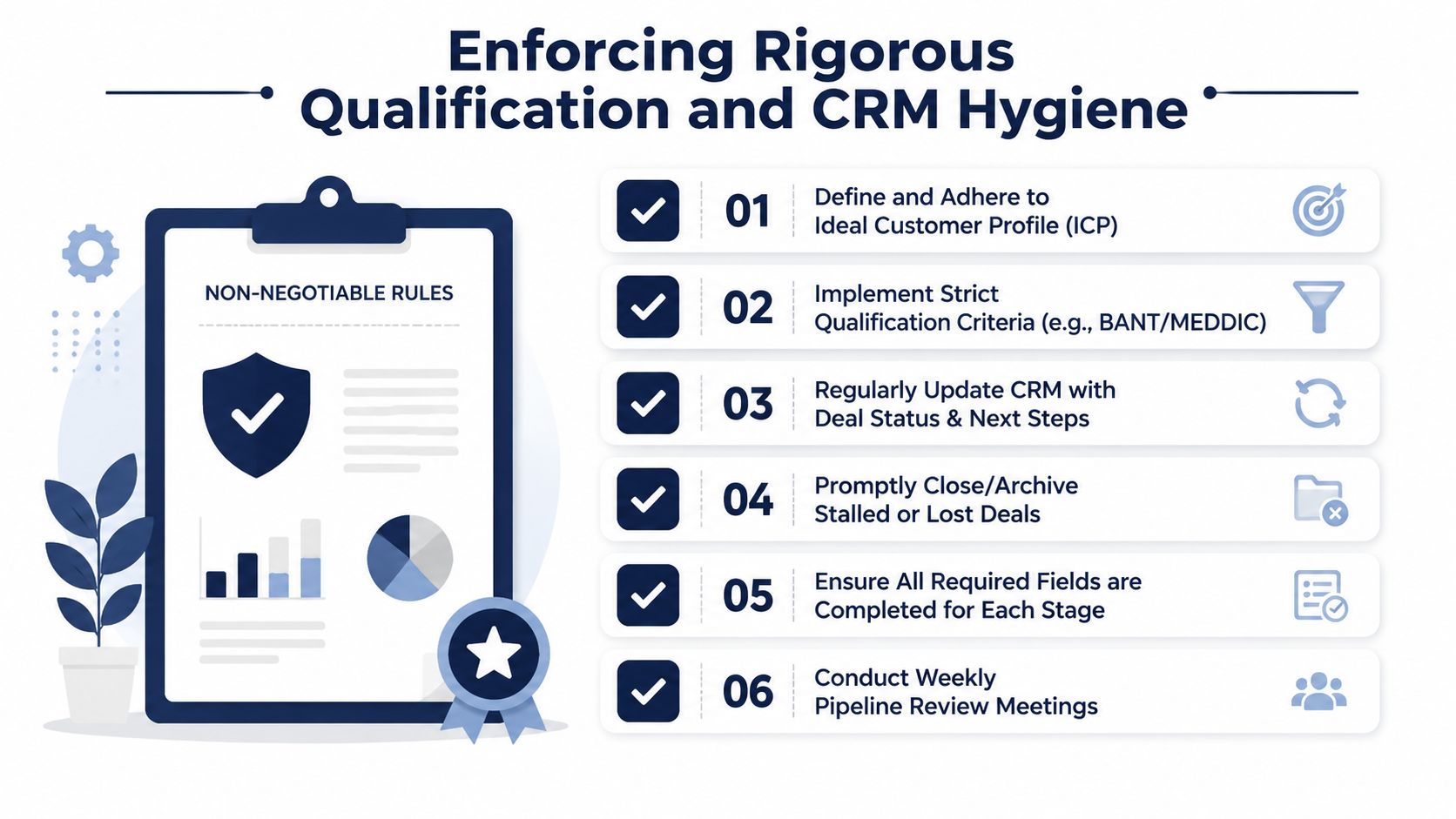
Good CRM hygiene isn't glamorous. It's operational honesty:
If your team is evaluating platforms to support this discipline, it helps to compare the best CRM for ecommerce through the lens of stage enforcement, required fields, and automation, not just contact management.
The most useful pipeline reviews are not broad team calls where everyone speed-runs updates. For high-velocity teams, 30-minute 1:1 pipeline reviews weekly or biweekly, covering 5 to 10 key deals per rep through the five pillars of Qualification, Coverage, Next Steps, Forecast Accuracy, and Execution, can improve close rates by 18% compared with aggregated reporting, according to Elephant RevOps' pipeline review framework.
That format works because it exposes deal truth.
Manager cue: “Show me the buyer evidence that earns this stage.”
If the rep can't answer that cleanly, the deal is in the wrong place. If that happens repeatedly, the issue isn't motivation. It's standards.
Forecasting gets easier when the pipeline reflects buyer behavior. It gets reliable when you stop pretending all pipeline dollars are equal.
Start with coverage. Then add weighting based on who owns the deal and how that channel converts.
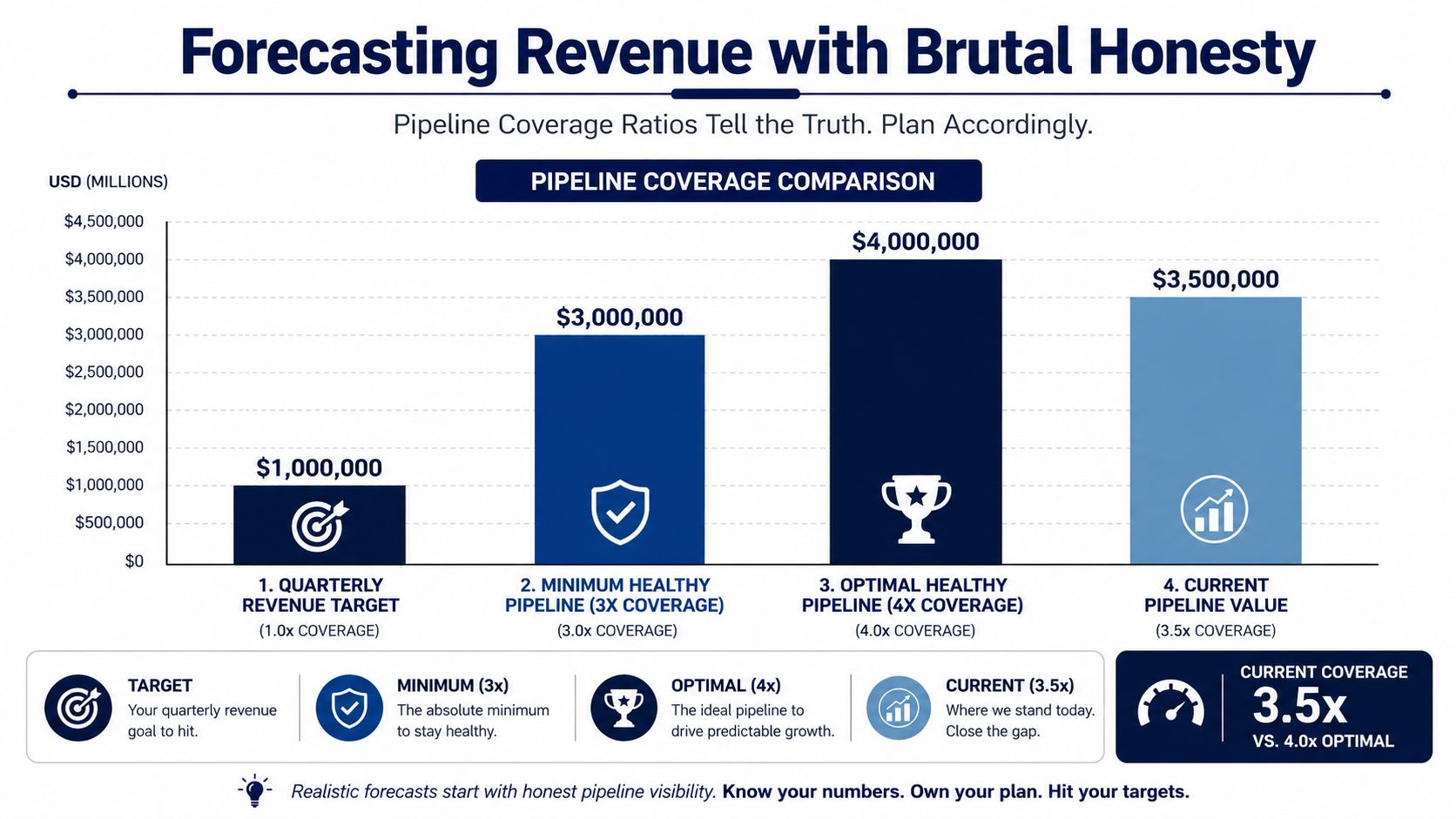
Industry best practice is to maintain a pipeline coverage ratio of 3x to 4x quota. If quarterly quota is $1 million, the pipeline should sit between $3 million and $4 million to absorb the typical 10% to 25% early-stage drop-out rate, according to Teamgate's explanation of pipeline coverage metrics.
That metric matters because many founders overestimate what's closable. A loaded pipeline feels safe. It often isn't. If coverage is below that range, there's no cushion for slippage, weak qualification, or timing misses.
A simple founder lens:
Typically, generic pipeline advice goes no further. It assumes average win rates are enough.
They're not, especially for omnichannel brands. A founder selling into retail, marketplaces, distribution, and strategic B2B accounts doesn't have one clean motion. Different reps close differently. Different channels behave differently. Seasonal demand changes how likely deals are to land in-period.
Prospeo's 2026 pipeline challenges analysis argues that a weighted pipeline built around individual rep effectiveness produces more accurate projections than blanket averages, especially in environments where rep performance differs sharply by channel, as described in its weighted forecasting discussion.
That's the useful model. Not “we usually close X percent.” More like:
Treating all of those as one blended probability gives you a comforting number and a bad forecast.
This is one place where smart systems help. Automated reminders, required next-step fields, and structured follow-up make the forecast cleaner because they force recency and evidence. Teams looking at practical strategies for boosting revenue with AI can use those tools to tighten follow-up discipline and surface risk earlier, but the core judgment still has to come from buyer-verified stage design.
The forecast should be something you'd use to make inventory and hiring decisions, not something you hope will rescue the quarter.
That's the standard. If you wouldn't plan cash against it, it isn't a forecast. It's pipeline theater.
Most dashboards track too much and explain too little. If you're managing the sales pipeline well, you don't need more metrics. You need a short list that tells you where momentum is breaking.
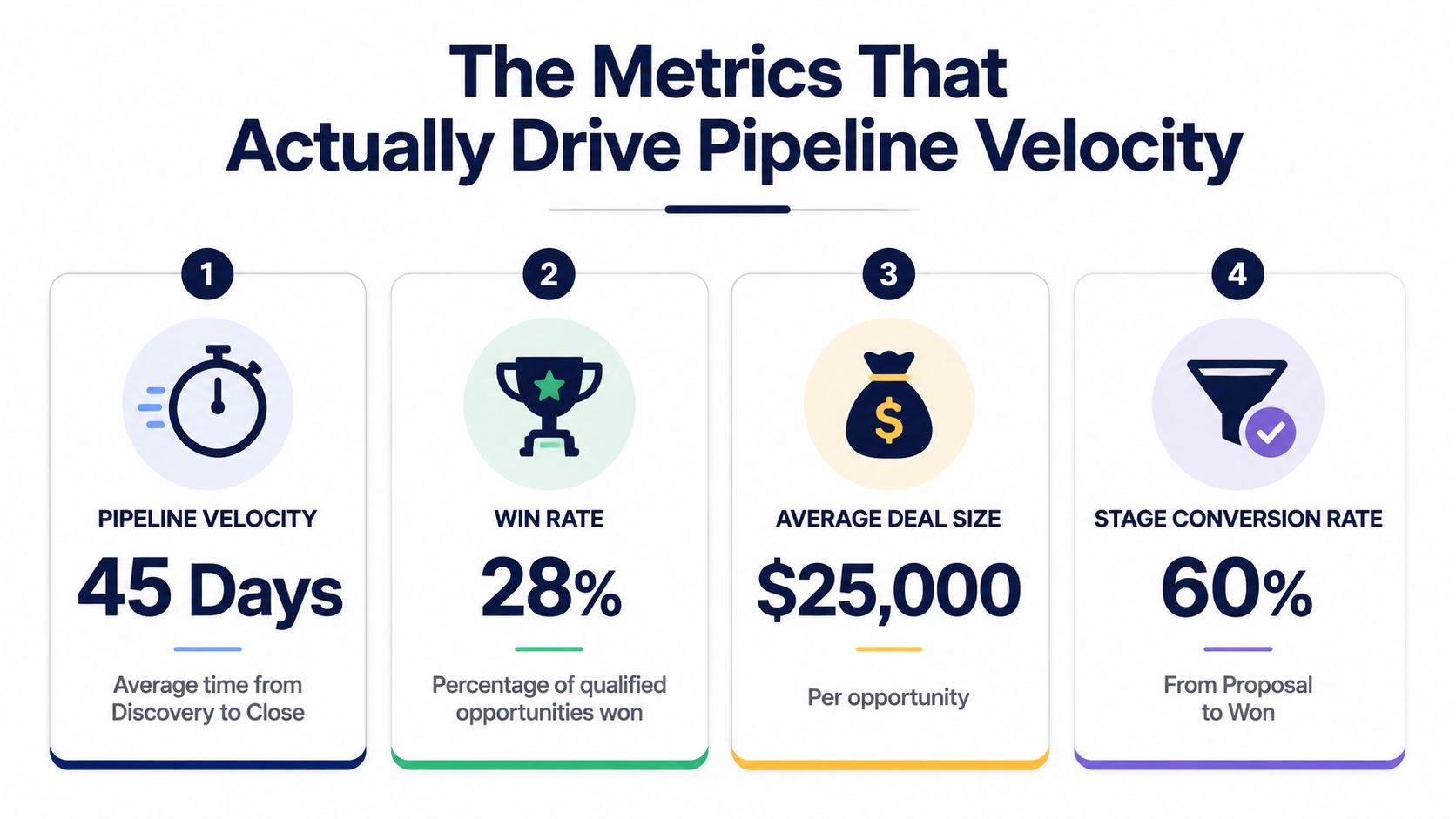
I like a compact operating dashboard built around these signals:
None of these numbers matter in isolation. The value comes from how they interact.
If average deal size looks strong but cycle length keeps stretching, you may be over-indexing on complex deals without enough shorter-cycle coverage. If velocity slows while conversion drops in one stage, that stage likely has a qualification or buyer-friction problem.
A few examples make this practical.
| Metric | What a drop usually means | What to inspect first |
|---|---|---|
| Sales velocity | Deals are stalling or late-stage quality is weak | Next-step discipline and stage recency |
| Stage conversion | A specific handoff is broken | Stage definition and buyer proof requirements |
| Average deal size | Team is chasing smaller or lower-fit accounts | ICP adherence and channel mix |
| Sales cycle length | Buyers face friction or internal approvals are slow | Stakeholder mapping and approval path |
The key is not to react with generic pressure. React with diagnosis.
A poor conversion rate between early qualification and mid-stage validation usually means the team is admitting weak-fit opportunities. A long cycle at the end often means nobody secured the decision-making process early enough.
High-performing teams review the pipeline at least weekly, and deals that sit for more than 14 days without a documented next step are more likely to be lost, according to the Salesforce guidance cited earlier.
That should shape the meeting agenda. Not a roll call of every open deal. A fast review of movement and risk.
A useful weekly review sounds like this:
A velocity review is not a motivation meeting. It's a bottleneck hunt.
Run it that way and the numbers become diagnostic. Run it as a status theater session and everyone leaves with the same blind spots they brought in.
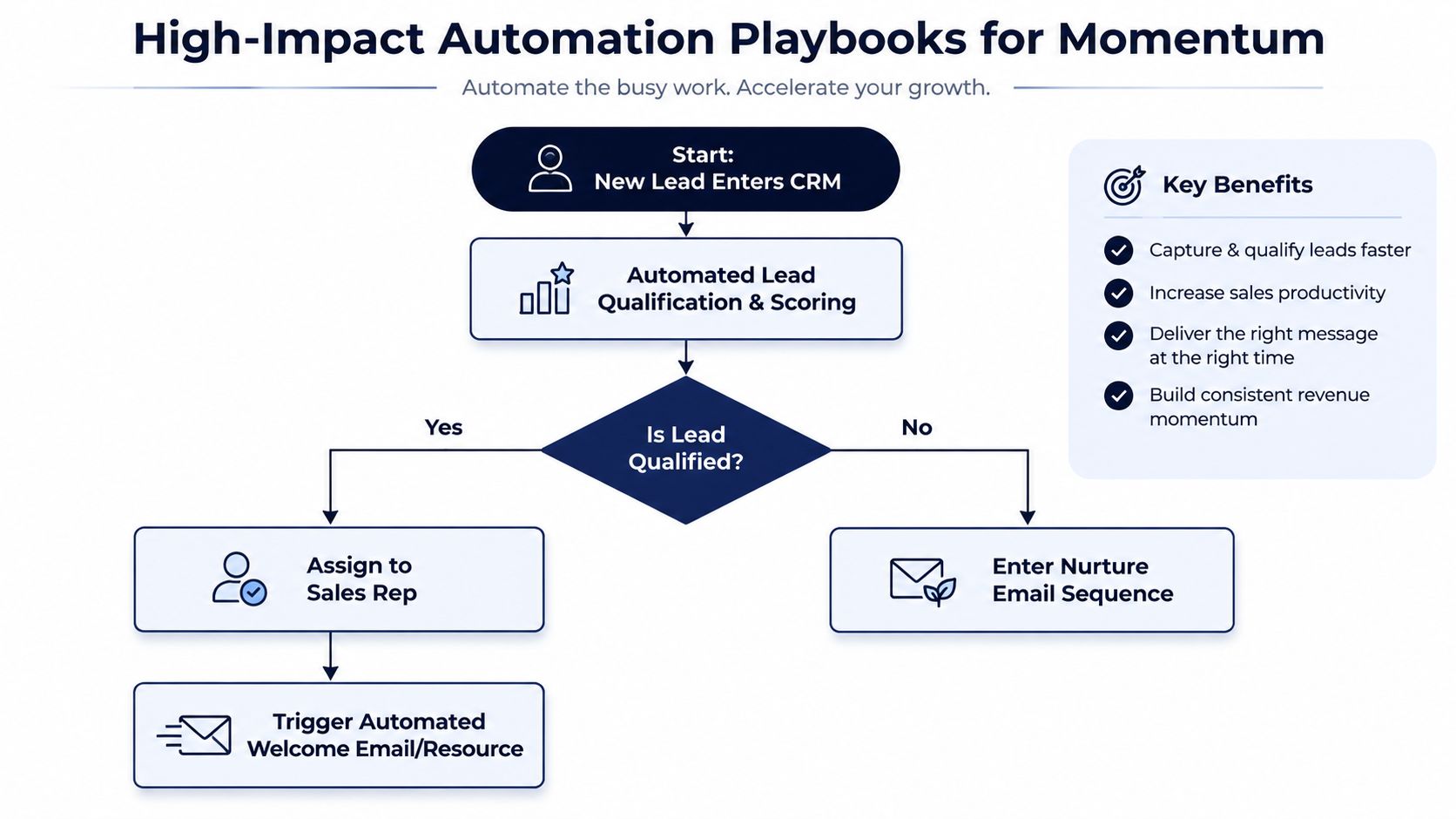
Automation is most useful when it behaves like a strict sales manager. Not a flashy assistant. Not a novelty. A rules engine that catches drift early and forces action.
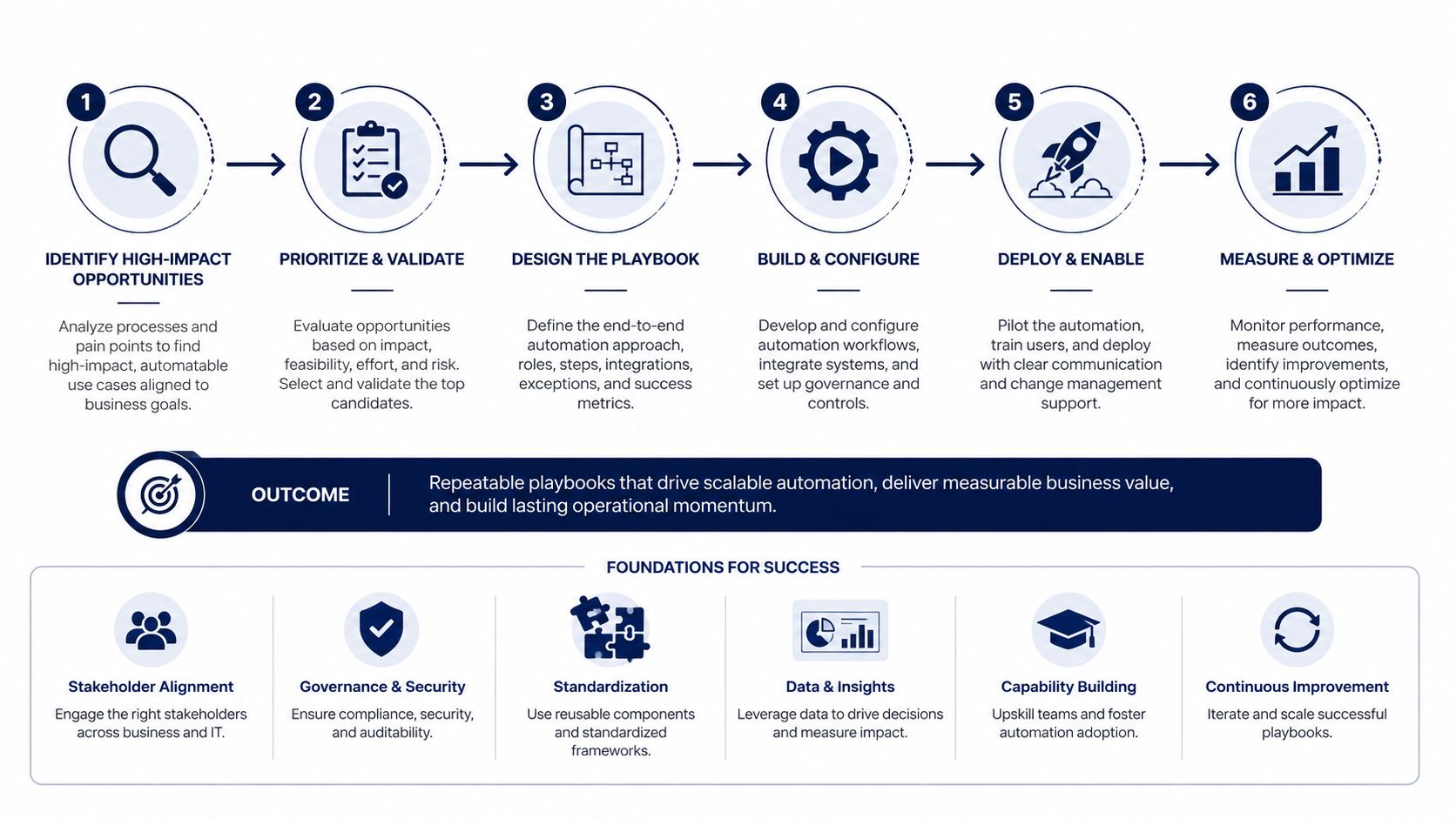
Organizations with automated follow-up sequences and mandatory next step + date fields on every opportunity achieve 15–22% higher revenue per rep than teams relying on manual processes, according to Prospeo's sales pipeline management best practices.
These are the ones I'd put in first.
Those automations don't replace management. They standardize it.
A practical setup can look like this:
Top of funnel
Lead enters HubSpot or Salesforce. Lead scoring tags fit and urgency. Qualified leads route to the right rep or channel owner.
Mid funnel
The CRM requires buyer evidence before the stage can change. Missing stakeholders or an undefined decision path trigger a task.
Late funnel
If the close date moves repeatedly, the system forces a manager review. If procurement starts, legal or finance gets notified internally.
For teams tightening operations across functions, automating business processes ceases to be an efficiency project and becomes a forecast integrity project.
Bad automation speeds up bad process. Good automation enforces standards the team already believes in.
That's why the order matters. First define buyer-based stages. Then enforce qualification. Then automate the rules. If you skip that sequence, the system just helps reps move weak deals faster and hide problems more neatly.
The best pipeline isn't the fullest one. It's the one you can trust.
Million Dollar Sellers is where serious e-commerce founders compare notes on what's working across Amazon, DTC, and omnichannel growth. If you want sharper operator-level conversations about forecasting, sales process, and scaling with less noise, explore Million Dollar Sellers.
Join the Ecom Entrepreneur Community for Vetted 7-9 Figure Ecommerce Founders
Learn MoreYou may also like:
Learn more about our special events!
Check Events