Chilat Doina
April 17, 2026
You’re probably in one of two positions right now.
Either you’ve watched Ridge show up everywhere for years and dismissed it as “just another heavily advertised wallet brand,” or you’ve looked at the business behind it and realized the product is almost beside the point. The core story is the machine. The product gets attention. The system compounds it.
That’s why the sean frank ridge wallet playbook matters. It’s not interesting because it sells a slim wallet. It’s interesting because it turned a narrow product into a broad, high-impact consumer brand without the usual venture-backed growth script. If you run Amazon, DTC, or both, Ridge is one of the cleaner examples of what happens when product design, customer acquisition, cross-sell logic, and operational discipline line up.
Most strong operators have had the same reaction to Ridge at some point. You see the ads. You see the creator integrations. You see the product line creeping wider. Then you ask the only question that matters. What’s underneath this thing?
The answer starts with bootstrapping and timing, but it doesn’t end there. Ridge began as a Kickstarter product and raised $266,000 to produce and sell the initial wallets, then later expanded under Sean Frank into a much larger men’s accessories business that grew to over $100 million in annual revenue without outside capital until recently, according to this Sean Frank interview on YouTube.

That matters because founder-led brands usually break in one of two places. They either never get beyond the hero SKU, or they expand too early and dilute what made the first product work. Ridge avoided both traps. It kept the wallet as the identity anchor while building a brand world around it.
Ridge didn’t win by being the cheapest option or the most technically complex product in the category. It won by being easy to understand, easy to gift, easy to demonstrate in video, and easy to attach to an identity. Minimalist. Durable. Modern. Premium enough to feel like a step up from a leather bifold, but still mass-market enough to scale.
That combination is rare.
If you sell online, especially in a crowded category, one lesson is immediate. The market often rewards products that compress a category story into one glance. Ridge does that well. You can also see a similar pattern in newer commerce channels where a product’s visible difference drives top-of-funnel attention. The broader mechanics are well illustrated in HiveHQ’s breakdown of how TikTok Shop creates category demand.
Ridge is a strong reminder that “obvious on camera” beats “technically better but harder to explain” more often than founders want to admit.
Don’t study Ridge as a wallet company. Study it as a model for:
Most brands never get all four right at the same time. Ridge did.
The first thing most sellers get wrong about Ridge is thinking the product won because of marketing alone. The marketing worked because the product was engineered to support a very specific narrative.
The wallet is compact, visual, and self-explanatory. It carries cards and cash in a metal form factor that looks different from a traditional wallet immediately. That last part matters more than founders think. In feed-based discovery, visual contrast is a growth lever.
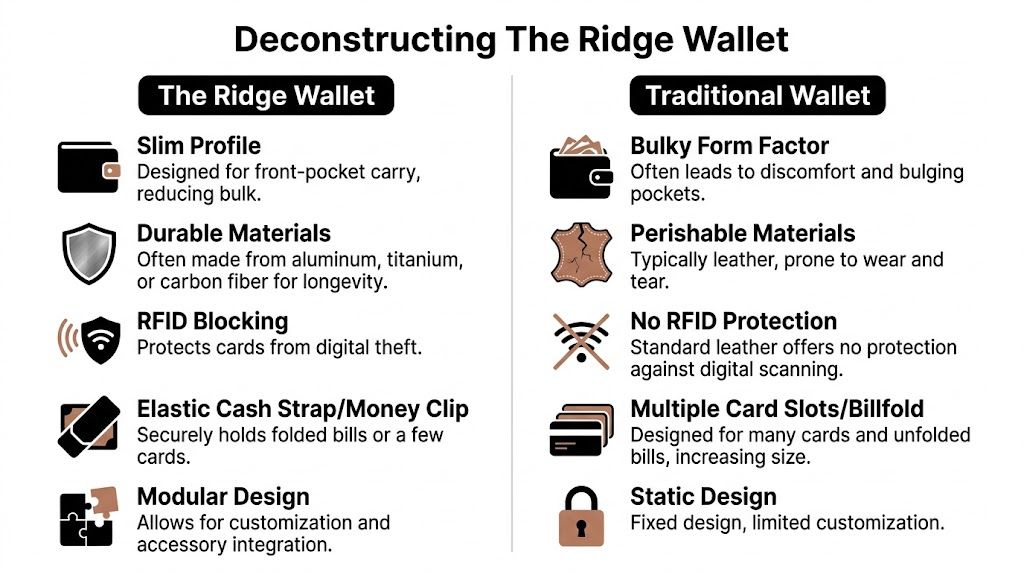
A traditional leather wallet asks the buyer to value familiarity. Ridge asks the buyer to value reduction. Less bulk. Fewer moving parts. Cleaner silhouette. That’s not just industrial design. That’s positioning.
The product also gives the brand room to ladder materials upward. Aluminum, titanium, and carbon fiber don’t just change the spec sheet. They create merchandising logic. One base concept. Multiple premium expressions.
Here’s the practical value of that structure:
| Product element | Why it matters commercially |
|---|---|
| Slim profile | Easy visual comparison against bulky wallets |
| Metal construction | Feels durable and premium on first impression |
| Material variants | Creates price architecture without changing category |
| Cash strap or clip | Adds visible modularity and preference choice |
| RFID framing | Gives a functional reason to upgrade |
That’s a textbook example of product-led premiumization. If you want more examples of brands creating defensible contrast inside a mature category, this breakdown of product differentiation examples is worth reviewing.
Founders often talk about premium materials as if buyers care about metallurgy. Most don’t. What buyers care about is whether the material choice supports a believable story.
With Ridge, each material tier says something slightly different:
That gives the merchandising team multiple angles without changing the core use case. It also helps the ad team. Different materials let you test different identities while selling the same format.
Practical rule: If one core product can support several buyer identities without fragmenting your catalog, keep pushing depth before you add width.
Ridge’s RFID-blocking story is one of the better examples of a functional USP doing real commercial work. The wallet uses dual metal plates to form a Faraday cage, mitigating 13.56 MHz NFC skimming, which gives the brand a clear security angle and supports premium positioning, as noted in this overview of Ridge’s RFID-blocking design).
For most brands, the mistake is slapping on a feature that nobody understands. Ridge avoided that by making the benefit intuitive. Even if the average customer can’t explain Faraday shielding, “protects your cards from digital theft” is easy to process.
That’s what makes the feature useful in conversion. It gives buyers a reason to justify spending more than they would on a basic wallet. It also helps gift buyers. When someone buys a practical product for another person, security is an easy emotional bridge.
The wrong takeaway is “make a metal version of a common item.” That misses the point. Ridge works because the product has all of these at once:
Miss two of those, and you don’t have a Ridge-style hero product. You just have a more expensive object.
The smart part of the sean frank ridge wallet strategy isn’t the wallet itself. It’s what the wallet allows the company to do after the first purchase.
Ridge uses the wallet as the front door. It’s the easiest product in the brand to understand, the easiest to gift, and the easiest to advertise repeatedly without exhausting the creative concept.

The backend's strategic advantage becomes apparent. Ridge’s playbook under Sean Frank uses the wallet to acquire customers, then cross-sells them into a broader accessories ecosystem. That approach helped the brand grow its ring line into an eight-figure revenue stream in its first year by selling into an existing base of over 5 million customers, according to this Ridge case study on ThoughtLeaders.
A lot of brands launch accessories as afterthoughts. Ridge built them as a system.
That distinction matters. A random add-on SKU usually creates operational clutter. A coherent adjacent SKU increases customer value without retraining the buyer on what the brand stands for. Ridge stayed inside the same identity zone. Everyday carry. Premium materials. Minimalist male-oriented accessories.
That’s why the expansion worked.
One clear acquisition product
The wallet brings people in with low conceptual friction.
Adjacency with logic
Rings, key organizers, luggage, and similar products sit close enough to the original purchase psychology to feel natural.
Installed-base monetization
Existing buyers are cheaper to sell to than cold traffic when the offer fits the same brand identity.
Channel continuity
The same creative themes can often be repurposed across multiple products because the aesthetic remains consistent.
They add products because they want more revenue, not because the buyer has another obvious next purchase.
That’s how catalogs become messy. One product solves a problem. The next product chases a keyword. The third exists because a supplier pitched it. Before long, the brand has no center of gravity.
Ridge’s discipline is clearer. The catalog feels like one person could plausibly own multiple products from the same company without cognitive dissonance.
Your second product shouldn’t need a brand rewrite. If it does, it probably belongs in a different company.
The best DTC operators know customer acquisition is only half the equation. If your first purchase barely breaks even, your second and third purchases decide whether the model works. Sean Frank’s edge appears to be understanding that the wallet didn’t need to be the entire business. It needed to be the customer creation engine.
That’s also why strong retention and merchandising infrastructure matter more than flashy launch tactics. If you’re trying to build a similar system, you need better segmentation, cleaner post-purchase sequencing, and a disciplined content pipeline. Teams looking at AI workflows for those systems may find Sharpmatter AI useful as a reference point for speeding up creative and operational execution.
A useful way to think about Ridge is this:
| Layer | Ridge’s apparent role |
|---|---|
| Hero product | Acquires attention and first purchase |
| Follow-on products | Extend customer value |
| Brand identity | Makes the extensions believable |
| Lifecycle marketing | Turns single orders into a relationship |
Here’s the more tactical lens. If your hero SKU is doing its job, your email and SMS flows should not feel like generic discount reminders. They should feel like guided migration into a product family.
A good interview gives more context on how operators think about these growth systems in practice.
Replicate the logic, not the category.
Don’t copy “wallet into rings.” Copy “hero SKU into adjacent products that preserve identity and raise customer value.” If you sell kitchen tools, fitness accessories, pet products, or travel gear, the structure still holds. One sharp entry point. One coherent customer persona. One adjacent catalog that makes obvious sense.
What doesn’t work is adding “more products” without a customer map. Ridge’s catalog expansion worked because the next offer was already implied by the first one.
Most founders can understand why Ridge gets attention. Fewer understand how a brand at that scale stays lean enough to keep compounding.
The headline metric is the one that should make every operator stop and reassess their org chart. Under Sean Frank’s leadership, Ridge generates $5 million in revenue per employee by deploying AI across the business, according to Shopify’s profile on how Ridge uses AI to grow revenue.
That figure isn’t interesting because it sounds impressive. It’s interesting because it forces a harder question. Where are you still hiring people to do work that a system should already absorb?
The old e-commerce model tolerated bloated teams because customer acquisition was easier and mistakes were cheaper. That model is fading. Today, brands need tighter inventory planning, faster creative iteration, cleaner customer support workflows, and fewer internal handoffs.
Ridge appears to have treated AI as infrastructure, not a novelty.
That’s the key lesson. Many organizations experiment with AI in isolated tasks. Strong operators redesign workflows around it. They don’t ask, “Can this tool help my copywriter?” They ask, “Should this process still exist in its current form?”
A lean team doesn’t mean under-resourced. It means the business only pays humans for judgment, exception handling, and leverage.
You don’t need Ridge’s exact org structure to borrow the operating philosophy. The practical applications are familiar:
If your team still runs on tribal knowledge, fragmented dashboards, and inbox-based approvals, scale will feel heavier than it needs to. That’s where process clarity matters. This guide on how to create standard operating procedures is useful if you need to codify decision paths before layering automation on top.
Blind automation creates new messes.
A lot of founders hear “AI efficiency” and rush to cut headcount before they’ve defined process ownership. That backfires. Bad systems scaled with software only produce cleaner chaos. The Ridge example is more disciplined than that. The company seems to use AI to handle repeatable volume while leaving judgment-heavy work to smaller, stronger teams.
That’s the difference between advantage and fragility.
If you want to resell Ridge, brand theory won’t save you from a counterfeit problem, a rights issue, or bad inventory bought from the wrong channel. This is one of those categories where one sloppy purchasing decision can cost margin, platform trust, and customer confidence in the same week.
The first rule is simple. Buy as if every unit will eventually need to be defended. If you can’t prove where the product came from, don’t touch it.
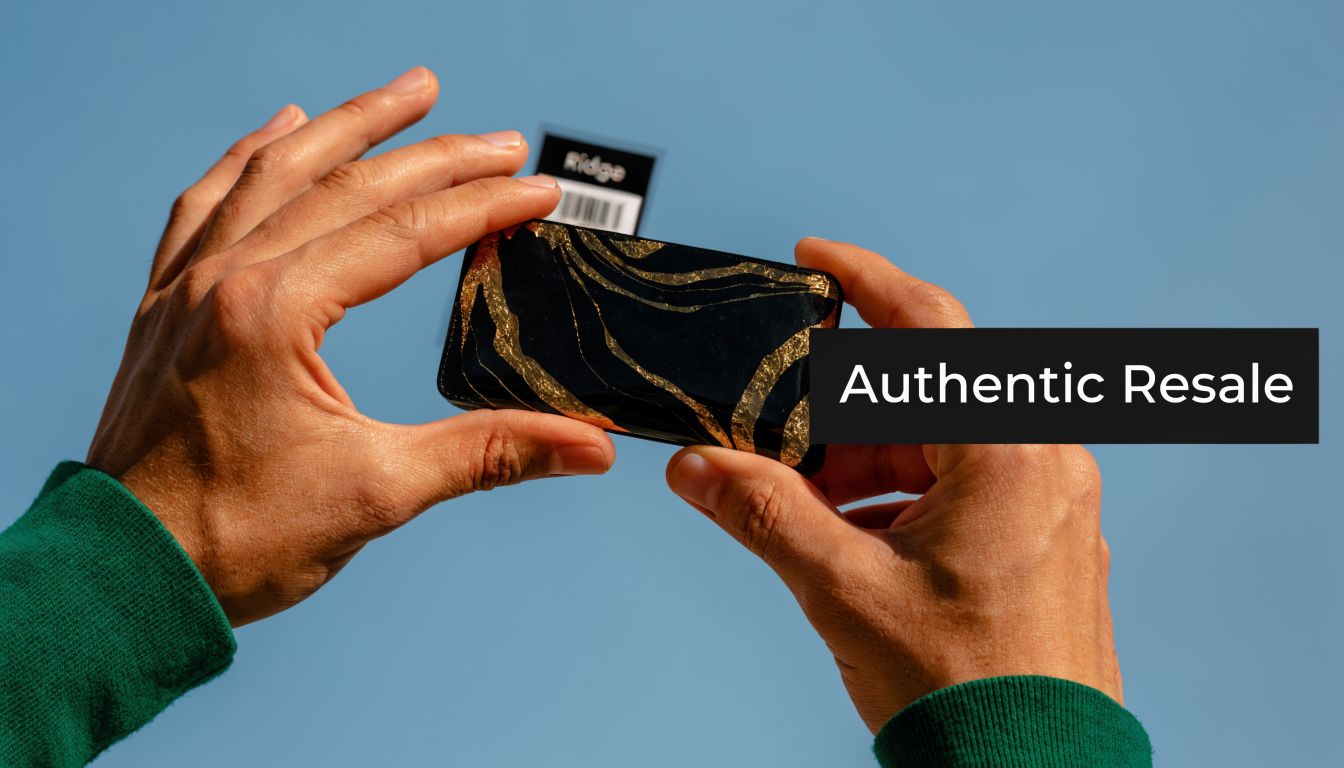
Serious sellers usually have only a few acceptable paths:
Direct brand authorization
Best option if available. Cleanest documentation. Lowest long-term risk.
Approved wholesale or distribution relationships
Acceptable if the chain of custody is clear and documented.
Secondary inventory from reputable business sellers
Highest risk. Only workable when invoice quality, product history, and rights posture are strong.
A lot of operators get tempted by “closeout” logic in premium accessories. That’s exactly where you get burned. If the pricing looks too generous, assume there’s a reason. It may be gray market inventory. It may be mixed authenticity. It may be old packaging. None of those problems stays small for long.
Counterfeit screening has to be systematic. Don’t rely on one sign.
Use a layered review:
Packaging consistency
Look for print quality, insert consistency, barcodes, and finish details that match known authentic units.
Material finish
Premium metal goods usually reveal fakes through uneven coating, rough machining, color inconsistency, or cheap-feeling edges.
Branding details
Examine logos, engraving precision, and alignment. Counterfeits often get close, then miss on sharpness and spacing.
Elastic and hardware quality
Stretch components and screws tend to expose weak manufacturing fast.
Variant coherence
If a seller offers combinations, finishes, or “limited” editions that don’t fit the brand’s normal merchandising logic, slow down.
The goal isn’t to “spot fakes.” The goal is to build a sourcing process where questionable units never reach receiving in the first place.
Good operators don’t just ask for a price list. They ask for paperwork, references, policies, and consistency over time. A proper supplier vetting checklist helps because it forces procurement discipline before money moves.
Questions worth asking include:
| Checkpoint | Why it matters |
|---|---|
| Business identity | Confirms you’re dealing with a real operator, not a transient broker |
| Invoice quality | Protects you if a marketplace requests proof of authenticity |
| Return policy | Tells you who absorbs defects or authenticity disputes |
| Inventory history | Reveals whether the seller actually controls the goods |
| Territory and channel rights | Prevents you from stepping into unauthorized resale issues |
Some sellers keep negotiating after the deal is already dead. Don’t do that.
Walk away if you see:
The best inventory often feels boring during due diligence. Clean docs. Predictable communication. No weird gaps. That’s exactly what you want.
Selling a product like Ridge successfully isn’t about copying the brand’s homepage and hoping traffic converts. You need a channel-specific plan. The offer, merchandising, listing structure, and compliance posture all change depending on whether you’re selling on Amazon, your own DTC site, or a blend of both.
Amazon is a demand-capture machine. Buyers arrive with intent and compare quickly. Your job is to remove friction, clarify authenticity, and make the product’s value obvious in seconds.
DTC gives you more room to frame the brand and control the journey. You can sell the lifestyle, the gift angle, and the adjacent products with more context. But you also have to earn attention and trust from scratch.
If you treat those channels the same, you’ll underperform on both.
On Amazon, the title and bullets have to do practical work. Keep the product identity clean. Lead with the exact model and material if that matters to the buyer. Surface the slim form factor, the premium construction, and the RFID story without turning the title into keyword soup.
Bullets should answer the core objections in order:
What is it
Slim metal wallet for cards and cash
Why this over leather
Lower bulk, more durable feel, modern carry profile
Why pay more
Premium materials, functional security positioning, giftable presentation
How it fits daily use
Carry method, access, pocket comfort, card organization
Backend keywords should focus on use-case language and comparison language that remains compliant. Don’t cram branded variants you’re not authorized to target. That invites problems.
On DTC, write with more personality. The same product can support stronger storytelling there. Use the hero image to make the silhouette obvious. Then follow with hands-on use, material close-ups, and one simple explainer graphic for the RFID angle.
A premium carry product needs more than a packshot. The buyer wants proof of feel, finish, and use.
A solid visual stack usually includes:
Clean hero image
White or neutral background. The product shape should read instantly.
In-hand scale shot
Buyers need size context.
Pocket or carry shot
This is where slimness becomes real.
Material close-up
Show the machining, texture, or finish.
Function demo
Cards in, cards out, cash secured.
Gift-oriented lifestyle image
Especially useful during gifting periods and for higher-priced variants.
Video should stay practical. Don’t overproduce it. Show how the wallet is carried, how cards are accessed, and why the materials feel upgraded. If you can’t demonstrate a meaningful difference in motion, your visual strategy is too abstract.
Buyers don’t need cinematic footage. They need confidence that the product will feel as premium in hand as it looks in the ad.
Premium accessories collapse fast when sellers train buyers to wait for discounts. If there’s any form of brand pricing policy or resale guideline, respect it closely. Even when a product can survive some promotional pressure, repeated discounting damages the thing you’re selling, which is perceived quality.
On Amazon, pricing discipline also protects you from a race to the bottom if other sellers enter the listing. On DTC, hold the line with merchandising instead of price cuts. Use bundles, gift framing, or limited presentation rather than teaching the customer that the item is perpetually negotiable.
A simple approach:
| Lever | Better move | Worse move |
|---|---|---|
| AOV growth | Bundle with coherent accessories | Slash base price |
| Conversion lift | Improve image stack and copy clarity | Add coupon clutter |
| Margin protection | Hold premium framing | Compete on cheapest option |
| Repeat purchase | Use post-purchase sequencing | Rely on front-end discounting |
Bundles work when they feel native to the product. They fail when they look like a liquidation tactic.
For a Ridge-style item, think in terms of use environment and gift logic. Pairings should feel like a tighter expression of the same customer identity. If the bundle requires too much explanation, the merchandising is off.
Good bundle logic usually follows one of three patterns:
Daily carry bundle
Core item plus one adjacent carry accessory
Gift-ready bundle
Product plus packaging or presentation enhancement
Material-consistent bundle
Products that share the same finish or visual language
The easiest mistake is forcing AOV with unrelated add-ons. That may lift cart size short term, but it weakens the product story.
For search-driven campaigns, keep the copy grounded in direct buyer motives. Good themes include slim profile, premium build, modern carry, and security-oriented design. Don’t write like a lifestyle magazine if the buyer is actively comparison shopping.
Useful angle families:
Problem-first
Bulky wallet frustration, overstuffed pockets, outdated carry
Upgrade-first
Better materials, cleaner profile, premium everyday carry
Gift-first
Useful, presentable, and category-safe for men’s gifting
Function-first
Card carry, cash hold, and security framing
On social, let the product be demonstrated. On Amazon Ads, let the listing carry the persuasion and keep the keyword intent tight.
In this scenario, many opportunistic sellers get themselves suspended.
If you’re reselling, be precise with product representation. Don’t invent claims, don’t imply authorization you don’t have, and don’t alter branded imagery in a way that creates confusion. Trademarked brand terms may be necessary to identify the product you’re lawfully selling, but your storefront, packaging, and supporting content shouldn’t mislead buyers about your relationship to the brand.
Keep documentation organized. Keep invoices accessible. Keep your copy factual. In premium branded resale, operational sloppiness often shows up as a legal problem later.
The common assumption is that a brand like Ridge can keep extending the same U.S. playbook into every major market. That’s possible in theory. In practice, international expansion usually punishes teams that assume customer preferences are universal.
That’s why the next interesting chapter in the sean frank ridge wallet story probably isn’t domestic category expansion. It’s localization. The open questions begin at this juncture.
According to coverage discussing Ridge’s next stage, significant unanswered questions remain about its strategy for international expansion into major markets like Europe and Asia, where cultural preferences and payment methods differ. For sellers, that creates both risk and opportunity in localized offerings, as discussed in this Buzzsprout episode on the Ridge Wallet story.
A lot of U.S.-based operators assume a winning domestic carry product will export cleanly. That’s not always how it works. Wallet preferences can be tied to card count, cash habits, fashion norms, and even how people carry items day to day.
The challenge isn’t just translation. It’s adaptation.
A few pressure points matter:
Product fit
Slim minimalist carry may resonate differently depending on local habits.
Messaging fit
Security, premium material, or gifting angles won’t land equally everywhere.
Operational fit
Returns, support expectations, and cross-border delivery complexity can erode the economics.
The opportunity is not “sell the same thing internationally.” It’s “sell the same core idea with local intelligence.”
That can mean different merchandising emphasis, different bundles, different marketplace sequencing, or tighter DTC localization before broad rollout. Sellers who move early and pay attention to local buyer behavior can often learn faster than the parent brand itself.
International growth rewards operators who respect local buying habits. It punishes those who assume brand strength alone will carry the conversion.
That’s the lens I’d use going forward. Ridge has already shown what disciplined product, acquisition, and operations can do in the U.S. The next edge will come from whoever closes the gap between global ambition and local execution first.
Million Dollar Sellers is where operators have these conversations at the level they matter. If you’re building across Amazon, DTC, or omnichannel and want sharper peer insight on brand strategy, sourcing, AI application, and expansion, Million Dollar Sellers is the room.
Join the Ecom Entrepreneur Community for Vetted 7-9 Figure Ecommerce Founders
Learn MoreYou may also like:
Learn more about our special events!
Check Events