Chilat Doina
October 29, 2025
Ever feel like you’re running your business on an island? Imagine swapping that isolation for your own personal board of directors—a hand-picked group of sharp, non-competing entrepreneurs who are just as invested in your success as you are. That’s the real power behind a mastermind group: it's a confidential, structured space built for deep problem-solving and serious accountability.
This is where collective intelligence truly comes to life.

It’s easy to mistake a mastermind for just another networking event, but that’s selling the concept way short. While you'll definitely build connections, the core purpose runs much deeper. It’s a genuine commitment to both giving and receiving unfiltered, honest advice within a tight-knit circle of peers you can trust.
Think of it as peer-to-peer mentoring on steroids. Instead of leaning on one mentor, you get the combined brainpower and battle-tested experience of several successful entrepreneurs. Each person brings a totally different perspective to your challenges, helping you spot blind spots, dodge expensive mistakes, and find shortcuts to grow your company.
The real magic happens when the group tackles a problem together. A solution that seems impossible to you alone can suddenly become crystal clear when several smart minds are focused on it.
When one member brings a challenge to the table—whether it’s a marketing campaign that’s falling flat, a tricky hiring decision, or a major scaling roadblock—the entire group focuses its energy on that one issue. This process doesn't just generate ideas; it produces practical, innovative strategies that have been proven in the real world.
And this isn't some new fad. The idea dates back to the early 20th century, when industrial giants like Andrew Carnegie credited their success to their "mastermind alliance." Carnegie and his peers brought their unique expertise to the table to solve massive industry challenges together. You can find more on these famous masterminds throughout history.
Unlike a casual coffee meetup, a truly effective mastermind group is built on structure. The meetings aren't a free-for-all; they’re typically facilitated and follow a clear agenda to make sure everyone’s time is respected and every member walks away with real value.
A typical structure looks something like this:
A well-run mastermind creates an environment where you are held to a higher standard by people who genuinely want you to win. It transforms vague intentions into concrete actions and measurable results.
This structured format is what sets a true mastermind apart from other professional organizations. While groups like EO and YPO are fantastic, they serve a different purpose. If you're curious about the nuances, our guide comparing EO vs YPO for entrepreneurs breaks it down.
At the end of the day, the goal is simple: leverage the group's collective wisdom to help you make smarter decisions, faster.
Joining the right mastermind group can feel like unlocking a secret level in the game of business. The benefits go way beyond just networking; it's about having a structured support system that directly impacts your growth and your bottom line. I’ve seen it time and again—these advantages are built on four powerful pillars that tackle the core challenges every single founder runs into.
First up is the incredible gift of unbiased feedback. Think about it. Your employees might hesitate to challenge your big ideas, and your family’s advice, while well-meaning, often comes with a ton of emotional baggage. A mastermind group is different. It’s a room full of peers who have no skin in your game other than a genuine desire to see you win.
They’ll give you the candid, unfiltered perspective you absolutely need to see your own blind spots. Imagine you're about to drop $20,000 on a new marketing campaign. Your team is all for it, but a peer in your group pipes up and points out a critical flaw they learned from making a similar—and costly—mistake last year. That one piece of honest feedback just saved you a massive headache and a ton of cash.
Next comes the sheer power of accountability. It’s one thing to set a goal for yourself in private. It’s another thing entirely to declare that goal out loud to a group of high-achievers you respect. That small act of commitment completely changes the game, turning vague intentions into concrete, must-do action plans.
When you know you have to report back on your progress at the next meeting, procrastination suddenly looks a lot less appealing. This isn't about pressure; it's about positive reinforcement. I saw a founder in one group finally commit to launching a product he’d been delaying for months. The group’s consistent check-ins and support were the final push he needed to get it across the finish line.
A mastermind group doesn't just ask you what you're going to do; it creates an environment where you feel compelled to follow through. The shared expectation raises your personal standard for execution.
This dynamic is a constant in high-level groups where members hold each other to incredibly high standards. You can get a sense of how this plays out by reading about the exclusive world of TIGER 21 members and their unique approach to peer accountability.
Maybe the biggest benefit of all is tapping into the group's collective intelligence. No single entrepreneur has all the answers. When you’re facing a complex problem, trying to solve it alone is a slow, frustrating grind. In a mastermind, you bring your challenge to the table and instantly get access to decades of diverse, real-world experience.
Think of it like this: your perspective is a single lens. The group gives you a whole set of different lenses to see the problem through. One member might have deep expertise in operations, another in digital marketing, and a third in raising capital. In one hour, their combined insights can solve a problem that might have taken you months to figure out on your own.
This collaborative problem-solving leads to:
Finally, a mastermind provides a network built on deep trust, not flimsy, transactional connections. These aren't just names in your phone. They are vetted, reliable allies. When a member recommends a contractor, a software tool, or a potential investor, that recommendation carries serious weight because it comes from a source you trust completely. This curated network can open doors to partnerships, key hires, and strategic opportunities you’d never find otherwise, helping you build a much stronger, more resilient business.
Walking into your first mastermind meeting can feel a bit like a mystery. What really happens in these sessions? While every group develops its own rhythm, most successful mastermind groups for entrepreneurs stick to a proven, structured format.
This isn't a casual coffee chat; it's a focused, strategic session. Think of it less like a networking event and more like your own personal board of directors meeting. The goal is to channel the group's collective energy into solving real-world business problems, and that requires structure to turn great conversations into tangible results.
A good meeting isn’t just about showing up. It demands a bit of prep beforehand and a real commitment to take action on the insights you gain afterward.
This infographic breaks down the powerful flow of benefits that a well-run meeting delivers—from candid feedback all the way to expanding your professional network.
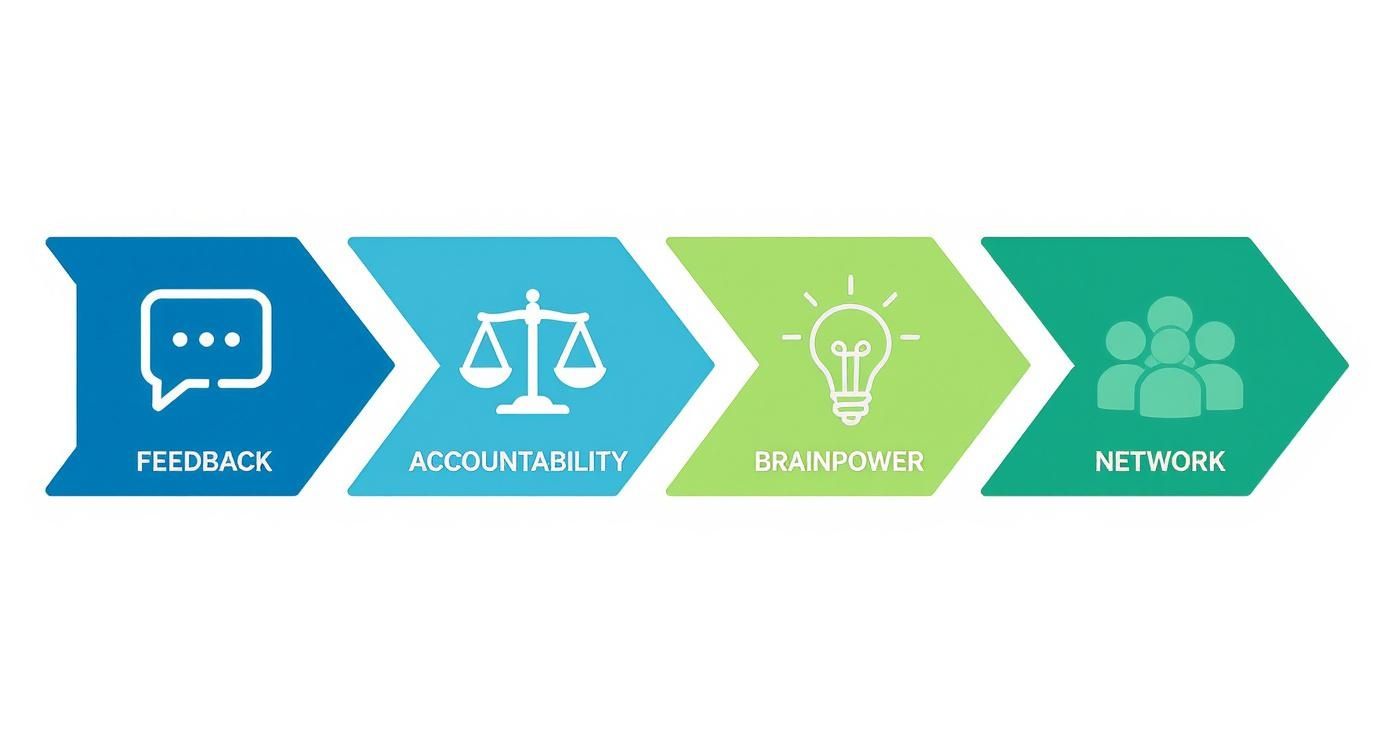
As you can see, it all starts with honest feedback, which builds accountability. That accountability unlocks the group's collective brainpower, and the natural result is a stronger, more trusted network.
Most meetings kick off on a high note with a round of "wins." Each person takes just a couple of minutes to share a recent success, big or small. This isn't about bragging. It’s a smart way to build momentum and create a culture of progress from the very start.
Sharing wins also keeps everyone looped into each other’s journeys, strengthening the group’s bond. Hearing about someone else’s breakthrough can be incredibly inspiring and might even spark an idea for your own business.
Right after that, there’s a quick accountability check-in. Members report back on the action items they committed to at the last meeting. It’s a simple but critical step that ensures advice actually gets put into practice.
The main event of almost every mastermind meeting is the "hot seat." This is where one member gets the floor—and the undivided attention of the entire group—to dive deep into their biggest challenge or opportunity.
The process is methodical, designed to get to the root of an issue. Here's how it usually works:
The hot seat is where the magic happens. It’s where the collective wisdom of the group delivers solutions that could have taken one person months to figure out on their own.
The goal of the hot seat isn't just to get answers. It's to gain new perspectives, challenge your assumptions, and walk away with a clear, actionable plan that has been pressure-tested by a group of trusted peers.
To give you a better idea of the timing, here’s a look at how a typical 90-minute meeting might be structured.
Time AllotmentAgenda ItemPurpose10 minutesWelcome & WinsKick off with positive energy and celebrate recent successes to build momentum.10 minutesAccountability Check-inBriefly review commitments from the last meeting to ensure follow-through.5 minutesHot Seat IntroductionThe selected member presents their challenge, providing necessary context.10 minutesClarifying QuestionsThe group asks questions to fully understand the issue before offering solutions.35 minutesGroup Brainstorm & AdviceMembers share experiences, strategies, and feedback to help the person in the hot seat.10 minutesAction Steps & CommitmentThe hot seat member summarizes their key takeaways and commits to specific next steps.10 minutesWrap-up & Key TakeawaysEach member shares one key insight they're taking away from the meeting.
This structure ensures that every minute is used effectively, providing a reliable framework for generating real progress.
A skilled facilitator is the glue that holds a great meeting together. They act as the guardian of the agenda, keeping the conversation focused, managing time, and making sure every member gets a chance to contribute.
A facilitator’s job includes:
Without someone in this role, meetings can easily drift into unstructured chats with no clear takeaways. The facilitator protects the process so that mastermind groups for entrepreneurs can deliver on their promise of accelerated growth. Real progress happens when you combine that structure with genuine trust.
So, you're sold on the power of a mastermind group. Awesome. The next logical step is figuring out where to find one. You’ve really got two clear paths here: you can join an existing, established group, or you can build your own from the ground up.
The right move really boils down to your goals, your budget, and how much control you want over the whole thing. Joining a group saves you the headache of organizing everything, but forming one gives you total say over who gets in and how it’s run.
Jumping into a pre-existing group means you get to step into a system that’s already working. These groups usually have skilled facilitators and a vetted membership, which can seriously fast-track your results. The trick is finding one that’s a perfect match for your business stage and your personal values.
There are tons of places to look for high-quality mastermind groups for entrepreneurs. Take Business Network International (BNI), for instance. Dr. Ivan Misner kicked it off back in 1984, and it has since exploded into the world’s largest network of its kind. Today, BNI has over 333,000 members in 11,562 chapters. Just last year, they generated $25.3 billion in business from referrals alone—a testament to the massive scale these groups can reach.
When you're on the hunt, start with these common spots:
Before you sign on the dotted line, do your homework. The right group chemistry is way more important than a list of impressive résumés or a slick brand. Treat this search like you're making a crucial hire for your business.
Once you’ve got a shortlist, vet them like you mean it. Look at the caliber of the members, the mix of industries, the meeting format (virtual or in-person?), and of course, the cost. Many paid groups will let you sit in on a trial meeting or have an intro call to see if it’s a good fit. If you need a little more direction, check out our guide on finding the right online business networking groups for you.
What if you can’t find the perfect group? Or maybe you just have a very specific vision for what you want. Building your own can be incredibly rewarding. You get to hand-pick every single member and set the rules from day one. It’s definitely more work upfront, but the payoff is a group that's perfectly tailored to you.
The whole point is to create a tight-knit circle of trust and accountability. This isn’t about numbers; it’s about quality. A small group of 4-6 dedicated members is almost always more effective than a big, wishy-washy one.
Here’s a simple but solid process for getting your own group off the ground:

Simply showing up to meetings isn't going to cut it if you want to unlock the real power of mastermind groups for entrepreneurs. The gap between a passive member and someone who has incredible breakthroughs is all about mindset and intentional action. It comes down to how you show up, what you contribute, and what you do after the meeting ends.
Those game-changing results don't just happen by magic. You have to actively create the conditions for them. That means you need to stop being a spectator and become a fully invested player in your own growth and the growth of everyone else in the room.
The most valuable people in any mastermind operate on one simple principle: give generously before you even think about getting. Your first instinct should always be to help others solve their problems with your undivided attention and experience.
When someone else is in the hot seat, really listen. Lean in, ask smart questions to get more clarity, and share insights from your own journey. By genuinely investing in your peers' success, you build a massive bank of trust and goodwill. It creates this powerful, reciprocal culture where everyone is all-in on helping each other win.
Trust me, when it's your turn in the hot seat, you'll get that same dedicated support right back from a group that respects what you bring to the table.
You can’t fix a problem you aren't willing to admit you have. So many entrepreneurs feel like they have to project this image of constant success, but a mastermind is the one place where you have to take off the armor. Real progress starts with being vulnerable.
Get transparent about your struggles, your fears, and the places where you just feel completely lost. Sharing the messy truth of your business—the metrics that are tanking, the launch that flopped, the team conflict you can't seem to solve—is the only path to getting real help.
Your peers can't help you navigate a maze if you only show them the map of where you want to go. You have to be brave enough to show them exactly where you are stuck. This honesty is the price of admission for real breakthroughs.
Winging your hot seat is a colossal waste of everyone’s time—especially your own. If you want high-quality, actionable advice, you need to show up prepared. That means doing the hard work of defining your problem with razor-sharp clarity before the meeting.
Take some time to think through and write down the following:
Coming prepared shows you respect your peers' time. It lets them skip the basic questions and jump straight into high-level problem-solving.
All the advice you get in a mastermind is completely worthless if it just sits in your notebook. The final, and arguably most important, step is to take action. The group invested their time and brainpower to help you out; now it's on you to put those insights to work.
After your hot seat, turn that feedback into a concrete action plan with clear next steps and deadlines. Then, at the next meeting, report back. Share what you did, what happened, and what you learned along the way.
This is what closes the accountability loop. It not only builds trust and shows you're committed but also lets the entire group learn from your experience, creating a powerful cycle of shared growth and success.
Alright, let's break down some of the nitty-gritty questions that pop up when you start thinking about joining or starting a mastermind group. Getting clear on the practical side of things—like cost, size, and what it actually is—is the first step to making a smart move.
Here are the straight-up answers to the most common questions entrepreneurs have.
The price tag on a mastermind can swing wildly, from absolutely free to the cost of a new car. What you pay usually comes down to the group's structure, how exclusive it is, and the level of expertise the person running it brings to the table.
When it comes to mastermind groups, bigger is definitely not better. You're looking for that perfect balance between having enough different perspectives in the room and still being able to have deep, meaningful conversations.
The sweet spot for most groups is somewhere between four to eight members. This size is small enough that everyone gets quality time to talk and get focused feedback, but it's large enough to bring a rich mix of experiences and ideas to the table.
If you go smaller than four, you risk the conversation getting stale or lacking diverse viewpoints. Go bigger than eight, and it becomes almost impossible for everyone to get their turn in the "hot seat" during a meeting.
This is a really important one to get right. People mix them up all the time, but they are fundamentally different. Picking the wrong one for what you need is a recipe for disappointment.
A mastermind group is all about peer-to-peer support. The value is cooked up from the collective brainpower and shared experiences of everyone in the room. The facilitator is there to keep the conversation on track, not to be the guru with all the answers.
Group coaching, on the other hand, is an expert-led model. The coach is the star of the show, teaching a specific curriculum or framework to the participants. It's more of a "one-to-many" relationship where the primary value flows from the coach to the group, rather than the collaborative "many-to-many" vibe of a true mastermind.
So, there you have it. You can see how mastermind groups for entrepreneurs are a game-changer. They're a direct antidote to the isolation and decision fatigue that grinds so many founders down. By creating a space for accountability, pulling in different perspectives, and just letting you have real, honest conversations, these groups turn your private struggles into shared wins. But knowing all this is one thing; actually getting those benefits requires one small, real-world action.
It's time to put this into practice. As you think about your next move, figuring out how to scale a business effectively is a huge piece of the puzzle—and it's a topic that comes up constantly in these groups. But knowledge without action is just trivia.
Your mission this week isn't to find the perfect group. It's just to get the ball rolling. Pick one tangible step and actually do it.
This isn't about blowing up your whole strategy overnight. It's about building a little momentum. To make it easy, just choose one of the following to knock out in the next seven days:
Taking one of these small steps shifts you from someone who is just interested to someone who is actively on the path.
At Million Dollar Sellers, we live and breathe this stuff. We know that peer-to-peer collaboration is what drives insane growth. Our entire community is built on the same foundation of trust, transparency, and a bias for action that we've talked about here. We connect top e-commerce founders so they can scale smarter, together. If you're ready to get in a room with the best, see if you qualify to join MDS at https://milliondollarsellers.com.
Join the Ecom Entrepreneur Community for Vetted 7-9 Figure Ecommerce Founders
Learn MoreYou may also like:
Learn more about our special events!
Check Events