Chilat Doina
October 7, 2026
A craft business can look healthy from the outside while losing money without anyone noticing. Orders arrive, reviews accumulate, and marketplace revenue climbs, but the maker still has little left after materials, packaging, postage, platform fees, advertising, refunds, and unpaid labor. That's not a marketing problem. It's a unit-economics problem.
The right way to sell craft online is to treat every order as an investment decision. Before choosing Etsy, Shopify, Amazon Handmade, or social commerce, determine what a profitable order looks like, which products can support it, and how much customer acquisition you can afford. Revenue is useful, but contribution margin pays the bills.
A craft shop can post record sales and still pay the owner less than minimum wage. The usual causes are easy to spot: pricing starts with materials alone, shipping is treated as harmless pass-through revenue, ads run before demand is proven, and labor never reaches the spreadsheet.
A busy shop can become an expensive hobby.
Contribution margin is the cash left from an order after its variable costs. Count materials, direct labor, packaging, shipping, payment processing, marketplace fees, sale-specific advertising, and a reasonable allowance for returns or replacements. Fixed costs still matter, but contribution margin shows whether another sale strengthens the business or increases the loss.
Use this contribution margin calculation guide to structure the spreadsheet. Then set a hard rule: do not choose a channel until you know the margin your product must produce there. Platform comparisons are secondary. Your unit economics decide whether a channel deserves your inventory, time, and ad budget.
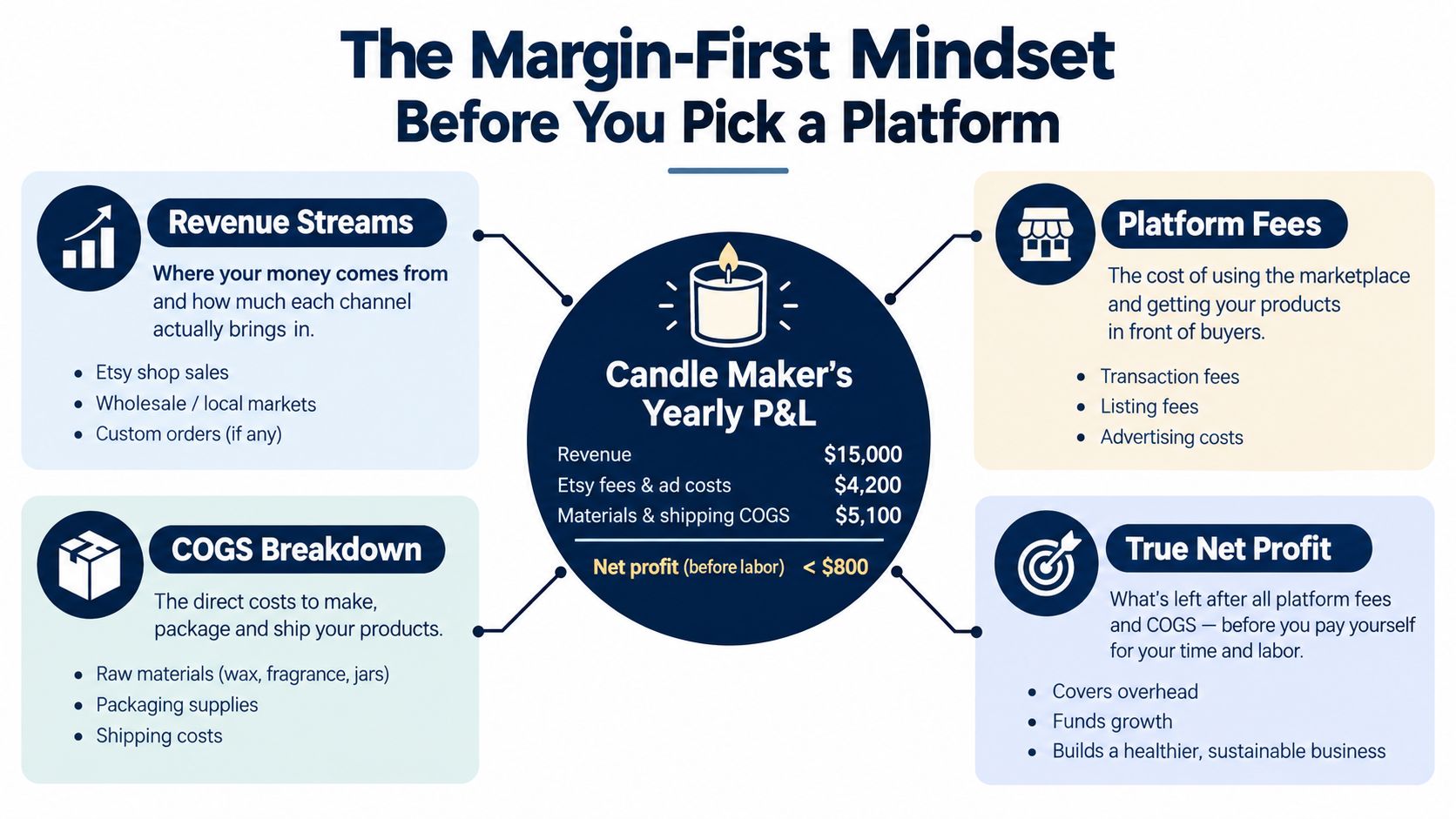
Cost of goods sold covers the direct inputs used to make an item. For a ceramic mug, that can include clay, glaze, kiln use allocated per piece, and packaging materials. For a candle, count wax, fragrance, wick, vessel, label, and the share of production supplies consumed by that unit.
Fully loaded variable cost per order includes costs triggered by a purchase. Add labor at your target hourly rate, the shipping label, marketplace and payment fees, gift wrapping, order-specific advertising, and a returns reserve. If the customer pays shipping separately, include that amount in the model because Etsy applies its transaction fee to the total order amount, including seller-charged shipping and gift wrapping, according to its fee basics.
Contribution margin per unit equals the selling price minus those variable costs. Track the dollar contribution and its percentage of the selling price. A strong percentage can still produce too little cash to fund customer service or growth. A higher-priced item with greater cash contribution may support a more expensive acquisition channel.
Practical rule: If you cannot explain the profit from one order in a spreadsheet, do not scale that product.
Etsy's early model reinforces the point. It launched in Brooklyn in June 2005 for handmade goods and craft supplies, with a $0.10 listing fee and a 3.5% transaction fee. Its early marketplace history is summarized in this Etsy business history. Low launch-era fees do not make a weak product profitable today. Calculate the order-level contribution first, then decide whether the platform, price, and advertising plan can work.
A product can sell steadily and still leave little cash after channel costs. Choose the platform only after checking what remains from each order once marketplace fees, payment processing, fulfillment, advertising, and customer acquisition are accounted for.
Etsy provides existing search demand, which makes it useful for testing products buyers already know how to describe. It charges a listing fee and a transaction fee on completed orders, before payment processing and other possible costs. Use Etsy for personalized gifts, low-SKU collections, and searchable niche products. Set a contribution-margin floor first, then test listings against that floor. Traffic alone does not justify a product that cannot fund its own labor and marketing.
Shopify gives you control over brand presentation, customer data, merchandising, and repeat-purchase flows. It does not create marketplace demand for you. You must bring visitors through search, email, partnerships, content, or paid acquisition. Choose Shopify when your products give customers a reason to return, such as replenishment, collections, personalization, or a strong brand relationship. A professional-looking store without a traffic and retention plan is an expensive storefront.
Amazon Handmade adds marketplace search and purchasing intent, but it also imposes referral fees and may add fulfillment costs when inventory enters Amazon's network. It fits standardized products with consistent packaging, repeatable production, and enough demand to support tighter operating requirements. Review this comparison of Amazon Handmade and Etsy, then calculate the channel's actual contribution before sending inventory there. Skip Amazon if each order requires custom handling that the fee structure cannot support.
Social commerce can generate attention quickly for products that look impressive on camera. “No listing fee” still leaves you paying in production time, editing, live selling, community management, and consistent publishing. Instagram Shop and TikTok Shop suit demonstration-friendly products, impulse purchases, and creator-led stories. Track content and selling time as acquisition costs rather than treating them as free labor.
| Channel | Main variable costs | Traffic source | Best-fit craft type |
|---|---|---|---|
| Etsy | Listing and transaction fees, payment processing, possible advertising costs | Marketplace search | Personalized gifts, niche handmade products, searchable collections |
| Shopify | Store subscription, payment processing, apps, and acquisition costs | Seller-owned traffic | Branded products with repeat demand and retention potential |
| Amazon Handmade | Referral fees, payment costs, and possible fulfillment charges | Marketplace search | Consistent products with proven demand |
| Social commerce | Content production and selling time, plus possible platform costs | Creator content and social discovery | Visual hero products, demonstrations, limited drops |
Organizations buy differently from individual consumers. If you sell branded merchandise to them, use this resource on selling merchandise for enterprises to assess bulk orders, branding requirements, and account-based demand before choosing a channel.
Make the channel earn its place. Etsy can validate search demand, Shopify can build customer ownership, Amazon can extend reach for operationally mature products, and social commerce can amplify strong visual hooks. Assign inventory only after the expected contribution margin clears your target.
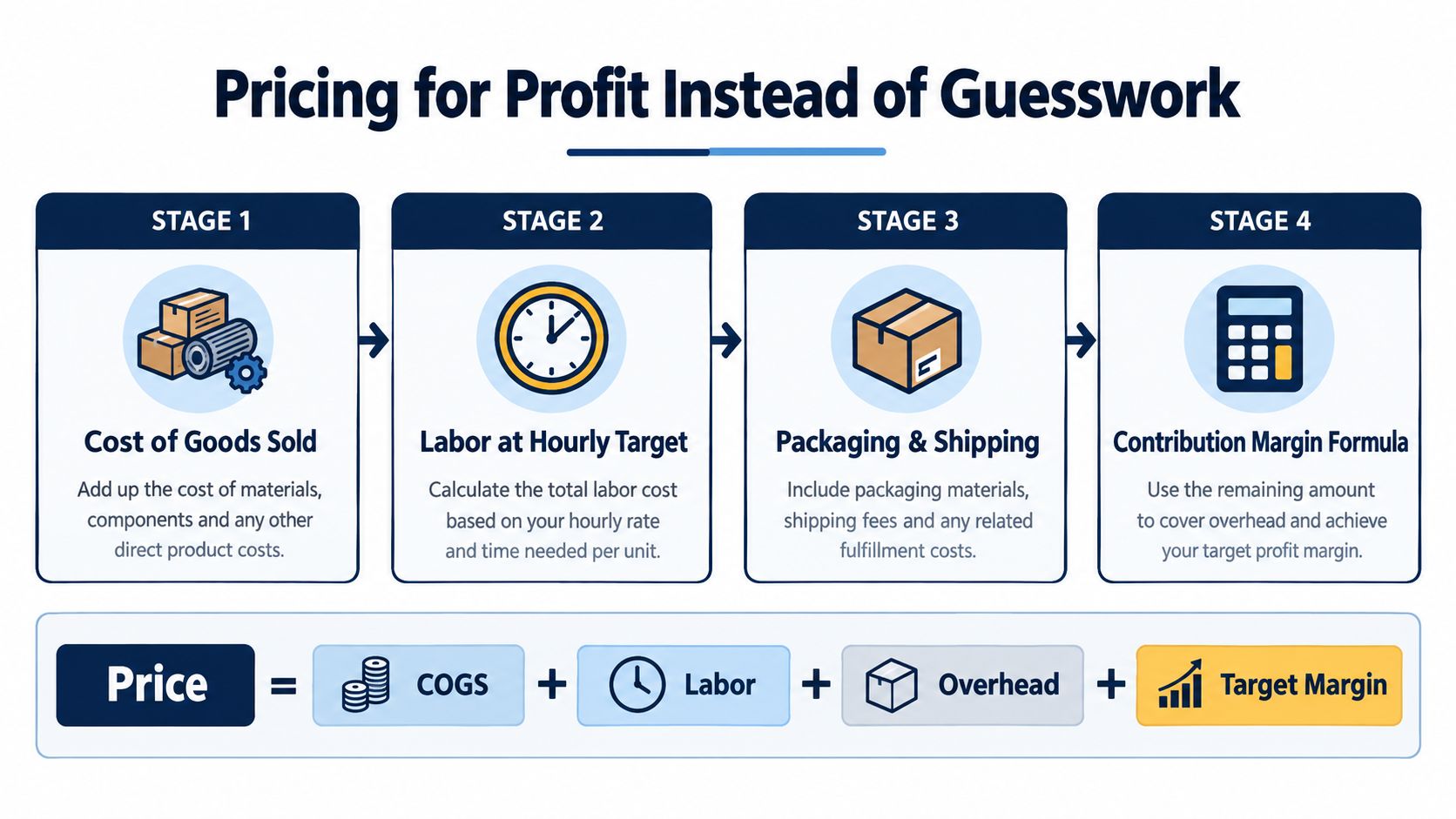
A maker can sell out and still lose money. That happens when pricing starts with materials and ignores the rest of the order economics. Build the price from the customer's payment backward, because that is where profit either survives or disappears.
Use this formula:
Selling price minus materials, packaging, direct labor, shipping, payment processing, platform fees, advertising, and returns allowance equals contribution margin.
Include labor even if you are the owner. Set an hourly target first, then price the product around it. If the market will not support that number, do not erase your labor from the math. Change the product, cut production time, improve positioning, raise perceived value, or drop the SKU.
Start with materials and packaging. Add the time needed to make, finish, inspect, and prepare the item for sale. Then add order-level costs, including postage, payment processing, marketplace deductions, and any ad cost tied to that order.
Etsy's fee structure shows why small omissions hurt. A $50 product with $8 shipping creates a $58 order total, so the 6.5% transaction fee is $3.77 before payment processing. The fee applies to the full order total, not just the item price. Underpricing shipping creates two losses at once. You subsidize postage, and the marketplace still takes a cut of that shipping amount.
Build pessimistic, base, and optimistic demand cases. Then release a small batch and track impressions, clicks, conversion rate, average order value, refunds, and contribution margin. Do not scale because an item gets attention. Scale when the attention turns into profitable orders.
The price also has to survive discounts and paid acquisition. If the product only works when every buyer arrives organically and no one returns it, the model is fragile. Read these pricing psychology strategies for ways to present value without living on permanent discounts. Higher prices hold up when buyers understand the materials, craftsmanship, use case, finish, customization, and service included in the purchase.
Pricing test: Raise the price on one controlled variation and watch conversion, contribution margin, and customer questions together. If buyers do not understand the value, fix the offer before you blame the channel.
Here is the final check. If a modest price increase kills conversion, your positioning is weak, your photos look generic, or the product is too easy to compare. Do not fix a positioning problem by buying more ads.
Most craft listings look like a cluttered workbench instead of a buy button. Buyers can't judge scale, finish, color, packaging, or intended use from a single dim photograph, and vague copy forces them to ask questions the listing should answer immediately.
Your product page has one job before the sale: remove uncertainty.
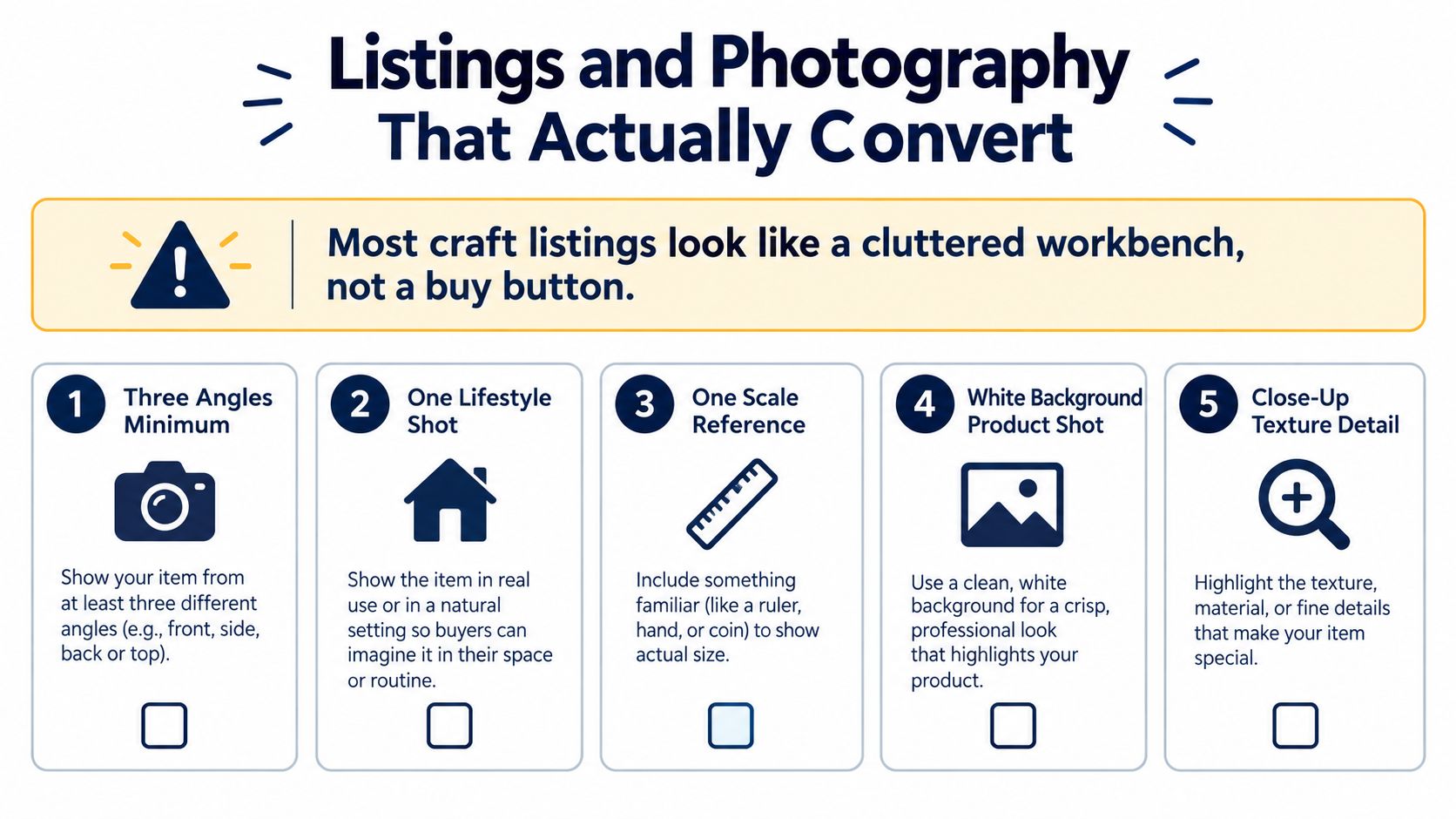
Use at least three useful angles rather than several versions of the same image. Show the front, side, back, closure, texture, or functional detail that matters for the product. Add one lifestyle image so the buyer can see the item in its intended environment, then include a scale reference such as a hand, ruler, shelf, table setting, or commonly understood object.
Shoot in consistent daylight or with controlled lighting. Keep white balance stable across the collection. Your first image should have a clean crop that remains legible on a mobile screen, with the product large enough to understand at a glance.
A candle photographed beside scattered tools communicates “unfinished project.” A clean image showing the candle in a calm interior, followed by a close-up of the wax and label, communicates a finished gift or home product. The difference isn't cosmetic. It changes what the buyer believes they're paying for.
Use a title structure that combines the primary keyword, material or construction, and recipient or use case. “Handmade soy candle, 8oz” identifies the object, but “Hand-poured soy candle for book lovers, cotton wick, gift-ready tin” gives the buyer a reason to continue.
The opening description should carry the hook and the essential specification. Put size, materials, finish, scent, customization limits, production details, and dispatch expectations where buyers can find them without hunting.
A practical listing structure looks like this:
Track listing visits, favorites, add-to-cart activity, conversion rate, and contribution margin on a regular schedule. Rewrite the weakest product page before you produce more inventory. A new SKU won't fix a listing that fails to explain the existing one.
Fulfillment isn't a status symbol. It's a cost-and-control decision.
Self-shipping from home gives you direct quality control, flexible customization, and immediate visibility into customer issues. It also consumes the maker's best hours. Packing orders can displace production, product development, customer service, and marketing long before the seller notices the tradeoff.
Use a simple operating procedure from the beginning:
Print-on-demand works when the product is a design applied to an item that doesn't need to be made at your workbench. It reduces inventory exposure, but it usually gives you less control over materials, packaging, production speed, and the unboxing experience. Test samples before attaching your brand to a supplier's quality.
A third-party logistics provider or prep center becomes useful when packing repeatedly interrupts production and the provider can improve tracking, inventory accuracy, or carrier access. Don't outsource chaos. Clean product data, consistent packaging instructions, barcodes, and a defined returns process should exist before inventory leaves your space.
| Option | Cost per order | Best order volume | Switch-up trigger |
|---|---|---|---|
| Self-ship from home | Direct postage, packaging, and your fulfillment time | Early-stage and customized orders | Packing consistently displaces production or customer service |
| Print-on-demand | Supplier production and fulfillment deduction | Designs with repeatable specifications | Quality, packaging, or margin no longer fits the brand |
| 3PL or prep center | Storage, handling, pick-and-pack, postage, and service charges | Multi-channel inventory with predictable processes | Outsourcing improves contribution margin or returns control |
Keep fulfillment in the same margin model as production. A faster operation that adds costs without improving delivery reliability, capacity, or customer retention is just a more expensive operation.
Marketing should be ranked by cash cost, time cost, ownership, and speed to useful feedback. Hype is not a channel strategy.
Search-optimized Etsy listings and product pages are usually the most economical place to start because the content keeps working after publication, although results take time to build. Pinterest suits decor, jewelry, wedding products, and visually searchable projects. Instagram and TikTok can create attention quickly, but they demand a steady stream of demonstrations, product shots, packaging clips, and founder-led content.
Email is different. You own the list, can segment buyers by product or occasion, and can promote launches without paying a platform to rediscover the same customer. Start capturing permission from the first sale, even if the list is small.
Paid ads come last, not first. Advertising should amplify a product with proven conversion and enough contribution margin to absorb acquisition cost. If you're still guessing whether the item, price, photo, or audience is responsible for weak sales, ads will make the diagnosis harder.
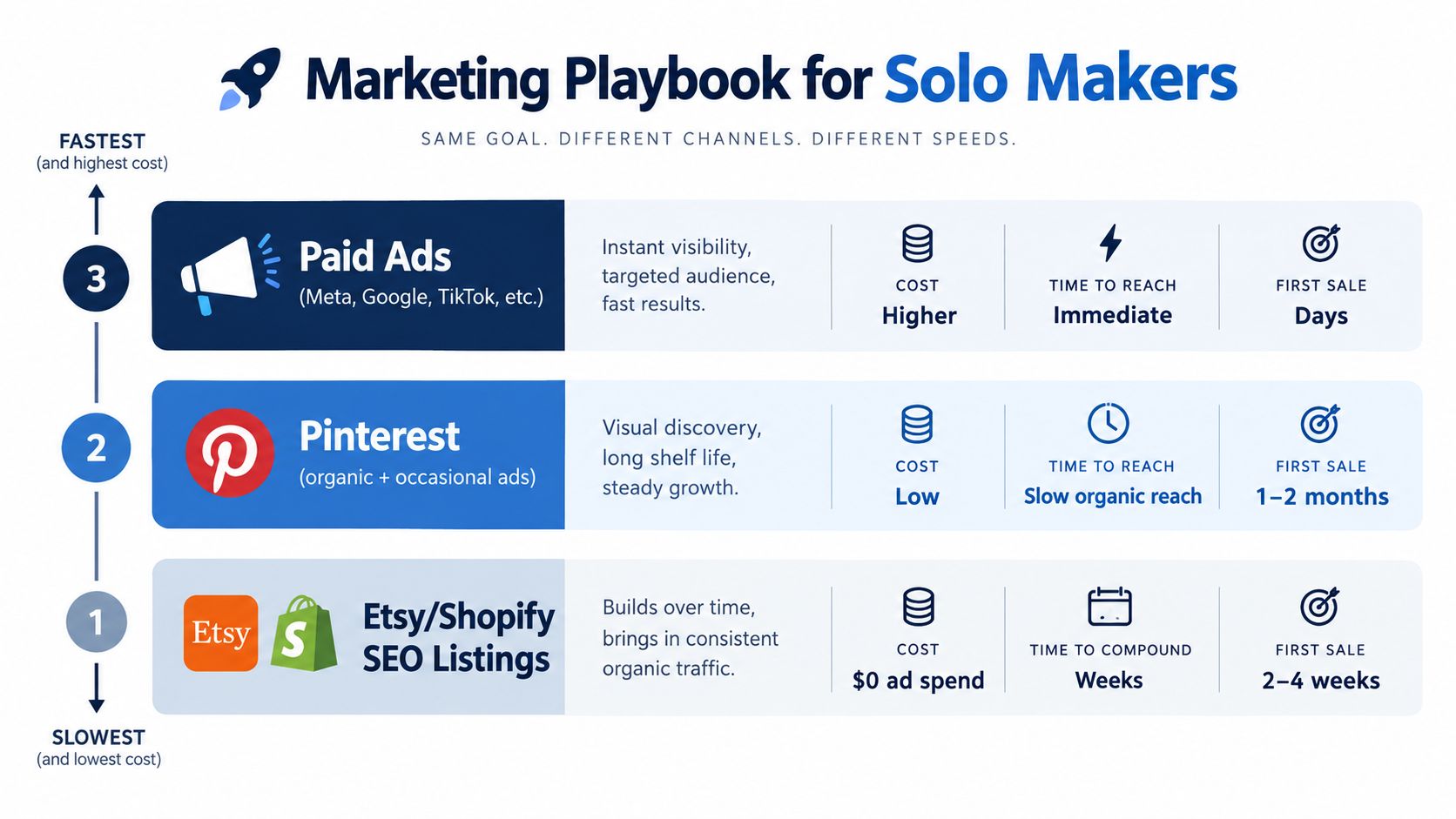
During the first phase, improve product titles, descriptions, image order, keyword targeting, and shop policies. Publish content that answers buyer questions instead of producing random posts.
During the next phase, add Pinterest distribution and an email capture offer that fits the product. A care guide, gift calendar, styling guide, or early access list can work better than a generic discount because it attracts people with a reason to stay connected.
In the final phase, choose one content channel and test a narrow retargeting campaign only if the contribution model supports it. Don't operate every social platform. A solo maker who spreads attention across too many feeds usually produces mediocre content everywhere.
Watch three metrics:
For a sharper measurement framework, review metrics that drive 5x revenue, then adapt the metrics to your own order economics rather than copying a headline target.
A useful weekly marketing workload can stay compact: improve listings, publish visual content, collect customer email permission, send one helpful message, and review the numbers. Million Dollar Sellers offers peer access and ecommerce strategy resources around product research, competitor analysis, sourcing, listing optimization, and keyword research, which can be relevant once a craft brand has repeatable economics and a serious growth problem.
Scaling starts when the maker stops asking, “How do I get more orders?” and starts asking, “Which orders deserve more capacity?”
A hobby shop should prioritize proof. Keep the catalog tight, learn which products convert, document production steps, and record every cost. Don't buy equipment or inventory because it feels like progress. Buy it when the current bottleneck is visible in the numbers.
A side business needs repeatability. The maker should know which products generate contribution, which customers return, which materials create delays, and which tasks someone else can perform without damaging quality. This is the stage for standard operating procedures, clearer product variations, reliable reorder points, and a second channel only when the first channel has proven demand.
A full-time operation needs management discipline. Separate owner pay from reinvestment, review channel-level contribution margin, and measure inventory turns, refund reasons, delivery performance, and customer concentration. Growth in marketplace volume can hide declining profit when labor, advertising, and fulfillment costs rise faster than revenue. Etsy's 2024 figures show the scale available in this category, with approximately $12.6 billion in gross merchandise sales, about $2.8 billion in revenue, roughly 96 million active buyers, and about 8 million active sellers reported for the marketplace, as summarized in this Etsy store overview. Scale exists, but it doesn't make weak operations safe.
Put early profit into inventory only when stockouts are limiting profitable sales. Invest in tools when they remove a repeated production constraint and preserve your target labor economics. Hire help when documented tasks consume time you could use for higher-value work and the margin remains positive after wages.
Open a second channel when your product data, inventory counts, photography, and customer service process can support it. Move toward a 3PL when fulfillment repeatedly blocks growth and the provider can meet your quality, tracking, and returns requirements.
The common plateau is a shop with more demand than the owner can fulfill, but not enough margin to hire. The correction is rarely “work faster.” It's usually a price increase, SKU reduction, production redesign, channel change, or decision to stop selling a product that attracts attention but drains cash.
Million Dollar Sellers is an invite-only peer community for established ecommerce entrepreneurs, with strategy sharing, mastermind calls, private forums, events, and vetted service recommendations. If you're ready to move from handmade sales to a more disciplined, scalable operation, visit Million Dollar Sellers and assess whether its founder network fits your next stage.
Join the Ecom Entrepreneur Community for Vetted 7-9 Figure Ecommerce Founders
Learn MoreYou may also like:
Learn more about our special events!
Check Events



.png)