Chilat Doina
March 20, 2026
Picking between Amazon Handmade vs Etsy isn't just about where you list your products—it’s a move that will shape your brand's entire journey. If you're set up for high-volume production, Amazon Handmade is a beast, offering unmatched logistics and a massive audience ready to buy. On the other hand, Etsy is the perfect ground for launching unique, story-driven brands and building a loyal community from scratch.
For serious artisans, this isn't just about picking a platform; it's a strategic decision that steers your whole business. This guide gets straight to the point, helping you decide based on what you actually want to achieve. Are you gunning for fast growth and a smooth-running operation, or do you want to build a niche brand with fans who keep coming back?
The answer will point you to the right partner. Let's break down the core differences to help you make that call.
At their core, Amazon Handmade and Etsy are built for different things. Think of Amazon as a powerful sales machine, while Etsy is more of an ecosystem for building your brand. Getting this distinction is the first step to making the right move for your business.
For established sellers, the question isn't "which is better?" but "which is better for my current growth stage?" Amazon is for scaling up. Etsy is for starting out and telling your story.
This decision touches everything, from how much you pay in fees to how you get customers and even what your day-to-day work looks like. For a quick look at how they stack up for established sellers, here's a high-level summary.
This table cuts right to the chase, highlighting the critical differences that matter most when you're ready to grow.
| Metric | Amazon Handmade | Etsy |
|---|---|---|
| Best For | High-volume sales and rapid scaling | Niche product validation and community building |
| Primary Audience | Prime members looking for convenience and speed | Buyers searching for unique, handcrafted items |
| Core Advantage | Fulfillment by Amazon (FBA) logistics | Brand control and direct customer relationships |
| Fee Structure | 15% referral fee (Professional Seller fee waived) | Lower transaction fees but many small, added costs |
| Competition | Lower, due to a strict, multi-week vetting process | Extremely high, with millions of active sellers |
Ultimately, it comes down to one thing: your readiness to scale. If your production is a well-oiled machine and you can handle a high volume of orders consistently, Amazon Handmade offers a direct pipeline to a huge market. But if you’re still perfecting your products and building your brand’s identity, Etsy provides the ideal space to cultivate a dedicated following from the ground up.
Understanding who shops on each platform—and more importantly, why they're there—is the first, most critical step in this whole comparison. The entire Amazon Handmade vs. Etsy debate really boils down to the customer's mindset. On one hand, you have a massive crowd hunting for convenience; on the other, you've got a community actively looking for unique products with a story.
Amazon Handmade isn't some separate, little-known website. It's a curated storefront right inside the biggest retail machine on the planet. This gives your products a backstage pass to a colossal global audience that’s already on Amazon buying everything from paper towels to laptops.
The numbers here are just staggering. Amazon Handmade gives you a shot at reaching Amazon's customer base of over 380 million active shoppers around the world. That completely dwarfs Etsy's very respectable 90-96 million niche buyers who are specifically on the hunt for handmade goods. For sellers ready to scale, this sheer volume is a massive advantage.
Let's be blunt: the typical Amazon shopper is on a mission. They value speed, trust, and getting what they need with as few clicks as possible. They usually land on the site with a specific need and trust Amazon's logistics to get it to their door, fast.
This audience is heavily swayed by a few key things:
For Amazon Handmade sellers, winning means you have to think like a search engine. Your job is to capture existing demand with crystal-clear, benefit-focused listings that play well with Amazon's A10 algorithm. You're not there to build a deep, personal brand connection on the platform itself.
This makes Amazon the perfect playground for a seller with a scalable product—think of a jewelry maker who can crank out hundreds of identical, high-quality necklaces. By using Fulfillment by Amazon (FBA), they can slap a Prime badge on their product, offload all the shipping and handling, and focus their energy on production and advertising to grab a piece of Amazon's massive traffic. For a deeper dive, our guide on whether selling on Amazon is worth it breaks down the pros and cons.
In stark contrast, Etsy shoppers are explorers on a journey of discovery. They aren't just buying a thing; they're buying a piece of a story, a direct connection to a creator, and an item that feels genuinely special.
Key traits of the Etsy buyer include:
This mindset makes Etsy the perfect home for someone like a bespoke woodworker creating custom furniture. Each piece is unique and has a story. That woodworker can use Etsy's customizable storefront to show off their process, build a real brand narrative, and talk directly with customers who truly appreciate the artistry. That’s how you build a loyal following and get repeat business.
Thriving on Etsy means you have to be great at branding, photography, and storytelling to forge an emotional connection that goes way beyond price and shipping speed. Ultimately, the choice between Amazon Handmade and Etsy depends on whether you're built to serve a high-volume, convenience-hungry audience or a niche community of craft lovers.
When you're trying to figure out where to sell your work, the fees can feel like a maze. It’s easy to get caught up in the headline percentages, but that's a classic rookie mistake. Your real take-home pay—your true profit—is what’s left after a whole network of transaction costs, ad spend, and other little fees have taken their slice.
Let's break down the money side of Amazon Handmade vs. Etsy so you can see where your earnings actually go.
On the surface, Amazon Handmade looks pretty straightforward. Once you’re approved as an artisan, they waive the usual $39.99 Professional Selling Plan monthly fee, which is a nice perk. From there, you just pay a flat 15% referral fee on the total sale price, which includes both the item's cost and any shipping you charge the customer.
Etsy’s model is more of a "death by a thousand cuts" situation. It's built on a bunch of smaller fees that really add up. You start with a $0.20 listing fee for every single item, and you have to pay that again every four months to keep it active. When you make a sale, Etsy takes a 6.5% transaction fee on the entire order amount. On top of that, there's a payment processing fee, which in the US is typically around 3% + $0.25.
Those base fees are just the beginning. Other costs will start nibbling at your profit margins almost immediately. For Amazon, the biggest one is advertising. While running Amazon PPC campaigns is technically optional, it's pretty much essential if you want to get found. It's not uncommon for these ad costs to eat up another 5-15% of your revenue.
Etsy has its own mandatory ad costs, but only for shops that hit a certain milestone. Once your sales top $10,000 in a 12-month period, you're automatically enrolled in their Offsite Ads program. This program costs you a 12% fee on any sale that comes from one of their ads on sites like Google or Facebook, and here's the kicker: you can't opt out.
If you’re just getting your feet wet, our guide on https://www.mds.co/blog/how-much-does-amazon-cost-to-sell can give you a solid foundation on these initial expenses.
The real takeaway here is that Amazon's fees, while higher upfront, are predictable. You know what you're getting into. Etsy's fees are fragmented and can swing wildly depending on ad performance and how often you renew listings. I've seen many high-volume Etsy sellers end up paying way more than the advertised 6.5%.
To get the full picture, you have to look at all the potential charges for selling on Amazon. It's the only way to make an informed decision.
Let's run the numbers. Imagine you sell a handmade item for $100 on both platforms. We'll assume a 10% advertising spend and a $10 shipping charge to the customer. This simple side-by-side shows you the real-world impact on your wallet.
| Fee Component | Amazon Handmade | Etsy (Top Seller) |
|---|---|---|
| Sale Price | $100.00 | $100.00 |
| Shipping | +$10.00 | +$10.00 |
| Total Revenue | $110.00 | $110.00 |
| Listing Fee | $0.00 | -$0.20 |
| Referral/Transaction Fee | -$16.50 (15% of $110) | -$7.15 (6.5% of $110) |
| Payment Processing | (Included in referral fee) | -$3.55 (3% of $110 + $0.25) |
| Advertising (10% of item) | -$10.00 | -$10.00 |
| Offsite Ad Fee (if applicable) | N/A | -$12.00 (12% of $100) |
| Total Fees (Best Case Etsy) | -$26.50 | -$20.90 |
| Total Fees (Worst Case Etsy) | -$26.50 | -$32.90 |
| Net Profit (Before COGS) | $73.50 | $67.10 - $79.10 |
As you can see, even though Amazon's 15% fee feels steep, your profit is consistent and easy to forecast. On Etsy, your profit depends entirely on whether a sale came from an Offsite Ad. This creates a huge, unpredictable profit range that makes financial planning a real headache.
So, how do shoppers actually find your products? The answer to that question gets to the very heart of the Amazon Handmade vs. Etsy debate. One is a massive, open-air bazaar, and the other is an exclusive, members-only club. Figuring out how to get seen on either platform is a totally different ballgame.
Etsy is famously crowded. It’s a vibrant, sometimes chaotic marketplace where literally millions of sellers are all trying to catch a buyer's eye. Winning here isn't just about playing an algorithm game; it's about building a standout brand with gorgeous photos and sharp, niche-specific SEO. If you’re just starting out, it can feel like you’re shouting into a hurricane.
Amazon Handmade, on the other hand, is a gated community inside the larger Amazon universe. You can't just set up shop. First, you have to go through a pretty strict application and vetting process to prove you're a genuine artisan. It's a hoop to jump through, but for serious sellers, it’s also a huge advantage.
That Handmade application isn't just a box to check—it’s a filter. Amazon uses it to make sure every product listed is actually handcrafted, which weeds out the dropshippers and casual hobbyists right away. The whole audit can take two to four weeks.
The result? A much smaller, more professional group of competitors.
Once you’re in, the game completely changes. Instead of battling millions of other shops for attention, you’re up against a select group of dedicated makers. Your focus shifts from simply standing out to strategically winning visibility using Amazon’s own powerful tools.
You’ll need to master things like:
Getting started is harder, no doubt. But for sellers who are willing to learn the rules, the path to getting seen is often much clearer.
Let's look at the numbers on Etsy. With around 8 million sellers all competing for 90-96 million buyers, the marketplace is incredibly dense. It's an environment where breaking through the noise depends on creative storytelling and building a brand that truly connects with a specific audience. It's a huge hurdle for new sellers, but for those who excel at brand-building—like many in the Million Dollar Sellers network—it's a massive opportunity.
In the Amazon Handmade vs. Etsy debate, discoverability comes down to this: On Etsy, you build a brand to attract an audience. On Amazon, you optimize a listing to capture existing demand.
This difference is everything. While the main Amazon site sees almost a million new sellers every year, the Handmade category stays carefully managed, protecting artisans from that cutthroat competition. You can launch an Etsy shop in 30 minutes. Handmade’s weeks-long review process creates a more controlled and professional arena.
This makes it a perfect fit for established makers who can handle 50-100 orders per month and are ready to compete on logistics and optimization, not just brand appeal.
Choosing between Amazon Handmade and Etsy boils down to one core trade-off: Do you want complete control over your brand, or do you want access to world-class logistics? This isn't just a small detail—it's a fundamental business decision that shapes how you operate, talk to customers, and plan for growth.
Etsy is all about giving you the keys to your own kingdom. It's built to feel like your shop. You get to customize your storefront with banners, write a compelling bio, and use every product listing to tell your story. This level of control is what lets you build a real, personal connection with your customers.
If your brand is built on a specific aesthetic or narrative, that freedom is everything. You're creating an entire experience, turning first-time buyers into loyal fans who are invested in you as the maker.
Amazon Handmade plays by a different set of rules entirely. The platform is built for operational efficiency, not individual brand expression. Your storefront will look like every other Amazon page because the goal isn't to showcase your unique brand—it's to sell your products as fast as possible.
While that might sound a bit restrictive, it comes with a massive upside: Fulfillment by Amazon (FBA). This service is hands-down the most powerful logistics engine available to online sellers, and it’s the main reason many high-volume makers pick Handmade. If you're not familiar with it, our guide on what FBA is breaks it all down.
When you enroll in FBA, you’re essentially handing your entire fulfillment operation over to Amazon. Here’s what they take off your plate:
FBA isn't just a shipping service; it's a scalability engine. It completely removes the operational bottlenecks that stop most handmade businesses from growing. While an Etsy seller is busy packing boxes, an FBA seller can be focused on creating new products or running ads.
Let’s translate this into a real-world scenario. Imagine you sell handcrafted leather wallets, and your business suddenly explodes. You're now getting 50 orders a day.
The Etsy Reality:
On Etsy, you're the one-person fulfillment center. Every single day, you have to print 50 shipping labels, carefully pack 50 wallets, and drive them to the post office. If a customer has a shipping question or needs a return, you're the one handling it. This model gives you total control over your beautiful, branded packaging, but your growth is capped by the number of hours you can physically work.
The Amazon Handmade Reality:
With FBA, those 50 orders are processed without you lifting a finger. Amazon handles it all automatically. Your main job is just to make sure the warehouse stays stocked with your wallets. This frees you up to find better leather, design new products, or run campaigns to push your sales from 50 to 100 orders per day.
Here’s how the trade-offs really stack up:
| Aspect | Etsy | Amazon Handmade with FBA |
|---|---|---|
| Brand Storytelling | Excellent. You have full control over your shop’s look and customer messaging. | Limited. Your product is just another item in Amazon's massive, uniform catalog. |
| Packaging Control | Total. You can use custom boxes, thank-you notes, and branding inserts. | None. All orders are shipped in standard Amazon-branded boxes. |
| Customer Interaction | Direct. You build personal relationships and handle all service directly. | Indirect. Amazon manages most customer service, creating a buffer. |
| Scalability | Limited. Your growth is tied directly to how many orders you can self-fulfill. | High. FBA allows for nearly infinite order volume with no extra work on your part. |
| Time Investment | High. A lot of your time goes into packing, shipping, and customer service. | Low. Most operational tasks are automated, giving you your time back. |
The Amazon Handmade vs Etsy decision here is pretty clear. If you want to build a boutique brand with a personal touch and you enjoy the hands-on fulfillment process, Etsy is the perfect platform. But if your main goal is to scale your business into a high-volume operation without getting buried in logistics, Amazon FBA is the undisputed winner.
After digging into the audiences, fees, and logistics, the Amazon Handmade vs. Etsy decision really boils down to your specific goals, how much you can produce, and where your brand is on its journey. There isn't a single "best" platform—just the right one for your business right now. The key is to honestly match your current needs with what each marketplace does best.
For some sellers, it's all about having total control over their brand and building a community. For others, it's about plugging into a massive logistics machine to hit maximum sales velocity. Neither path is wrong; they just serve different business models. Be real with yourself about where you are and where you're headed.
If you're just starting out, Etsy is your launchpad. The barrier to entry is incredibly low, upfront costs are minimal, and the community-focused vibe is perfect for testing out product ideas and finding your groove. You can get a shop up and running in less than an hour and start getting feedback from real customers almost immediately.
Use Etsy to:
For established brands, especially if you're thinking about adding a handmade or personalized collection, Etsy is an ideal, low-risk testing ground. Instead of messing with your main sales channels, you can spin up an Etsy shop to see if a new product category has legs. Its audience is already looking for unique goods, giving you quick, valuable data before you go all-in.
This flowchart breaks down the central choice you'll need to make between prioritizing brand control and leaning into logistics.
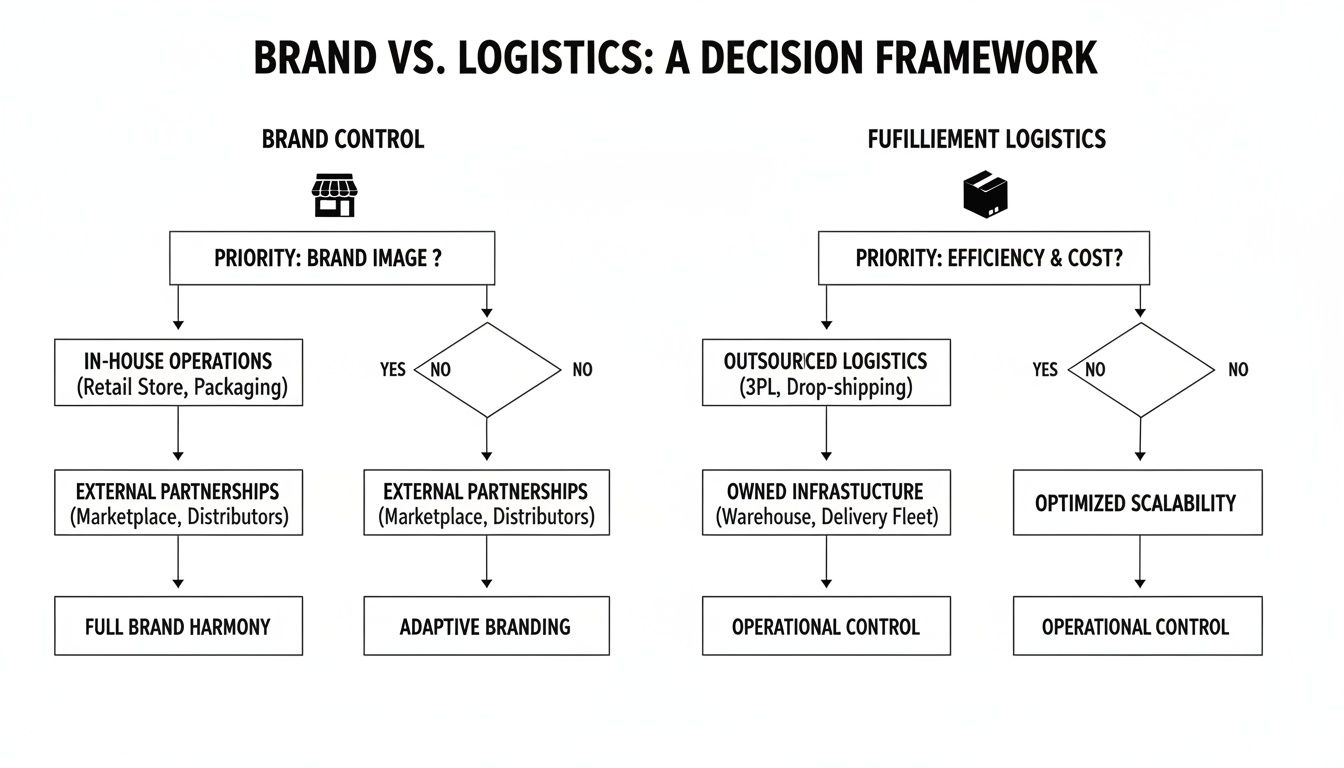
As you can see, sellers who live for storefront customization and direct customer chats will naturally lean toward Etsy. On the other hand, those who are laser-focused on efficiency and scale will find Amazon’s fulfillment powerhouse a much better fit for their goals.
Once you have a proven product and your workshop can handle 50+ orders per day, it's time to get serious about Amazon Handmade. The platform is an engine built for scale. Access to Fulfillment by Amazon (FBA) is a complete game-changer, breaking through the fulfillment bottleneck that keeps most handmade businesses from growing.
If you're spending more time packing boxes than creating products, you've outgrown your current model. Amazon Handmade with FBA is the logical next step to reclaim your time and unlock exponential growth by tapping into a massive, purchase-ready audience.
You should be looking at Amazon Handmade when you need to focus your energy on production and marketing, not shipping. That higher referral fee is simply the cost of admission for unmatched reach and operational freedom.
Why choose just one? The sharpest sellers use both platforms, but for different things. This omnichannel strategy lets you grab the best of both worlds, building a business that's both powerful and resilient.
This dual-platform strategy creates a flywheel. A strong brand on Etsy can drive awareness and search traffic over to your Amazon listings. At the same time, the high-volume sales and cash flow from Amazon can fund the new product development you launch to your Etsy community. For ambitious artisans, it’s not a question of Amazon Handmade vs. Etsy—it's about using both to build an unstoppable brand.
When you’re weighing Amazon Handmade against Etsy, a few key questions always seem to pop up. Let's cut through the noise and get you some straight answers so you can decide which platform is the right move for your business.
The big one we hear all the time is: can you sell on both? Absolutely, yes. In fact, many of the sharpest artisans do exactly that. They use Etsy to build their brand story and connect with a community, then push their proven best-sellers over to Amazon Handmade to tap into its massive sales volume.
This is where things can get a little tricky. Both platforms are for handmade goods, but their rulebooks aren't identical. These differences can be a dealbreaker depending on what you create.
Amazon Handmade: They are incredibly strict here. Your products have to be made entirely by hand, hand-altered, or hand-assembled. You, or a small team of no more than 20 people, have to be the one doing the work. Forget about using a production partner or selling mass-produced items—it's a non-starter.
Etsy: Etsy gives you more breathing room. You can sell handmade items, but also vintage goods (anything over 20 years old) and craft supplies. The game-changer, though, is that Etsy allows you to work with production partners for your designs. This is why it's the go-to for print-on-demand shops and designers who don't physically make every single item.
The real difference comes down to this: Amazon Handmade insists that you are the maker. Etsy is fine with you just being the designer. That distinction is everything if your business model relies on outside production.
Not only can you switch, but it's a smart growth strategy we see all the time. Many brands cut their teeth on Etsy, using it as a testing ground to validate their products and build an initial following.
Once they have a hit product and a solid production process, they migrate their top-performing items to Amazon Handmade. This move lets them hand off fulfillment to FBA and tap into a much larger audience, allowing them to scale up without getting swamped by shipping logistics. It's a natural and powerful step in a brand's journey.
At Million Dollar Sellers, we see top entrepreneurs execute these exact strategies every day. If you're an established seller ready to scale your brand with proven insights from the world's best e-commerce founders, find out if you qualify for our exclusive community. Learn more at Million Dollar Sellers.
Join the Ecom Entrepreneur Community for Vetted 7-9 Figure Ecommerce Founders
Learn MoreYou may also like:
Learn more about our special events!
Check Events