.webp)
Chilat Doina
February 2, 2026
For high-volume e-commerce sellers, pricing often feels like a constant battle between protecting margins and driving sales velocity. You can adjust ad spend, optimize listings, and refine your supply chain, but the price tag itself remains one of the most powerful, yet underutilized, tools in your arsenal. What if you could influence customer buying decisions before they even compare you to a competitor? The secret isn't just about undercutting the market; it's about leveraging the predictable, often irrational, ways the human brain perceives value.
This is where the science of pricing comes into play. To truly grasp the scientific nature of pricing and its impact on customer behavior, it's essential to understand the core principles of Conversion Rate Optimization. Every pricing decision is, at its core, a hypothesis about what will compel a customer to convert. The most successful brands don't guess; they test and measure.
This guide moves beyond theory and provides a detailed playbook for 10 battle-tested pricing psychology strategies used by top-tier DTC and Amazon sellers. For each tactic, we will break down not just the what but the how:
Mastering these strategies isn't optional for serious operators. It's a critical lever for scaling profitability and dominating a category. Let's dive into the science of selling smarter.
Charm pricing, often called "The .99 Effect," is one of the most widely used pricing psychology strategies. It leverages the "left-digit bias," a cognitive quirk where consumers focus heavily on the leftmost digit of a price, leading them to perceive a price like $19.99 as significantly lower than $20.00, even though the difference is just one cent. The brain rounds down, anchoring the perceived value closer to $19 than to $20.
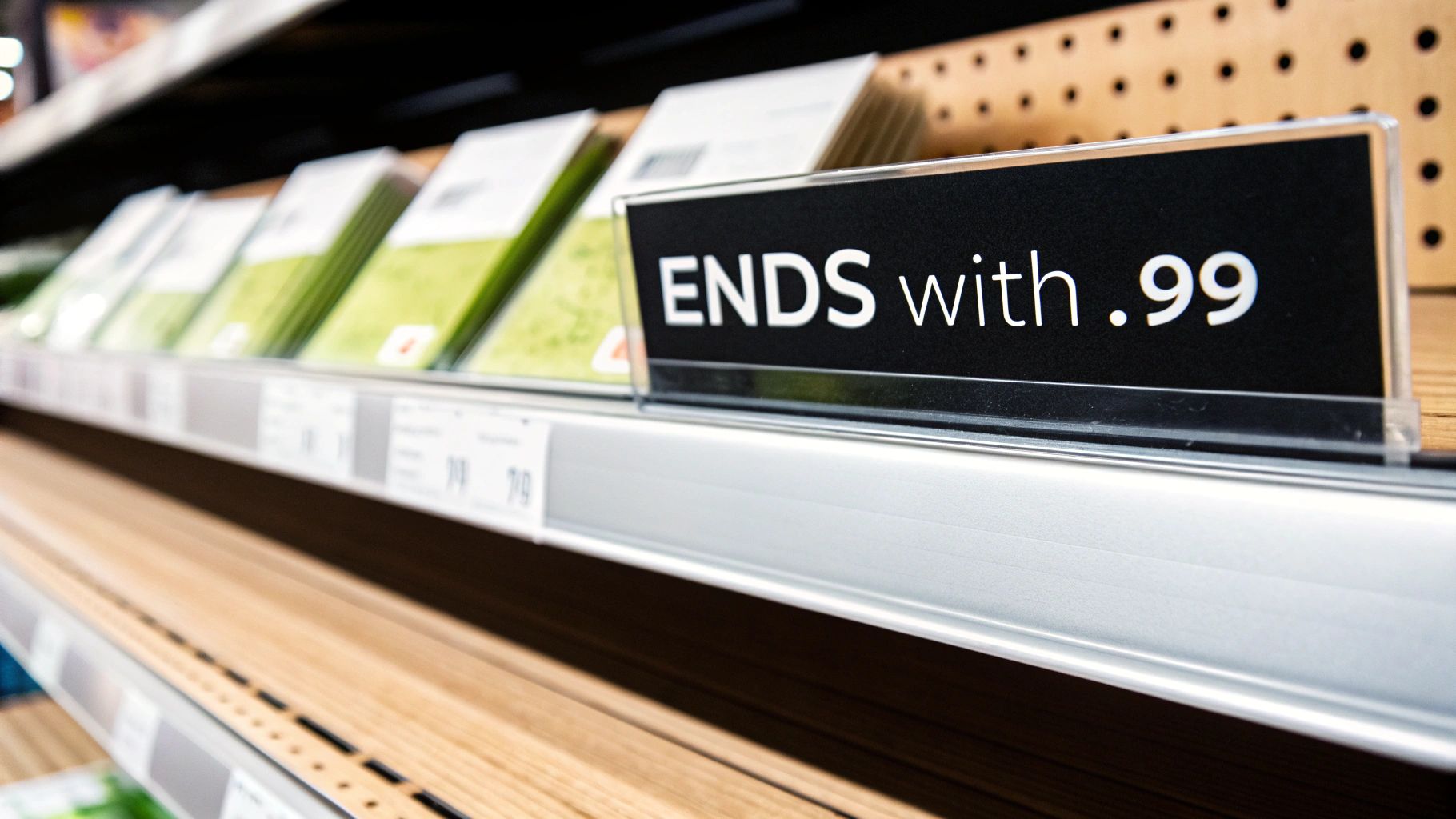
This strategy creates the impression of a great deal or a discount, making it particularly effective for mid-range, value-driven products where customers are more price-sensitive. It's less suited for luxury or premium brands, where a whole number price (e.g., $200) can signal higher quality and prestige.
Implementing this tactic is straightforward, but optimizing it requires testing.
Pro Tip: While .99 is common, test other endings like .95 or .97. Warby Parker famously uses $95 for its eyeglasses, which can feel less overtly promotional and more established than the standard .99, blending value with a sense of brand confidence.
Price anchoring is a powerful cognitive bias where consumers rely heavily on the first piece of information offered (the "anchor") when making decisions. By establishing a higher reference price next to the actual sale price, you make your current offer seem like a much better deal, significantly increasing its perceived value. This is a core tenet of pricing psychology strategies.
This strategy works by framing the purchase as a gain (the amount saved) rather than just a cost. It’s highly effective for products with a clear Manufacturer's Suggested Retail Price (MSRP) or a known market value. Amazon excels at this by displaying a "List Price" with a strikethrough next to "Your Price," instantly highlighting the savings.
Successful implementation hinges on credibility and clear visual cues.
Pro Tip: Ensure your reference price is genuine and defensible. The FTC has regulations against deceptive pricing. Use a price that was genuinely offered for a reasonable period (e.g., at least 30 days) to maintain customer trust and stay compliant.
Tiered pricing, also known as the "Good-Better-Best" model, is a powerful pricing psychology strategy that presents customers with multiple options at different price points. By offering three distinct tiers, brands leverage the "Goldilocks Effect," where consumers naturally gravitate toward the middle, "just right" option, avoiding the extremes of the cheapest and most expensive choices. This guides buyers toward the intended product and often increases average order value.
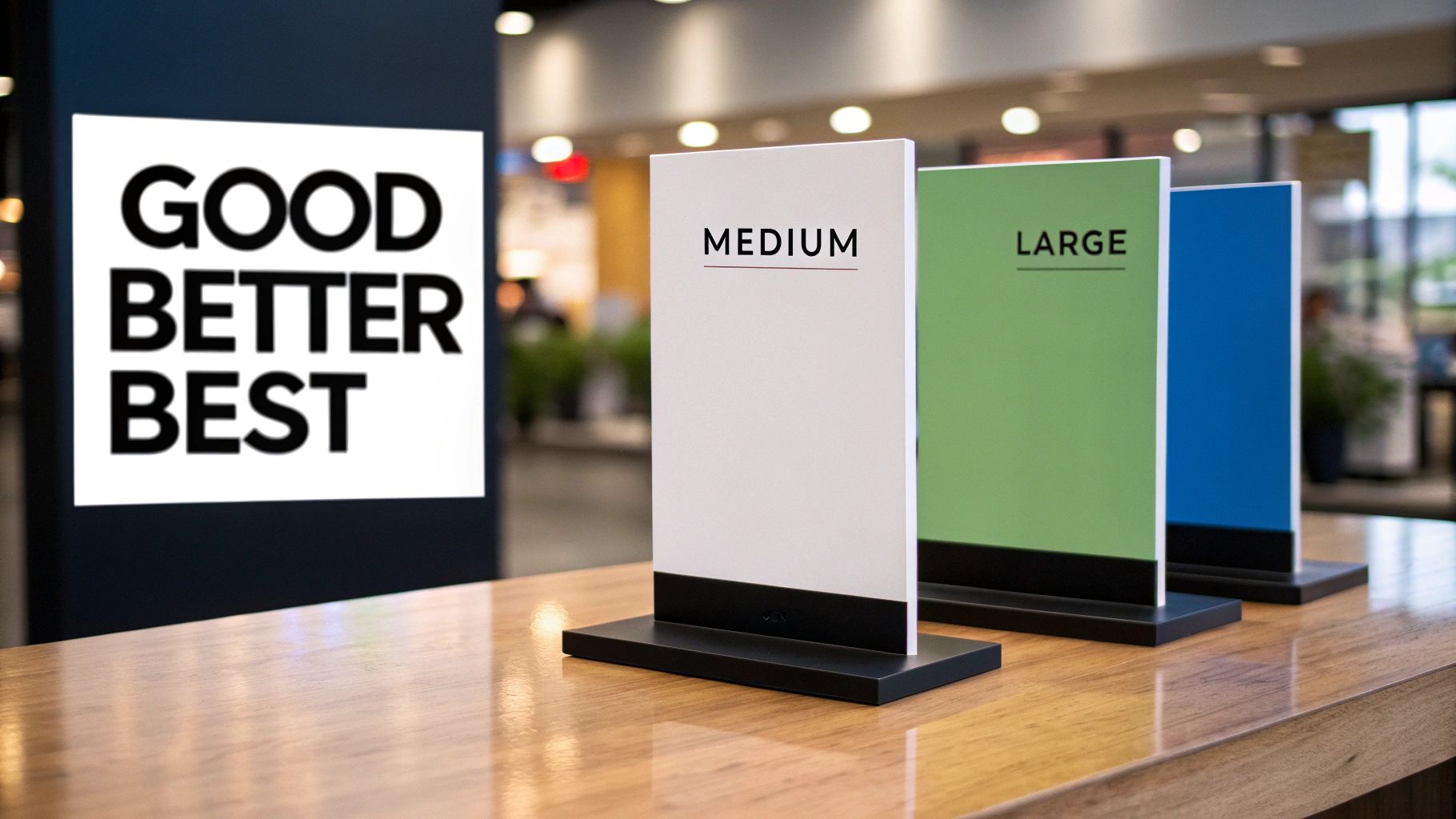
This strategy works by framing the middle option as the best value, making it seem like the most rational and balanced decision. It's highly effective for SaaS companies like Shopify with their Basic, Shopify, and Advanced plans, as well as for digital products and service-based businesses. It gives customers a sense of control over their purchase while subtly steering them toward a more profitable outcome for the business.
Properly structuring your tiers is crucial for success. The value difference between them must be clear and compelling.
Pro Tip: Ensure the value jump between the "Good" and "Better" tiers is substantial enough to justify the price increase, but not so large that it pushes customers back down. The "Best" tier often serves as an anchor, making the middle option appear more reasonably priced in comparison.
The Decoy Effect, also known as asymmetric dominance, is a powerful pricing psychology strategy that steers customers toward a specific choice. It involves introducing a third, slightly inferior option (the "decoy") to make your target product look like a significantly better deal. The decoy is priced and featured in a way that makes another option seem clearly superior in comparison, influencing the customer's decision-making process.

This tactic is extremely effective for businesses with tiered product offerings, subscriptions, or bundles. By presenting a decoy, you reframe the purchasing decision from "Which of these two is better?" to "Which one is the obvious winner?" This simplifies cognitive load and nudges buyers toward the more profitable, higher-value option you want them to select.
Careful positioning is key to making the decoy effect work without feeling manipulative.
Pro Tip: For Amazon sellers, this can be applied to product variations. If you have a 10oz bottle for $15 and a 20oz bottle for $25, add a decoy 18oz variation for $24. The 20oz option for just one dollar more becomes the logical choice, boosting sales of your larger, more profitable unit.
Bundle pricing is a strategy where several related products are sold together as a single package, often for a lower price than if each item were purchased individually. This tactic capitalizes on the customer's desire for value and convenience, framing the purchase as a smart, economical choice. By grouping complementary items, you simplify the buying process and introduce customers to products they might not have considered otherwise.
This strategy is highly effective for increasing the perceived value of an offer and is a powerful tool to boost average order value. It works well for products that naturally go together, like a skincare routine kit, a gaming console with games, or a camera with a lens and memory card. Amazon’s "Frequently Bought Together" feature is a prime example of algorithmic bundling in action.
Creating effective bundles requires understanding customer behavior and product relationships.
Pro Tip: Don't just bundle products; bundle solutions. Frame your package as the complete answer to a customer's problem. Instead of "Shampoo + Conditioner," market it as "The Ultimate Hair Repair Kit." This shifts the focus from a simple discount to providing comprehensive value, a key element in effective pricing psychology strategies.
Prestige pricing, or premium pricing, is a strategy that intentionally sets product prices high to convey a sense of exclusivity, superior quality, and luxury. This approach leverages a powerful cognitive bias where consumers use a high price as a signal for high value. Instead of attracting bargain hunters, it targets affluent customers who associate cost with craftsmanship, status, and a premium experience.
This strategy is ideal for brands in niche markets with high-quality, unique products, such as handcrafted goods, high-end skincare, or limited-edition collectibles. Tesla and Hermès are masters of this, creating aspirational products where the high price point is a core part of their brand identity. It is completely unsuitable for value-driven or mass-market products, as it would alienate the target customer base.
Implementing prestige pricing is about brand building as much as it is about setting a number. It requires a holistic commitment to a premium identity.
Pro Tip: Never discount. Sales and promotions can erode the perceived value and exclusivity you've worked to build. Instead of lowering prices, add value through exclusive gifts, premium services, or loyalty programs for top-tier customers. This reinforces brand integrity while rewarding your best clients.
Psychological price points are specific price thresholds that consumers use to categorize products into different mental buckets of affordability. This strategy involves setting a price just below a major whole-number threshold (like $100, $500, or $1000) to keep the product in a lower, more accessible price category in the consumer's mind. For example, a consumer might mentally group a $99 item with other sub-$100 products, making it seem significantly more affordable than a $100 item, which crosses into a new, higher-priced category.
This tactic is extremely effective for products where crossing a specific dollar amount represents a major purchasing decision, such as electronics, furniture, or high-end apparel. By pricing an item at $499 instead of $500, a brand leverages the consumer’s categorical thinking to increase perceived value and reduce the friction associated with a higher price commitment, a key technique in the arsenal of pricing psychology strategies.
Finding the right threshold is crucial for this strategy to work effectively.
Pro Tip: Analyze competitor pricing to identify established thresholds in your market. If most competitors price similar items at $49.99, introducing a product at $52 could inadvertently push it into a higher mental price bracket for shoppers, hurting your conversions even with a minimal price difference.
Scarcity and urgency are powerful psychological triggers that motivate immediate action. This strategy leverages the principles of FOMO (Fear of Missing Out) and loss aversion, suggesting that a product is in limited supply or available for a limited time. When customers believe they might miss out on an opportunity, they are more likely to make a purchase decision quickly rather than delay.
This tactic is extremely effective for flash sales, limited edition product drops, and clearing out seasonal inventory. Amazon's "Limited Time Deal" badges and countdown timers are a classic example, creating a clear window for action. However, its power depends entirely on credibility; if customers sense the scarcity is artificial or constant, the effect diminishes rapidly.
Implementing this requires genuine limitations, whether in time or stock, to maintain customer trust.
Pro Tip: Combine scarcity with urgency for maximum effect. For example, an email campaign can announce, "Our limited edition collection drops Friday at 9 AM. Only 100 units available." This creates a time-based event (urgency) for a finite number of products (scarcity), driving peak engagement.
Price Discrimination, also known as price segmentation, is a pricing strategy where a business charges different prices for the same product or service to different customer segments. This is not about arbitrary price changes; it's a calculated approach based on legitimate factors like purchase behavior, geographic location, or willingness to pay, allowing businesses to capture maximum revenue from each distinct group.
This strategy works by acknowledging that not all customers value a product equally. A new customer might be enticed by a welcome discount, while a loyal, repeat buyer might value access to exclusive bundles. Airlines have mastered this, with prices fluctuating based on demand and booking time. Similarly, software companies offer tiered pricing for students, individuals, and large enterprises.
Successful segmentation requires careful planning and a deep understanding of your audience. Transparency is key to avoiding customer backlash.
Pro Tip: Focus on value-based segmentation rather than just demographic data. Instead of offering a discount based on location alone, tie it to a legitimate cost difference, like reduced shipping costs for a nearby warehouse. This frames the price difference as fair and logical, not arbitrary.
Value-based pricing shifts the focus from internal costs to external customer perception. Instead of basing your price on production costs and a desired margin (cost-plus pricing), this strategy sets prices according to the perceived value and outcomes your product delivers to the customer. It answers the question, "What is the transformative result worth to my target audience?"
This approach is highly effective for innovative products, DTC brands offering unique transformations (like a premium skincare line promising clear skin), or B2B SaaS tools that deliver measurable ROI. For example, Peloton doesn't just sell an exercise bike; it sells a complete fitness transformation and community, justifying its premium price. This is one of the more advanced pricing psychology strategies as it requires deep customer understanding.
Implementing this strategy is less about a simple price change and more about a fundamental shift in marketing and research.
Pro Tip: Build and showcase case studies and testimonials that quantify the results your customers have achieved. Social proof is your most powerful tool in justifying a value-based price. Highlighting tangible outcomes makes the perceived value concrete and believable for prospective buyers.
Item🔄 Implementation Complexity💡 Resource Requirements📊 Expected Outcomes / Impact⚡ Ideal Use Cases⭐ Key AdvantagesCharm Pricing (The .99 Effect)Low — immediate to deployLow — price updates, A/B tests5–20% conversion upliftLow–mid price e‑commerce, high-volume retailSimple; low cost; consistent conversion liftPrice Anchoring & Reference PricingMedium — requires verification & controlsMedium–High — price history, competitor data, legal review20–35% conversion uplift when credibleSales/promotions, competitive markets, MSRP-driven categoriesDramatically increases perceived value; reduces objectionsTiered Pricing (Good‑Better‑Best)Medium — design tiers & UX workMedium — productization, UX, testing15–30% increase in AOV; middle tier dominanceSaaS, subscriptions, products with feature gradationIncreases AOV; appeals to segments; simplifies choiceThe Decoy Effect (Asymmetric Dominance)Medium — careful option design & testingLow–Medium — configuration, pricing experiments20–40% shift toward target optionBundles, subscription plans, menu pricingBoosts preference for target option; frames choice effectivelyBundle PricingMedium — inventory & margin coordinationMedium — inventory management, fulfillment, margin calc30–50% increase in AOVCross-sell, slow-moving inventory clearance, starter kitsHigher AOV; perceived savings; improves product discoveryPrestige Pricing (Premium Pricing)High — brand alignment & sustained strategyHigh — marketing, premium CX, product qualityHigher margins (≈2–3x) but lower volumeLuxury goods, premium tech, aspirational brandsSignals exclusivity; enables high margins; reduces price competitionPsychological Price PointsLow — simple pricing adjustmentsLow — market research on thresholds, A/B tests10–25% conversion lift at key thresholdsRetail SKUs, subscriptions, entry-level price pointsLow-cost; easy to test; complements other tacticsScarcity and Urgency PricingMedium — campaign cadence and credibility neededMedium — inventory signals, timers, comms channels20–40% uplift during campaignsFlash sales, product drops, checkout recoveryDrives immediate action; reduces cart abandonmentPrice Discrimination (Segmentation)High — requires personalization & complianceHigh — data infrastructure, analytics, legal oversightMaximizes revenue by capturing willingness to pay (variable)Airlines, geo-pricing, loyalty/enterprise segmentationRevenue optimization; tailored conversion per segmentValue‑Based PricingHigh — deep research & value quantificationHigh — customer research, ROI cases, sales enablement50–100%+ higher margins when value aligns with priceB2B SaaS, professional services, outcome-driven productsCaptures maximum willingness to pay; shifts focus to outcomes
You've just explored ten of the most powerful pricing psychology strategies available to e-commerce brands. We've dissected everything from the simple but potent effect of Charm Pricing to the sophisticated architecture of Tiered and Decoy Pricing. Each tactic offers a unique lever to pull, but the true mastery lies not in using one, but in orchestrating several in a cohesive, data-driven framework.
Pricing isn't a "set it and forget it" task on your launch checklist; it's a dynamic, ongoing conversation with your customer about the value you provide. Viewing it as such transforms it from a simple number on a product page into one of your most critical growth drivers.
For most direct-to-consumer and Amazon sellers, the path forward isn't about implementing all ten strategies at once. That would create chaos. Instead, think in layers.
With a solid base and a growth engine in place, you can introduce more nuanced, situational strategies.
The single most important takeaway is this: your assumptions are probably wrong. The only way to know for sure which combination of pricing psychology strategies will resonate with your audience is to test relentlessly.
Key Insight: Don't just test the price itself; test the presentation of the price. How you frame the value is often more important than the specific number. An A/B test could compare a simple $49 against a tiered offer where the middle $49 option is highlighted as the "Best Value." The price is the same, but the psychological context is completely different.
Start small. Pick one strategy, formulate a clear hypothesis (e.g., "Changing our price from $50 to $49.99 will increase our conversion rate by 5%"), and run a controlled A/B test. Measure the impact on conversion rate, AOV, and revenue per visitor. What works for one brand might not work for another. Your data is your only source of truth.
By moving from a static to a strategic approach, you'll unlock one of the most powerful and often overlooked levers for sustainable, profitable growth.
Ready to discuss these high-level pricing strategies with entrepreneurs who are actively testing and scaling them? The Million Dollar Sellers community is an exclusive mastermind for verified seven- and eight-figure e-commerce sellers to share what's working right now. Learn more and see if you qualify at Million Dollar Sellers.
Join the Ecom Entrepreneur Community for Vetted 7-9 Figure Ecommerce Founders
Learn MoreYou may also like:
Learn more about our special events!
Check Events