Chilat Doina
September 22, 2026
86% of companies have employees who can't name the strategy, and only 7% of leaders say more than 75% of daily work clearly ladders up to strategy, according to a 2026 strategy execution benchmark. That gap isn't mainly a planning failure. It's an operating rhythm failure.
Ecommerce leaders usually don't lack ambition, insight, or strategic documents. They lack a repeatable system that turns priorities into weekly decisions, assigns one person to each outcome, and flags drift before a quarter disappears. A strategy to execution framework fixes that operating gap by connecting intent, ownership, meetings, metrics, and resource allocation.
The practical standard is simple. Every team should know what matters this quarter, every KPI should have one accountable owner, every week should produce a decision, and every change in market conditions should trigger a deliberate trade-off rather than a fire drill.
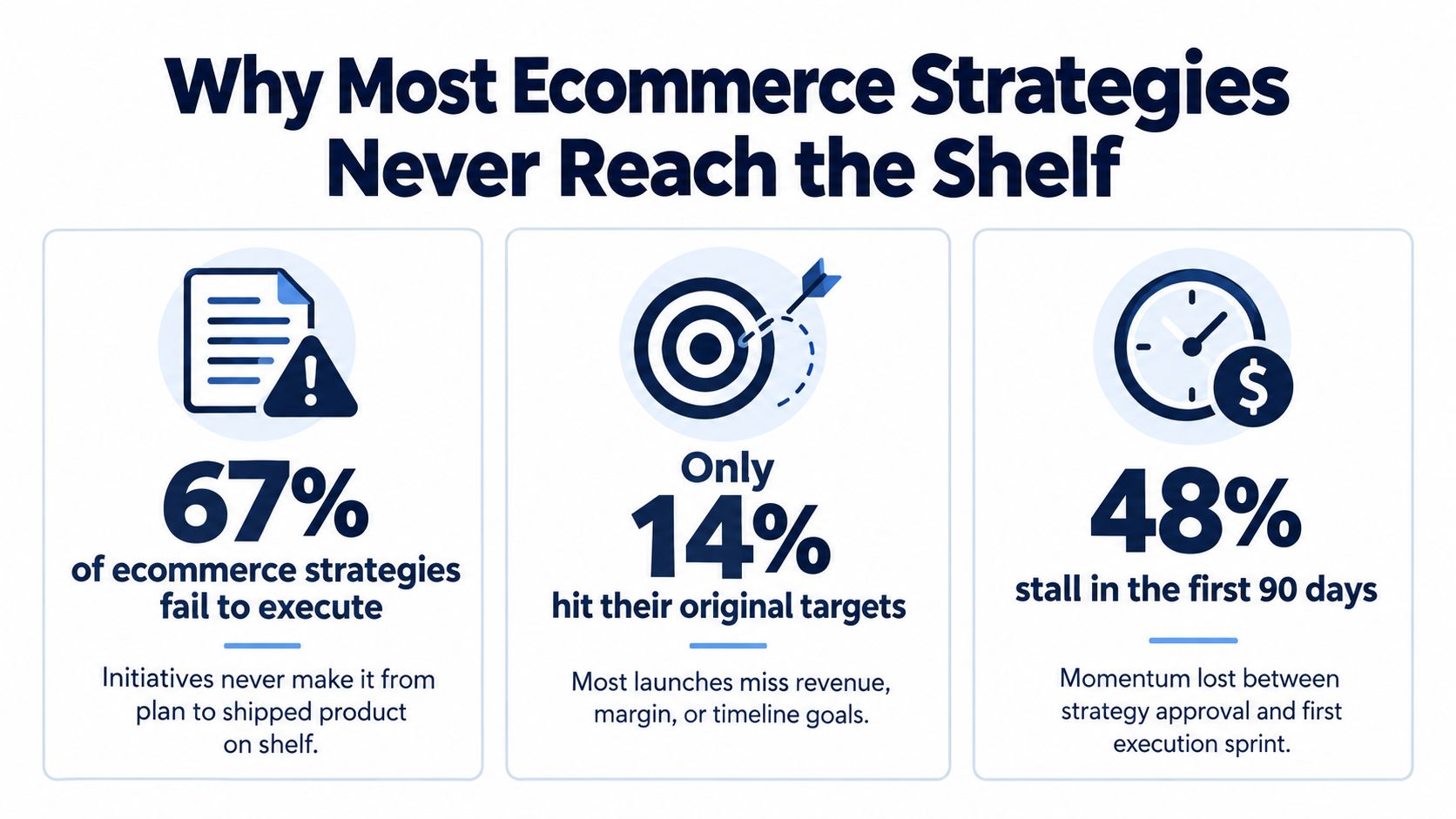
A widely cited 2026 estimate says 67% of well-formulated strategies fail because of poor execution, while only 12% of companies fully deliver on the ambition they set (strategy execution statistics). For ecommerce founders, the useful diagnosis is operational: where did the company stop converting strategic intent into decisions, assignments, and shipped work?
Brands can spend weeks refining positioning, channel plans, launch calendars, and financial models. After approval, functional teams return to their own scorecards. Paid media pursues acquisition efficiency, merchandising protects assortment, operations protects availability, and finance protects cash. Each team may perform well locally while the company misses the outcome that justified the strategy.
The Balanced Scorecard, formalized in 1992 by Robert Kaplan and David Norton, connected vision and strategy with objectives, measures, targets, and initiatives across financial, customer, internal process, and learning and growth perspectives (Harvard Business School's Balanced Scorecard overview). The useful lesson is direct: strategy earns value only when it changes measurable work and the decisions surrounding it.
Install four operating rules:
The failure is usually not a shortage of activity. It is activity without a visible connection to the company's chosen bets. If the founder prioritizes margin improvement, the media lead, buying lead, finance lead, and retention lead need defined contributions, measures, and decision rights. Otherwise, the priority stays in the presentation rather than reaching the shelf.
Operating rule: A strategic priority needs a named owner, a weekly metric, and a decision forum before it qualifies as an execution priority.
Review the strategy when the assumptions are wrong. Do not rewrite it because execution feels slow. First establish the weekly rhythm that exposes stalled work, forces trade-offs, and gives owners authority to correct course. A clear plan reviewed only at quarter-end is an aspiration. A clear plan converted into weekly decisions is an operating system.
A repeatable strategy to execution framework needs four connected building blocks. Together, they close four operating gaps: unclear intent, unsequenced work, weak accountability, and slow correction.
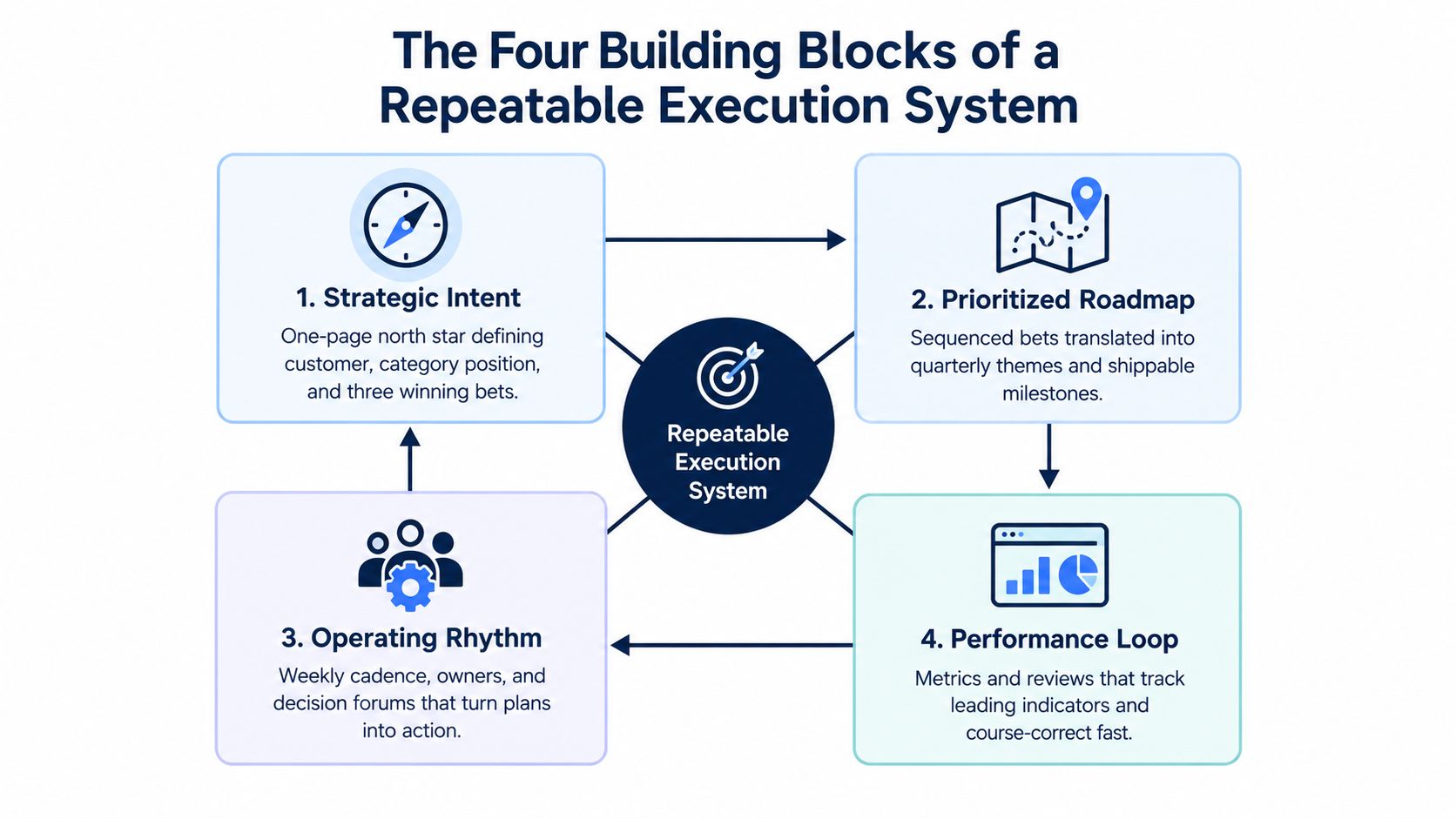
Put the quarterly strategy on one page. Define the customer you're prioritizing, the category position you intend to own, and the three revenue bets that deserve disproportionate attention. Each bet needs a target business outcome, a leading driver, and a stated constraint.
For an ecommerce brand, the bets might focus on increasing repeat-customer contribution, improving the economics of a core acquisition channel, or keeping a hero product available. “Grow the brand” is not an operating priority. A useful priority tells the team what to do, what to measure, and what to ignore.
Sequence the work before you assign resources. Turn each revenue bet into quarterly themes, milestones, dependencies, owners, and explicit exclusions. The roadmap must show what ships first, who is blocked, what needs funding, and which attractive projects will wait.
Leaders can review these examples of tactical roadmaps for planning formats, then adapt the structure to launches, channel initiatives, inventory work, or retention programs. Do not copy a template blindly. Use it to expose sequencing conflicts before the team commits time or budget.
The rhythm turns intent into weekly decisions. Schedule the weekly business review, channel updates, forecasting touchpoint, and quarterly strategy review before the quarter begins. Give each forum named attendees, a defined decision right, and a concrete output.
Document recurring work through clear standard operating procedures, particularly reporting, budget changes, inventory escalation, and campaign launch approvals. Without written procedures, owners rebuild the process every week and execution quality varies with whoever is available.
A roadmap without this cadence becomes a project list. The cadence assigns attention, resolves trade-offs, and gives owners authority to act before a small issue becomes a quarterly miss.
Connect metrics to action. Build one dashboard with lagging outcomes and leading indicators, then define the threshold that triggers a review, escalation, or resource shift. A declining contribution margin, rising stockout exposure, or weakening repeat-purchase signal should prompt a decision before the end-of-quarter presentation.
Use Kaplan and Norton's Balanced Scorecard framework as a reference, then simplify it for ecommerce. One scorecard with a focused set of KPIs is more useful than multiple layers of metrics that no weekly meeting uses. Each KPI needs one owner, one review rhythm, and a defined response when performance moves outside the expected range.
Your calendar should force the company to make trade-offs while the information is still useful. Don't create a meeting for every team. Create a small number of forums with clear decision rights.
Monday Weekly Business Review, 30 minutes. The CEO, finance lead, and channel or functional owners attend. Inputs are the prior week's KPI snapshot and a three-bullet update from each owner: what moved, what didn't, and what decision or blocker needs attention. The output is a reallocated priority list for the week. The single decision is, “What gets attention and resources now?”
Wednesday Channel Stand-ups, 15 minutes asynchronously. Each channel owner posts spend, CPA, one meaningful performance movement, and one blocker. The channel owner can resolve routine issues without waiting for the CEO. Escalation is reserved for changes that affect budget, margin, inventory, or another team's committed work.
Friday Forecasting Touchpoint, 20 minutes. The finance lead meets with the CEO and relevant commercial owners to update the rolling cash and contribution margin view. The decision is whether next week's operating assumptions still hold. If they don't, the Monday meeting starts with a known reallocation question rather than a surprise.
Monday Quarterly Kickoff. Reset the three revenue bets, confirm owners, approve the roadmap, and publish the KPI definitions. The decision is what the company will prioritize and what it will deliberately defer.
Mid-quarter Strategy Check. Score each bet red, yellow, or green. Review leading indicators, dependencies, and resource sufficiency. The decision is whether to continue, modify, pause, or kill a bet.
End-of-quarter Retrospective. Review outcomes, decisions, missed signals, and execution bottlenecks. The decision is what carries forward, what changes, and what gets removed from the next strategy map.
| Meeting | Cadence | Attendees | Input | Output | Decision Owned |
|---|---|---|---|---|---|
| Monday Weekly Business Review | Weekly | CEO, finance lead, channel and functional owners | KPI snapshot, three-bullet owner updates | Reallocated weekly priorities | What gets attention and resources this week |
| Wednesday Channel Stand-ups | Weekly | Channel owners, relevant operators | Spend, CPA, performance movement, blocker | Written issue list and escalations | Which blockers the channel owner resolves or escalates |
| Friday Forecasting Touchpoint | Weekly | CEO, finance lead, commercial owners | Cash and contribution margin view | Updated operating assumptions | Whether the forecast still supports current plans |
| Monday Quarterly Kickoff | Quarterly | Leadership and all strategic owners | Strategy map, roadmap, KPI definitions | Published quarterly operating plan | Which bets receive focus and funding |
| Mid-quarter Strategy Check | Quarterly | Leadership and bet owners | Leading indicators, risks, dependencies | Red-yellow-green bet status | Continue, modify, pause, or kill |
| End-of-quarter Retrospective | Quarterly | Leadership and owners | Outcome results, decision log, missed signals | Next-cycle changes | What carries forward or gets removed |
Keep the forums short because preparation should happen before the meeting. If a meeting produces no decision, convert it into an async update. Strategy survives when the calendar repeatedly asks leaders to choose.
A strategic objective should connect three layers of measurement:
That structure prevents a common ecommerce mistake. Leaders track revenue after the fact, then wonder why nobody knew what to do on Tuesday. A channel owner needs a driver metric and an activity counter that reveal whether the current work can still produce the outcome.
Use a primary owner and a backup. Collaboration remains necessary, but the primary owner has the responsibility to explain movement, recommend action, and escalate a decision. The owner also needs a documented definition, a target band, and a red-flag threshold.
The table below is an operating template, not a claim about universal targets. Set the bands from your own economics, seasonality, channel mix, and inventory position.
| KPI | Primary Owner | Weekly Target Band | Red-Flag Threshold |
|---|---|---|---|
| MER | Growth lead | Approved weekly range | Below the approved range with margin risk |
| Blended ROAS | Paid media lead | Channel plan range | Below the floor required by contribution economics |
| AOV | Merchandising lead | Current offer and mix range | Sustained decline that weakens order economics |
| Gross margin | Finance lead | Approved product margin range | Below the floor after discounts, freight, and fees |
| Contribution margin | CFO or finance lead | Quarterly economic target range | Negative movement that threatens the operating plan |
| Repeat purchase rate | Lifecycle lead | Cohort expectation range | Cohort behavior below the approved retention assumption |
| Inventory turn | Operations or supply chain lead | Assortment-specific range | Excess or shortage risk requiring a buying decision |
Avoid two ownership failures. First, don't assign “the leadership team” to a KPI. That creates discussion without accountability. Second, don't rely only on metrics that update too slowly to influence the current week.
For practical KPI definitions and selection guidance, use this ecommerce KPI reference while building your scorecard. Then add the decision attached to each metric. A number without a decision rule is reporting, not management.
Drift is more expensive than bad strategy. A flawed strategy can be challenged directly. Drift is harder because the team keeps working, reports remain positive in isolation, and the quarterly plan erodes through small unresolved deviations.
The Monday review exists to make those deviations visible before they become expensive. It requires no slides and no new project requests. Open the dashboard, compare the prior week with the target band, and classify each metric as on-track, slipping, or broken.
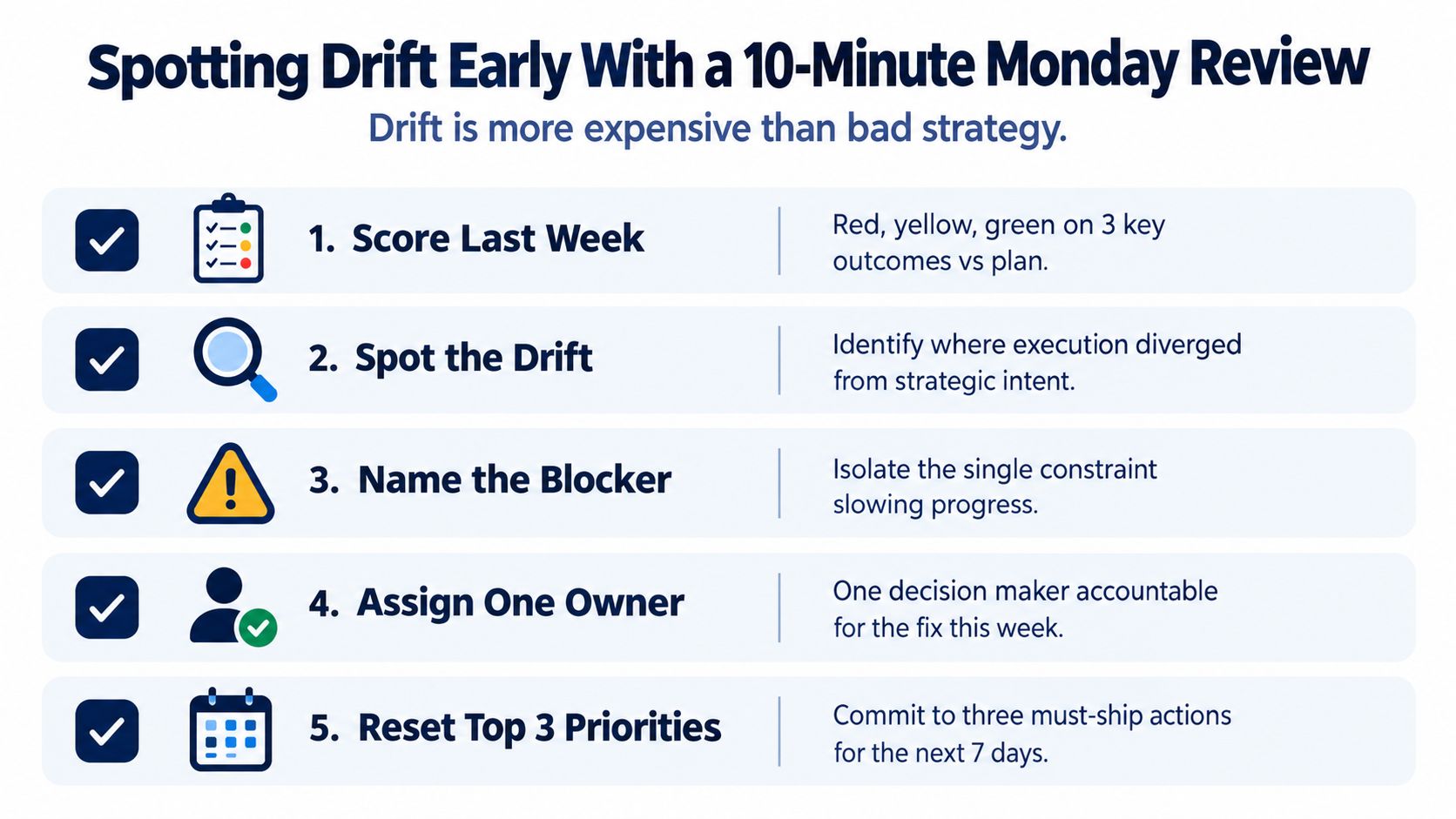
Use the same sequence every Monday:
Post one line per KPI in the leadership channel. A useful status note looks like this:
Contribution margin, yellow: Paid social efficiency weakened after the offer change. The growth lead will restore the approved offer structure and report the next performance readout on Friday.
The review's output is a short status document, not a larger task list. If a metric is on-track, leave it alone. If it's slipping, assign one corrective action. If it's broken, decide whether to reallocate, pause the initiative, or change the assumption behind the plan.
Quarterly reviews are too infrequent to serve as the first detection mechanism. A Monday habit surfaces problems earlier because it looks at execution while the team can still change the week's work. The discipline also protects owners from surprise criticism. They know the review is routine, the definitions are stable, and the response is a decision rather than a blame exercise.
A resilient execution system must handle change without forcing the team to pretend the original plan still works. Consider an eight-figure DTC brand whose paid social channel produced declining contribution margin for three weeks. The leadership team decided to kill the channel, move 30% of its budget into creator and search, and redeploy two media buyers to lifecycle and retention work.
That scenario is included as an operating example, not a verified case study. The important point is how the decision moves through the framework.
On Monday, the contribution margin KPI was flagged as slipping. The finance lead documented the movement, the growth lead named the channel as the leading constraint, and the CEO required a decision rather than another diagnostic cycle.
The weekly business review owned the kill decision. The team reviewed the economic trade-off, approved the budget move, and assigned the redeployed media buyers to specific lifecycle and retention initiatives. No separate emergency committee was needed because the decision rights already existed.
At the quarterly strategy check, leadership re-baselined the affected targets. The objective didn't disappear, but the route to it changed. The KPI ownership table was updated in one place, with creator and search owners taking responsibility for their revised inputs and the lifecycle lead owning the retention work.
This is why cadence matters more than a static plan. A business that lacks regular reviews treats every pivot as a restart. People debate history, rebuild forecasts, and wait for permission. A business with visible metrics and clear rights treats the pivot as a controlled trade-off.
Decision standard: Change the tactic quickly, but change the objective only after reviewing the evidence and the economics.
The operating model described in this guide to pivoting business strategy is useful when the change affects more than one function. In ecommerce, channel, inventory, cash, and customer experience decisions rarely stay inside one department. Your framework should make those dependencies explicit without slowing the owner who can act.
The best system doesn't prevent change. It makes change cheap, traceable, and reversible where possible.
Don't launch this as a transformation program. Install the minimum operating system, run it, and inspect whether the team uses it under pressure.
Write the one-page strategy and choose the three revenue bets. Name the seven role owners across growth, paid media, merchandising, finance, lifecycle, operations, and executive sponsorship. Build the KPI ownership table, define target bands and red flags, and place every recurring meeting on the calendar.
Use a simple onboarding format to assign responsibilities, such as the MyCulture.ai onboarding plans, then adapt it to your ecommerce operating roles. The format matters less than making each owner's first actions and decision rights explicit.
Run two complete weekly business reviews, two Monday drift checks, and one quarterly strategy review using the inputs and outputs already defined. Don't improve the template every week. First prove that owners arrive with current numbers, identify blockers, and leave with decisions.
At day 60, audit the meeting behavior. Did the review reallocate priorities, or did it become a reporting session? Did owners make decisions within their rights, or did every issue return to the CEO? Those answers reveal whether the framework is operating or merely documented.
Use a real reallocation scenario, even if the shift is modest. Measure the cycle time from signal to decision, review whether the KPI table changed with the decision, and inspect whether teams can explain how current work supports the quarter's bets.
| Phase | Days | Key Deliverables | Owner | Checkpoint Criteria |
|---|---|---|---|---|
| Foundation | 1 to 30 | One-page strategy, three bets, seven owners, KPI table, recurring cadence | CEO and finance lead | Pass when every bet, KPI, owner, and meeting is documented |
| Activation | 31 to 60 | Weekly reviews, drift checks, channel updates, strategy review | Operating lead | Pass when meetings produce decisions and owners use defined rights |
| Resilience test | 61 to 90 | Reallocation scenario, signal-to-decision measurement, outcomes scorecard | CEO and functional owners | Pass when the system handles a change without reverting to ad hoc escalation |
At day 30, hold the foundation review. At day 60, run the rhythm audit. At day 90, publish the outcomes scorecard and ask one uncomfortable question: Did the quarter run on cadence, or did the company revert to heroics?
That answer separates scalable brands from brands that repeatedly depend on a founder's memory, urgency, and late-night intervention. A framework earns its place only when it still works during a difficult week.
Million Dollar Sellers offers peer-led strategy sharing, execution discussions, and operating insights for serious ecommerce founders building across Amazon, DTC, and omnichannel channels. If you want practical perspective from 7-, 8-, and 9-figure operators on turning strategic priorities into repeatable execution, visit Million Dollar Sellers.
Join the Ecom Entrepreneur Community for Vetted 7-9 Figure Ecommerce Founders
Learn MoreYou may also like:
Learn more about our special events!
Check Events