Chilat Doina
April 6, 2026
You can feel the ceiling when a brand is still growing, but every new dollar of growth costs more than the last one.
Paid acquisition gets you to scale. Then it starts taxing scale. Creative fatigue sets in, incrementality gets harder to prove, channel volatility creeps into forecasts, and the team ends up working harder to protect contribution margin than to expand it. That is usually the moment founders start asking a better question. Not “How do we buy more traffic?” but “How do we build demand that does not disappear when we stop spending?”
At that point, community ecommerce stops being a nice brand idea and becomes an operating decision. For an established brand, community is not a side project for social. It is infrastructure for retention, advocacy, product feedback, support efficiency, and conversion.
The operators who get this right do not just create content. They create a place, a habit, and a reason for customers to come back.
The strongest argument for community ecommerce is simple. It provides an advantage where paid channels create dependency.
When a brand relies too heavily on ads, it rents attention. When it builds community, it owns a relationship. That distinction matters more now because ecommerce is crowded and buyers have more choices than ever.

This is not a niche behavior. The global social commerce market reached $2 trillion by the end of 2024, accounting for 17% of total ecommerce sales, and 71% of Gen Z prefer product discovery via social channels, while community signals like reviews and UGC drive 30% higher conversion rates than traditional ecommerce according to CreatorLabz’s social commerce statistics and trends.
That matters because social commerce is one of the clearest expressions of community ecommerce. People are not just buying products. They are buying through conversations, recommendations, creators, reviews, and visible proof from other customers.
For a scaled operator, that changes the growth model. Your brand no longer competes only on media buying efficiency. It competes on whether customers trust the people around your brand more than they trust a competitor’s ad.
Most brands still approach community like an engagement program. They launch a Facebook group, a Discord, or a VIP email segment and call it community. That creates activity, not advantage.
Real community ecommerce works when the customer experience gets better because other customers are present. The signals are practical:
That is why founders looking for durable growth have started treating community as part of the operating system, not part of the campaign stack.
A good example of this mindset appears in this piece on building a DTC community for long-term brand growth. The core idea is right. Community is not there to decorate the brand. It is there to deepen trust and create compounding demand.
Practical takeaway: If your growth plan still depends on buying more reach every quarter, you do not have a growth engine. You have a media bill.
Most founders talk about community ecommerce as if it is one thing. It is not. There are several operating models, and they produce different outcomes.
The mistake is trying to copy another brand’s format without understanding the underlying business model. A private membership, a social-selling engine, a brand forum, and a cohort-based experience can all work. They just solve different problems.
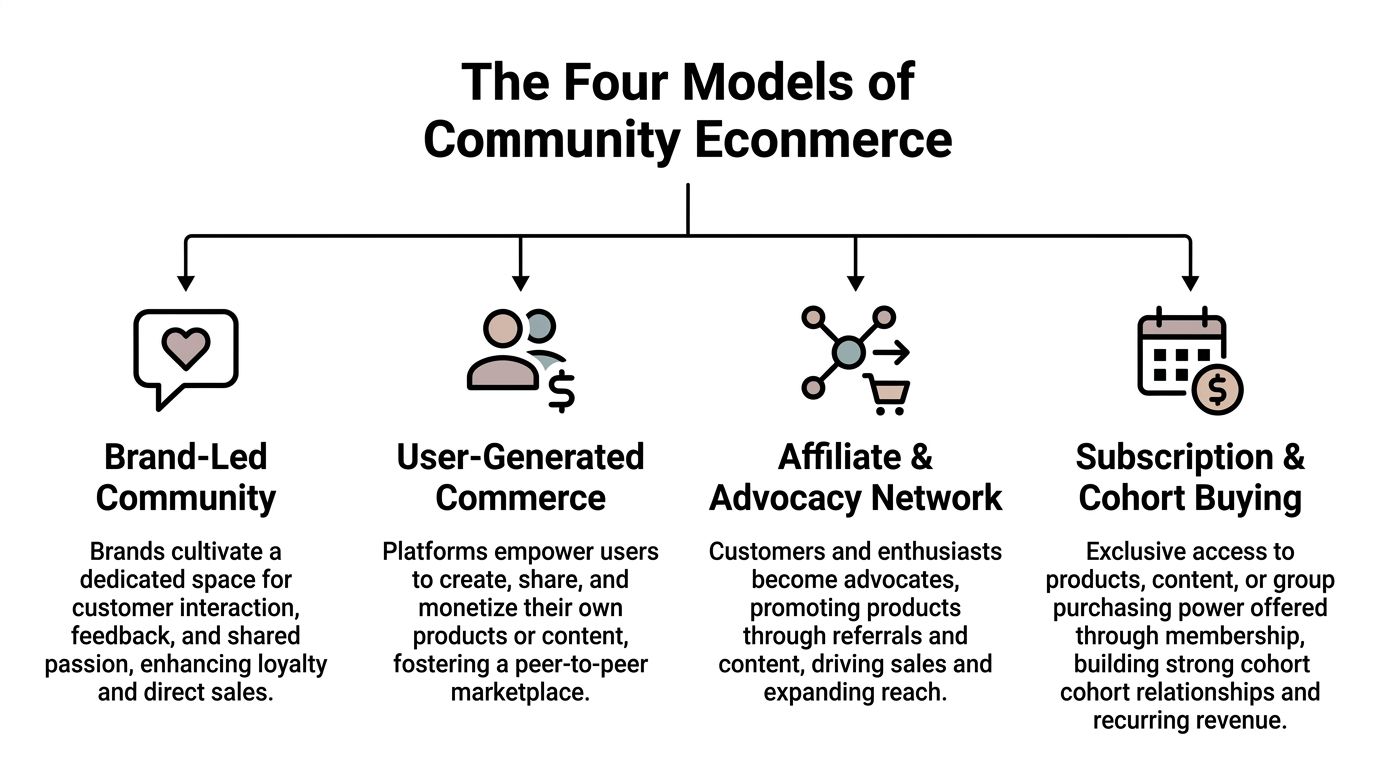
This model turns access itself into part of the product.
Members get something the general market does not. That could be early access, exclusive drops, education, private support, premium content, or recurring perks. The value comes from belonging plus utility.
This works best when your brand already has strong affinity and repeat behavior. Beauty, wellness, collectibles, education-led commerce, and enthusiast categories tend to fit well because customers want more than a one-time transaction.
The upside is predictable revenue and stronger retention. The trade-off is pressure to keep delivering fresh value. If the only perk is occasional discounts, the program starts acting like a coupon club, not a community.
A few signs this model fits:
This is the fastest-moving model and often the easiest place to start.
The community layer lives on social platforms where discovery, conversation, and checkout happen close together. The product gets sold inside the feed, around creator content, live selling, comments, and customer proof. The brand benefits from momentum and lower friction.
This model fits visually driven categories and brands that already know how to create platform-native content. It also suits operators who want speed over control in the early stage of community ecommerce.
The problem is obvious. You do not own the platform, the algorithm, or the customer relationship to the same degree. Social commerce can scale quickly, but it is fragile if you never move those buyers into owned channels.
This is the model most serious operators eventually care about.
You create a brand-controlled space where customers interact with each other and with the company. That can be a dedicated community platform, a forum, a customer hub, or an integrated experience tied to your store and CRM. Done well, it becomes the town square for your best customers.
The true advantage is not engagement for its own sake. It is operational depth. You can connect product pages to discussions, collect zero-party data, surface customer stories, gather feedback before launches, and reduce support load by letting members help members.
This model is ideal for brands with enough customer volume, content velocity, and internal discipline to keep the space useful. It fails when the team launches a forum and expects customers to generate all the value.
Use this model when: You want control over data, branding, moderation, and the direct connection between community behavior and store performance.
This is the most underused model in ecommerce.
Instead of building a permanent always-on community first, you organize people into time-bound experiences. That could be a product challenge, a guided onboarding group, a private launch cohort, a training series, or a seasonal use-case group.
Cohorts work because they create urgency, structure, and shared momentum. Customers are not staring at an empty community waiting for someone else to speak. They are joining a live experience with a reason to participate now.
This model is strong for:
It is also easier to operationalize than a full-scale community launch. You can pilot a cohort with a narrow customer segment, learn what rituals work, then decide whether a broader community layer makes sense.
The best community ecommerce strategy is often hybrid.
A brand may use social commerce for discovery, cohorts for onboarding, and a brand-owned community for retention and advocacy. What matters is choosing the model based on the business constraint you are solving.
If your issue is top-of-funnel trust, social-native community may be enough. If your issue is repeat purchase and support complexity, brand-owned community usually wins. If your issue is launch performance, cohorts often outperform broad community spaces because they give customers a clear reason to show up.
Most brands think loyalty means points, discounts, or reorder reminders. That is not a moat. That is a retention tactic.
A moat changes customer behavior in a way competitors cannot easily copy. Community does that because it creates social switching costs. Leaving your brand no longer means leaving only a product. It means leaving a group, a status layer, a feedback loop, and a familiar place where customers feel known.
Price is easy to match. Product features get copied. Creative angles burn out.
Community is harder to clone because it depends on accumulated trust. A competitor can mimic your product page, but they cannot instantly replicate a base of customers answering questions, sharing results, posting use cases, and reinforcing the brand story for you.
That makes community ecommerce especially powerful in crowded categories. The buyer sees proof before purchase, support after purchase, and belonging between purchases. Those are not abstract brand benefits. They influence whether the next order goes to you or to the cheaper lookalike.
The underrated part of community is signal quality.
When customers talk to each other in public threads, comments, events, and product conversations, your team gets context that surveys often miss. You can see what language customers use, where confusion begins, what objections repeat, which product pairings happen naturally, and what people wish existed.
That input improves more than product development. It sharpens merchandising, lifecycle messaging, landing pages, support scripts, FAQs, creator briefs, and launch sequencing.
Key insight: Good community operators do not ask, “How do we keep people engaged?” They ask, “What decisions can we make better because this community exists?”
A founder who treats community only as a retention channel leaves a lot on the table. The stronger use is as a live intelligence system.
Here is a useful framing on community-led brand dynamics:
UGC is often discussed like a content tactic. In practice, it is a trust asset. The best community ecommerce programs turn customer participation into a standing source of demonstrations, stories, objections handled, and purchase reassurance.
That lowers the burden on the internal team. Instead of manufacturing every proof point, the brand curates and amplifies what the customer base is already showing.
This matters for finance. A community that improves trust can influence LTV, reduce pressure on paid creative production, and improve merchandising decisions because the team sees real usage patterns earlier.
Founders sometimes hear “community” and assume it is soft. It is not soft when it changes margin structure and decision speed.
A healthy community can help you:
That is why community ecommerce belongs in board-level conversations. It is not a side initiative for brand teams to justify after the fact. It is one of the few assets a scaled operator can build that improves both offense and defense at once.
Most community launches fail for one reason. The brand opens a space before it has designed behavior.
People do not join because a platform exists. They join because there is a clear reason to participate, a visible payoff, and enough structure that the first interaction feels easy. Community ecommerce works when you engineer those conditions early.
The first job is not growth. It is usefulness.
Before inviting a broad audience, define what members will do inside the community. Ask a narrow question. Share a specific challenge. Invite photo replies around a use case. Open a thread on product hacks. Give members something concrete to react to. Many operators overcomplicate things at this stage.
A practical starting setup looks like this:
The point is to create rhythm, not volume.
Once the community has a pulse, commerce can move closer to the conversation.
That does not mean blasting promotions into every thread. It means connecting buying moments to member value. Early access is one of the cleanest examples. Limited launches, product voting, beta testing, bundles for members, and access to founders or experts can all drive revenue without making the space feel transactional.
The strongest monetization flows usually come from these patterns:
Co-created offers
Members help shape a product, variant, bundle, or launch. When the offer goes live, demand is already pre-sold emotionally.
Member-first access
Instead of discounting broadly, give the community priority. That rewards participation without training customers to wait for markdowns.
Problem-based selling
If the community is organized around outcomes, products can be introduced as tools inside that journey rather than as standalone pitches.
Analytics are also important here. According to Insight Global’s analysis of ecommerce customer experience optimization, combining quantitative analytics with community-driven Voice of Customer feedback can produce a 15% to 25% uplift in conversion rates, and exit-intent surveys show up to 40% of abandonments come from unanswered questions that community Q&A can address.
That finding lines up with what operators see in practice. Buyers often do not need more persuasion. They need fewer unresolved doubts.
Practical move: Pull your top pre-purchase objections from support tickets, post-purchase surveys, and on-site chat logs. Build community threads that answer those objections in customer language, then link those discussions from product pages and launch emails.
The best communities stop feeling brand-managed over time.
That does not mean the company disappears. It means members start carrying part of the value creation. They answer questions, welcome newcomers, share examples, host conversations, and reinforce standards. If all useful activity still comes from your team after months of operation, the model is weak.
To get there, founders need to install a layer between staff and the broader member base:
This member-led layer matters because scale creates dilution. New people join without context. Quality slips. Threads get repetitive. Staff burns time moderating instead of learning. Empowered members help absorb that load.
Here is the blunt version.
What works:
What does not:
Community ecommerce becomes valuable when it changes the business, not when it creates chatter.
If a founder cannot connect community activity to business outcomes, the initiative becomes vulnerable the first time budgets tighten.
The fix is to stop reporting engagement in isolation. Community metrics only matter when they explain movement in retention, support efficiency, conversion, and customer value.
Health metrics tell you whether the community is alive. Impact metrics tell you whether it matters.
Health comes first because weak communities rarely produce business lift. But health alone is not enough. A busy community that does not improve buying behavior or reduce operational cost is just another channel to maintain.
According to WPManageNinja’s write-up on community-driven ecommerce strategy, community members show a 20% to 30% higher repeat purchase rate and a higher 12-month LTV than non-members, while top-performing communities maintain a community answer rate above 70%, which correlates to a 30% to 50% reduction in support ticket volume over six months.
That gives you a practical model. Track behavior inside the community, then compare downstream outcomes against non-members.
| Community Health KPI | Business Impact KPI | Target for Scaled Brands |
|---|---|---|
| Monthly active members | Repeat purchase rate | Member cohort outperforms non-member cohort |
| New member activation | Time to second purchase | Fast onboarding and early participation |
| Community answer rate | Support ticket volume | Above 70% answer rate |
| Product feedback participation | Merchandising and launch performance | Community insights used before launches |
| Member-generated discussions linked from store pages | Conversion rate on influenced pages | Measure community-assisted page performance |
| Ambassador participation | Referral and advocacy contribution | Consistent member-led activity |
One useful way to frame this internally is through a simple chain:
Activation leads to participation. Participation leads to trust. Trust leads to repeat orders, lower support burden, and better product decisions.
That is how community gets out of the “brand initiative” bucket and into the operating dashboard.
The cleanest measurement setup compares members and non-members by cohort.
Do not ask whether the community is “working” in general. Ask tighter questions:
Operator rule: If your dashboard cannot show a member versus non-member outcome, it is measuring activity, not impact.
Do not center the reporting pack on vanity metrics such as total posts, reactions, or raw member count.
Those numbers can look healthy while the economics stay flat. For a scaled brand, the scoreboard should stay close to revenue, retention, cost savings, and conversion. Community health metrics are leading indicators. They are not the final answer.
The right community ecommerce platform is less about features and more about trade-offs. Every choice sits somewhere on the spectrum between speed and control.
Founders usually evaluate tools backwards. They ask which platform has the most features. The better question is which category fits your operating model, data priorities, and integration tolerance.
Tools like Circle are attractive because they are fast to deploy and clean for members.
You get a polished front end, native community mechanics, and less technical overhead. For many brands, that is enough to prove the model before committing deeper resources.
The downside is structural. Hosted platforms can limit how tightly you connect community behavior to your commerce data, lifecycle stack, and customer records. They also constrain branding and workflow decisions once the operation becomes more complex.
This route is best when speed matters more than customization.
The second category sits closer to the commerce stack.
These tools or plugin-based setups can connect community experiences with Shopify, WordPress, customer accounts, support systems, and CRM workflows. The benefit is obvious. Community becomes part of the same environment as transactions, customer history, and service interactions.
That usually gives operators better measurement and more useful automation. It also creates more implementation work, more QA, and more dependency on internal technical discipline.
If your team is already investing in retention systems, CRM hygiene, and lifecycle segmentation, this category tends to create the most long-term impact. It also pairs well with broader decisions about the best CRM for ecommerce brands, since customer identity and community identity should not live in separate universes for long.
Discord, Facebook groups, Instagram, TikTok, and similar environments are often where community behavior starts naturally.
These channels are fast, familiar, and can create momentum quickly. They are strong for discovery, live interaction, and informal feedback loops. They are weaker when you need durable organization, data ownership, structured onboarding, or direct integration with the rest of the business.
A useful mental model:
At scale, the winning stack is rarely one tool.
Most serious brands end up with a layered model. Social for discovery. Owned infrastructure for retention and insight. CRM and help desk connections for measurement and service efficiency. The exact tooling matters less than one principle: community data should inform merchandising, support, lifecycle messaging, and product decisions.
If it cannot, you built a destination. Not an operating asset.
Most failed community ecommerce efforts do not fail because customers dislike community. They fail because the company launches without a business case, without a behavior model, or without integration discipline.
That is why smaller brands sometimes look active for a few months while larger operators pull the plug. Scale exposes weak assumptions fast.

A new community can look promising early because the brand team and existing superfans create initial energy. That does not mean the model works.
The dangerous assumption is “build it and they will come.” In practice, people come when there is a job to be done. They stay when the experience saves time, reduces risk, offers access, or creates identity.
If the launch plan is mostly invitations and branding, the initiative is already at risk.
This is the concern founders should take seriously.
As noted in Rachel Andrea’s discussion of community-building strategy and ROI gaps, 40% of DTC brands abandon communities within six months because they fail to prove quantifiable ROI. That number should not scare you away from community ecommerce. It should force rigor.
Community should have a measurement hypothesis before it has a logo, name, or launch calendar.
A practical example of a good hypothesis sounds like this:
Those are testable. “We want deeper engagement” is not.
Preventive rule: Never launch a community without defining the exact business line item it is supposed to move.
This one hits omnichannel brands especially hard.
The same source notes that 62% of scaled omnichannel brands report less than 10% cross-platform engagement because fragmented tools and data silos break the experience. That shows up in familiar ways. Amazon customers are invisible to your owned community. Shopify customer tags do not sync cleanly. Social engagement lives in one place, support data in another, and no one can tie activity back to revenue.
At that point, the community becomes isolated from the business. It may still feel lively, but the team cannot operationalize what it learns.
The fix is not always a bigger stack. Often it is a narrower first use case with cleaner integration. Start with one path, such as post-purchase onboarding for DTC customers or VIP launch access for repeat buyers, and make the data flow work there before expanding.
A lot of communities become busy and less useful at the same time.
If the internal team rewards posting frequency over substance, members learn to produce chatter. If promotions dominate, members learn to wait for offers. If moderation is loose, the best contributors fade out.
Strong communities reward contribution quality. The member who gives a great product use case or answers a hard question should carry more weight than the member who leaves ten low-value reactions a day.
Community ecommerce touches retention, CX, product, content, support, and merchandising.
When one team owns it in isolation, everyone else consumes the outputs passively. That slows decision-making and weakens accountability. The better model is cross-functional. Community should feed support insights to CX, objections to marketing, language to creative, patterns to product, and intent signals to lifecycle.
That is how community stops being a side channel and starts influencing the business.
The shift is not from marketing to community. It is from transactions to relationships that improve the economics of the brand.
Community ecommerce works when it is treated like an operating system for trust, insight, retention, and advocacy. Not a trend. Not a vanity project. Not a prettier way to post content.
Start smaller than you think. Do not launch a giant platform. Identify your first 100 true fans, give them a clear reason to gather, and build one repeatable ritual around value. If that works, the rest gets easier.
If you want to pressure-test your community ecommerce strategy with founders who operate at serious scale, Million Dollar Sellers is where those conversations happen. It is an invite-only network of top ecommerce operators sharing what is working across Amazon, DTC, and omnichannel brands.
Join the Ecom Entrepreneur Community for Vetted 7-9 Figure Ecommerce Founders
Learn MoreYou may also like:
Learn more about our special events!
Check Events