Chilat Doina
December 9, 2025
Supply chain risk management is just a fancy way of saying you have a backup plan. It's about figuring out what could go wrong—from a factory fire to a sudden shipping blockage—and having smart, proactive steps in place to handle it. Think of it as protecting your revenue and operations before disaster strikes.
Every sale feels like a win, but there are silent threats lurking in your supply chain that can turn that victory into a full-blown crisis overnight. For an e-commerce brand, this isn't some distant corporate problem; it's a real-time challenge that hits your bottom line and your customer's trust.
Picture your supply chain as a ship navigating unpredictable seas. A sudden factory shutdown, a spike in raw material costs, or a blocked shipping lane is the storm that can capsize your entire business.
Ignoring these weak spots is a high-stakes gamble. The real cost isn't just one delayed shipment; it's a domino effect of negative outcomes that can be incredibly difficult to come back from.
When a single link in your chain breaks, the consequences ripple through your entire operation. These aren't abstract problems—they cause real, tangible damage to your brand.
This is where effective supply chain risk management strategies come in. They can transform these potential disasters into a powerful competitive advantage. It's all about building an operation that’s resilient enough to absorb shocks and keep delivering when others can't.
A resilient supply chain doesn’t just survive disruptions—it thrives on them. While your competitors are scrambling to find new suppliers or explain delays, you’re the one still serving customers and grabbing market share.
This guide is your roadmap to building that resilience. We'll get straight to the point with actionable playbooks to help you spot threats before they strike. This means securing every part of your logistics network. While big-picture strategic risks get a lot of attention, basic physical security is just as critical. For a deep dive into protecting your goods in transit, check out this ultimate guide to shipping container security.
By taking a proactive stance now, you can turn your supply chain from a source of anxiety into a well-oiled machine ready for any storm.
You can’t fix a problem you can’t see. This is the simple truth at the heart of supply chain risk management strategies. It all starts with visibility—and I don't just mean knowing who your primary suppliers are. I’m talking about a deep, comprehensive map of your entire operational ecosystem.
Think of it like this: setting sail without a nautical chart. Sure, you know your destination, but you have no idea about the hidden reefs, shoals, and treacherous currents just below the surface. Without a map, you’re just sailing blind, hoping for the best.
Many founders get a false sense of security because they have a great relationship with their Tier 1 factory. The real danger, though, often lurks with your suppliers’ suppliers (Tier 2) or even the raw material providers further down the line (Tier 3). A sudden shutdown at a Tier 2 component manufacturer you've never even heard of can bring your production line to a grinding halt just as fast as a fire at your own assembly plant.
This is how tiny, unseen issues can cascade into massive business disruptions. Mapping your supply chain is the first real step toward building a business that can withstand the shocks.
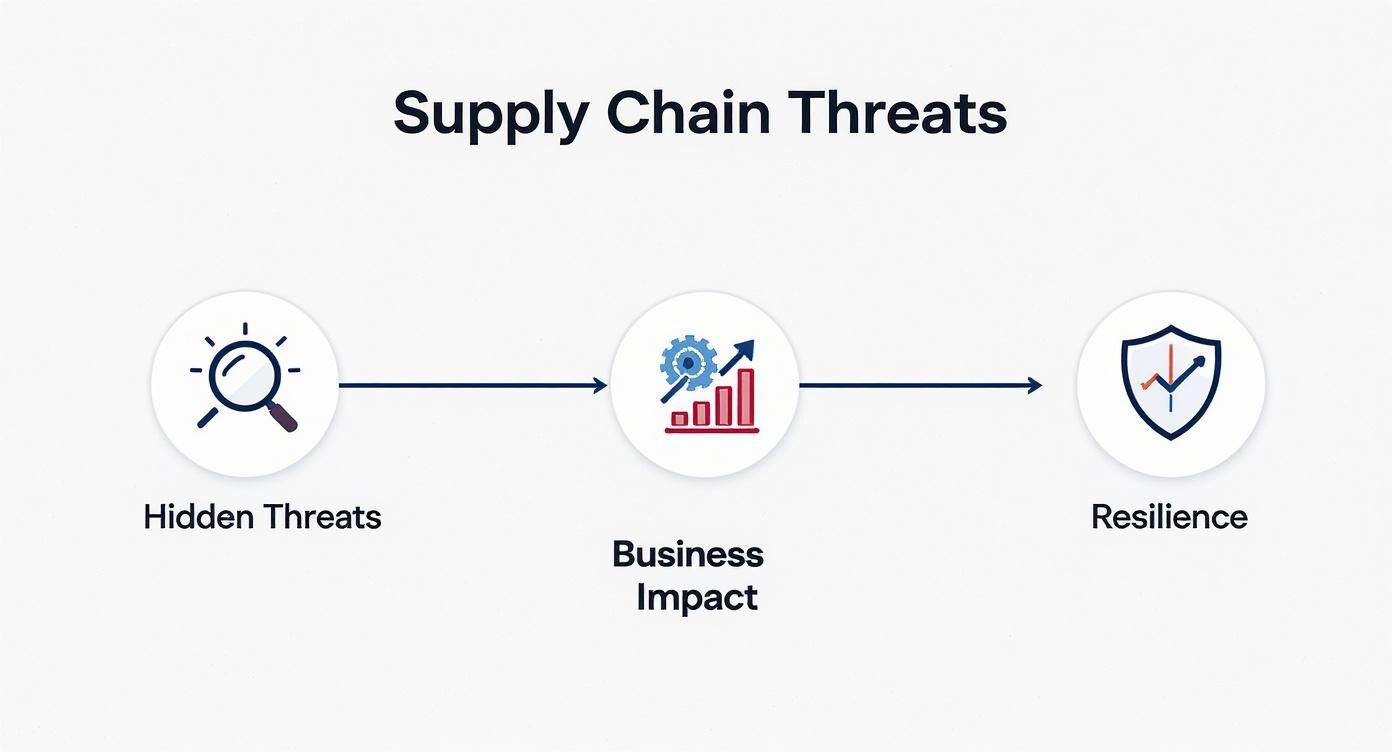
This diagram nails it: you move from identifying those hidden threats to understanding their real-world impact. It’s about being proactive, not reactive.
Drawing this map doesn't have to be some monumental task. It’s an exercise you build on over time, and with each step, the fog begins to clear. You’ll start spotting the single points of failure, the over-reliance on one specific region, and the logistical bottlenecks that were invisible before.
Kick things off by tracing every critical link in your value chain—from the origin of your raw materials all the way to your customer's doorstep.
Key Components to Map:
This mapping process is a fundamental building block of a resilient operation. For a deeper dive into streamlining these moving parts, check out our guide on supply chain management best practices.
Think of supply chain mapping as a CT scan for your business. It reveals the internal structure and highlights potential blockages or weak points that aren't visible on the surface. Without it, you're only guessing where the next problem will emerge.
Once you have this map laid out, "risk" stops being an abstract concept. It becomes real. You can literally point to a spot and say, "If this port shuts down," or "If this province goes into lockdown, we're in trouble."
With your map in hand, you can shift from just identifying problems to actually assessing them. A risk assessment matrix is a surprisingly simple but incredibly effective tool for this. It helps you cut through the noise, score your vulnerabilities, and focus your energy where it will have the biggest impact.
The whole point is to score each potential risk on two simple criteria: how likely is it to happen, and how bad would it be if it did? By multiplying those two scores, you get a clear, prioritized list of what to tackle first.
This framework will help you score and prioritize your supply chain risks based on their potential impact and likelihood.
Risk Category (e.g., Supplier, Logistical, Geopolitical)Specific Risk ExampleLikelihood Score (1-5)Impact Score (1-5)Overall Risk Priority (Likelihood x Impact)SupplierSole-source component supplier faces bankruptcy2 (Low)5 (Critical)10 (High)LogisticalPrimary shipping lane (e.g., Suez Canal) blockage1 (Very Low)5 (Critical)5 (Medium)GeopoliticalNew tariffs imposed on goods from a key country4 (High)3 (Moderate)12 (High)Quality ControlTier 2 supplier provides a faulty batch of raw materials3 (Medium)4 (High)12 (High)
This exercise isn't just about numbers; it forces you to have honest conversations about what could go wrong and just how much it would hurt. Remember, your highest-priority risk isn't always the most likely one. Often, it's the one whose combined likelihood and devastating impact poses the biggest threat to your brand's future.
Relying on a single supplier for a critical product is like balancing your entire business on a tightrope with no safety net. One gust of wind—a factory fire, a regional lockdown, a trade dispute—and everything comes crashing down. This is the most common single point of failure for e-commerce brands, and frankly, it's one of the most dangerous. Moving beyond this vulnerability is a core pillar of any real supply chain risk management strategy.
The solution isn't just to find more suppliers; it's to build a smarter, more resilient network. This means strategically spreading your production across different partners and regions to insulate your business from isolated shocks. It’s a deliberate shift from prioritizing the absolute lowest cost to balancing that cost with stability and reliability.
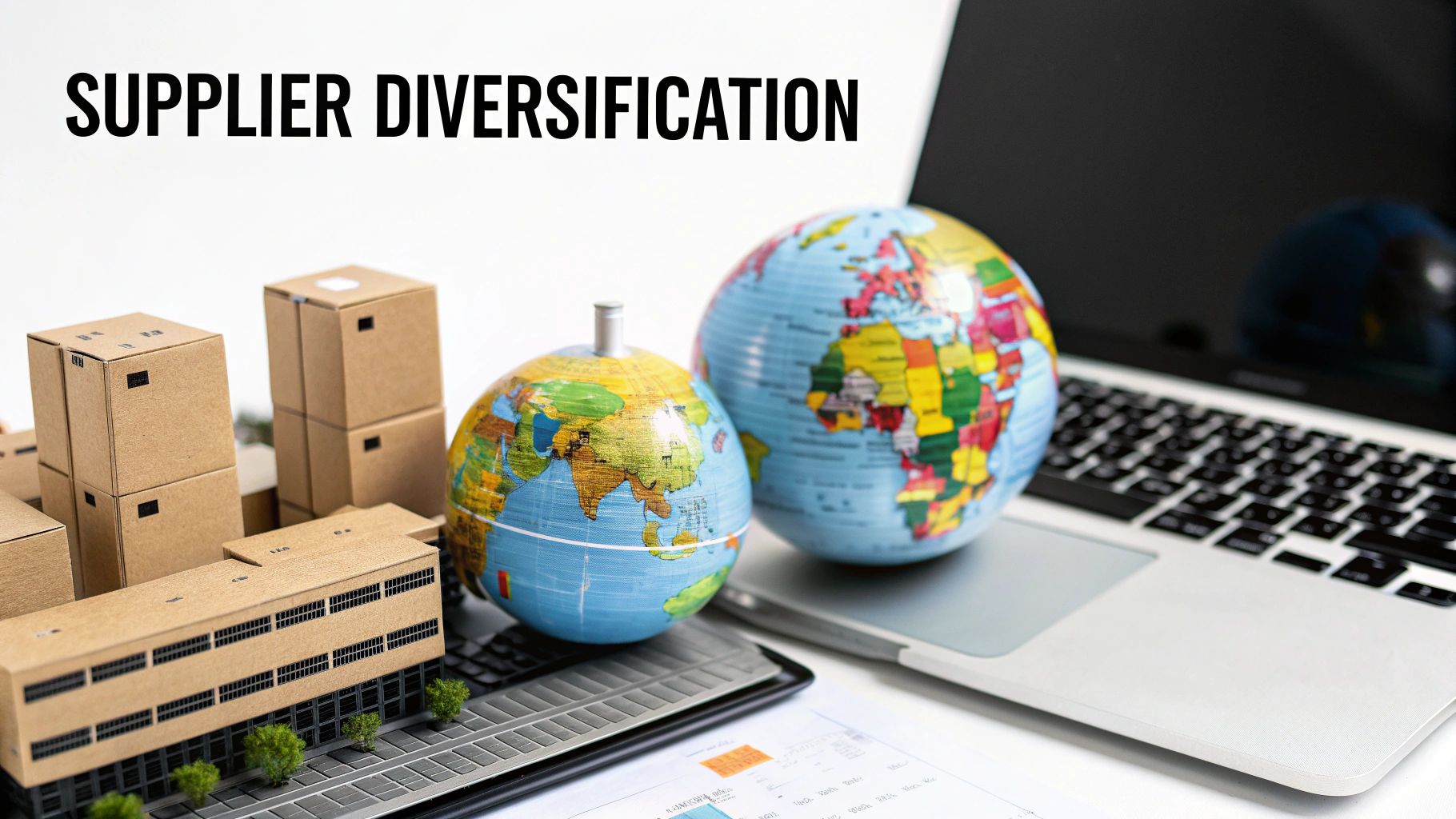
Once you break free from the single-source model, you unlock some powerful options. Each approach offers a different blend of cost, resilience, and complexity, so you can dial in the right fit for your brand's specific needs and risk tolerance.
The move toward geographic diversification is picking up serious steam. By 2025, it's projected that around 50% of companies will have adopted multi-shoring strategies to shield themselves from regional shocks. This shift is expected to boost supply reliability by about 10% by spreading risk across the map.
Adding new suppliers isn't as simple as just signing a contract. It demands careful planning and solid processes to keep quality, consistency, and communication locked in across your entire network. Strong partnerships are the bedrock of a supply chain that can actually take a punch.
First, your vetting process has to be rigorous. Don't just chase the lowest price. You need to dig into a potential partner's financial stability, their quality control standards, and even their own supply chain vulnerabilities. A great factory is only as reliable as its raw material suppliers, after all. Managing these relationships effectively is a make-or-break skill, which is why we put together a guide on vendor relationship management best practices.
Next, you need crystal-clear communication channels and standardized procedures. When you're working with multiple factories—often across different cultures and time zones—having documented quality standards, production protocols, and communication workflows is completely non-negotiable. This is what ensures your product stays consistent, no matter which factory it came from.
Think of it like a well-balanced investment portfolio. You wouldn't dump all your money into a single stock, right? Spreading your manufacturing across different suppliers and regions follows the exact same logic, protecting your business from the volatility of any one market.
Finally, start small. You don't have to diversify your entire product line overnight. Pick your top-selling, highest-margin product and start there. Find a qualified secondary supplier and give them a small trial order—maybe 10-15% of your total volume. This low-risk approach lets you test their capabilities, build a relationship, and iron out any kinks before you actually need to rely on them in a crisis. This measured approach turns diversification from a daunting overhaul into a manageable, strategic process.
In an unpredictable world, inventory is your business’s shock absorber.
For decades, the e-commerce playbook preached the gospel of Just-in-Time (JIT) inventory. The idea was simple: a lean model designed to slash carrying costs by having goods show up precisely when they were needed. It was beautiful in theory and worked great in a stable, predictable world. But as we've all learned the hard way, recent global disruptions have exposed JIT for what it is: incredibly fragile.
A single delayed container or a surprise surge in demand can leave you with empty virtual shelves and a long list of unhappy customers.
That's why modern supply chain risk management strategies have flipped the script. We no longer see inventory as a liability to be minimized at all costs. Instead, it's a strategic tool you can optimize. The real goal is finding that sweet spot for your brand—enough stock to handle disruptions and jump on unexpected demand, but not so much that it drains your cash flow.
It's about shifting your mindset and turning inventory from a cost center into a core part of your resilience strategy.
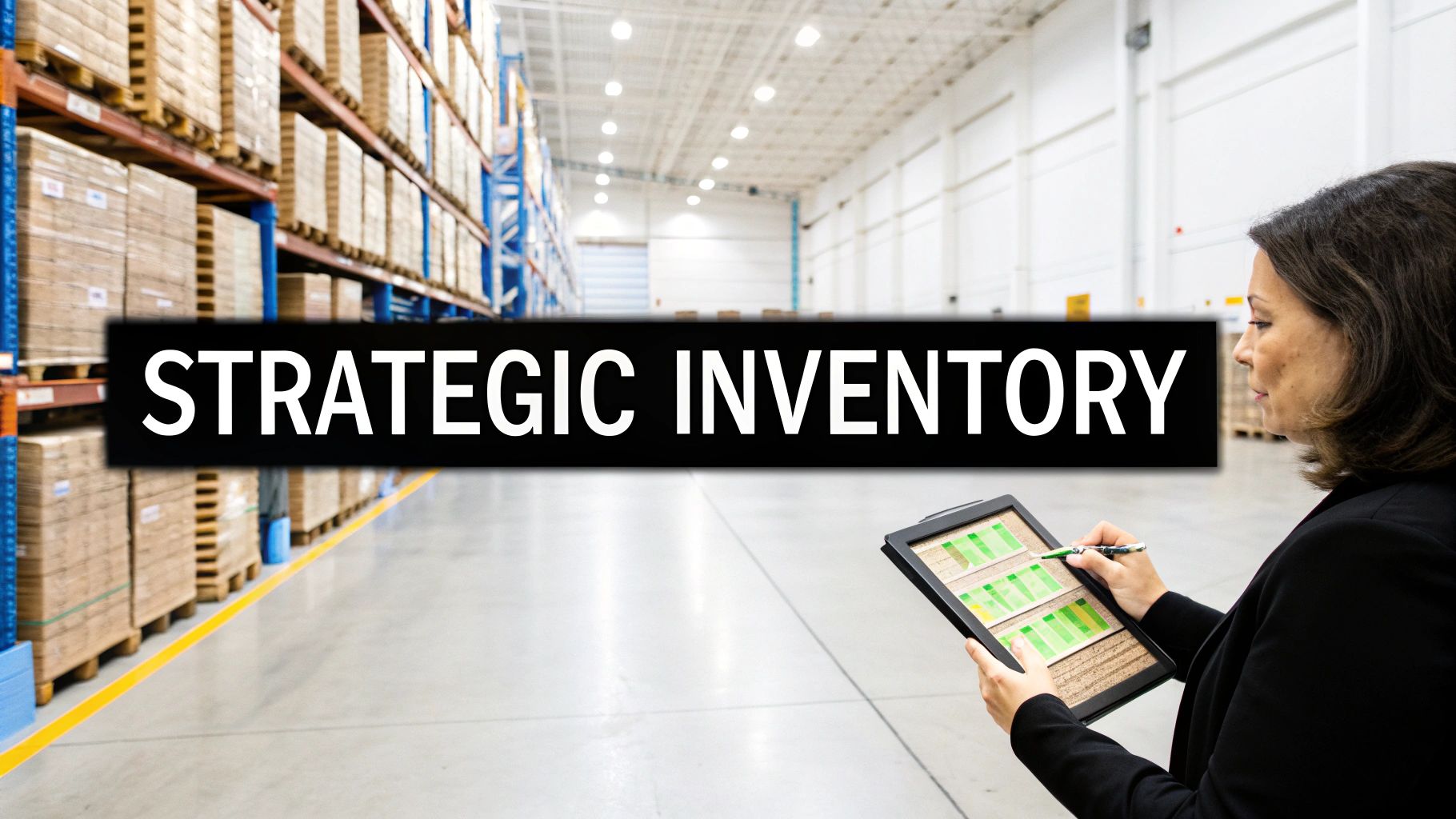
Moving away from a pure JIT model doesn't mean you should start hoarding mountains of slow-moving stock. That's just trading one problem for another. The smart move is adopting more nuanced, intelligent inventory strategies that build up buffers where they'll have the biggest impact. This proactive approach is what keeps you selling when parts of your supply chain are screaming for mercy.
Two powerful concepts are at the heart of this new approach:
The big question isn't if you should hold extra inventory, but how much and where. Getting this right is a science. Just guessing how much safety stock you need is a quick way to either run out of product or tie up a ton of cash.
To get started, you need to dig into the data for your products and look at a few key variables:
Accurately predicting what your customers will buy is the cornerstone of this entire process. To get a handle on the different ways to do this, it’s worth exploring various inventory forecasting methods to find the right approach for your brand.
Think of inventory like a dam on a river. A lean, JIT model is like having no dam at all—you’re completely vulnerable to both floods (demand spikes) and droughts (supply disruptions). A strategic inventory system is a well-engineered dam. It lets you store water (inventory) during plentiful times and release it methodically during dry spells to keep everything running smoothly.
By analyzing your sales history and supplier performance, you can use proven formulas to calculate optimal stock levels. This data-driven approach takes the guesswork out of the equation. It allows you to place your inventory "bets" intelligently, maximizing your resilience and making sure you can always meet customer expectations, no matter what the world throws at you.
Your supply chain doesn't just exist on a spreadsheet; it’s out there in the real world, fully exposed to the chaos of global politics and economics. For an e‑commerce brand, a sudden tariff, a new trade restriction, or a diplomatic spat can feel like a freak storm appearing on a sunny day. One minute everything is fine, the next your costs, lead times, and even access to entire markets are under threat.
You just can't afford to ignore these external forces anymore. A single policy change made thousands of miles away can slap a 25% tariff on your goods overnight, completely wiping out your margins and forcing you to pass on painful price hikes to your customers. Solid supply chain risk management strategies have to account for this kind of macro-level volatility.
These aren't just abstract headlines you scroll past on your phone; they are direct, tangible risks to your business that demand a watchful eye and a flexible game plan.
Tariffs are probably the most direct way geopolitical tensions can punch you in the gut. They're just taxes on imported goods, and they can be changed with almost no warning, instantly jacking up the landed cost of your products. All of a sudden, a sourcing region that was a slam dunk financially becomes a liability.
It's the same story with trade restrictions or embargoes, which can completely sever your access to a key supplier or raw material, leaving you scrambling for a Plan B you never made. The hard truth is that tariffs and trade barriers are now major players in how global supply chains are shaped. One recent analysis found that a staggering 82% of supply chains are feeling the heat from new tariffs, which now impact between 20% and 40% of all supply chain activity. This has forced countless brands to rethink where they make their products and get creative to sidestep the costs and delays. You can dive deeper into this in a supply chain risk report from Moody's.
Think of your sourcing strategy like a shipping route. For years, you might have used one main channel because it was cheap and reliable. Now, that channel is suddenly riddled with expensive new tolls (tariffs) and unpredictable blockades (trade restrictions). A resilient brand needs to have alternate routes already mapped out and ready to go.
You can't control global politics, but you can absolutely control how your business prepares for the fallout. Building resilience here is all about weaving flexibility and awareness into the very fabric of your operations.
Here are a few practical strategies you can start putting into place today:
By getting out in front of these geopolitical and economic headwinds, you shift your supply chain from being a passive victim of world events to an agile, responsive operation. That kind of foresight will give you a massive edge when your competitors are left scrambling to react to the next international crisis.
When a major disruption finally hits—and it will—a solid plan is what separates a controlled, decisive response from pure operational chaos. All the mapping, diversification, and inventory strategies we've discussed are your proactive defenses. But you still need a playbook for the moment a crisis actually lands on your doorstep.
This isn't some theoretical document destined to collect dust on a shelf. It’s a hands-on guide that gives your team the confidence to perform under extreme pressure.
Think of it as the fire escape plan for your business. You hope you never have to use it, but you practice the drills anyway. When the alarm sounds, everyone knows exactly where to go and what to do without a second of hesitation. That's what a crisis response plan does: it transforms a gut-wrenching mess into a structured, manageable process.
The goal here is a living document that empowers your team to act fast and smart when every second counts. Without one, you’re just improvising, and that’s a dangerous game when your revenue and reputation are on the line.
In a crisis, ambiguity is your worst enemy. The very first step is to establish an unshakable chain of command. Who has the final say? Who’s responsible for getting intel from suppliers, and who owns customer communication?
You need to define these roles now, not in the middle of a five-alarm fire.
This structure ensures that every action is coordinated and no critical task gets dropped. It brings clarity when your team needs it most.
Once you know who’s doing what, you need to define how information flows and what specific actions to take for different scenarios. Your response to a key supplier suddenly going bankrupt will look very different from your response to a major port shutting down.
Create pre-built action plans for your most likely or highest-impact risks. For example, if a critical shipping lane is blocked, your playbook should instantly trigger a switch to a pre-vetted air freight option for your A-list SKUs.
Your crisis plan isn't meant to be a static document. It should be a dynamic tool that empowers your team to act with confidence. Regular drills—even simple tabletop exercises—are crucial for testing its effectiveness and building muscle memory.
Finally, script your communications ahead of time. Draft email templates for customers explaining potential delays with honesty and transparency. Prepare internal updates to keep the entire team aligned and on the same page. Having these ready to go saves precious time and helps you control the narrative from the get-go.
This kind of proactive crisis management is a hallmark of truly effective supply chain risk management strategies, turning a potential catastrophe into an opportunity to build unbreakable customer trust.
Navigating the world of supply chain risk management can feel overwhelming, especially when you're trying to build a resilient brand from the ground up. Let's tackle some of the most common questions we hear from founders.
Before you do anything else, you have to map your supply chain. It's that simple. You can't protect yourself from risks you can't see. Trying to manage an unmapped supply chain is like driving cross-country with no GPS—you're going to get lost.
Start with your Tier 1 suppliers, the folks you pay directly. From there, push to identify their key suppliers, your Tier 2s. Even a simple spreadsheet or a flowchart that shows every player involved will instantly shine a light on your biggest dependencies and single points of failure. This map is the foundation for everything that comes next.
This is a big one. Diversifying doesn't mean you have to double your inventory costs or place massive new orders overnight. It's all about being strategic.
Pick your single most critical product and find a qualified backup supplier. Then, start them off with a small but consistent slice of your orders—even just 10-20% of your total volume is enough to get the ball rolling. This smart, low-cost approach does two things perfectly:
Another play is to explore nearshoring for a piece of your production. Yes, the unit cost might look a little higher on paper, but when you factor in the money you save from faster shipping and dodging port congestion, it often becomes a financially savvy move for boosting reliability.
Think of diversification as building a bench of reliable players for your team. You don't need to put them all in the game at once, but having them warmed up and ready to go is what wins championships when your star player gets sidelined.
Your supply chain is a living, breathing part of your business, and your risk plan needs to be, too. A plan that just collects dust on a shelf is worse than useless—it gives you a false sense of security.
At a minimum, you should do a full-scale review once a year. But more importantly, you need to trigger a review anytime something significant changes. That could be bringing on a major new supplier, expanding into a new market, or seeing a shift in trade policies that affects one of your key sourcing regions. Sticking to this rhythm of regular and event-driven reviews ensures your playbook is always ready for the current threats, not last year's problems.
At Million Dollar Sellers, we know that building a resilient supply chain is a non-negotiable part of scaling an e-commerce brand to 7, 8, and 9 figures. Our exclusive community connects you with top founders who have mastered these challenges and are willing to share their playbooks. Learn how MDS can help you scale smarter at https://milliondollarsellers.com.
Join the Ecom Entrepreneur Community for Vetted 7-9 Figure Ecommerce Founders
Learn MoreYou may also like:
Learn more about our special events!
Check Events