Chilat Doina
October 28, 2026
Brand consistency is the deliberate, repeatable delivery of the same core identity, promise and customer experience across every channel and touchpoint over time.
You may already have a polished Amazon storefront, a carefully designed direct-to-consumer (DTC) website and professional packaging. Yet customers still ask whether the products are identical, which return policy applies or why an email promises something the listing doesn't. Those questions reveal a consistency problem that matching logos won't solve.
A shopper sees your bottle in a sponsored Amazon result described as premium outdoor equipment. On your DTC site, the same bottle becomes a budget-friendly everyday accessory. An email then promotes it as a luxury gift, without explaining what makes it special.
Brand consistency means preserving a recognizable identity and promise while making the company's actions match them. The brand-orientation manuscript hosted by White Rose Research Online describes consistency through alignment between company activity, brand vision and positioning, including the stability of brand attributes over time.
Think about recognizing a friend's voice on the phone and across a crowded room. Their volume changes, but their characteristic way of speaking remains familiar. Your brand needs the same balance.
The visual example below illustrates recognizable branding across different screens, rather than identical page layouts.

Your value proposition, tone, visual identity, product expectations and service behavior should point toward the same interpretation. An Amazon bullet can be concise while a creator video is conversational. Neither should introduce a different product promise.
Repeated, compatible signals give shoppers less to reconcile. Someone moving from an advertisement to a product page can connect the new information with what they already understand, instead of deciding which version to believe.
The opposite happens when a premium listing leads to slow, generic support that ignores the customer's question. The logo may be correct, but the service contradicts the positioning.
Ask whether customers receive the same promise everywhere, not just whether the logos match.
That's the practical answer to “What is brand consistency?” It's a standard for the whole buying experience, including what happens after payment.
Use this comparison as a working reference for Amazon and DTC teams. Read each row from left to right: identify the standard, then translate it into the customer experience on each channel.
Five components of brand consistency on Amazon and DTC
| Component | What stays fixed | Amazon example | DTC example |
|---|---|---|---|
| Visual identity | Logo, color palette, typography, photo style | Product photography stays recognizable; A+ modules use approved colors and type | Site, packaging and email templates share one design kit |
| Verbal identity and claims | Tone of voice, approved claims, product naming | Bullet points use approved claim wording exactly | Product pages and ads use the same claim phrasing |
| Product promise | Specifications, materials, quality standard | Listed dimensions and materials match what ships | Product-page specifications match the packed product |
| Service standards | Response commitments, return handling, support tone | Returns follow the applicable policy communicated to shoppers | Support replies and return instructions match the site |
| Packaging and unboxing | Protective materials, inserts, presentation quality | Marketplace shipments protect the product to the agreed quality standard | Branded box, insert and thank-you card uphold that standard |
Visual identity breaks when teams recreate assets from memory. Store approved files together, including usable font specifications and photography examples. Amazon main images should follow marketplace requirements, not imitate a website banner; recognizable product presentation matters more than forcing decorative elements into every placement.
For typography rules that different teams can apply, the resource on scalable branding with Font Checker Pro provides a useful starting point. Pair those execution rules with a clear account of your positioning, such as the approach in MDS's guide to building brand identity.
Verbal identity needs more than adjectives such as friendly or confident. Give writers approved product names, exact claim language and examples of unacceptable exaggeration. Otherwise, an editor can unintentionally turn water-resistant into waterproof while trying to improve a headline.
The product promise breaks when a supplier changes a material but the listing stays unchanged. Connect specification updates to content updates, and check the packed product rather than relying only on a spreadsheet.
Service needs equally concrete rules. A compassionate reply shouldn't require a customer to repeat information already supplied, and return instructions shouldn't send shoppers between incompatible processes. Channel policies may differ, so explain those differences clearly rather than promising identical terms you can't deliver.
Packaging completes the experience. An Amazon shipment doesn't need to reproduce every decorative feature of a DTC unboxing, but the product should arrive protected, correctly labeled and presented without misleading inserts.
Rank these components using customer complaints and purchase objections. A fragile product may need packaging attention before a typography refresh; a technical product may need clearer specifications first.
Consistent presentation is reported to increase revenue by 10% to 20%, while 68% of companies attribute 10% to 20% of their revenue growth to consistency, according to WiserNotify's compilation of branding statistics. Treat these as reported business survey findings, not proof that changing your templates will cause a particular revenue lift.
The same compilation reports the expectation and enforcement figures below. They're useful management benchmarks, but they aren't forecasts for an individual seller.
Reported business effects of brand consistency
| Finding | Reported figure | What it means for an Amazon or DTC seller |
|---|---|---|
| Revenue increase from consistent presentation | 10% to 20% | Use as context, then measure your own baseline |
| Companies attributing revenue growth to consistency | 68% attribute 10% to 20% of growth | Consistency is treated as a commercial concern |
| Consumers expecting a similar experience across channels | 90% | Shoppers compare encounters across your channels |
| Organizations with brand guidelines | 95% | A document alone doesn't establish reliable execution |
| Organizations that enforce guidelines consistently | Approximately 25% to 30% | Implementation deserves attention alongside documentation |
The infographic highlights the reported revenue findings, rather than a guaranteed business outcome.
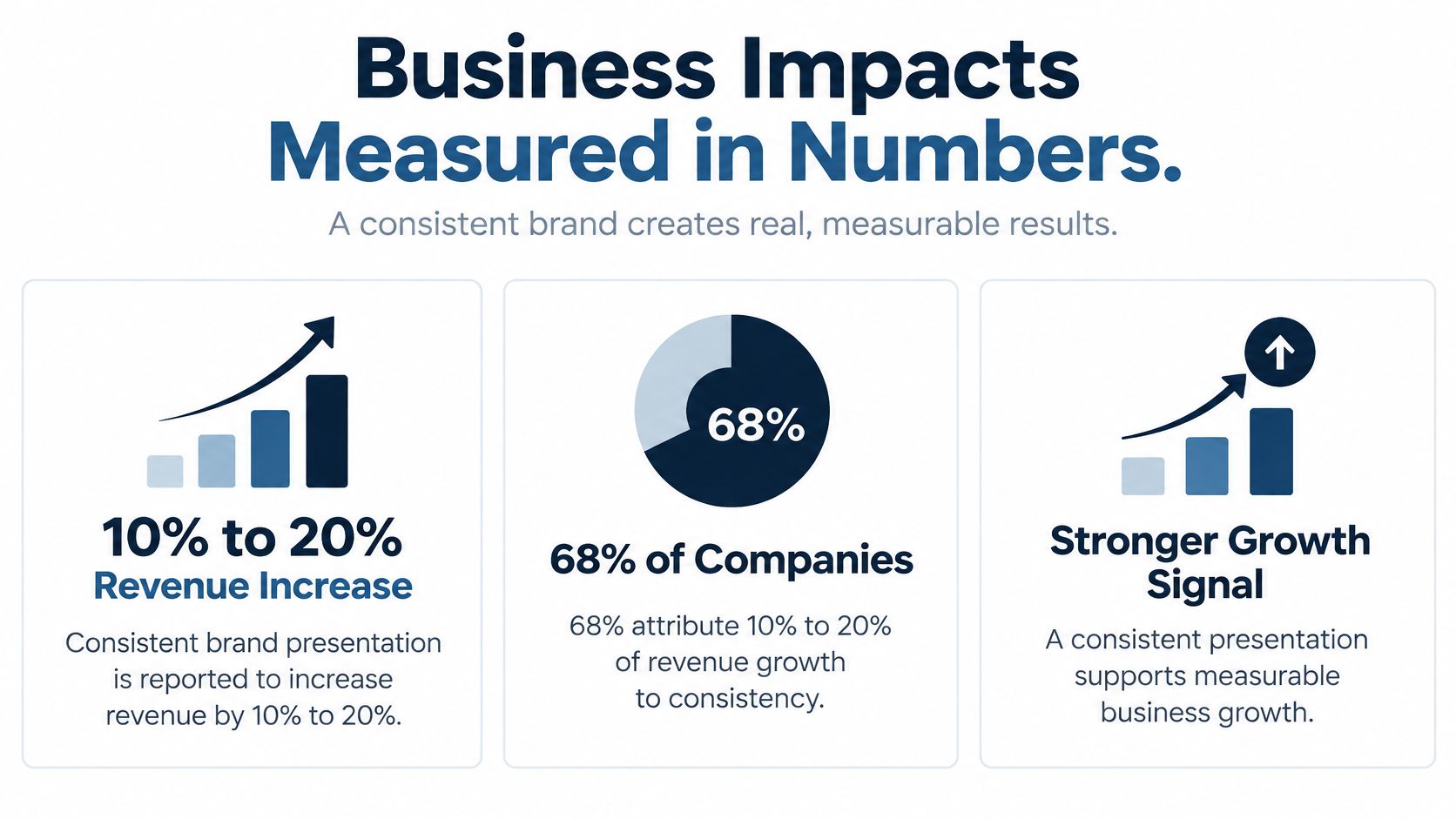
The enforcement gap is the actionable point. A brand book can describe an excellent customer experience while marketplace managers, designers and support agents continue working from different instructions.
Put approved claims inside listing templates. Include service expectations in support macros, and make packaging specifications part of purchase-order approval. For a complementary explanation of the business rationale, consult Sprello's guide to brand consistency.
Measure branded-search conversion, detail-page conversion, add-to-cart rate, repeat purchase by channel and misunderstanding-related support contacts. Record other changes, including price, traffic mix and availability, so you don't attribute every improvement to branding. MDS's guide to measuring brand equity offers a broader framework for evaluating brand strength.
Use the video below as an additional discussion prompt for your team, then translate the discussion into assigned operating changes.
A storefront can pass a design review and still disappoint customers. The operational blind spot matters: in a 2025 survey of customer-experience leaders, 21% identified service standards as the most important element of cross-channel brand consistency, according to CMSWire's customer-trust statistics overview.
Look for these failure patterns during content and customer-experience reviews:
Treating consistency as visual sameness. The logo matches everywhere, but the Amazon listing sells premium durability while the website relies on bargain language. Fix the positioning conflict before approving another design refresh; price promotions should explain the offer without redefining the product.
Publishing guidelines without an owner. Designers know where the brand book lives, but nobody checks new listings or retires outdated claims. Assign a reviewer and publish approved versions in a shared asset library, with a clear route for requesting changes.
Allowing marketplace drift. Amazon bullets describe one material while the DTC product page names another. Maintain a product-truth record that content owners use for specifications, origin statements and substantiated benefits, then update affected channels together.
Letting creators improvise product claims. A creator brief approves the concept but leaves benefit language open, or AI-generated copy introduces an unsupported result. Give creators and writers approved claims, prohibited statements and an escalation contact before production starts.
Separating service from positioning. A helpful, reassuring website leads to dismissive support macros or return instructions that contradict the purchase experience. Review replies against real customer questions, and make the applicable policy understandable before and after checkout.
Measuring appearance instead of outcomes. Teams inspect screenshots but ignore damaged arrivals, confusing instructions and repeated complaints. Pair asset reviews with return reasons, support conversations and repeat-purchase behavior so problems don't disappear behind a visually polished storefront.
Diagnostic question: If every customer-facing image were perfect, what would customers still complain about?
The final pitfall can hide all the others. When nobody checks whether customers received what they expected, teams may keep approving attractive assets while the underlying product, policy or service conflict remains unresolved. Prioritize the mismatch customers experience, not the one that's easiest to spot in a presentation.
Pasting identical copy into Amazon listings, short-form video, email and retail presentations isn't disciplined branding. It ignores why someone is using each channel and how much information they need there.
A 2025 study of 994 omnichannel retail customers in South Korea found that identity dimensions had different effects across retailers: trendiness and reliability were strongest for one, while usability dominated for another, according to the study published in Sustainability. That finding doesn't establish priorities for your store, but it cautions against assuming every business needs the same hierarchy of brand elements.
Use this as an approval model, not a requirement to send every edit through senior management.
Fixed and adaptable brand elements by channel
| Element | Keep fixed | Adapt by channel | Who approves exceptions |
|---|---|---|---|
| Product truth and claims | Yes | Legal disclosures and marketplace formatting | Compliance or legal lead |
| Core promise and proof standard | Yes | Emphasis and proof order | Brand lead |
| Visual identifiers, including logo, palette and type | Yes | Layout, crop and aspect ratio | Design lead |
| Product naming | Yes | Keyword phrasing around the approved name | Marketplace manager |
| Hooks, length and creator style | No | Adapt to format and shopper intent | Channel owner |
| Offers and cultural references | No | Market-specific offers and references | Regional manager |
A DTC page can explain how a product works through a detailed demonstration. An Amazon bullet may need to lead with compatibility or dimensions. Both are legitimate when they preserve the underlying facts.
The same distinction applies to localization. Translate meaning naturally, use locally understandable references and obtain appropriate review for disclosures. Don't let localization change ingredients, performance expectations or warranty commitments.
Approval rule: Changes to product truth need sign-off before publication; changes to presentation stay with the channel owner unless they cross a defined boundary.
AI-assisted production makes that distinction especially important. Name the person authorized to approve a new claim, and require generated copy to be checked against the product-truth record. Approval of a writing tool isn't approval of everything it produces.
Start with a shared spreadsheet, not a redesign project. Create columns for the touchpoint, live URL or asset location, product, owner, assessment, customer impact and required correction.
The process below gives your team a common way to inspect the experience.
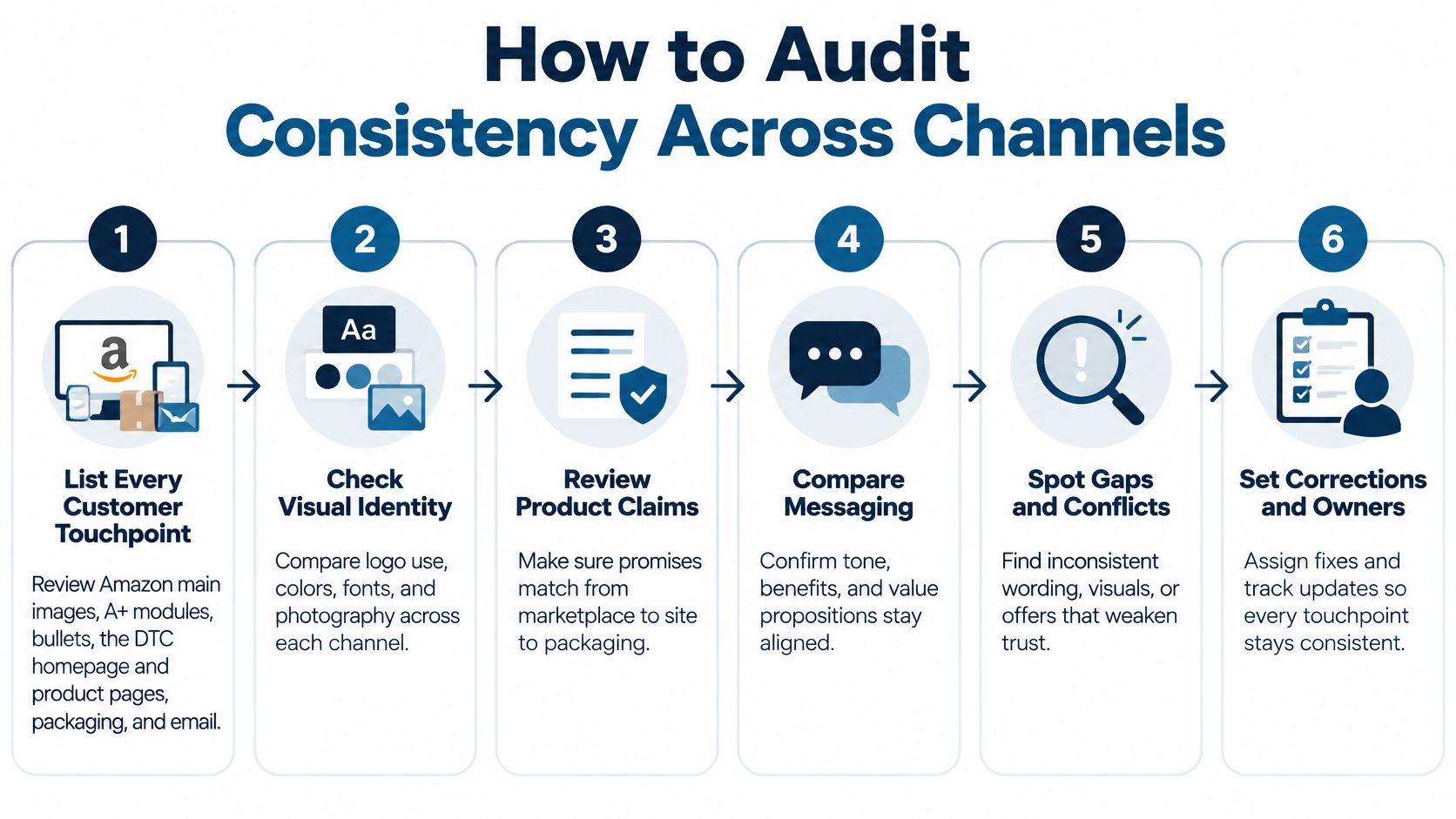
Inventory the customer touchpoints. Include Amazon main images, A+ modules and bullets, the DTC homepage and product pages, packaging, post-purchase email, support macros and the returns page. This prevents the audit from stopping at assets the marketing team happens to own.
Mark the essential elements. Attach the approved claims, specifications, naming, visual identifiers and service commitments relevant to each product. Reviewers need a reference standard, not their personal opinion of what feels on-brand.
Score alignment consistently. Use descriptive ratings such as conflicts, partly aligned and matches, then add evidence explaining each judgment. Keep factual or policy conflicts visible instead of averaging them away inside a favorable overall score.
Inspect delivered outcomes. Compare the advertised experience with a received order, read return reasons and sample support replies to the same customer question. A correct product page doesn't excuse a package containing outdated instructions.
Connect findings with customer behavior. Compare asset assessments with the funnel and retention measures your team tracks, looking for plausible relationships rather than declaring causation. Segment by channel and product so a strong catalog average doesn't conceal a problematic listing.
Assign corrections and review ownership. Give every conflict a named owner, a completion date and a verification task. Schedule quarterly reviews and require new listings, creator briefs and major product changes to pass a prepublication check.
Begin with the products and touchpoints customers encounter most, then expand the inventory. Don't promise a completion time before you know how many variants, languages and outdated assets need review.
For a discovery channel such as Pinterest, Pin Generator's guide can help you identify gaps in your Pinterest strategy. Include saved and older promotional content in your inventory, because shoppers can still arrive through material your current team has forgotten.
Apple and Starbucks offer familiar, widely observed examples of recognizable branding across physical and digital settings. These are qualitative illustrations, not measured claims about consistency causing their commercial performance.
Apple uses a restrained design language across its website, retail environments and product packaging. The useful behavior to notice is how product imagery and presentation remain recognizable as the shopper moves between screens, a store display and a box. An ecommerce founder can apply that principle without copying Apple's aesthetic: use compatible photography and product explanations throughout the buying journey.
Starbucks connects stores, its app and cups through recognizable visual cues and product terminology. A customer ordering through an app still needs the resulting drink and pickup experience to match the order. That's the operational lesson, not the repeated use of a familiar color.
Consider an illustrative DTC skincare brand selling on its website and Amazon. Its team keeps substantiated claim language aligned across packaging, product pages and bullets, rather than allowing a paid advertisement to imply a medical outcome. Where channel return rules differ, the team explains the applicable process instead of publishing a blanket promise that support can't honor.
An illustrative Amazon-first accessories brand takes a different route. Its product photography and A+ modules use the same visual vocabulary as its DTC site, but Amazon copy answers fit and compatibility questions immediately while the website includes installation guidance. The brand adapts the amount and order of information without changing the product's identity.
Recognizable execution helps customers identify the product; reliable delivery gives them a reason to trust the next purchase.
The shared lesson is to agree on the promise and its proof while allowing the execution to fit the buying situation.
Don't postpone the work until your team has time for a complete rebrand. Put a usable standard into the launch process you already follow.
Write a compact operating standard. List approved claims, product truth, the core promise, visual identifiers, product naming and service expectations. Name an owner for each, and use MDS's guide to creating brand guidelines to help turn those decisions into accessible instructions.
Audit the most visible customer encounters. Start with priority Amazon listings, the homepage, a best-selling product page, post-purchase email and return instructions. Correct factual contradictions and broken promises before spending time on minor decorative differences.
Make review part of publishing. Put the standard into creator briefs and new-listing checklists, and schedule recurring reviews. Require confirmation that corrections reached live assets, not just the design files.
Test the standard with experienced operators outside your team. A founder peer group or your professional network can challenge unclear approval rules and help you distinguish necessary channel adaptation from accidental drift.
A standard is worth more than a brand book when people follow it. Judge yours by whether customers receive the promised experience during the next launch, not whether everyone has downloaded the document.
Million Dollar Sellers offers ecommerce founders a private peer community for strategy sharing, operator discussions and practical insights across Amazon, DTC and omnichannel businesses. Visit Million Dollar Sellers to explore the community and assess whether peer feedback on your brand standards, approval workflows and customer experience would support your next stage of growth.
Join the Ecom Entrepreneur Community for Vetted 7-9 Figure Ecommerce Founders
Learn MoreYou may also like:
Learn more about our special events!
Check Events