Chilat Doina
August 12, 2026
Due diligence is a pre-transaction investigation that verifies facts, surfaces risk, and confirms value before money, inventory, or a contract changes hands. In major deals, it's also a real cost center, with financial due diligence for large-cap M&A often landing in the $1–3 million range and overall diligence commonly running 0.2%–4% of deal value depending on size and complexity LexisNexis.
If you've ever looked at a brand that prints cash on paper, then felt your stomach drop when you realized the top SKU depends on one factory, one freight lane, and one contractor who owns the product photos, you already know why the banker version of due diligence falls short. In ecommerce, the dangerous stuff usually lives in the operating model, not the P&L.
A seven-figure Amazon acquisition can look spotless in the data room and still turn into a headache six months later. The numbers might check out, the seller might be organized, and the broker might swear the business is stable, but if the supplier base is really just one factory and the brand assets sit in a contractor's email thread, the deal is carrying hidden liabilities from day one.
That's the practical definition of what is due diligence. It's a pre-transaction investigation used to verify facts, assess risk, and confirm value before capital changes hands or a contract gets signed Munich Business School. In ecommerce, that means asking not only, “Does the spreadsheet look right?” but also, “What breaks if the platform changes, the supplier slips, or the IP chain isn't clean?”
An accounting audit looks backward and tests whether the books are fairly presented. Due diligence is broader and more tactical, because it's trying to answer whether the business is what the seller says it is, and whether the deal still makes sense once risks are visible.
It also isn't post-close integration. Integration starts after you own the asset. Diligence happens while you still have the power to reprice, renegotiate, walk away, or add protections.
Practical rule: if a finding would change valuation, timing, structure, or the survival of the deal, it belongs in diligence.
That's why the expensive failures in ecommerce rarely come from a simple accounting mistake. They come from hidden dependencies that a generic checklist doesn't surface, especially when the business is built on Amazon, one fulfillment lane, a single supplier, or contractor-owned assets.
For a founder lens on how valuation gets interpreted in deals, this business valuation multiples guide is useful context, because diligence and pricing always move together.
The cleanest way to think about diligence is as four linked workstreams, not four separate chores. Each one answers a different question, and each one can change the economics of the deal.
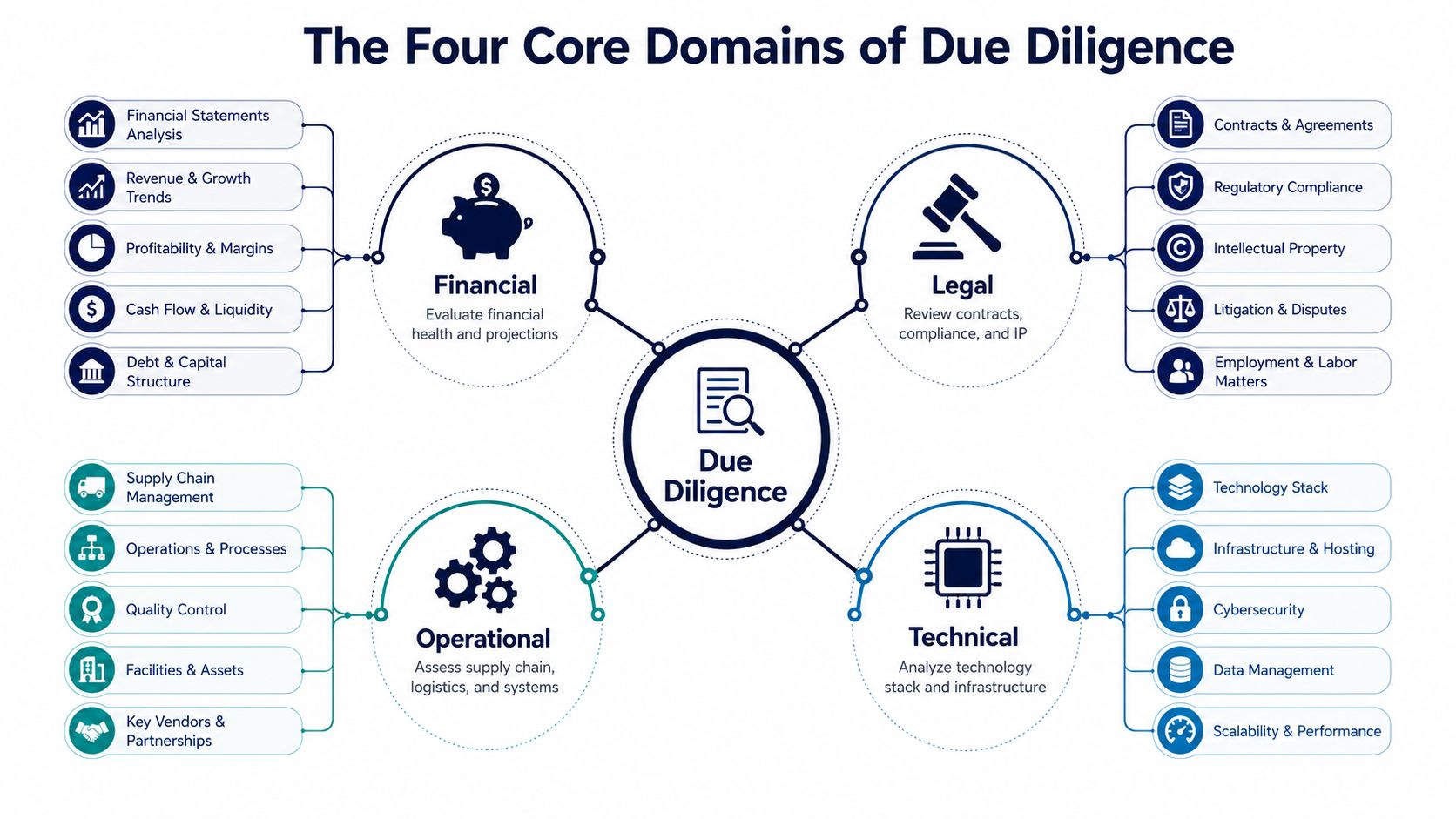
Financial diligence answers whether the revenue, margin, and cash flow are real. For ecommerce, that means more than reading a profit and loss statement. You want cohort-level revenue, refund behavior, channel-level margin, and any concentration that hides behind blended numbers.
Legal diligence answers who owns what, what the contracts say, and where the business is exposed. That matters a lot when contractors touch branding, photos, copy, software, or product development, because weak ownership chains can become expensive fast. The key proof points are assignment agreements, IP registrations, and customer or vendor contracts.
Operational diligence answers whether the business can deliver what it sells. In ecommerce, that means supplier concentration, fulfillment reliability, inventory controls, and marketplace or 3PL dependencies. The practical question is simple, what happens if one node in the chain slips?
Technical diligence answers whether the stack is secure, maintainable, and accurately described. For brands with proprietary tooling or customer data, this includes software architecture, access controls, security posture, and data handling. The strongest review looks at evidence, not claims.
The domains only work when they're treated as one risk-allocation exercise. A financial issue can be caused by an operational dependency. A legal issue can become a technical issue if the data or code ownership is messy.
A quick operator test helps here.
| Domain | Purpose | Typical proof |
|---|---|---|
| Financial | Validate performance and quality of earnings | Revenue detail, margin analysis, refund data |
| Legal | Confirm ownership and contract exposure | IP assignments, agreements, compliance records |
| Operational | Test the engine that fulfills demand | Supplier files, logistics docs, process maps |
| Technical | Check system integrity and risk | Access controls, security policies, architecture notes |
For operators building supplier review workflows, this supplier vetting checklist is a practical companion to the operational side of diligence.
Diligence isn't just an M&A event. For ecommerce operators, it shows up every time money, exclusivity, or continuity is on the line.
The common thread is risk transfer. In an acquisition, you're buying the revenue. In a supplier relationship, you're buying continuity. In a partnership, you're buying access or reach. The work changes, but the core question stays the same, what could break the economics later?
| Situation | Financial | Legal | Operational | Technical |
|---|---|---|---|---|
| Acquisition | Full review of revenue quality, margin, and cash flow | Full review of ownership, contracts, and liabilities | Full review of suppliers, fulfillment, and dependencies | Full review of stack, data, and security |
| Minority investment | Focus on unit economics and downside risk | Review key rights, governance, and ownership | Heavier review of execution and dependency risks | Targeted review if systems are material to value |
| Supplier onboarding | Light but real, focused on pricing and stability | Review terms, compliance, and liability allocation | Deep review of capacity, quality, lead times, substitution risk | Review only if software, data, or integrations matter |
| Brand partnership | Minimal financial review | Tight review of IP, exclusivity, and termination | Light review of fulfillment or campaign dependencies | Usually limited unless data sharing is involved |
A minority investment usually needs less exhaustive financial work than an outright purchase, but it still needs real operational scrutiny if the investor is betting on upside tied to a fragile fulfillment model. A supplier onboarding process flips the lens, because the business is doing diligence on the partner, not the asset. The same goes for co-marketing or brand licensing deals, where the smallest legal gap can create the biggest future friction.
For ecommerce teams, supplier onboarding is where diligence becomes routine. The seller is assessing whether a factory, co-packer, 3PL, or software vendor can support the business without creating hidden breakage.
That's why a good diligence habit is more valuable than a one-time heroic review. It gives the operator a repeatable way to decide whether the other side can support demand, handle risk, and survive scrutiny.
The first 30 days of diligence should feel controlled, not frantic. A founder does not need to read every line personally, but the founder does need to own the judgment calls, the trade-offs, and the final risk position. In ecommerce, that usually means treating diligence as a revenue-protection system. Platform rules, supplier fragility, IP ownership, cyber posture, and fulfillment dependencies can do more damage than a weak-looking income statement.
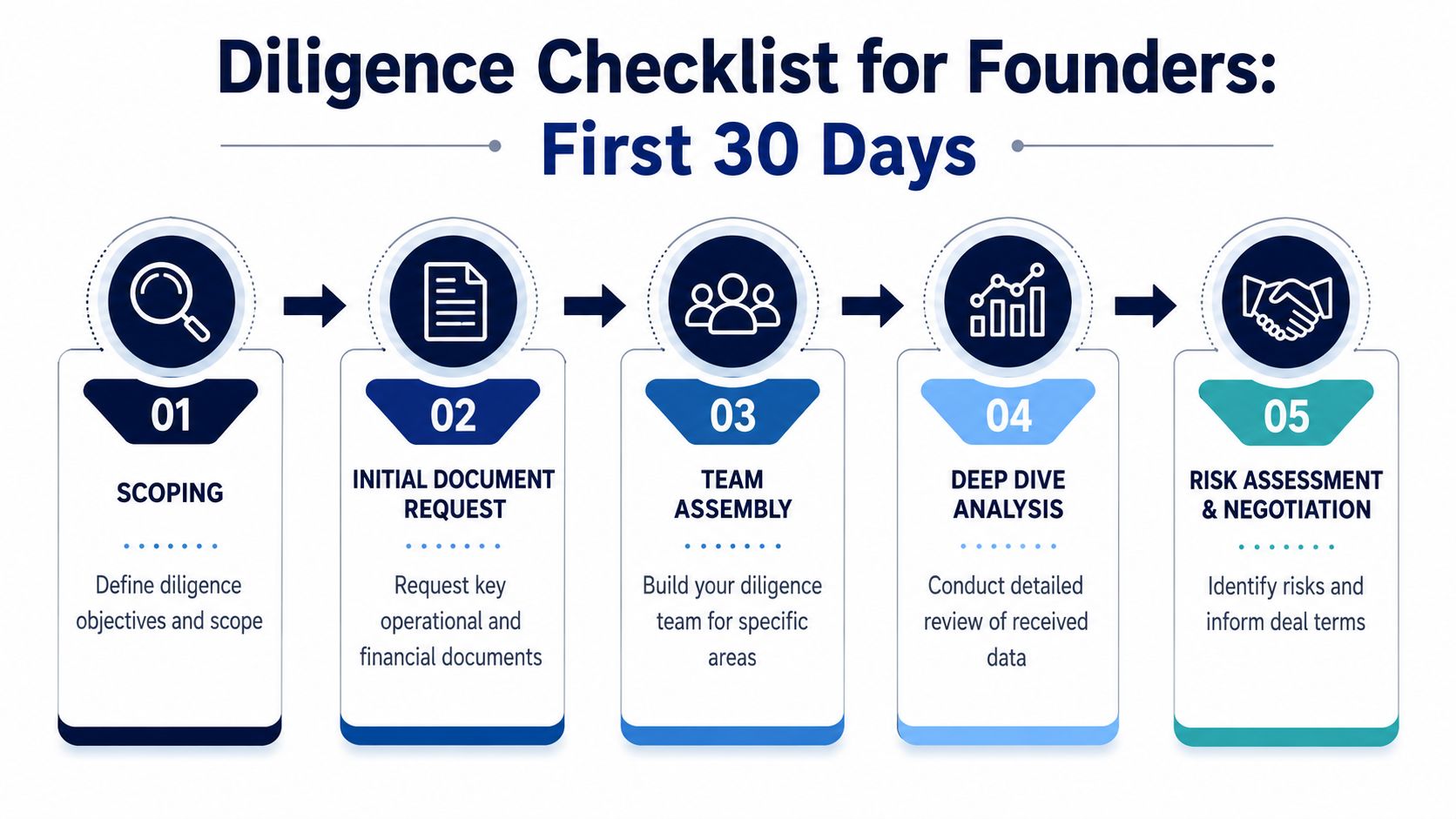
Start by writing the three questions the deal has to answer. Is the asset worth the price, is the risk acceptable, and what would make you walk away or restructure the deal?
If those questions are not clear before documents arrive, the process turns into file collection instead of decision-making. That wastes time and hides trade-offs behind volume.
Request documents that prove the business can withstand scrutiny. For ecommerce, that means financial exports, supplier agreements, IP assignments, platform account history, product documentation, security policies, and fulfillment records. It also means asking for the operational proof that shows whether the business can keep earning if one dependency breaks, which is why a focused supplier vetting checklist can save time before the bigger questions start.
A clean structure matters more than a giant request list. Organize by domain so both sides can see what is missing, what is late, and what looks out of place. If you need a reference point for how sellers can get their books ready, get your financial records ready for sale is a useful piece to send early.
The most useful diligence conversations happen when you ask the same issue in different ways. A seller may say the top supplier is stable, but the operations lead, the buyer, and the account manager may tell a different story once you press for examples and recent changes.
That is where founders catch the gap between the headline and the reality. A polished answer is not the same thing as a durable answer.
Use a one-page tracker with three fields, issue, likelihood, and deal impact. That keeps the discussion grounded when people start hand-waving, and it makes it easier to compare an inventory problem against a platform risk or an IP gap.
If a risk shows up twice in different formats, it is usually not a coincidence. It is a pattern.
The final output should force a real decision. State the conditions that have to be met for the deal to close, the concessions that would make the risk acceptable, and the issues that mean the answer is no.
Good operators also force the record to be readable by someone who was not in every meeting. That is why the memo should stand on its own, with enough detail to explain why the deal still works, or why it does not. The same discipline helps sellers get your financial records ready for sale before they put a company on the market.
For founders who want a practical process lens on internal operating discipline, this SOP guide maps well to how good diligence gets repeated across deals.
The point of the checklist is not paperwork. It is to build a repeatable rhythm you can use on a supplier contract, a platform migration, or a brand acquisition without losing sight of where risk sits.
The most expensive diligence failures in ecommerce usually aren't balance-sheet problems. They're hidden operating-model dependencies that generic checklists barely touch.
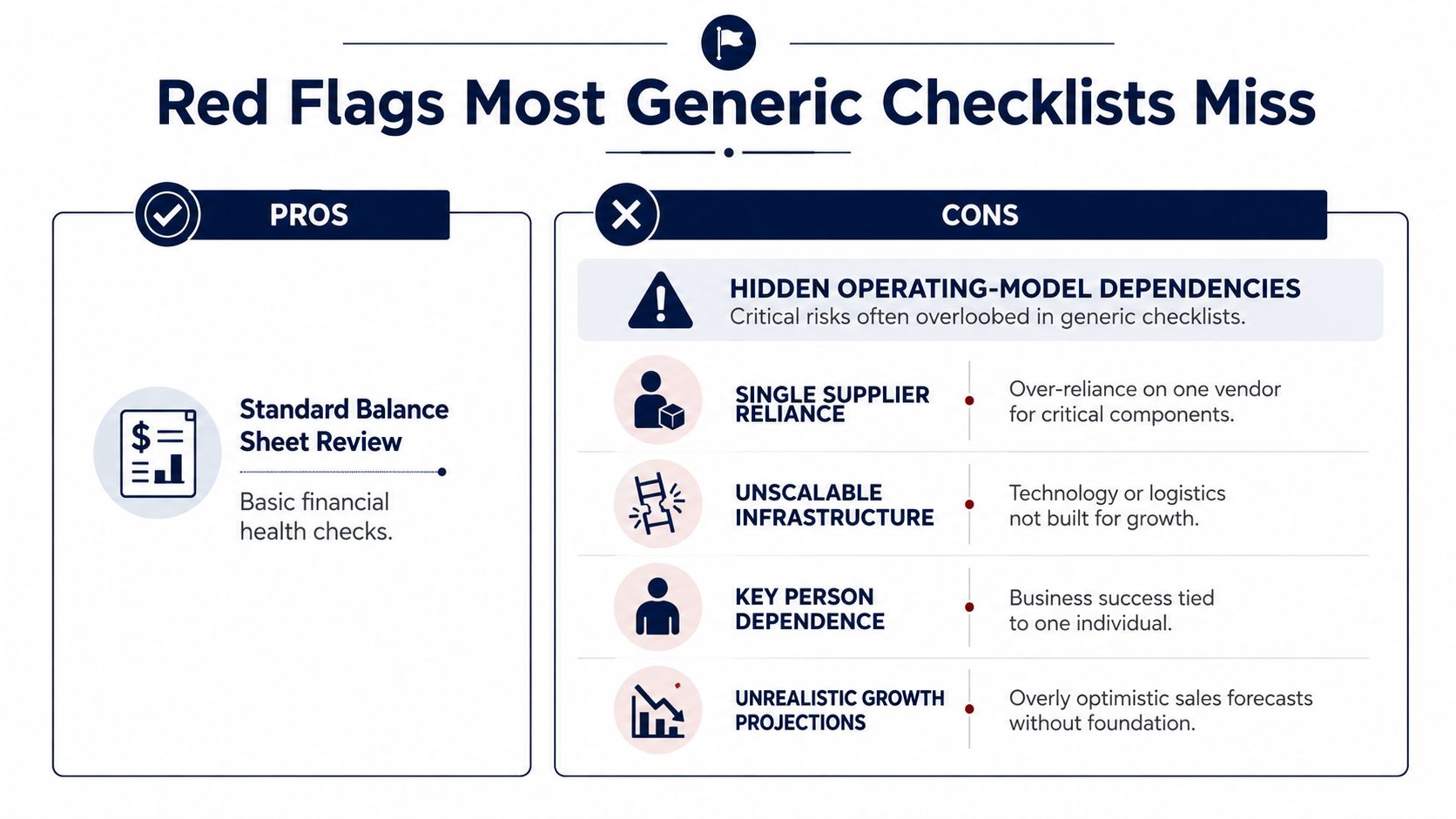
Channel concentration is the first one. If one marketplace or one SKU drives the business, the diagnostic question is simple, what happens if that channel changes rules or that product stalls? The document to inspect is the channel mix and SKU contribution report, because a concentrated business can still be good, but it can't be priced like a diversified one.
Supplier fragility comes next. Ask whether there's a single factory, single freight lane, or one point of failure in tooling or materials. A real test is a substitution or backup plan, not a verbal promise.
IP ownership gaps are common in ecommerce because photos, copy, design, and even product concepts often get produced by contractors. The question is who owns the assets if the relationship ends. You want assignment documents, work-for-hire language where relevant, and proof that the brand can keep using the creative without dispute.
Platform-rule exposure can blindside a business that looks strong on paper. Account health, gated category issues, and brand registry status all matter because the platform isn't a neutral backdrop, it's the revenue engine. Ask for screenshots, policy correspondence, and historical enforcement records.
Customer-data hygiene belongs in diligence even when the buyer doesn't think of themselves as a tech company. Consent, retention, and breach history matter because poor handling can create legal and reputational exposure. Technical diligence becomes a valuation issue, not a footnote, in such cases.
AI-tool exposure is the newer gap. If the target uses vendor AI tools with customer or proprietary data, you need to know what's being uploaded, who can reuse it, and whether the vendor terms create hidden exposure. The relevant test is simple, review the tool list, data flow, and vendor terms before closing.
The cybersecurity angle matters because breach cost is no longer abstract. IBM's 2024 Cost of a Data Breach Report put the global average breach cost at USD 4.88 million, which makes cyber posture part of the economic model, not just the IT review IBM 2024 Cost of a Data Breach Report.
For a broader perspective on hidden acquisition risks, these red flags in business acquisition line up well with what experienced operators worry about.
Effective diligence utilizes reusable artifacts. Without them, founders end up rebuilding the process for every buyer, supplier, or partnership, which slows decisions and hides the patterns that matter.
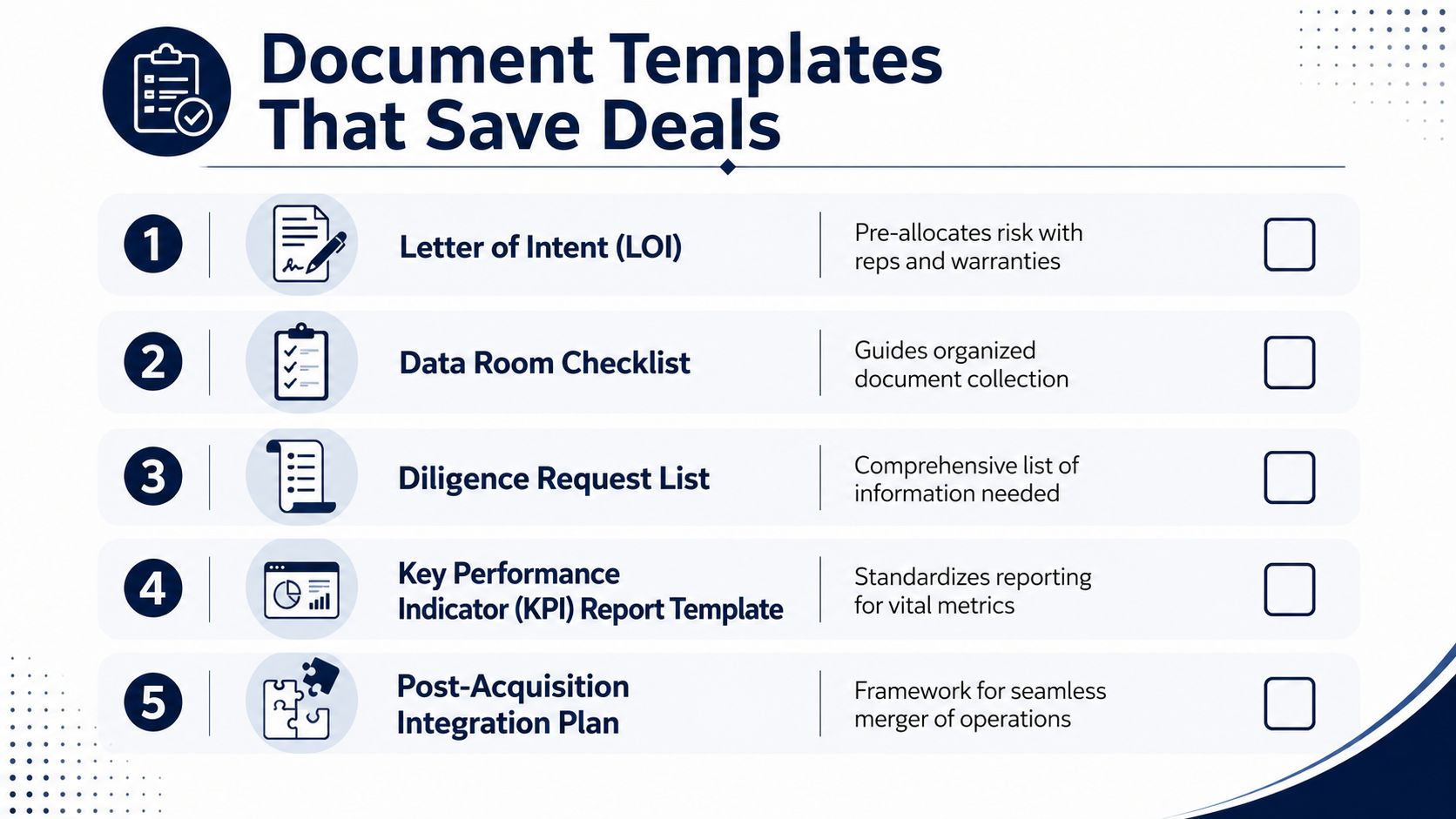
A letter of intent should do more than signal intent. It should allocate risk through reps, warranties, indemnification language, and the closing conditions the founder cannot afford to hand-wave. Its real value is that it forces both sides to confront where the risk sits before momentum or ego takes over.
A data room index keeps the request flow organized by domain. Built well, it stops everyone from guessing whether a missing contract points to a legal problem, an operations gap, or simple file chaos.
A diligence request list should stay live from first request through final follow-up. Every answer, exception, and open item belongs in one place so nothing disappears in a side thread or a late call.
A KPI report template standardizes how performance gets shown. It matters when comparing sellers, suppliers, or investment targets because the same metric can be framed three different ways unless the template fixes the format.
A post-acquisition integration plan turns diligence findings into action. The plan should track the first 30, 60, and 90 days so the deal closes with a clear operating path instead of drifting into guesswork. The same discipline shows up in how to create standard operating procedures, because repeatable operations start with repeatable documentation.
Templates don't replace judgment. They make the hard conversations unavoidable.
Reuse the templates every time. Only change them when the risk profile changes, because that is the point where a generic file set stops being useful and starts hiding exposure.
One founder I've seen handle this well was evaluating a DTC brand acquisition that looked clean on paper. The diligence work surfaced two issues that would've been expensive after close, a single-supplier dependency and photography IP held by a contractor. The seller had to accept a lower price, and the buyer insisted on a 90-day substitution plan before signing. The deal still made sense because the risk was priced, not ignored.
The second story went the other way. A fast-scaling Amazon seller brought on a new co-packer without a capacity audit and assumed the relationship would flex with demand. When a Prime Day cycle hit, the business stocked out, rank fell, and the recovery took two quarters. That wasn't a finance problem. It was a diligence failure on the operating side.
Those two outcomes point to the same lesson. Diligence is rehearsal for what will go wrong after the contract is signed. The founder who treats it that way protects revenue, influence, and optionality.
A useful quarterly habit is to ask three questions before any deal, supplier change, or partnership starts moving. What can break revenue, what proof do we have that it won't, and what are we willing to accept if the answer isn't perfect?
If you want to pressure-test deals with founders who've bought, built, and sold ecommerce businesses, join Million Dollar Sellers. It's a peer network where operators compare diligence notes, supplier risk, and deal structure in the context of real ecommerce execution.
Join the Ecom Entrepreneur Community for Vetted 7-9 Figure Ecommerce Founders
Learn MoreYou may also like:
Learn more about our special events!
Check Events