Chilat Doina
July 7, 2026
You know you've outgrown your current setup when the warehouse starts arguing with your growth plan.
Orders are up. Marketing is doing its job. Your ads, email, Amazon listings, retail accounts, or creator partnerships are pushing more demand through the pipe. Then fulfillment becomes the choke point. The team can't find inventory that the spreadsheet says is in stock. Pickers walk the same aisles three times. Customer support starts seeing “where is my order?” tickets that shouldn't exist. Operations spends the day patching exceptions instead of building capacity.
That's the stage where a lot of founders make the wrong call. They think they need more labor, more floor space, or more heroic effort. Sometimes they do. But more often, they need a system that can run the warehouse instead of merely recording what happened after the fact.
A familiar sequence plays out in fast-growing e-commerce brands.
At first, a simple inventory tool and a few disciplined people are enough. Everyone knows the top SKUs by memory. Receiving happens on one side of the building, packing happens on the other, and the founder can still step in to fix a bad day. Then order volume climbs, channels multiply, and the operation starts breaking in quiet, expensive ways.
The first problems rarely look like “we need a warehouse management system.” They look like this:
None of that is just warehouse mess. It's margin erosion.
A warehouse under strain doesn't only create operational pain. It weakens the promise your brand makes to the customer. If marketing is selling speed, reliability, subscriptions, limited drops, or omnichannel convenience, fulfillment has to deliver on that promise every day, not just on calm days.
A growing brand can survive mediocre creative for a while. It won't survive operational distrust for long.
That's one reason adoption keeps accelerating. The global warehouse management system market is valued at USD $3.4 billion in 2025 and projected to reach USD $16.0 billion by 2033, with a 21.9% CAGR from 2026 to 2033, according to Grand View Research's warehouse management system market analysis. Founders aren't buying warehouse management systems because the category sounds exciting. They're buying them because warehouse chaos gets expensive fast.
The turning point comes when you stop asking, “How do we push harder?” and start asking, “How do we make the warehouse predictable?”
That usually means standardizing movement, location logic, task assignment, and scan-based accountability. It also means tightening the handoff between warehouse execution and transportation. If you're also looking at streamlining transport logistics with AI, that work pairs well with warehouse discipline because you don't want a clean pick-pack flow feeding a messy shipping admin layer.
For brands trying to improve throughput without losing control, this guide on improving warehouse efficiency is also worth a read. The key point is simple. Efficiency isn't a motivational issue. It's a systems issue.
A lot of bad software decisions start with a category mistake.
Founders buy a WMS expecting it to behave like an ERP. Or they bolt together an inventory app and an order tool, then wonder why the floor still feels chaotic. The simplest way to think about it is this. A basic inventory system is a ledger. A warehouse management system is an execution engine.
A ledger tells you what you own. A WMS tells the warehouse what to do next.
That distinction matters. In a busy operation, the hard problem isn't only knowing that you have 200 units of a SKU. The hard problem is directing where inbound stock goes, which bin should be picked first, who should replenish a forward location, what happens when inventory is damaged, and how to prevent two people from creating conflicting moves in the same hour.
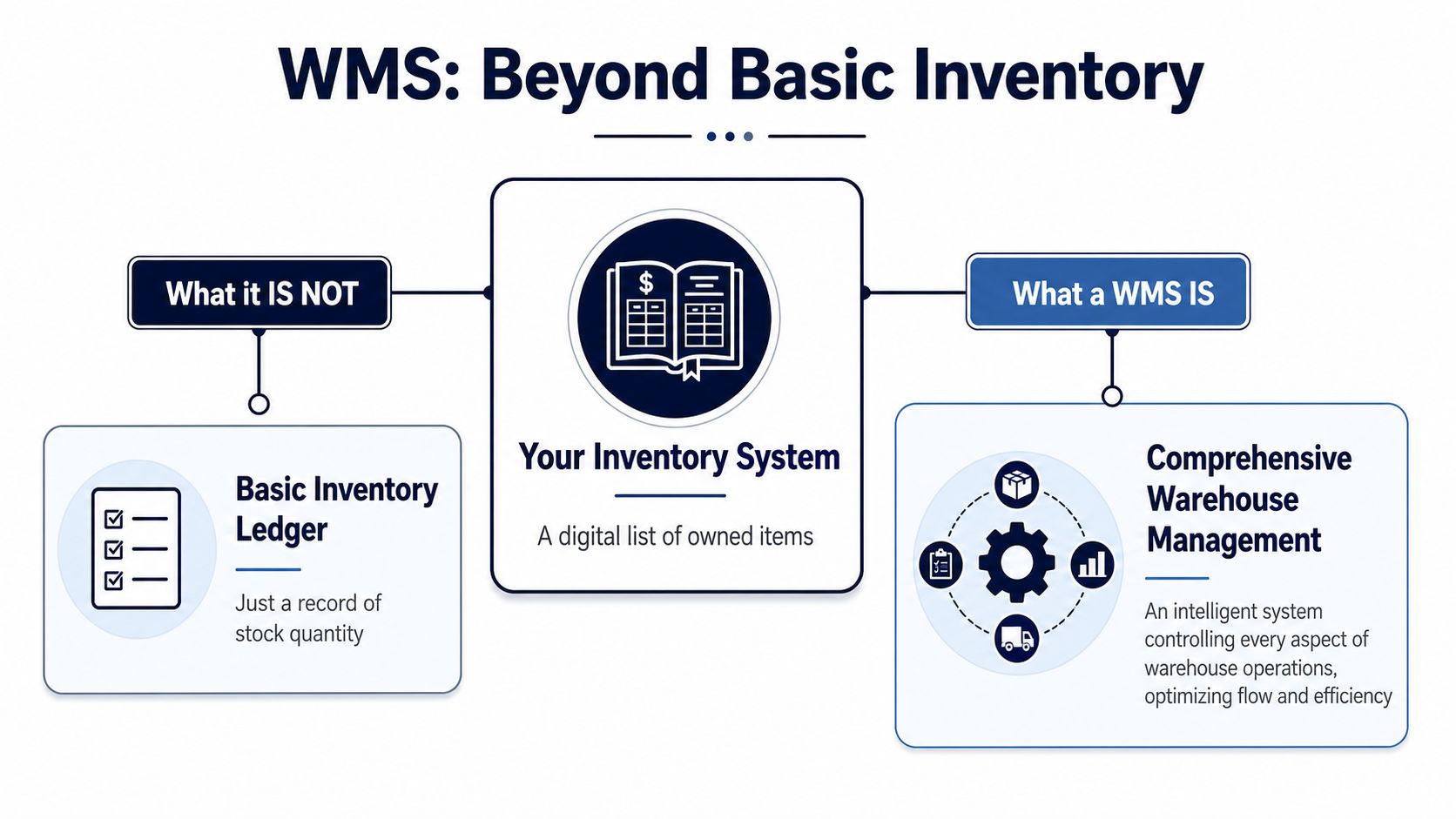
The original purpose hasn't changed as much as people think. The first WMS, pioneered by J.C. Penney in 1975, had three goals: identifying inventory, tracking storage locations, and determining sellable quantities, as noted in InfoPlus's warehouse management statistics overview. Modern platforms are far more capable, but they still live or die on those fundamentals.
Here's the practical split I use when evaluating systems:
| System | Primary job | What it should not be asked to do |
|---|---|---|
| Inventory app | Track stock levels and basic locations | Run complex floor operations |
| OMS | Capture, route, and prioritize orders across channels | Control bin-level warehouse execution |
| ERP | Handle financials, purchasing, planning, and broader business data | Direct picker movement or putaway tasks |
| WMS | Orchestrate receiving, putaway, inventory control, picking, packing, and shipping workflows inside the warehouse | Replace the ERP or own every customer-facing workflow |
The biggest mistake is assuming “inventory visibility” means “warehouse control.”
It doesn't.
A founder sees that stock is synced across Shopify, Amazon, and the back office, then assumes the operation is digitized. But if the floor still depends on tribal knowledge, paper pick lists, Slack messages, and someone yelling across the aisle, the software stack isn't controlling execution.
Practical rule: If your team still relies on memory to know where product should go or what should happen next, you don't have a controlled warehouse. You have a digital record of an uncontrolled one.
A good WMS doesn't just count inventory. It turns warehouse activity into directed work.
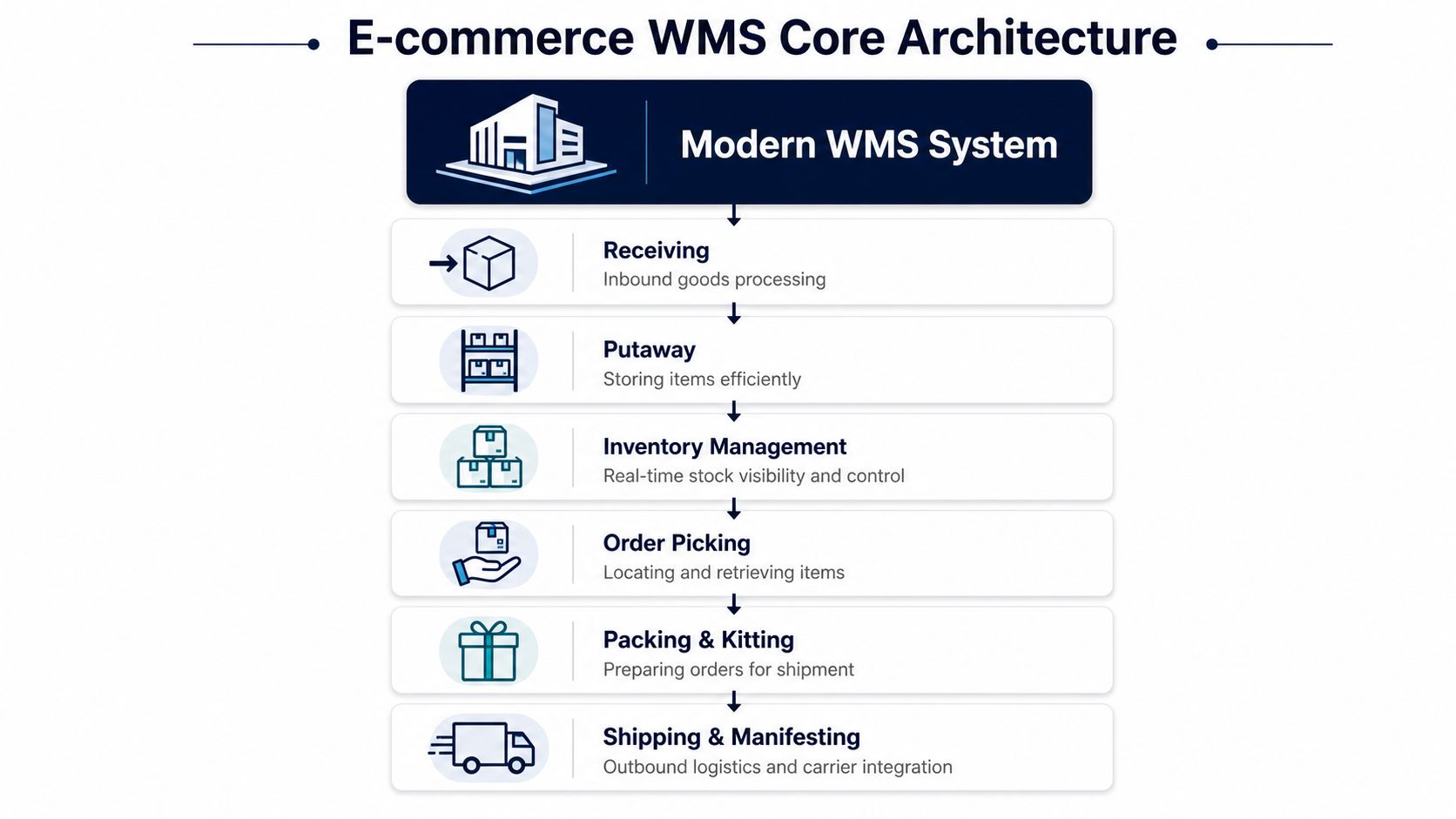
The easiest way to judge a WMS is to follow one unit through the building.
It arrives. It gets received. It gets stored. It gets counted. It gets picked into an order. It gets packed, labeled, and shipped. The system should improve each of those moments, not just produce a dashboard about them.
Receiving is where bad data enters the warehouse. If receiving is sloppy, every downstream process gets slower.
The highest-value capability here is system-directed putaway. Not generic “put this on shelf B.” Real location logic tied to velocity, space, handling needs, and replenishment strategy. Fast movers should land where they support fast picking. Bulky or slow units should stop stealing prime real estate from top sellers.
A strong inbound flow should handle:
Many brands believe their strength lies in their stock counts. Counts matter. Control matters more.
The key feature here is location-level real-time tracking supported by scans and disciplined movements. If inventory can move without the system knowing, your available-to-sell number becomes a guess under pressure.
The best WMS setups also make cycle counting part of normal operations instead of turning inventory accuracy into a quarterly crisis. That changes behavior. Teams stop fearing counts because counts stop being a special event.
Good inventory control isn't about admiring accuracy reports. It's about trusting replenishment, purchasing, and fulfillment decisions in real time.
Outbound is where labor hours turn directly into customer experience.
For most DTC brands, the biggest lever here is choosing the right picking strategy for the order profile. Single-order picking might be fine at low complexity. It starts breaking when volume climbs or when bundles, subscriptions, and marketplace orders compete for the same labor pool. That's where batch, wave, and zone picking become operational choices, not software jargon.
If your brand is selling across channels, this also ties into omnichannel fulfillment strategy. The warehouse can't treat every order as identical if customer promises, service levels, and routing logic differ by channel.
Most founders underestimate this pillar because it sounds like HR. It isn't. It's throughput.
The one feature that usually drives the most practical value is task assignment tied to actual warehouse priorities. A good WMS should decide whether the next best use of labor is receiving, replenishment, picking, packing, or exception resolution. Without that, supervisors spend the day manually dispatching work.
Here's what separates useful labor management from fluff:
A modern WMS isn't one feature. It's a chain of controlled decisions from dock to doorstep.
The ROI case for warehouse management systems gets butchered when vendors keep it technical.
Your CFO doesn't care that the system has a clean UI or supports five picking modes. They care whether the warehouse becomes less fragile, less cash-hungry, and less dependent on constant intervention from your best operators.
A useful framing comes from the questions founders should ask during evaluation: “What pains can the system solve on an organizational level?” and “Will it pay for itself?” AutoStore's overview also notes that businesses are prioritizing scalability and future growth compatibility over a simple feature list, which is exactly the right lens for this decision, as outlined in AutoStore's guide to warehouse management system types.
A quick visual helps put that business lens in view.
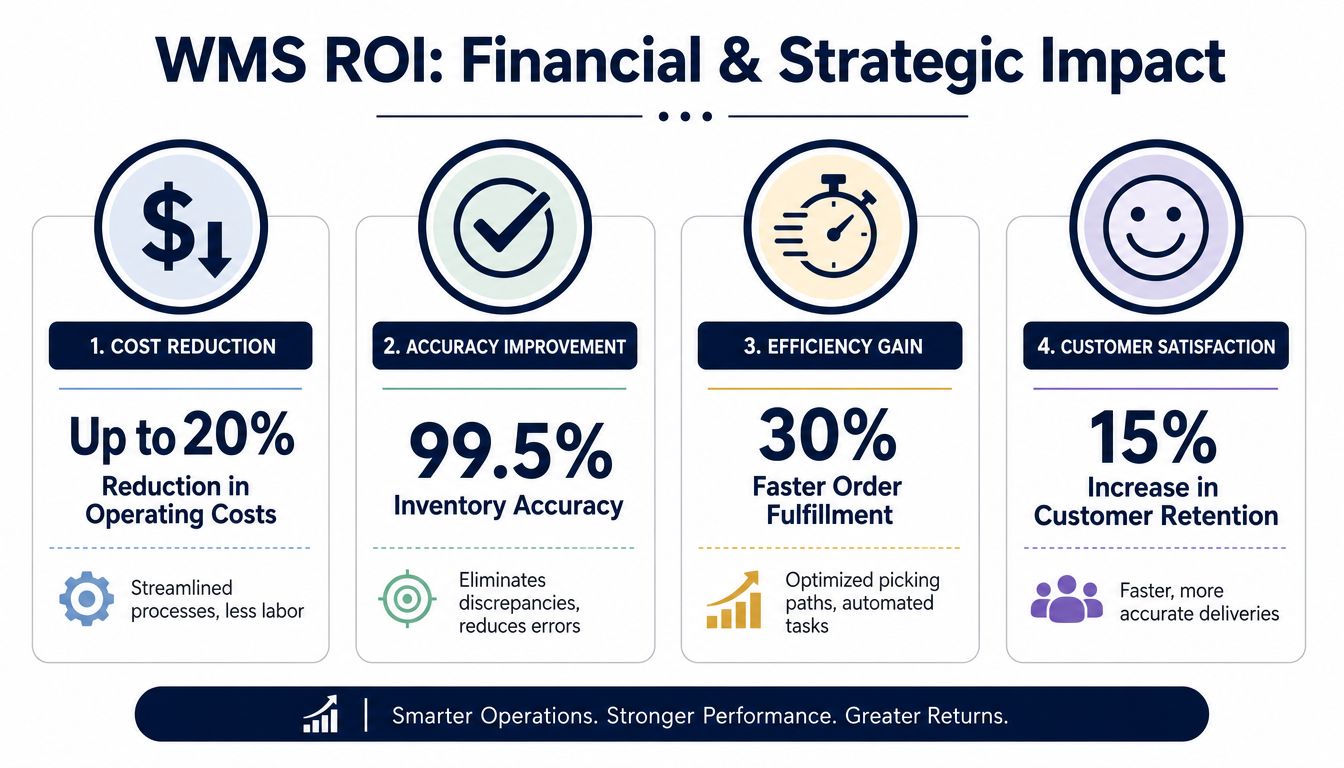
A WMS earns its keep in a few places that compound over time:
Those returns don't show up as one magic number. They show up as a warehouse that stops leaking money through dozens of small failures.
There are three business outcomes I'd push on hardest in any internal budget conversation.
First, cash flow improves when inventory placement and visibility are reliable enough to reduce defensive buying. Teams stop padding purchase decisions, for they don't trust what the warehouse says.
Second, customer lifetime value benefits when fulfillment becomes boring in the best way. Fewer avoidable mistakes means fewer negative support moments. Customers don't praise you for sending the right item on time. They just keep buying because you removed a reason to leave.
Later in the buying process, it helps to see one more operational walkthrough before you sign off on platform scope.
Third, scalability becomes real. A lot of warehouses can survive growth with overtime and strong managers. Far fewer can absorb channel expansion, new SKUs, promotions, and peak season complexity without a systemized execution layer.
If the warehouse only works when your best operator is on-site, you don't have a scalable process. You have a talented person holding the operation together.
That's the financial case. A WMS reduces dependence on heroics.
Most demos are theater.
The rep clicks through a polished interface, shows a dashboard, mentions integrations, and tells you the system is “built to scale.” None of that tells you whether the platform fits your operation. Founders need sharper questions, especially if the business has Shopify, Amazon, retail, subscription orders, or a 3PL component in the mix.
I'd pressure-test a vendor in five areas.
Deployment model. Cloud is usually the default for e-commerce because it lowers operational friction and keeps updates out of your IT backlog. But “cloud” alone isn't enough. Ask how configuration, permissions, mobile device access, and support work in practice.
Integration depth. “We integrate with Shopify” is a meaningless answer. Ask what data syncs, how often it syncs, how inventory adjustments flow back, and what happens when one system fails mid-process.
Pricing shape. The wrong pricing model punishes growth. A tool that looks cheap today can get expensive once users, sites, order volume, or support needs expand.
| Criteria | Key Question for Vendor | Red Flag to Watch For |
|---|---|---|
| Order flow integration | How do orders move from storefront or marketplace into the WMS, and how are exceptions handled? | The vendor gives a generic “API-based” answer with no workflow detail. |
| Inventory sync | How are inventory changes pushed back to selling channels and other systems? | Sync timing is vague or depends on manual exports. |
| Warehouse logic | How does the system handle putaway, replenishment, and bin-level movement? | It tracks stock but doesn't direct work on the floor. |
| Mobile and scanning support | Which handhelds, scanners, and packing stations are supported natively? | Hardware compatibility requires workarounds or custom development. |
| Pricing model | What changes the bill as volume, users, and facilities grow? | Core functions sit behind add-ons that you'll obviously need later. |
| Implementation support | Who owns data mapping, testing, training, and go-live support? | The vendor expects your team to figure out process design alone. |
| 3PL readiness | Can the system work with in-house fulfillment now and outsourced fulfillment later? | The product is rigid if your operating model changes. |
If you're comparing in-house operations against outsourced fulfillment, this breakdown of what 3PL fulfillment means helps frame the handoff questions you should ask.
The best vendors answer at the workflow level.
They can explain how a return hits inventory status. They can explain what happens when receiving discovers an overage. They can explain how the system handles partial picks, substitutions, kit components, and damaged stock. They don't hide behind feature names.
What doesn't work is buying based on a logo slide, a reference list, or a founder's fear of being “too small” for a real WMS. If your warehouse is already creating avoidable errors, the right system is usually cheaper than continuing to operate blind.
Buying the software is the easy part. Making it work inside your business is where most pain lives.
The technical side matters. Data mapping matters. Order states, SKU conventions, location naming, and inventory statuses all need discipline. But implementation usually fails for a more human reason. The warehouse keeps behaving like the old warehouse after the new system goes live.
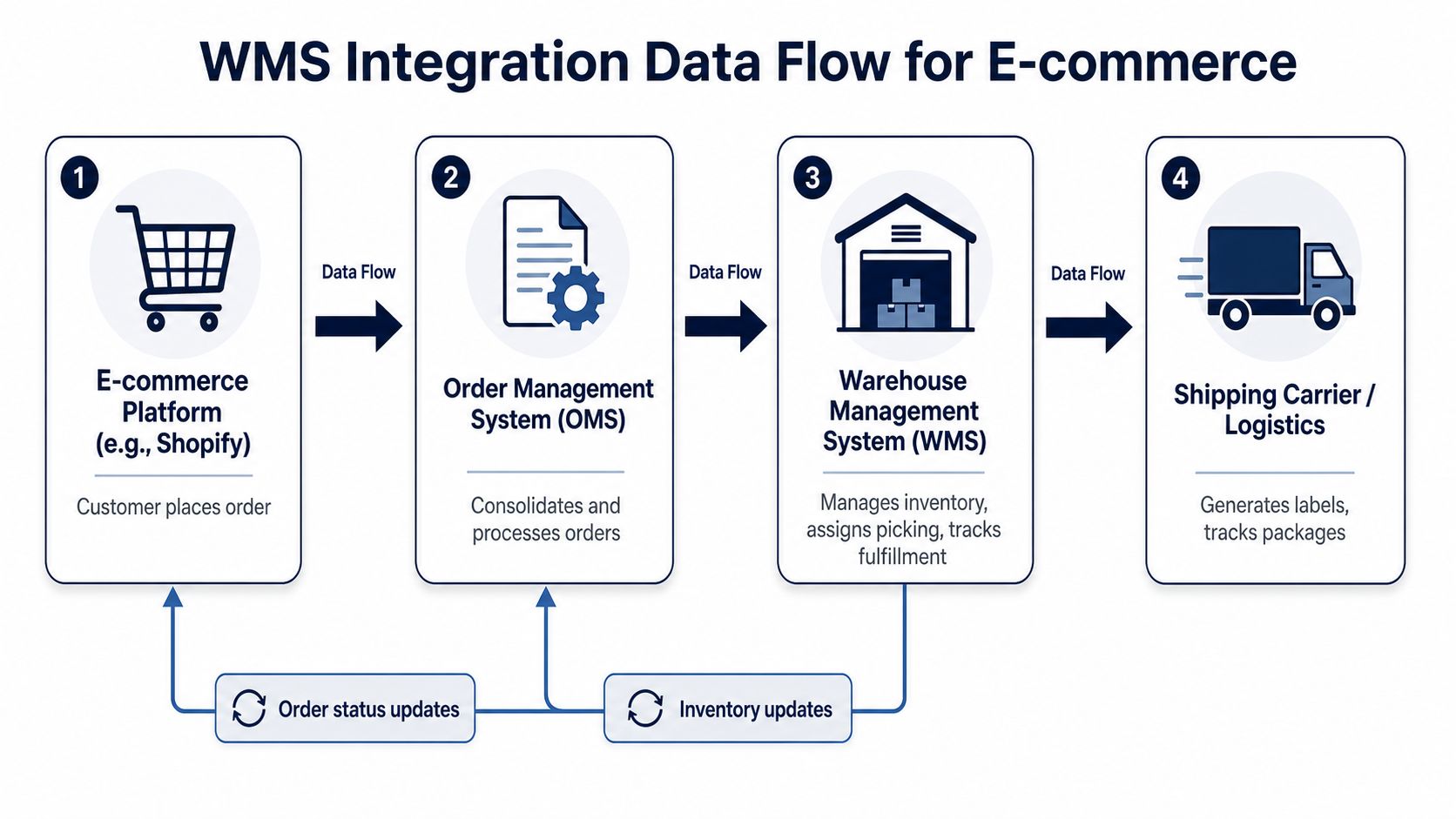
In a common e-commerce stack, the sequence often looks something like this:
That sounds clean on a diagram. In practice, problems show up when one system has stale inventory, mismatched SKU naming, or vague status logic. A canceled order that isn't properly released in one layer can create phantom shortages in another.
This is an issue that is often underestimated.
Even with real-time warehouse data, operations can still fail because of the coordination gap, the moment where “everybody assumes someone else did the thing.” That warning is worth taking seriously because it's not a software bug. It's a process failure rooted in people, ownership, and handoffs, as discussed in Manhattan Associates' overview of warehouse management systems.
A WMS can tell you inventory arrived. It can't force a lead to quarantine damaged units correctly if the process is unclear. It can assign replenishment. It can't prevent shift A from assuming shift B already handled it if nobody owns the queue review. The software raises the ceiling, but management still has to close the loop.
The most dangerous sentence in a warehouse is, “I thought someone already did that.”
Implementation gets cleaner when you treat it as an operational redesign, not a software install.
Dirty master data
Bad SKU naming, duplicate items, inconsistent units of measure, and sloppy location logic will poison the rollout fast.
Training only on clicks
Teams need to learn decision logic, not just screen navigation. They should understand why the scan matters and what breaks if they skip it.
No process owner
If receiving, replenishment, exceptions, and inventory control don't have clear owners, the WMS becomes an expensive witness to confusion.
Go-live with legacy workarounds intact
If the team still uses side spreadsheets and verbal shortcuts for core workflows, the system never becomes the source of truth.
A realistic implementation plan also needs time for testing, user practice, and process tuning. If you need a broader reference point for what phased rollout expectations look like, this SaaS implementation timeline is a useful companion.
The hard truth is simple. Warehouse management systems don't eliminate management. They make disciplined management pay off faster.
At a certain stage, the warehouse stops being a back-office function and starts becoming a strategic asset. Or it becomes the thing that caps the company.
That fork matters more than most founders admit. A brand can have strong product, healthy contribution margin, and serious demand, then still lose momentum because fulfillment stays reactive. When that happens, every launch feels riskier than it should. Every peak period becomes a fire drill. Every inventory decision carries more uncertainty than finance, operations, or customer experience can comfortably absorb.
A well-implemented WMS changes the operating posture of the business.
Instead of asking people to remember where things are, the system directs movement. Instead of discovering problems through support tickets, leaders see exceptions earlier. Instead of staffing around chaos, managers build repeatable workflows that new hires can follow.
That's why I don't look at warehouse management systems as software purchases. I look at them as operating decisions. They force clarity on process, ownership, and execution. Done right, they make growth easier to absorb. Done poorly, they expose every weak habit the team has been using to get by.
The question isn't whether your warehouse could benefit from better visibility. Almost every growing operation could.
The question is whether you want to keep scaling on memory, patches, and tribal knowledge. That approach can get a brand to seven figures. It gets very shaky when complexity rises. The brands that keep compounding tend to build control into the operation before the next growth wave hits, not after it breaks the team.
If your fulfillment engine feels fragile, that's the signal. Not to buy the flashiest platform on the market. To build the warehouse your next stage of growth requires.
If you're the kind of operator who wants unfiltered feedback from founders who've already been through these decisions, Million Dollar Sellers is the room to know. It's where serious e-commerce leaders compare playbooks, pressure-test systems, and learn what works at scale across Amazon, DTC, and omnichannel brands.
Join the Ecom Entrepreneur Community for Vetted 7-9 Figure Ecommerce Founders
Learn MoreYou may also like:
Learn more about our special events!
Check Events