Chilat Doina
January 9, 2026
Every product sitting in your warehouse has a silent tax attached to it, and it’s called inventory carrying cost. This isn't just some boring accounting term—it's a real, direct drain on your cash flow and profitability that can quietly suffocate your margins.
Imagine every item on your shelves has a tiny meter attached, constantly ticking up costs the longer it stays there. That’s your inventory carrying cost, sometimes called holding cost. It’s the sum of all the money you spend to store products before they finally sell. For anyone selling at scale, whether on Amazon or a DTC store, these costs are anything but trivial.
Think about it this way: every dollar you have tied up in unsold inventory is a dollar you can't use for marketing, developing new products, or just plain growing your business. We're not just talking about warehouse rent, either. It’s a whole collection of different expenses that pile up over time, making that slow-moving stock more and more expensive by the day. Getting a grip on this concept is the first real step toward making your business financially bulletproof.
If you ignore your carrying costs, you're flying blind when it comes to your actual profitability. You might see a healthy margin on paper, but if a product sits for six months, the holding costs you've racked up can completely wipe out that profit. It's a massive factor in keeping your cash flow healthy.
A high carrying cost is a flashing red light for potential problems in your operations, like:
In fact, for a lot of e-commerce brands, these hidden expenses can add up to 20% to 30% of their inventory's total value every year. That means for every $1 million of inventory you’re holding, you could be spending up to $300,000 a year just for it to sit there.
To really see how much damage this can do, it helps to look at your business in terms of cost centers and profit centers. This mindset shifts your warehouse from being just a place to hold stuff into a major operational expense that needs to be managed with a sharp strategy. When you can accurately measure and control these costs, you turn a huge liability into a powerful competitive advantage.
To really get a handle on your inventory carrying cost, you need to look past the top-line percentage and dig into what’s actually driving that number. The standard formula gives you a framework, but the real power comes from understanding its four core components. Nailing these is a non-negotiable for any e-commerce founder serious about protecting their margins.
Think of your total carrying cost like a utility bill with four distinct line items. Each one represents a different way your inventory costs you money just by sitting there. These aren't abstract accounting terms; they're real, tangible expenses hitting your cash flow and profitability every single day.
This mind map shows you the four primary components that all add up to your total inventory carrying cost.
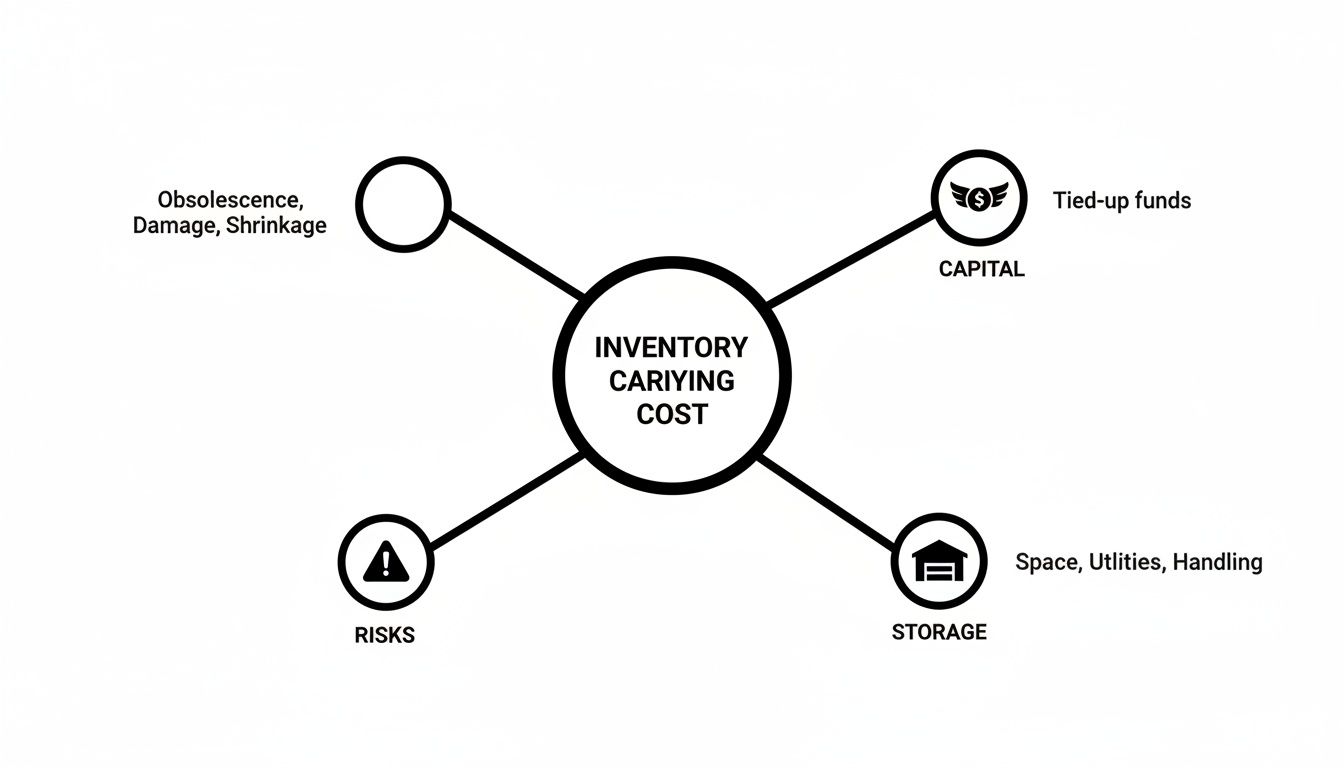
As you can see, capital, storage, services, and risk are the pillars holding up your total holding expenses. Each one chips away at your bottom line in its own unique way.
This is the big one, and honestly, it's the cost most sellers forget about. Capital costs represent the opportunity cost of having your cash locked up in physical products. Every dollar you spend on inventory sitting on a shelf is a dollar you can't invest somewhere else—like in a killer marketing campaign, new product development, or even just a high-yield savings account. It’s the hidden "what if" cost of your money.
For example, if you have $500,000 tied up in stock and your cost of capital (the return you could get from another investment) is 8%, your annual capital cost is a whopping $40,000. That’s a real expense, even if it never shows up as a line item on your P&L.
This is the most obvious component, but there's more to it than meets the eye. Storage costs cover all the direct expenses of physically housing your inventory. For most sellers, this goes way beyond just paying the warehouse rent.
These costs typically include:
While these are the most visible part of your carrying cost, they're just one piece of the puzzle. It's also worth remembering that storage is a key part of your total product expense. To get the full picture, it's a great idea to also learn how to calculate landed cost correctly.
Beyond just finding a place to put your stuff, you have to actually manage and protect it. Service costs cover all the operational expenses needed to handle and secure your inventory. This bucket includes a wide range of services that keep your stock in good shape.
Service costs are often underestimated but are absolutely critical for accurate accounting. They include everything from the software you use to track inventory to the insurance that protects it from disaster.
Key service costs to keep an eye on include:
Finally, holding physical products just comes with risk. This category accounts for the very real possibility that your inventory will lose value while it's in your possession.
The main drivers of risk costs are:
Think about a brand selling seasonal apparel. They face a massive obsolescence risk. If those winter coats don't sell by the time spring rolls around, their value plummets, and that loss becomes a major part of their inventory carrying cost.

Knowing your inventory carrying cost is one thing. But understanding how it stacks up against the competition is where real strategy begins. Are your holding costs a competitive advantage, or are they a hidden anchor dragging down your profitability? Without that context, it's impossible to know if you're leaving money on the table.
For most high-performing ecommerce brands, a healthy inventory carrying cost typically falls somewhere between 20% and 30% of the inventory's total value, calculated annually. This isn't just a random number; it's a critical benchmark that signals operational efficiency. If your costs are creeping above this range, it’s a clear sign that something in your supply chain needs a hard look.
That 20-30% figure covers everything we've discussed—capital, storage, services, and risk. For a brand holding $5 million in inventory, this translates to a staggering $1 million to $1.5 million per year in expenses just for those products to sit on a shelf. As warehousing becomes an ever-larger global industry, you can bet the cost of holding inventory is only trending upward, making efficiency more vital than ever. You can dig into more data on these rising warehousing costs and how they impact sellers like you.
Of course, not all businesses are created equal. Your target carrying cost will depend heavily on your specific business model and what you sell. A brand slinging fast-fashion apparel has a wildly different risk profile and storage needs than a company selling non-perishable home goods.
A few key factors determine whether you should aim for the lower or higher end of that 20-30% range:
To get a clearer picture of where your brand should be, it helps to see how these factors play out across different ecommerce models. The table below breaks down typical carrying cost percentages, helping you zero in on a more accurate target for your own operations.
This table shows how typical carrying cost percentages can shift based on your business model, the types of products you sell, and your fulfillment strategy.
Think of these benchmarks as a diagnostic tool. If your calculated carrying cost is way higher than the benchmark for your model, it’s a powerful signal to start digging into your forecasting, reorder points, and fulfillment strategy. That's where you'll find the biggest opportunities for optimization.
Knowing your inventory carrying cost on a spreadsheet is one thing. Seeing it as your tiny slice of a massive, multi-trillion-dollar global problem is something else entirely. Poor inventory management isn’t just some isolated issue hitting your P&L; it's a systemic drag that puts a huge financial strain on the entire retail world.
There's a name for this mess: inventory distortion. It’s the expensive combination of holding way too much of the wrong stuff (overstocks) and not nearly enough of the right stuff (stockouts). And the scale of this problem is just staggering.
In 2023 alone, inventory distortion cost retailers nearly $1.8 trillion worldwide. That figure is equal to about 7.2% of all global retail sales—basically a colossal tax the industry pays for failing to match supply with demand.
This isn't just some abstract number for economists to throw around. It’s macro-level proof of the pain high-growth sellers feel every single day. When your business is struggling with capital locked up in slow-moving SKUs or you’re bleeding sales from stockouts, you're feeling a direct symptom of this global headache. Thinking about your carrying cost in this context shifts it from a simple accounting line item to a major strategic weakness.
Let's bring that huge $1.8 trillion figure down to earth for a high-volume seller. Say your brand holds around $8 million in inventory over the course of a year. If your carrying cost is a very reasonable 22%, you're spending $1.76 million annually just for that inventory to sit in your warehouse.
That $1.76 million isn't just the cost of doing business—it's a direct reflection of inventory distortion happening inside your own four walls. Every single dollar of that expense is capital that could have been put to work growing the business, like:
When you look at it this way, a high carrying cost is more than an expense; it’s a strategic liability. It's the anchor slowing you down, making it harder to pivot, innovate, and run circles around your competitors. For top-tier sellers, ignoring this just isn't an option anymore.
The good news? The tools to fight back against this inefficiency are getting seriously powerful. The sheer scale of global inventory distortion is exactly why modern, AI-enabled supply chain solutions are catching on so fast. These systems are built to attack the root causes of high carrying costs head-on.
Studies show that AI-powered supply chains can deliver incredible results, including cutting logistics costs by 15%, dropping overall inventory levels by 35%, and boosting service levels by a massive 65%. For any business playing in the 7-, 8-, and 9-figure arena, this is a fundamental shift.
Treating your inventory carrying cost as a number you can actually measure and optimize—instead of just a background annoyance—is now a competitive must. You can find more insights on how modern inventory management tackles these costs over at MRPeasy.com. In a world where margins are always under pressure, getting a handle on this hidden expense is one of the smartest moves you can make.
Your inventory carrying cost isn't a static number you calculate once and just forget about. It's a living metric that flexes with the global economy. Powerful external forces, from overseas shipping rates to local warehouse space, are constantly applying pressure and can make your holding expenses swell—even when you haven't changed a thing in your own operations.
Think of your inventory's journey like a cross-country road trip. The price of the car (your product) is fixed, but the cost of gas, tolls, and overnight parking can fluctuate wildly. A sudden spike at the pump makes the entire trip more expensive, right? In the same way, global macro trends directly inflate what you pay just to hold onto your products.
Understanding this connection is what separates the good operators from the great ones. It lets you anticipate cost increases and build that volatility into your inventory strategy, instead of just reacting when the bill comes due.
When a major event disrupts global supply chains, the impact goes way beyond a single late container. These disruptions create a powerful ripple effect that directly inflates your carrying cost in ways that aren't always obvious. A sharp increase in ocean freight prices, for example, doesn’t just raise your freight bill; it increases the capitalized value of your inventory.
This is a critical concept to get your head around. Because freight is part of your inventory's landed cost, higher shipping fees mean the value of the goods on your books literally goes up.
Let’s say your carrying cost is 25%. If you pay that on inventory valued at $1 million, your annual holding expense is $250,000. But if soaring freight costs push that same inventory's value to $1.2 million, your holding expense automatically jumps to $300,000. That’s a $50,000 increase without adding a single extra unit.
This compounding effect means you're paying your carrying cost percentage on a much larger base number, quietly draining your cash flow.
This link between macro trends and holding costs isn't just theoretical; it's measurable. The savviest sellers watch key economic indexes to get ahead of the curve. The Logistics Managers’ Index (LMI), for instance, gives you a monthly pulse on the U.S. supply chain by tracking costs, capacity, and inventory levels.
Recent data shows just how interconnected these forces are. In the December 2024 LMI report, U.S. logistics executives reported that inventory costs were still expanding. At the same time, warehousing capacity continued to expand at a rate of 61.6 while transportation prices climbed to 66.8—their fastest rate of expansion since April 2022.
For any ecommerce operator, that combination is a perfect storm. Rising transportation prices and climbing inventory costs mean every strategic decision to pull inventory forward comes with a higher price tag.
By monitoring these trends, you can make smarter, more cost-effective decisions about when to order, how much to hold, and where to store it. You can turn a potential threat into a calculated advantage.
Knowing your inventory carrying cost is one thing, but actually doing something about it is where you start to pull ahead of the competition. Slashing this number isn't about making a few dramatic cuts; it's about building a smarter system for how you buy, store, and move your products.
This playbook is packed with high-impact strategies to help you systematically chip away at your holding costs and inject that cash back into your business. Each tactic zeroes in on a specific piece of the carrying cost puzzle—capital, storage, and risk. By making small, smart improvements across these key areas, you can turn one of your biggest expenses into a serious operational advantage.
Let's get into the practical steps that will make your inventory work for you, not against you.
The simplest way to cut carrying costs is to stop buying inventory you don't need. Over-ordering is the number one cause of bloated storage fees and tied-up capital. Getting your demand forecasting right is the best defense against this expensive habit.
It’s time to move beyond gut feelings and basic historical sales data. Modern forecasting is all about pulling together multiple data streams to paint a much clearer picture of what’s coming. For a deep dive, our guide on inventory forecasting methods covers some advanced strategies.
Here’s where to start:
A finely-tuned reorder point is your secret weapon against both stockouts and overstocks. It’s the magic number that tells you exactly when to place a new order so you don't run out before the next shipment lands. Set it too high, and you’re burning cash on storage. Set it too low, and you're leaving sales on the table.
The classic reorder point formula is beautifully simple:
(Average Daily Sales x Average Lead Time in Days) + Safety Stock = Reorder Point
For this formula to be effective, your data has to be solid. Track your supplier lead times like a hawk and calculate a realistic safety stock based on how much your demand fluctuates. If you consistently review and tweak these numbers for your top products, you’ll be much closer to holding the perfect amount of inventory.
The faster you sell your products, the less time they spend sitting on a shelf racking up costs. Boosting your inventory turnover ratio is one of the most powerful ways to bring down holding expenses across the board. This isn't just about selling more—it's about selling smarter, especially when it comes to old or slow-moving stock.
Try these tactics to get aging inventory out the door:
Your relationship with suppliers has a direct line to your capital costs. Negotiating better terms can give your cash flow some much-needed breathing room and lessen the financial weight of your inventory. If you want a masterclass in this, check out these proven procurement cost reduction strategies.
Even small tweaks in your agreements can make a huge impact. Focus on negotiating:
Of course. Here is the rewritten section, crafted to sound like it was written by an experienced human expert.
When you're in the trenches of running an ecommerce business, the theory behind inventory costs is one thing, but applying it is a whole different ball game. You’ve got questions, and we’ve got answers—not the textbook kind, but the practical, in-the-weeds kind that actually helps you make better decisions.
Let's cut through the noise and tackle some of the most common questions we hear from serious operators looking to dial in their financial strategy.
As a rule of thumb, you should be running these numbers at least quarterly. Things change too fast in ecommerce to let it slide for a whole year.
But here’s the real answer: you need to recalculate it anytime something significant shifts in your operations. Think of these as trigger events that demand an immediate re-evaluation:
This is the million-dollar question, and it really depends on your category. But for most successful FBA brands, a healthy inventory turnover ratio lands somewhere between 4 and 8.
Hitting this sweet spot means your cash isn't just sitting on a shelf collecting dust; it's actively working for you. It shows you’re selling through inventory efficiently without tying up too much capital.
Be careful about pushing that number too high, though. An aggressive turnover ratio can look great on paper, but it dramatically increases your risk of stocking out. One unexpected demand spike on Amazon, and you could be leaving a ton of sales on the table. It's all about finding that perfect balance for your specific products and lead times.
Managing inventory is one of the biggest headaches for top sellers. In the Million Dollar Sellers community, 7-, 8-, and 9-figure founders share the exact strategies they use to optimize cash flow, slash carrying costs, and scale without imploding. Learn more about how MDS can help you stay ahead of the curve at https://milliondollarsellers.com.
Join the Ecom Entrepreneur Community for Vetted 7-9 Figure Ecommerce Founders
Learn MoreYou may also like:
Learn more about our special events!
Check Events